In 2026, generative AI tools like Sora and Runway routinely produce subtle visual artifacts such as temporal flickering, warped geometry, and unnaturally smooth "oily" textures. These high-frequency issues are easy to miss on typical 4K displays but become detectable at native resolution on a 5K monitor. For independent AI video editors, this makes 5K pixel density a practical requirement for reliable quality control rather than a luxury.

The 2026 Shift: Why Generative AI Demands a New Display Standard
Generative models have introduced an entirely new class of errors that traditional video workflows never faced. According to academic analysis of AI-generated video, these include temporal inconsistencies, structural distortions, and texture anomalies that appear most clearly in high-frequency areas such as edges and fine details (Artifact-Bench: Evaluating MLLMs on Detecting and Assessing the Artifacts of AI-Generated Videos).
For editors, the display now doubles as a diagnostic instrument. A 5K panel reveals micro-inconsistencies before export, reducing the risk of delivering flawed content to clients. Lower-resolution screens often smooth these problems through downsampling, creating false confidence that the clip is clean.
Spotting the Hallucinations: Detecting AI Artifacts at Native Resolution
AI video artifacts concentrate in high-frequency regions where classifiers also look for cues. As noted in research on detection methods, these edge and texture anomalies are most apparent when viewed at native pixel ratios rather than scaled or interpolated views (What Matters in Detecting AI-Generated Videos like Sora?).
A particularly troublesome issue is "clip generation drift," where background elements or textures shift subtly across frames in models like Sora-2 or Runway Gen-3. These micro-changes often remain invisible on 4K but can be caught through frame-by-frame inspection on higher-density displays. The result is fewer surprises after delivery and more accurate quality control during review.

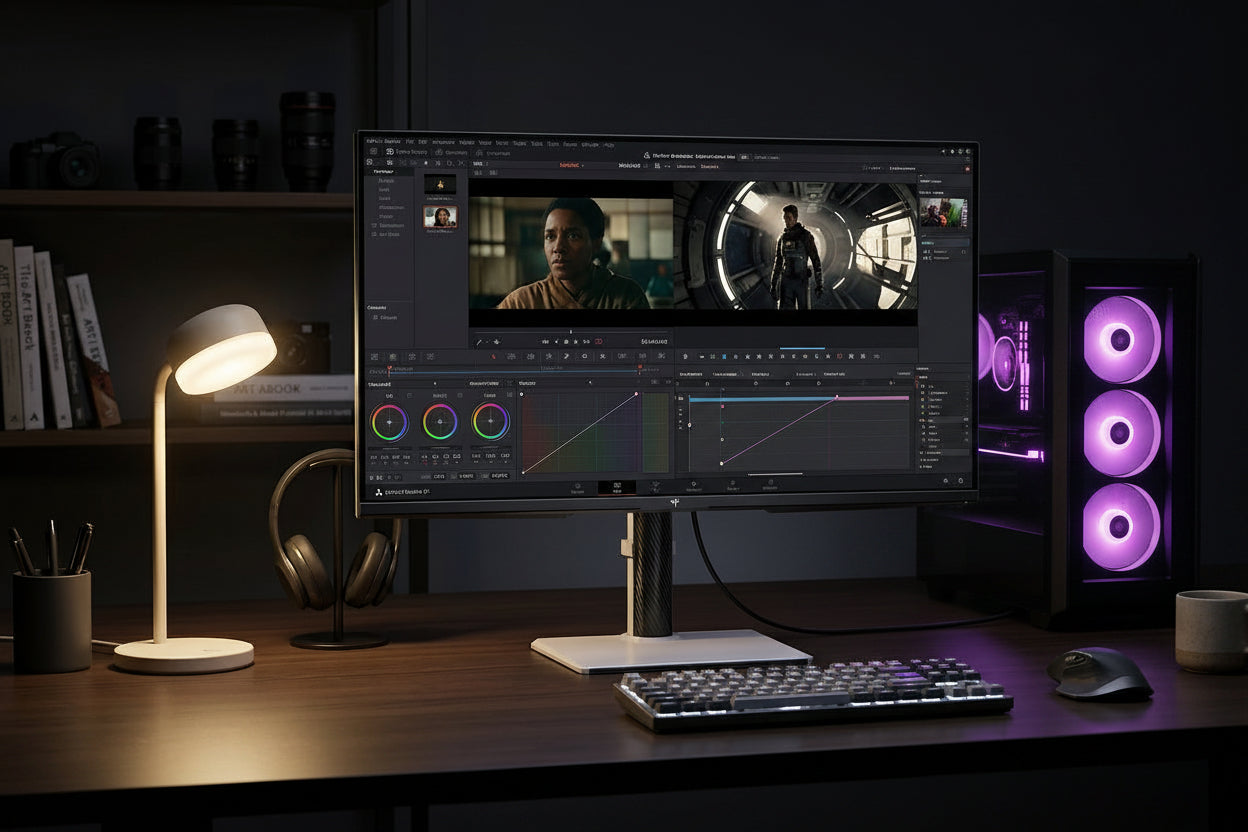
5K enables true 1:1 preview of 4K source material while leaving room for tool panels. This setup removes the constant zooming and window toggling that breaks concentration and hides problems. The extra canvas turns review from a compromised compromise into a reliable diagnostic step.
Managing Complex AI Timelines Without Compromise
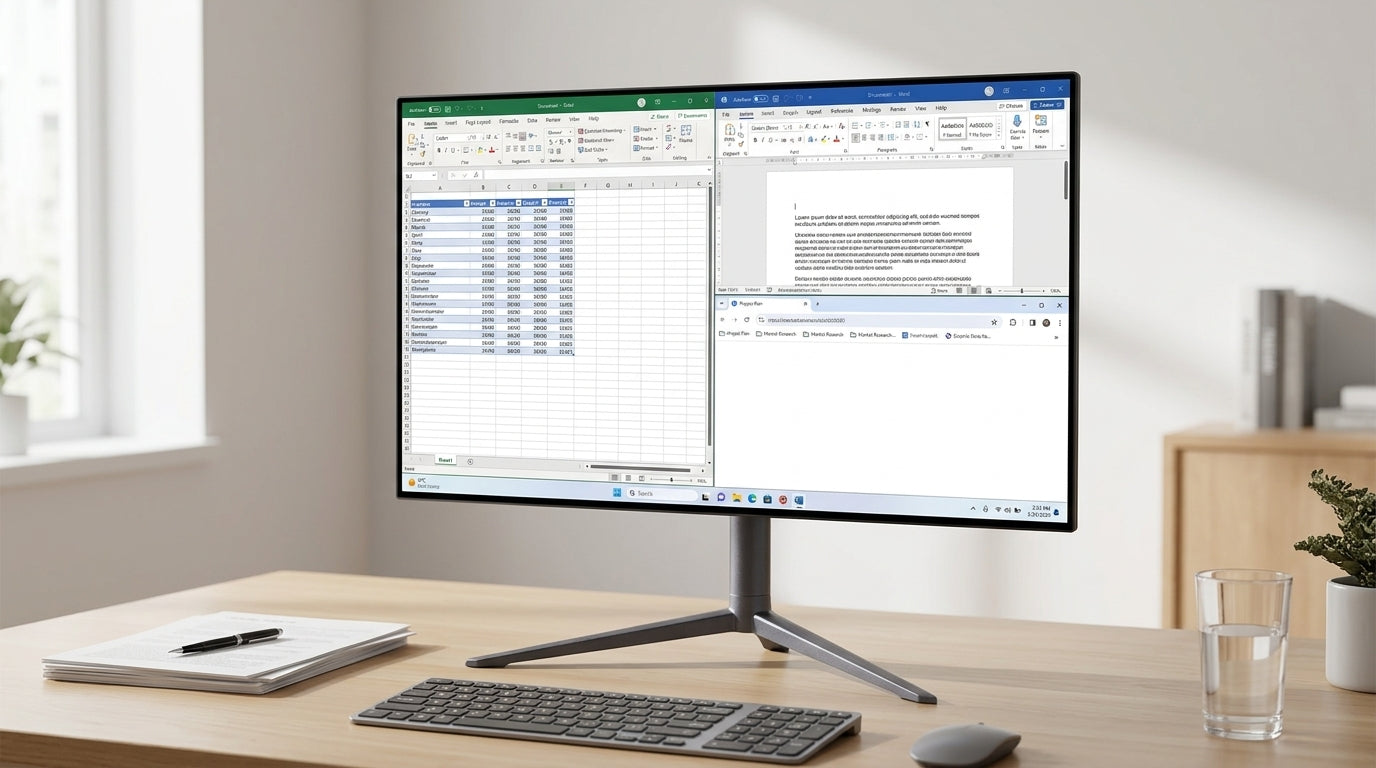
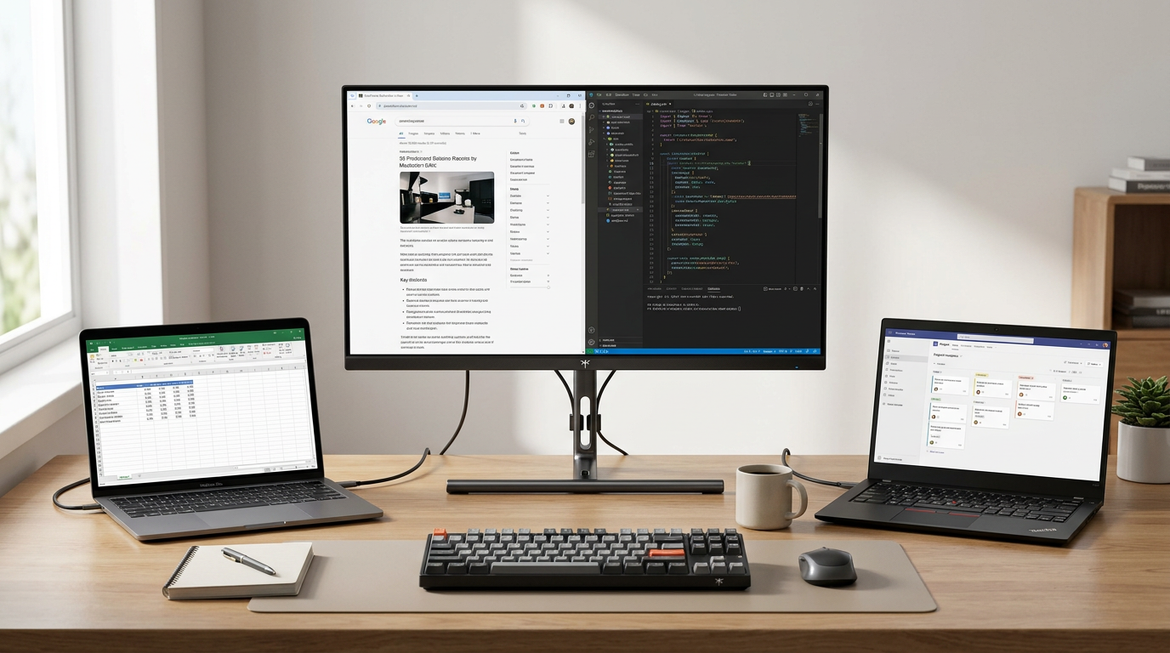
AI-assisted projects quickly become dense with layers, masks, captions, reference windows, and prompt tools. A 5K monitor (5120 × 2880) delivers roughly 77% more workspace than a standard 4K panel, according to industry workspace comparisons. This extra real estate lets editors keep a native 4K preview open alongside full timelines, scopes, and engineering panels without constant resizing.
On 4K displays, creators frequently face a forced trade-off: full-screen preview that hides the timeline, or scaled editing that reduces preview accuracy. The 5K layout eliminates that friction, keeping creative flow intact and lowering the chance of overlooking artifacts hidden by downsampling.
4K vs. 5K for AI Video: Escaping the "Bad Zone" of Pixel Density
4K vs 5K on 27-inch Mac Displays
5K is the safer fit for AI video QC because it keeps text and edges cleaner under integer scaling, while 4K falls into a fractional-scaling zone that can add edge fuzz and make real artifacts harder to judge.
View chart data
| Category | PPI | Scaling quality | Artifact confusion risk | Workspace headroom |
|---|---|---|---|---|
| 27-inch 4K | 163.0 | 2.0 | 3.0 | 1.0 |
| 27-inch 5K | 218.0 | 3.0 | 1.0 | 2.0 |
Mac users encounter an additional challenge with display scaling. At 27 inches, a 5K panel reaches 218 PPI, allowing macOS to apply clean 2× integer scaling where one logical pixel maps exactly to four physical pixels. The same size 4K panel sits at 163 PPI and requires 1.5× fractional scaling, which introduces mathematical interpolation and visible edge shimmer.
This "visual gaslighting" matters for AI work. The added fuzz from fractional scaling can resemble the temporal flickering or edge warping produced by generative models, making it hard to tell whether a flaw is in the AI output or the display itself. The KTC blog on Mac scaling explains why 5K avoids this interference and delivers the crispness needed for confident artifact detection (5K vs 4K for Mac: Why Resolution Matters for Crisp Text).
For creators prioritizing detection accuracy, 5K moves out of the problematic density zone that 4K occupies on typical 27-inch Mac setups. If your workflow mixes heavy Mac use with AI review, check your current PPI and scaling behavior first; many users discover the fractional-scaling layer is quietly masking or mimicking the very issues they need to catch.
Building Your 2026 AI Creator Workstation on a Budget
Independent creators rarely have access to $2,000+ professional reference monitors, yet they still need enough pixel density and color fidelity to trust their QC process. The sweet spot is a display that delivers native 5K sharpness, wide color coverage, and solid contrast without premium color-grading pricing.
The KTC H27P3 27" 5K monitor meets these needs with 99% DCI-P3 coverage, ΔE<2 accuracy after calibration, and a 2000:1 contrast ratio. Its 5120×2880 resolution and 218 PPI provide the clean integer scaling macOS prefers, making it a strong fit for artifact review and timeline management in Sora or Runway workflows. At its price point, it remains accessible for freelancers and small teams who treat 5K as a functional tool rather than a luxury.
For editors who also want strong HDR performance or occasional high-refresh gaming, the KTC M27P6 Mini-LED 4K monitor offers a useful alternative with 1152 local dimming zones and HDR1400 capability. However, for pure resolution-critical AI video tasks on Mac, 5K remains the clearer standard. Read more about the practical differences in our guide to Mini-LED IPS vs. Standard IPS and What Delta E Values Actually Mean for Your Creative Work.
Before purchasing, verify that your GPU and video software can drive 5K comfortably at 60 Hz. Most modern creative workstations handle it without issue, but older hardware may benefit from testing. Pair the monitor with a VESA arm if you need height or portrait adjustments beyond the included tilt stand.
FAQs
How much more workspace does a 5K monitor actually give compared with 4K?
A 27-inch 5K panel provides roughly 77% more pixels than 4K. This extra canvas lets you keep a full native 4K preview window open while maintaining visible timelines, scopes, reference footage, and prompt tools. The difference reduces constant window management and helps maintain focus during long AI editing sessions.
Can 4K still work for AI video editing if I scale everything to fit?
It can, but scaling often masks the very high-frequency artifacts (edge flicker, texture drift, warped geometry) that generative models produce. Many editors report discovering problems only after client review on larger screens. If your workflow includes frequent QC for commercial delivery, the added clarity of native 5K usually outweighs the cost.
Is 5K overkill for Windows-based AI video workstations?
Windows users gain the same pixel-density benefits for artifact detection, but they avoid the macOS-specific fractional scaling problem that makes 27-inch 4K especially problematic. 5K still offers more workspace and sharper 1:1 preview; the advantage is simply larger for Mac users who rely on integer scaling for clean text and edges.
What color accuracy level is realistic on an affordable 5K monitor?
Current mid-tier 5K panels like the H27P3 achieve 99% DCI-P3 coverage and factory ΔE<2 after simple calibration. This is sufficient for reliable artifact review and most AI-assisted creative work. It is not a substitute for a dedicated $3,000 reference monitor used in final color grading, but it is more than adequate for independent QC and timeline management.
Should I prioritize Mini-LED backlighting or pure 5K resolution for generative video?
For pure artifact detection in high-frequency detail, resolution and pixel-level clarity matter more than peak contrast. Mini-LED models excel when your workflow also involves HDR review or gaming. Many creators start with a 5K IPS panel for Mac-based editing and later add a Mini-LED 4K as a secondary display when budget allows. The choice depends on whether your primary pain point is scaling noise or dynamic range.