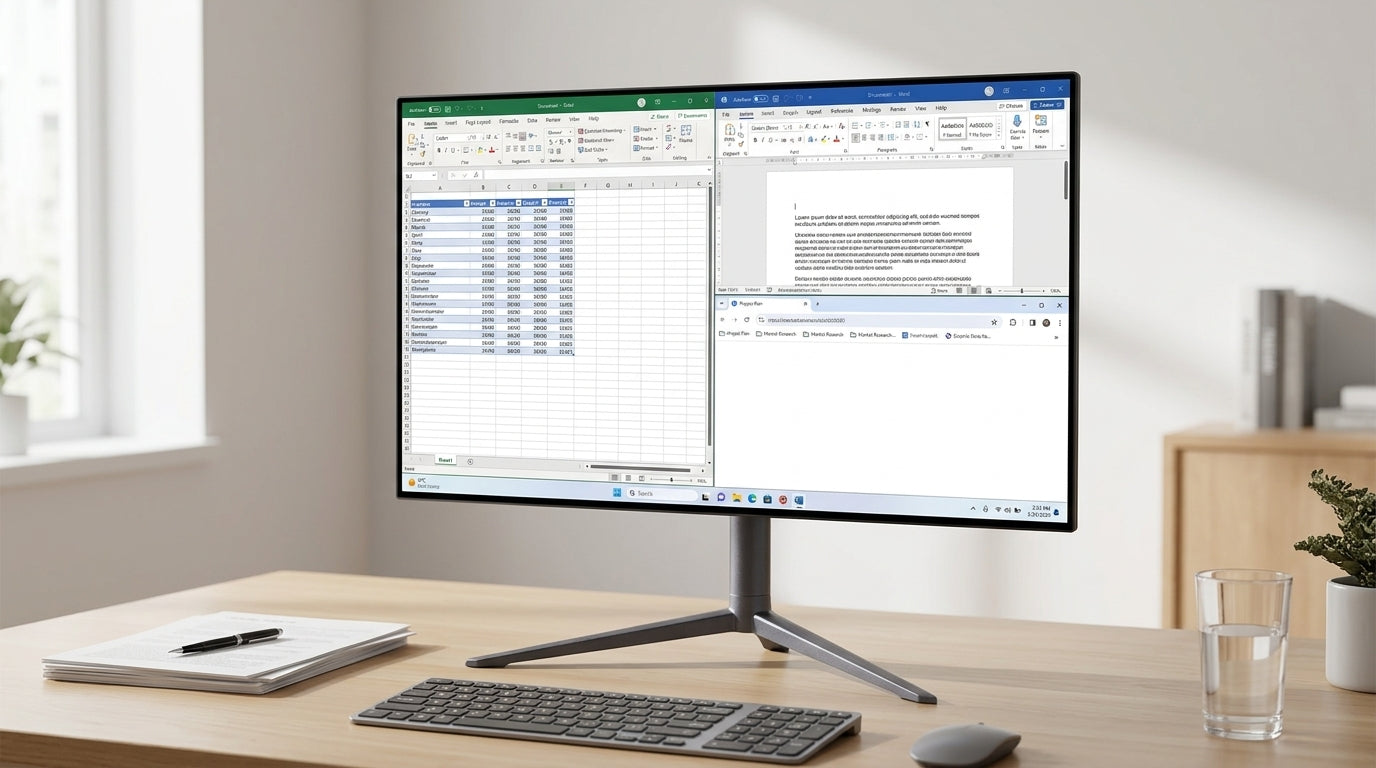
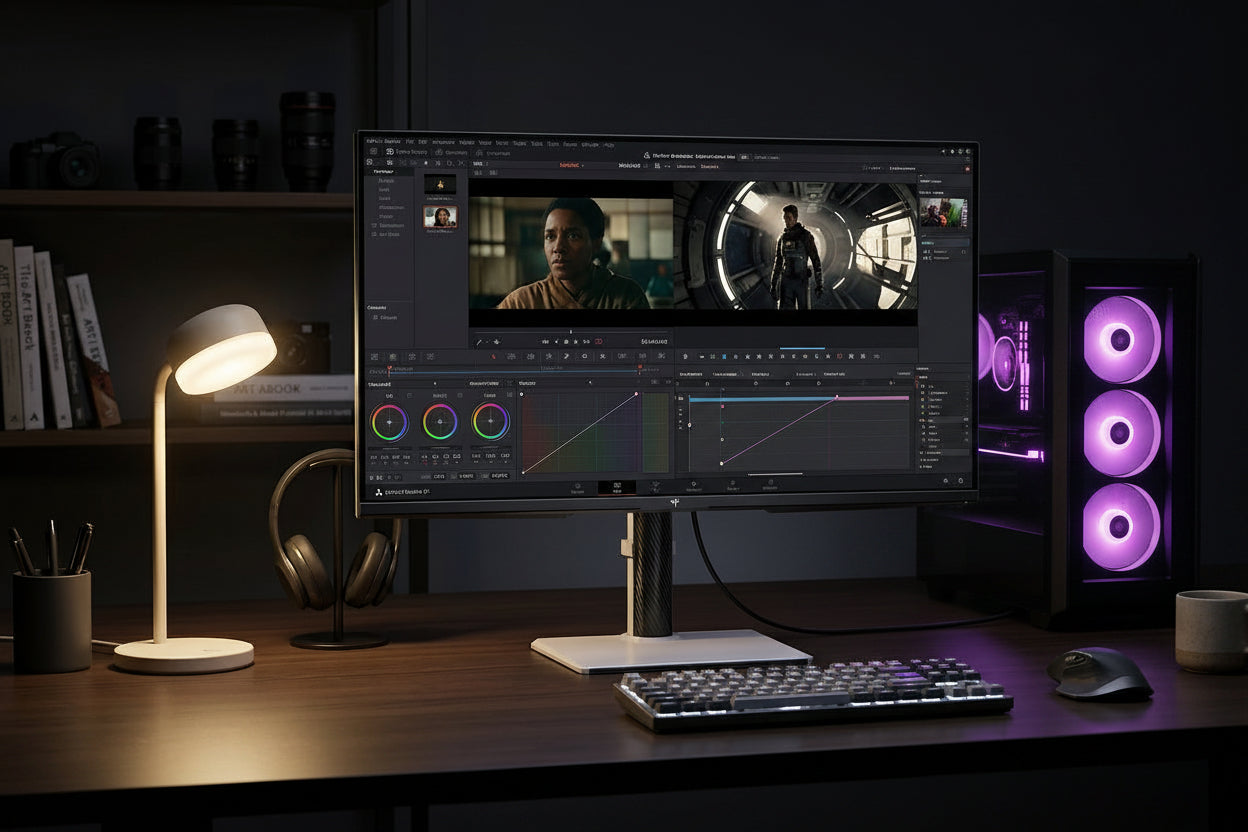
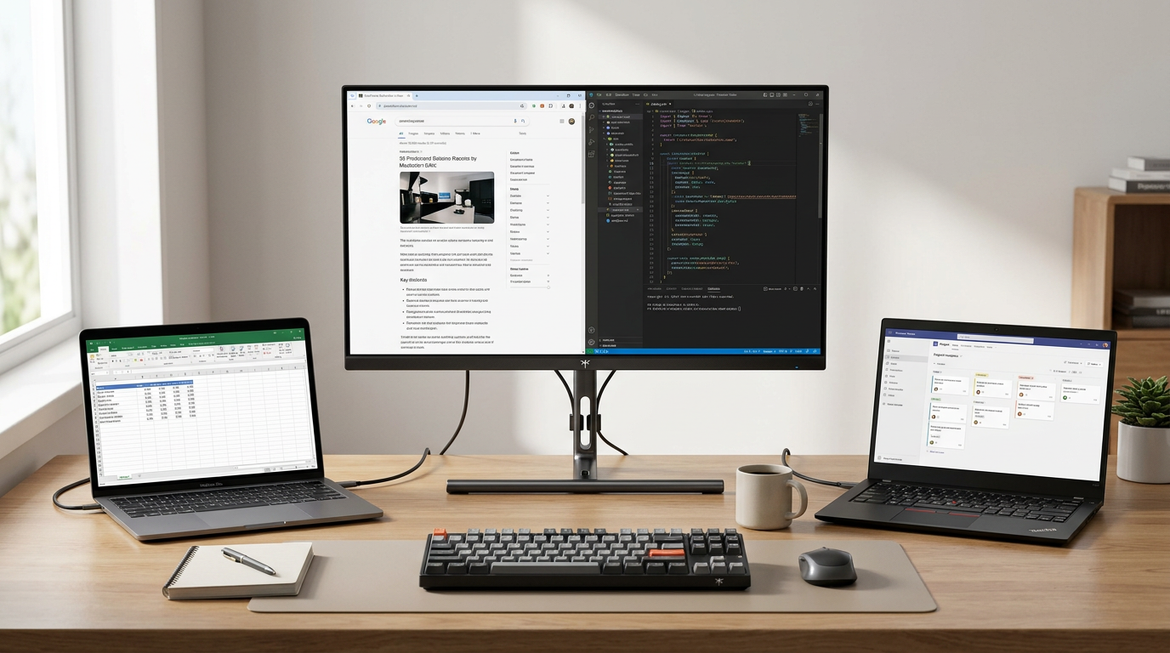
A 27-inch gaming monitor offers the strongest balance of pixel density, motion clarity, and desk or console compatibility for most PC and console players in 2026. This size delivers approximately 109 pixels per inch at 1440p, which keeps text sharp without forcing heavy GPU demands, while still fitting comfortably on standard desks.
The 27-Inch Sweet Spot: Why Size and Resolution Matter Most
Is 27 inches really the best size for both my PC and my PS5 or Xbox? At this diagonal, 1440p resolution hits a practical sweet spot for desktop use because it maintains high legibility at typical viewing distances while keeping frame rates high on mid-range GPUs. Moving to 4K on the same screen size increases sharpness for console titles that output native 4K, yet it also raises the performance floor required from your hardware.
Hybrid users who split time between competitive PC sessions and console play often prefer staying at 1440p unless they own a GPU at or above RTX 4070 Ti levels. Text scaling remains native at 1440p, avoiding the 150 percent Windows scaling that some legacy applications handle poorly at 4K.
PC Gaming Priorities: Refresh Rates and Motion Clarity
What should I look for to get the best competitive edge on PC? Higher refresh rates reduce motion blur and perceived input lag during fast-paced titles. Panels rated 144 Hz already deliver noticeable improvement over 60 Hz displays, while 240 Hz and 300 Hz models further tighten frame-time consistency for esports.

Fast IPS and modern HVA panels typically achieve 1 ms gray-to-gray response times when paired with overdrive settings. These panel types also preserve color accuracy better than older TN options, which matters when you switch between gaming and productivity tasks on the same screen.
The Console Connection: Why HDMI 2.1 Matters for PS5 and Xbox Series X
Will this monitor actually support all the features of my new console? To enable Variable Refresh Rate on PlayStation 5, the display must carry HDMI 2.1 bandwidth. The official PlayStation VRR support page confirms this requirement. Many budget 1440p monitors still ship with HDMI 2.0 ports, which disables VRR and limits output to 4K 60 Hz or 1440p 120 Hz without the full feature set.
For Xbox Series X owners the same interface rule applies if you want 4K 120 Hz with VRR. Premium 27-inch models that include dual HDMI 2.1 ports remove this barrier while still supporting high-refresh PC gaming through DisplayPort.
Mini-LED vs. Standard IPS: The HDR Contrast Revolution
Is Mini-LED worth the extra cost over a standard gaming monitor? VESA DisplayHDR 1000 and 1400 certifications require both high peak luminance and effective local dimming. The VESA DisplayHDR standard shows that only backlights with hundreds of dimming zones, such as Mini-LED arrays, reach these tiers. Standard edge-lit IPS panels top out at DisplayHDR 400 and cannot produce the same simultaneous bright highlights and deep blacks.
Mini-LED also avoids the burn-in risk associated with OLED panels during long static-UI work sessions. For users who keep spreadsheets or coding environments open for hours before switching to evening gaming, this durability difference often outweighs the incremental contrast gain of OLED.
Navigating the 'Toggle Tax': Optimizing Your Hybrid Setup
How do I avoid constantly messing with settings when I switch from work to gaming? Many Mini-LED monitors require manual toggling of local dimming or HDR modes to prevent blooming around desktop icons. VA panels with 3000:1 native contrast mask these halos better than IPS, allowing local dimming to stay enabled during mixed use.
On IPS models, enabling Windows Light Mode or using the Win+Alt+B hotkey to toggle HDR only during gaming sessions reduces daily OSD navigation. Treating HDR as a session state rather than an application state further cuts friction for hybrid schedules.
Value Comparison: Performance-per-Dollar vs. Legacy Brands
Am I sacrificing quality by choosing a value-focused brand? Factory-direct pricing removes layers of marketing overhead while still sourcing the same panel generations used by larger manufacturers. Full ergonomic stands, USB-C power delivery, and verified HDMI 2.1 ports appear on multiple 27-inch models without the typical price premium attached to legacy branding.
Reliability data from panel suppliers shows comparable failure rates once firmware maturity is reached, so the primary remaining variable is post-purchase software support cadence rather than hardware construction.
Choosing Your Best 27-Inch Gaming Monitor by Use Case
Which specific model is right for my setup? Competitive esports players who prioritize frame rate over resolution often select the H27E6 for its 300 Hz refresh and full ergonomic stand. Console-first users who want native 4K fidelity with VRR benefit from the dual-mode M27P6, which switches instantly between 4K 160 Hz and 1080p 320 Hz.
Budget-conscious PC gamers who still want 200 Hz QHD performance and solid color volume find the H27T22C-3 meets most daily needs without overspending. Hybrid productivity and gaming users who value HDR impact plus creator-grade color typically choose the M27T6S Mini-LED model.
Before finalizing any purchase, verify that the chosen monitor lists HDMI 2.1 ports if console VRR is required, and confirm the stand provides the height and tilt range your desk height demands.
Frequently Asked Questions
What Resolution Should I Choose for a 27 Inch Gaming Monitor?
1440p remains the practical default for most desktop PC setups because it preserves high frame rates while delivering sharp text. 4K becomes worthwhile primarily when your console or GPU can sustain 120 Hz output and you prefer maximum sharpness for single-player titles.
Does HDMI 2.1 Really Make a Difference for PS5 Gaming?
Yes. Without HDMI 2.1 bandwidth, the PS5 cannot enable Variable Refresh Rate, which eliminates tearing and improves motion smoothness in supported games. Monitors limited to HDMI 2.0 still deliver 4K 60 Hz or 1440p 120 Hz but lose this key next-gen feature.
Is Mini-LED Noticeably Better Than Standard HDR400 Panels?
Mini-LED backlights with hundreds of local dimming zones produce higher peak brightness and better black levels than edge-lit HDR400 panels. The improvement is most visible in dark-room HDR content, while the difference narrows under bright ambient lighting.
How Can I Reduce Eye Strain During Long Gaming Sessions?
Enable flicker-free backlighting, keep brightness below 300 nits for typical room lighting, and use the monitor's blue-light filter or Windows Night Light during evening play. Proper ergonomic positioning, with the top of the screen at or slightly below eye level, further reduces neck strain.
Can One 27 Inch Monitor Serve Both Work and Gaming Needs?
Many recent models include KVM switching, USB-C power delivery, and wide color coverage that support both productivity and gaming. The main remaining trade-off is whether you accept occasional OSD toggles for HDR or blooming control when switching between spreadsheet work and evening titles.