Sustainable IT procurement in 2026 is less about a green badge on the box and more about how a display fleet is bought, moved, repaired, and eventually replaced. For startups, the practical question is simple: does the setup reduce packaging waste, stay serviceable long enough to avoid early replacement, and hold up on total cost over time?
Why Circular Procurement Matters Now
The circular shift matters because display buying is no longer just a one-off capital expense. Frameworks for ICT procurement now emphasize full lifecycle impacts, including packaging, repairability, reuse, and disposal, while public-sector criteria from the EPA’s ICT guidance point in the same direction. In plain terms, the unit price matters, but it is not the whole decision.

Startups feel this sooner than larger firms because office fit-outs scale quickly. When a team goes from a few desks to dozens of displays, small inefficiencies in shipping, returns, and replacement cadence start to compound. That is why sustainable IT procurement should be treated as a fleet decision, not just a purchasing task.
A good decision sentence here is: if the display will be moved, reconfigured, or replaced often, lifecycle handling matters more than an attractive sticker price; if the fleet is stable and lightly used, simpler office models can be enough. The boundary is important because “circular” does not automatically mean “best” for every team.
For reporting teams, the safer approach is to treat procurement records as operational evidence, not as proof of compliance by themselves. That keeps the discussion grounded when budgets and sustainability claims are reviewed together.
What Factory-Direct Procurement Changes
Factory-direct sourcing can reduce avoidable packaging and handling steps, but only when the supply chain is actually simpler. That is a bounded advantage, not a guaranteed environmental outcome. In practice, fewer intermediary hops can mean fewer cartons, fewer repacks, and fewer chances for damage that later becomes a return shipment.

The bigger operational benefit is control. With a tighter sourcing path, procurement teams can more easily ask about packaging, batch consistency, accessory inclusion, and what happens when a unit needs service. The EU’s ICT procurement criteria and the ITU’s circular ICT guidance both point to the same underlying logic: the useful life of the product matters, and the surrounding process matters too.
That makes this the right filter: factory-direct is usually a better starting point when your team wants more control over fleet standardization, packaging handling, and service flow. It is not a fit if the only reason to choose it is the assumption that it will automatically cut emissions or cost without checking shipping, support, and return terms.
If you want a deeper look at how consistency is handled in a factory-direct model, see The 'Panel Lottery' Myth: How Factory-Direct Brands Ensure Grade-A Consistency in 2026.
Design for Repair, Not Replacement
Circular fleet thinking favors displays that can stay in service longer through simpler handling, clearer support paths, and fewer unnecessary swaps. In startup offices, the real friction is not usually dramatic failure. It is desk moves, cable wear, awkward stand setups, and the temptation to replace a working display because service looks inconvenient.
Repairability is easiest to judge through a few practical checks. Does the model include a stand or mount pattern that fits your desks? Are accessories and cabling straightforward to replace or standardize? Is warranty support long enough to make repair feel easier than disposal? The Global Electronics Council’s purchaser guide on circularity is useful here because it pushes buyers to ask about durability, repairability, reuse, and recyclability rather than relying on marketing claims.
For teams with a small but growing fleet, a simple rule works well: if a display is likely to move between desks, it should be easy to mount, easy to reconnect, and easy to keep in rotation. If it cannot meet those basics, it can become a hidden replacement cost even when the upfront price looks reasonable.
The 2026 'Repair-First' Monitor: How Modular OEM Design Extends Display Lifespan is a useful next read if your team is weighing how much serviceability matters against price.
For a concrete product reference, the KTC 27" 5K@60Hz 2K@120Hz Home&Office Monitor | H27P3 has a 3-year warranty, 75x75 VESA support, a quick-release tilt stand, and 65W USB-C. That does not make it universally the right circular choice, but it does show the kind of support and mounting details that can simplify a fleet setup when those features matter.
The KTC 32" 2K IPS 100Hz/120Hz Home&Office Monitor | H32T13 and KTC 27" 2K 100Hz/120Hz Home&Office Monitor | H27D9 offer additional 2K options with strong office fit.
Measure TCO Without Greenwashing
TCO should include the parts of ownership that often get ignored: shipping frequency, return likelihood, warranty support, replacement cadence, and disposal burden. The ITU’s circular procurement guidance for ICT is helpful here because it frames procurement as a lifecycle decision, not just a purchase decision.
A lower upfront price can still cost more if the monitor is awkward to service, more likely to be replaced during scale-up, or harder to standardize across a mixed team. That is why a spreadsheet that only compares MSRP usually misses the point.
Use the same frame for every candidate:
| TCO Factor | What To Check | Why It Matters | Easy-To-Overstate Risk |
|---|---|---|---|
| Sticker price | Initial unit cost | Useful, but incomplete | “Cheap” can hide replacement cost |
| Shipping and packaging | Delivery handling, box size, accessory count | Affects waste and setup effort | Claims about reduced waste may be contextual |
| Warranty and support | Length, access, replacement terms | Changes how long you can keep units in service | Warranty length alone does not prove durability |
| Replacement cadence | Expected refresh window | Strongest driver of long-run fleet cost | Assuming one model lasts longer without evidence |
| Desk-move resilience | Mounting, cables, stand simplicity | Common startup source of accidental wear | “Flexible” can still be inconvenient in practice |
| End-of-life planning | Reuse, transfer, recovery path | Keeps usable hardware out of premature disposal | Recovery plans are often weaker than they sound |
If you want a budget lens that still avoids brand inflation, the spec-per-dollar framework can help structure the cost side before you commit to a fleet.
Choose the Right Display for the Team
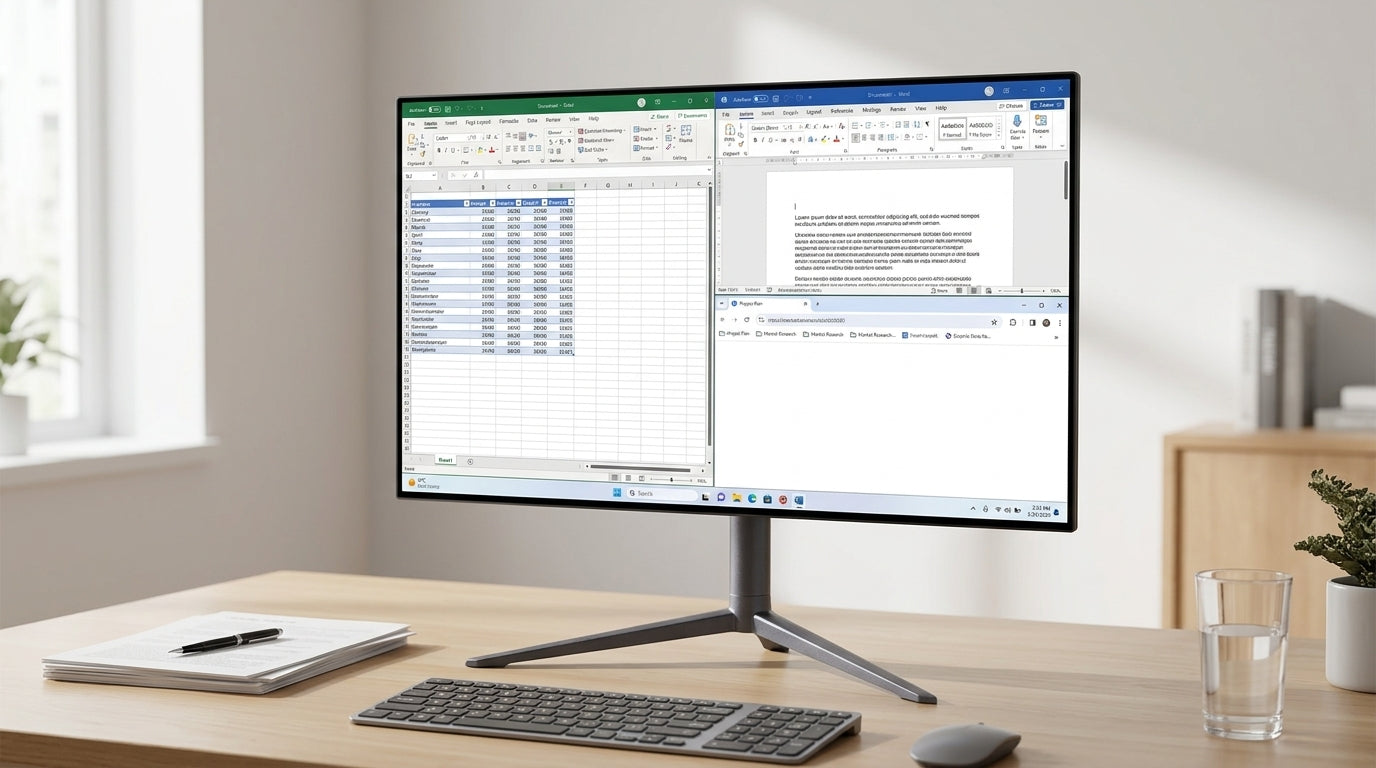
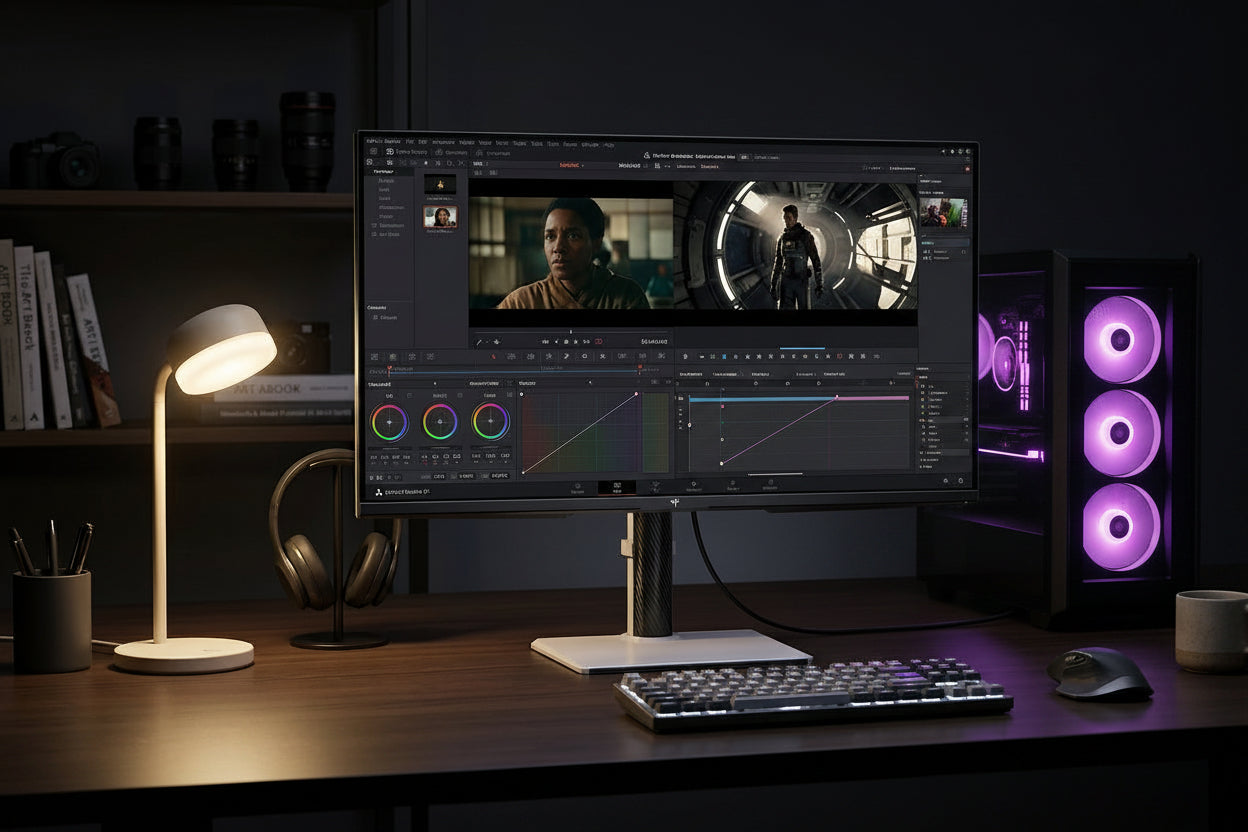
The best display class depends on what your startup actually does with the screen. If the work is text-heavy, design-heavy, or long-session productivity, a sharp office display is usually the safer starting point. If the team also needs frequent motion, a higher-refresh model may fit better. If multitasking across many windows is the main benefit, ultrawide can be compelling.
Use the following rule of thumb: choose the simplest class that still satisfies the real work pattern. If you add complexity without a use case, you usually add cost and support burden too.
Here is the decision split:
- Choose a 5K or 4K office display when text clarity, layout space, and creator-adjacent work are the priority.
- Choose a 1440p office display when you want a lower-cost, easier-to-standardize fleet with decent sharpness.
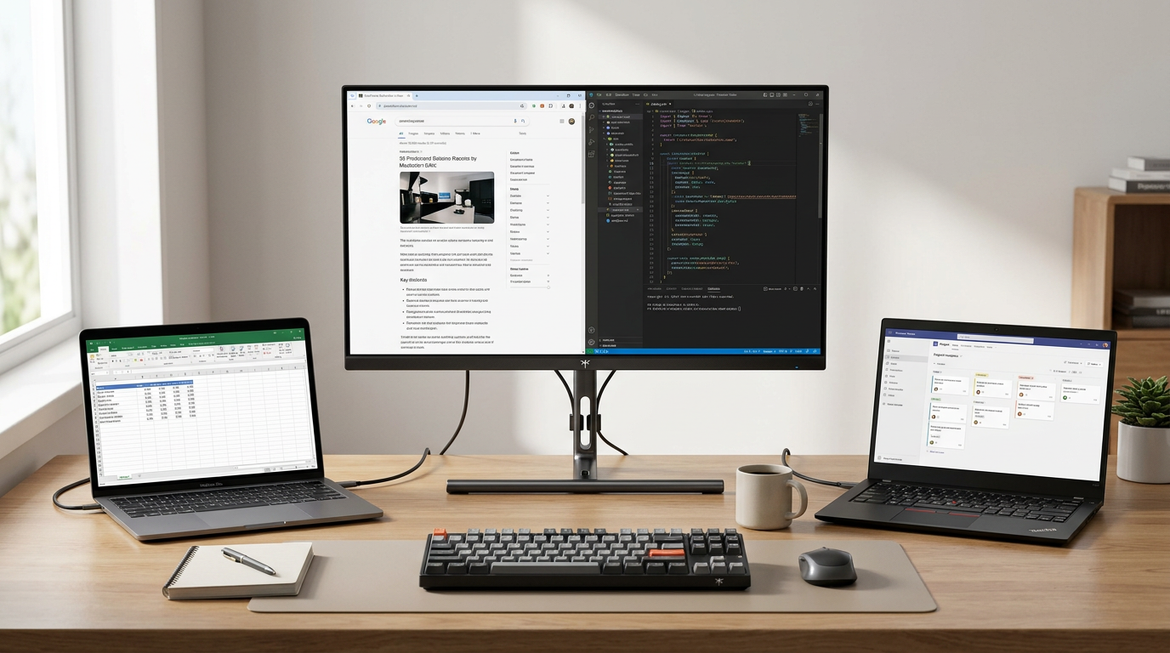
- Choose an ultrawide when side-by-side workflows replace the need for multiple smaller monitors.
- Choose a smart monitor only when built-in apps or entertainment use is part of the real plan.
- Choose a portable or touch display only when mobility or presentation flexibility justifies the extra setup complexity.
That hierarchy also matches the available browsing paths. If your team is narrowing options, Office Monitor collection is the most focused category for workstation deployment, while All Monitors collection is the broader starting point when you are still comparing office, smart, portable, and performance categories.
A second decision sentence is worth keeping in mind: if the fleet needs frequent desk moves or presentation flexibility, a more adaptable display class can be worth the extra complexity; if the office layout is fixed, a simpler office model usually creates fewer moving parts and fewer regrets.
The table below summarizes the practical trade-offs across display classes.
| Display Class | Packaging | Repairability | TCO | Mobility | Refresh Rate |
|---|---|---|---|---|---|
| 27-inch 4K/5K office monitor | Strong | Strong | Balanced | Limited | Standard |
| 1440p office monitor | Strong | Strong | Strong | Limited | Standard |
| Ultrawide monitor | Moderate | Strong | Balanced | Limited | Higher |
| Smart monitor | Moderate | Moderate | Balanced | Good | Higher |
| Portable/touch display | Moderate | Moderate | Moderate | Excellent | Standard |
Build a Circular Rollout Plan
Start with the baseline use case, desk count, and replacement horizon before comparing models. A startup with 20 desks does not need the same fleet logic as one rolling out 50 or more displays across hybrid teams.
Then set minimum requirements for service, mounting, and connectivity. If those requirements are vague, the procurement process tends to drift back toward the cheapest unit rather than the best fit.
Next, standardize the unglamorous parts: packaging handling, spare accessories, return logistics, and how units are reassigned inside the company. That is where circular procurement becomes operational instead of rhetorical.
Finally, set a review cadence for repairs, transfers, and end-of-life recovery. If no one owns the follow-through, the fleet will quietly revert to wasteful replacement habits.
FAQs
Q1. How Does Circular Procurement Lower Display Waste Over Time?
It lowers waste when teams buy fewer replacement units, keep displays in service longer, and reduce packaging and return churn. The biggest gains usually come from better lifecycle planning, not from a single feature on the spec sheet.
Q2. What Should Startups Prioritize Before Buying New Office Displays?
Check the use case first, then warranty, support path, mounting fit, and connectivity. If those basics are unclear, the cheapest option often creates more friction later because it is harder to standardize, repair, or move.
Q3. Can Factory-Direct Procurement Improve ROI Without Overstating Savings?
It can, but only when lower handling, fewer returns, and longer service life offset the initial price. The safest way to judge it is to compare the full fleet cost pattern, not just unit price or promotional savings.
Q4. Why Does Repairability Matter in a Small Fleet?
Small fleets still face moves, desk swaps, cable wear, and occasional damage. If a display is simple to service and easy to keep in rotation, it is less likely to be replaced early just because the fix feels inconvenient.
Q5. Can Sustainability Reporting Use Display Procurement Data?
Yes, procurement records can support internal sustainability reporting, especially for fleet size, replacements, and reuse decisions. They should be presented as operational evidence, though, not as a blanket proof of compliance or emissions reduction.
Make the Next Purchase Count
A startup does not need a perfect circular system on day one. It needs a procurement process that avoids obvious waste, keeps displays serviceable, and makes replacement decisions more disciplined than default retail buying. Standardize the fleet, document the lifecycle, and choose the right class for the job.