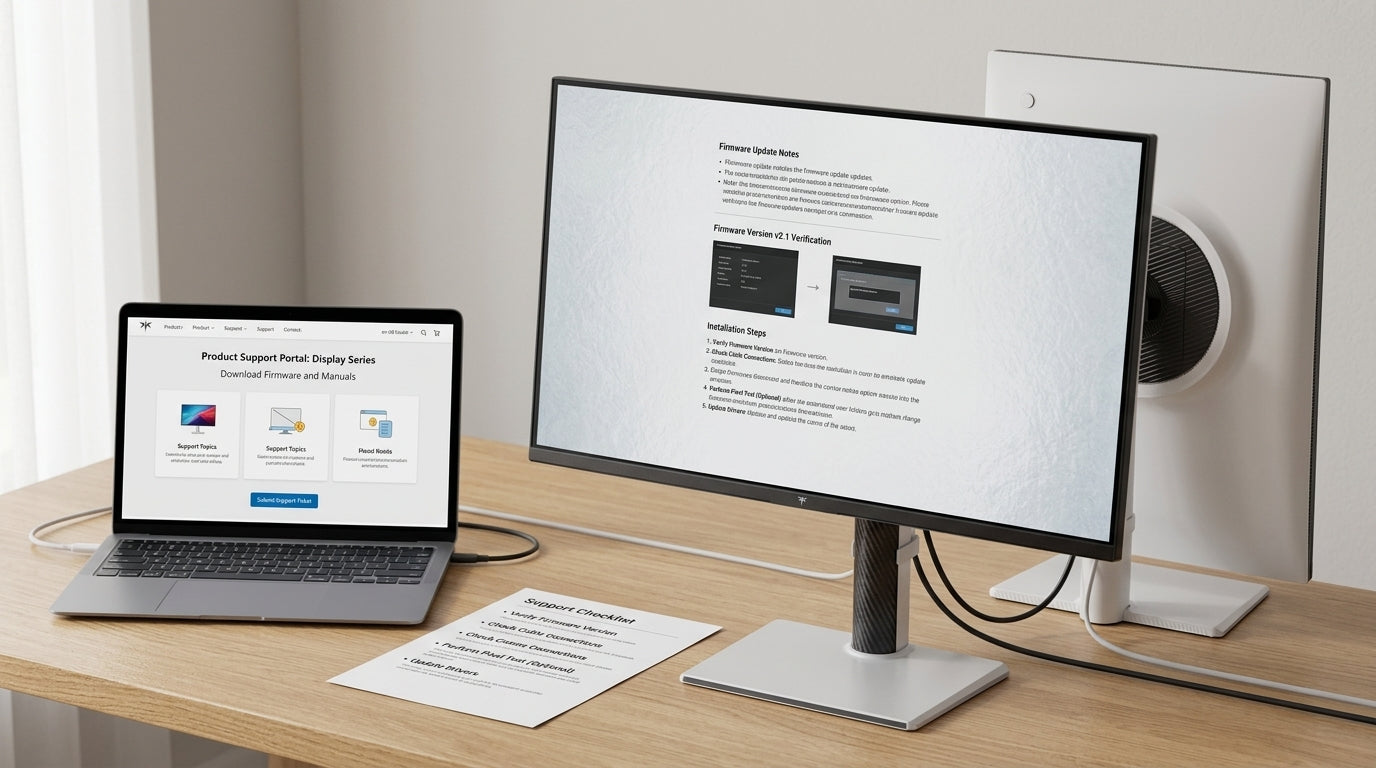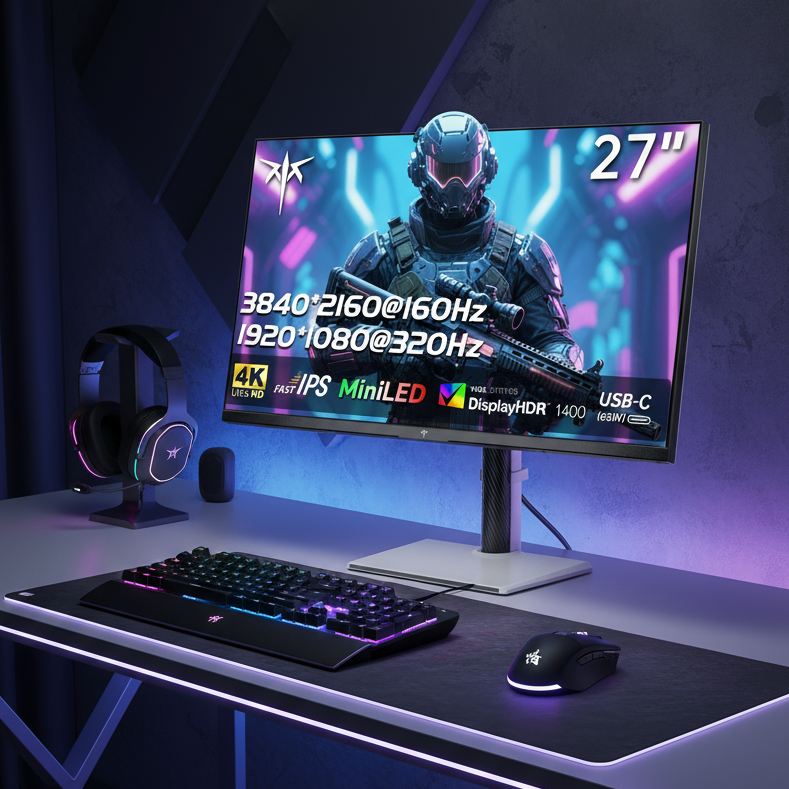



USB-C monitor power delivery limits for laptops are easy to overread. A usb c monitor can charge a laptop, carry video, and sometimes move data too, but only when the port, cable, and laptop all support the same path. In many setups, that means convenience charging rather than full-speed charging.

What USB-C Monitor Power Delivery Actually Does
USB-C can carry power, video, and data through one connector, but that does not mean every monitor USB-C port does all three. Some ports are mainly for display, some add charging, and some also act like a small hub. The label looks simple; the behavior is not.
The wattage number on the monitor is only the ceiling it can offer. USB Power Delivery 3.0 supports up to 100W, and USB PD 3.1 Extended Power Range reaches up to 240W, but that upper limit only matters when the monitor, laptop, and cable all support it. Advantech's USB PD 3.1 overview is a useful anchor for that ceiling.
For most laptop buyers, the practical question is simpler: will the monitor keep the battery from dropping, or will it actually replace the charger during normal work? Those are different outcomes. A usb c monitor may maintain charge on a light desk day, then fall behind during heavier use.
That is why the core keyword, usb c monitor power delivery limits laptop, should be treated as a compatibility check, not a universal promise. If the setup is meant to replace a charger or dock, the whole chain has to line up first.

How to Check Laptop and Monitor Compatibility
Start with the laptop, then the monitor, then the cable, then a real desk test. That order catches most slow-charging complaints before they turn into returns.
- Check the laptop's USB-C behavior first. The port has to support video output and charging, not just data transfer. Some laptops have one USB-C port that handles display and another that does not.
- Check the monitor's USB-C port label and spec sheet. Look for power delivery plus video support, not just a generic USB-C label.
- Check the cable before you blame the monitor. Above 60W, USB-C cables need to be full-featured and E-marker capable, which is why a random charge cable often causes trouble. Cable Matters' USB-C power delivery guide explains the cable side clearly.
- Test it directly before adding hubs or adapters. Connect the laptop straight to the monitor with one known-good cable. If that works, add other devices later.
- Watch for workload changes. A laptop that charges on email and browsing may charge more slowly, or not at all, while editing video or gaming.
The useful internal follow-up here is USB-C KVM monitor setup, which stays focused on the same compatibility question.
A good rule of thumb is this: if the setup fails at the direct cable test, do not add a dock or adapter until the laptop port, cable, and monitor port are confirmed. That avoids mixing multiple variables at once.
Monitor Examples That Fit Different Desk Setups
The right monitor class depends on how much the laptop needs from the display path. A portable usb c monitor can make sense when you want simpler single-cable use, while a desktop monitor only becomes dock-like when its USB-C feature set is actually verified.
| Setup type | What it usually covers | Best fit | Watch out for |
|---|---|---|---|
| Portable USB-C display | One-cable display use, with limited desk expansion | Travel or light desk setups | Do not assume every portable screen behaves the same way |
| Smart monitor with hub features | Video plus some charging and peripheral convenience | Users who want fewer boxes on the desk | Check the real USB-C power rating before expecting dock replacement |
| Standard desktop monitor | Display first, charging only if the spec says so | Buyers who already use a dock or charger | USB-C may not be the active input or power path |
KTC's A25Q5 portable touch screen is a bounded product example because it has USB-C connectivity and is designed for flexible use, but it should not be treated as proof that every desktop monitor from the brand behaves the same way.
For buyers who want a more all-in-one desk feel, smart monitor options are a better browsing path than assuming any USB-C display will replace a dock. If you want to compare premium models that are more likely to include stronger desk features, higher-end monitors is a useful category to scan.
When a USB-C Monitor Can Replace the Dock
A usb c monitor can replace some dock functions when the laptop supports video over USB-C, the monitor offers the right power delivery, and the cable is full-featured. That is the minimum line for a one-cable desk.
For Mac users, Apple's guidance on fast charging MacBook Pro matters because the 14-inch and 16-inch MacBook Pro models need 96W or 140W adapters for fast charging. If a monitor delivers less than that, it may still charge, but not at the same speed you get from the original adapter.
Apple also notes that power behavior depends on the power source and the laptop's own needs, which is why a monitor can look fine on paper and still struggle during heavier use. That is the point where the category shifts from convenience charging to a partial solution.
Here is the practical split:
- Monitor-only fits best when you mainly want display plus everyday charging and you do not mind if the laptop battery is only maintained.
- Monitor-plus-hub fits when the monitor also covers the peripheral paths you actually need, such as a keyboard, mouse, or simple desk switching.
- Dock-first is safer when you need Ethernet, multiple USB accessories, several displays, or a fast-charge target the monitor cannot meet.
One important boundary: a monitor is often a display first, and a dock second. If your desk depends on lots of peripherals, the monitor may still be useful, but it is not the thing to buy as the only expansion device.
Practical Setup Checklist Before You Buy
Use this quick pass/fail check before checkout:
- Does the laptop USB-C port support both display and charging? If not, the setup will not work as a one-cable plan.
- Does the monitor list USB-C power delivery, not just USB-C input? If the spec does not say so, verify it before buying.
- Is the cable full-featured and E-marker capable if you need more than 60W? Weak cables are a common reason a monitor charges slowly.
- Is the laptop's charging need close to the monitor's PD output? If the laptop normally expects more power, expect slower charging or battery drain under load.
- Do you need Ethernet, extra USB ports, or multiple displays? If yes, a dock may still be the better anchor for the desk.
- Have you tested a direct connection first? That is the fastest way to isolate the problem before adding adapters.
If you want a category path instead of a guess, browse smart monitor options first, then verify the port details on the exact model. That keeps the decision grounded in the actual USB-C path, not the marketing label.
FAQs
How Do I Know If My USB-C Monitor Will Charge My Laptop at Full Speed?
Compare the laptop's charging requirement with the monitor's USB-C power delivery rating, then check the cable. Full-speed charging is only realistic when the monitor has enough wattage headroom and the laptop accepts it during normal use. If the laptop needs more than the monitor supplies, charging may be slower.
What Makes a Laptop Charge Slowly or Inconsistently Through USB-C?
The most common causes are the wrong USB-C port, a cable that cannot handle higher power, insufficient wattage headroom, or heavy laptop workload. If the laptop charges slowly while editing, gaming, or running many apps, the monitor may simply be delivering less power than the system is using.
Can One USB-C Cable Handle Charging, Display, and Data at the Same Time?
Yes, but only when the laptop, monitor, and cable all support the same full-function path. Some displays can pass video and power yet still leave the USB hub side limited. If one link in the chain is missing support, the setup may only do part of the job.
Why Does My Laptop Show Video but Not Charge From the Monitor?
Video and charging are separate negotiation paths. A setup can pass display while missing USB-C power delivery, using the wrong port, or relying on a cable that does not support the needed power level. Test with a known-good cable and the direct monitor port before replacing hardware.
Can a USB-C Monitor Fully Replace a Dock?
Sometimes, but only for lighter desk setups. If you need extra USB ports, Ethernet, or multiple external displays, a dock is usually the better fit. A monitor can still be the main screen, but it does not automatically replace every dock function.
Final Takeaway
USB-C monitor power delivery can reduce desk clutter, but it is not a universal dock replacement. The safe way to shop is to match the laptop's charging need, the monitor's PD output, and the cable's capability before expecting one cable to do everything. If those pieces line up, a usb c monitor-only setup may be enough; if not, keep the dock in the plan.