If touch accuracy shifts after a firmware update, the fastest fix is usually to remap the touchscreen to the correct display, return the panel to its native resolution, and run the operating system’s touch calibration tool again.
You update your portable monitor, reconnect it to your laptop, and suddenly every tap lands on the wrong icon or the wrong screen. The failure pattern is usually recognizable: touches may register on the built-in display, drift toward one edge, or become unreliable on small buttons. This guide gives you a practical workflow to restore accurate tapping, dragging, and gesture control on a portable touchscreen monitor.
Why Touch Accuracy Changes After a Firmware Update
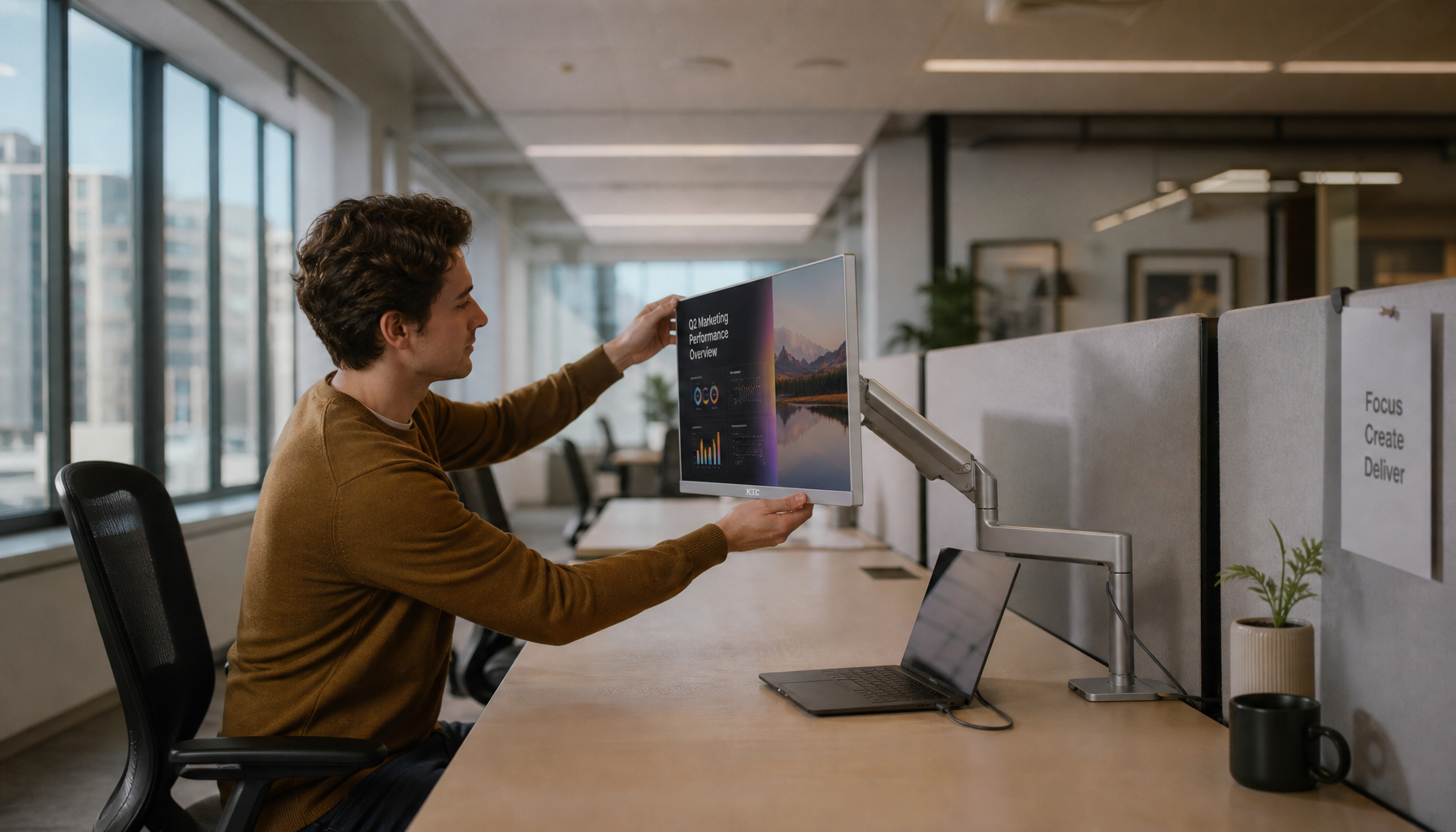
A firmware or software update can shift touch alignment because the touch controller, driver, or operating system may start handling screen coordinates differently than before. On a portable monitor, that matters more than on a fixed desktop display because you are often reconnecting through USB-C, moving between laptops, or rotating the screen between travel and desk use. A calibration that felt fine before the update can become visibly offset after the system re-enumerates the display.
The symptom is not always a simple “tap is slightly off” problem. A real portable touchscreen monitor case on a desktop environment showed touches landing on the laptop’s built-in screen instead of the external portable monitor, even though the display and active pen otherwise worked. That is an important distinction for monitor buyers and users: a panel can still look sharp, hit its expected resolution, and behave normally for pen input while touch mapping is wrong.
Portable monitor reviews also tend to focus on panel quality first. Common buying criteria for portable displays include at least 1080p resolution, about 250 nits brightness, and contrast near 1000:1, but those checks do not verify touch mapping after firmware changes. If touch support is one reason you bought the monitor, treat calibration as a separate post-update task, not as proof that the display itself is defective.
Pre-Calibration Checks That Matter on Portable Monitors
A clean screen and stable environment matter more than many users expect. Fingerprints, dust, unstable power, heat, humidity swings, and nearby interference can all reduce touch accuracy or create false inputs. On a portable monitor sitting next to a laptop charger, dock, power brick, or wireless device, this is easy to overlook. Before opening any calibration tool, wipe the panel with a lint-free cloth, confirm the monitor is powered properly, and let the setup sit for a few minutes in steady conditions.

A wrong resolution or bad cable path can make calibration look broken when the real problem is upstream. Verify that the portable monitor is running its native resolution, that the USB connection used for touch is fully seated, and that the system recognizes the display correctly. If your monitor uses a separate USB line for touch data, video can look perfect while touch fails or drifts, so do not assume a clean image means the touch path is healthy.
Check |
Why it matters after an update |
What “correct” looks like |
Native resolution |
Coordinate mapping depends on the expected pixel grid |
Monitor runs at its listed native mode, such as 1920 x 1080 |
Touch-to-display mapping |
The OS may assign touch to the wrong screen |
Taps affect the portable monitor, not the laptop panel |
USB/video/power connection |
Firmware updates can expose weak or partial connections |
Display, power, and touch all work consistently |
Environment |
Interference and contamination can skew capacitive touch |
Clean glass, stable power, minimal nearby interference |
Calibration tool choice |
Newer 24H2 builds and older builds use different workflows |
You use the correct setup or calibration method for your OS |
The Operating-System Workflow That Usually Fixes It
A touch setup pass in the system settings panel is often the first real fix when a portable monitor starts registering input on the wrong screen. Open the system’s touch-display setup panel, choose touch input, and press Enter until the prompt appears on the portable monitor you want to control. Then tap that screen. This step does not just “calibrate” accuracy; it tells the operating system which physical display should receive the touch device.

A standard operating-system calibration pass comes next if taps are still offset. Search for touch calibration, select the external monitor, choose Calibrate, then tap each target as precisely in the center as possible and save the data. If your workflow depends on precise UI hits on a 15.6-inch portable monitor, use the more detailed calibration mode when available, because small offsets are most noticeable on compact displays.

A newer 24H2 system build may not show the old calibration button, so the fallback is the built-in command-line calibration tool. Set the portable touchscreen as the main display temporarily, launch that tool, and complete the crosshair prompts on that panel. If the touch settings window is hard to find, a control-panel shortcut or the monitor maker’s shortcut method can still expose the setup interface on supported systems.
Quick Action Checklist
- Clean the touchscreen with a lint-free cloth.
- Reconnect power, video, and USB touch cables firmly.
- Confirm the monitor is using its native resolution.
- Run the system touch-display setup flow to map touch to the correct display.
- Run touch calibration or the built-in command-line calibration tool on newer 24H2 builds.
- Save the calibration data and test edge taps, drag paths, and pinch gestures.
Multi-Monitor Mapping Problems on Another Platform Need a Different Fix
An external-monitor touch bug on another platform can look like a calibration failure even when the larger issue is display coupling. In one device report, pen and touch mapping appeared to span the laptop display plus the external monitor area, and detaching the external display restored normal behavior. That kind of symptom points to mapping logic, not necessarily a bad touch layer.
The desktop-environment report for a portable touchscreen monitor shows the same pattern from another angle: the monitor worked generally well, but touch landed on the built-in panel. On that platform, check the desktop environment’s input mapping options before assuming the firmware update damaged the monitor. Users in another desktop environment reported success by toggling the tablet display-coupling setting, and the maintainer also pointed to device-mapping configuration as a likely cause on affected hardware.
For portable monitor users, this matters because these setups often mix laptops, docks, and rotating external displays. A recalibration attempt will not fix a screen-association problem if the system is still sending touch to the wrong display. Validate mapping first, then test calibration.
When Recalibration Still Does Not Fix It
A driver refresh is the next step after a failed recalibration. Update the monitor’s touch driver, USB-related drivers, and firmware using the manufacturer’s latest package. On desktop operating systems, checking the system device manager and reinstalling a missing or stale touch device can restore normal behavior after an OS or firmware change.

A USB and firmware-level refresh on a desktop OS can also help when touch disappears, becomes intermittent, or returns after a reboot only to drift again later. If you are troubleshooting a portable gaming monitor or work-travel display that reconnects several times a week, this is worth doing because connection state changes can expose older driver problems that stayed hidden before the update.
Sometimes the issue is no longer software. A repeated offset example with a small touchscreen showed about 6-8 pixels of Y-axis error, about 2 pixels on the X-axis, and a dead zone near the edge even after multiple recalibration attempts. On a portable monitor, a comparable pattern of persistent edge misses, dead zones, or uneven response after proper setup usually points to hardware wear, a damaged digitizer, or a controller fault that needs service rather than another calibration pass.
Final Takeaway
A successful calibration routine is usually a sequence, not a single click: clean the screen, stabilize the setup, verify resolution and cables, map touch to the correct display, then calibrate with the right tool for your operating system. That order matters because it separates coordinate-mapping mistakes from true touch-panel inaccuracy.
For most portable monitor owners, the practical rule is simple: if the display image looks right but touch is wrong after a firmware update, start with display association and calibration before blaming the panel. If the problem survives a correct mapping pass, a full recalibration, and current drivers, escalate to hardware diagnosis or manufacturer support.
FAQ
Q: Do I need to set the portable monitor as the main display to calibrate it?
A: Sometimes, yes. Newer 24H2 builds using the built-in command-line calibration tool specifically require setting the touchscreen as the main display first, while older operating-system calibration tools may work without that extra step.
Q: Why does touch work, but on the wrong screen?
A: A multi-monitor mapping issue can associate the touch device with another display even when the monitor image, brightness, and cable connection are fine. Run the display setup step before repeating calibration.
Q: Will this work on another desktop platform with a portable touch monitor?
A: Not always. External touch support on some platforms is limited, so a portable monitor may show video normally while direct touch input is unsupported or incomplete.
References
- A desktop-environment discussion: external touchscreen input registering on built-in screen
- A company help article: common portable touchscreen monitor problems
- A company help article: calibrating portable touch screens
- A monitor maker guide: touch screen setup and calibration
- A monitor maker guide: touch screen calibration and troubleshooting
- An open-source issue: pen and touchscreen offset with external monitor
- A hardware guide: touchscreen peripheral setup and calibration
- A forum thread: offset touchscreen accuracy example
- A display brand blog: portable monitor buying context