Use the smart monitor’s built-in browser or cloud app, sign in to your storage account, and pin that workflow to the home screen if supported. For heavier office, media, or team use, a USB-C laptop connection, local NAS media server, or centralized cloud manager is usually more reliable.
Is your presentation, spreadsheet, or design file sitting in the cloud while your smart monitor is ready but your laptop is across the room? A practical setup can give you direct access to cloud-drive folders, shared workspaces, or object-storage dashboards without moving files through a flash drive. Here is the clean, reliable way to connect cloud storage to a smart monitor and decide when direct access is worth it.
What “Direct File Access” Means on a Smart Monitor
Direct file access means the monitor can open, preview, stream, or manage files from a cloud account without acting only as a passive display. In practice, that can happen through a built-in web browser, a native app, a connected cell phone, a local media server, or a laptop connected over USB-C, HDMI, or DisplayPort.
The important distinction is control. A normal monitor only shows what another device sends to it. A smart monitor has its own operating system, Wi-Fi connection, apps, and sometimes cloud-drive features, so it can behave more like a lightweight workstation for documents, photos, video files, dashboards, and shared folders.
Cloud storage itself is remote storage managed through internet-connected infrastructure, and cloud storage is especially useful for documents, images, videos, logs, and other unstructured files that need to be retrieved from different devices. For a smart monitor, that means your display becomes a front end for files instead of just a screen at the end of a cable.
The Best Connection Methods
Use the Built-In Browser for Cloud Drives

The most universal method is the browser route. Connect the smart monitor to Wi-Fi, open its web browser, go to your cloud provider’s web app, sign in, and test whether the monitor can preview your file types. This is the best first test because it does not depend on a dedicated monitor app.
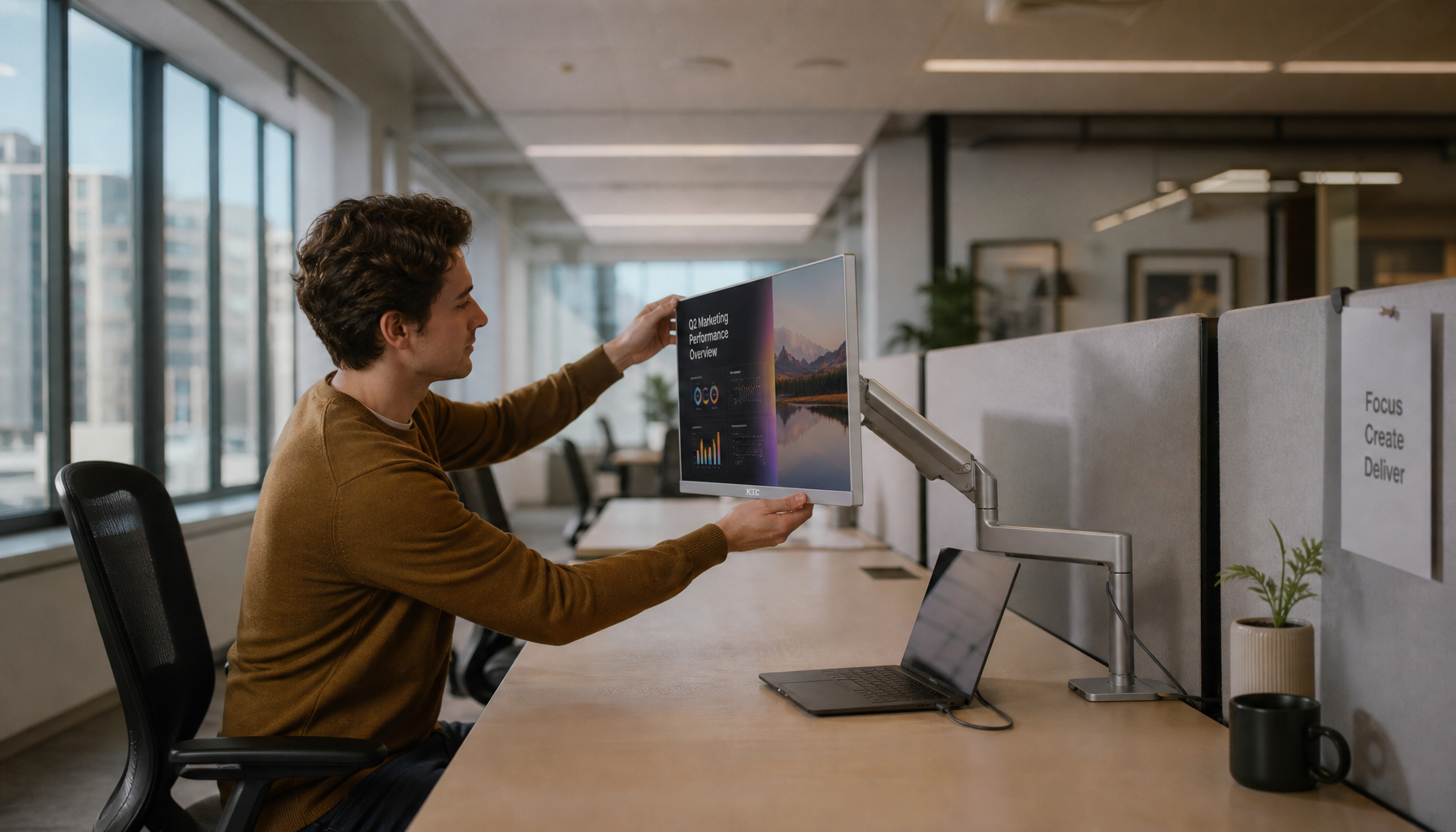
For office productivity, this works well with PDFs, images, text files, cloud documents, and lightweight spreadsheets. If you are reviewing a slide deck before a meeting, a browser session on the monitor can be enough. If you are editing a complex spreadsheet, handling large design files, or jumping between many tabs, connect a keyboard and mouse by Bluetooth or USB if the monitor supports it.
For provider selection, match the account to your workflow. Some services are built around collaboration, others around office-suite integration, sync and sharing, or scalable developer storage; business cloud storage comparisons also separate collaboration-focused services from backup-oriented and enterprise-security options. That matters because a smart monitor is only as productive as the web interface it can comfortably run.
Use a Native Cloud App When the Monitor Supports It
Some smart displays include built-in cloud-drive or file-access features. If your monitor has an app store, search for your provider first, then confirm whether the app supports viewing only, downloading, playback, or full editing. A native app can feel cleaner than a browser because it is designed for remote-control navigation, but it may support fewer advanced features than the desktop or web version.
The test is simple: open one PDF, one image, one office document, and one large media file you actually use. If all four open without repeated sign-in prompts or formatting issues, the app is worth keeping in your monitor workflow. If only photos and videos work well, treat it as a viewing tool rather than a full file workstation.
Cast or Mirror from a Cell Phone for Quick Access
Wireless screen sharing is ideal when the smart monitor and phone are on the same Wi-Fi network and you need a quick preview. Open the file on your phone, cast or mirror the screen, and use the monitor as a larger canvas. This is fast for photo review, PDF inspection, and quick meeting-room handoffs.
The downside is that the phone remains the real file-access device. If a call comes in, the battery gets low, or the phone locks, the workflow can break. For serious productivity, mirroring is a convenience path, not the most durable setup.
Connect a Laptop Over USB-C, HDMI, or DisplayPort

For performance-first work, a wired laptop connection still wins. Use USB-C when you want one cable for display, power, and possibly peripherals, assuming your monitor and laptop both support it. Use HDMI or DisplayPort when you mainly need a stable video signal.
This method is not “direct” in the strictest sense because the laptop accesses the cloud, but it is often the best user experience. If you are opening a 400 MB creative asset, editing a spreadsheet with many formulas, or managing multiple cloud folders, the laptop’s browser, local sync client, and keyboard shortcuts will beat most smart monitor apps.
Use a Cloud Storage Manager for Multiple Accounts
If your work spans several providers, a cloud storage manager can reduce account switching. A cloud storage manager is positioned as software for managing multiple cloud services from one place, which is useful when you need one interface for scattered accounts. On a smart monitor, this usually means running the manager on a connected computer rather than directly on the monitor, unless the monitor’s operating system supports that software.
This setup is valuable for power users: a creator with one cloud drive for scripts, another shared folder for client uploads, and object storage for archives can keep the monitor focused on preview and review while the computer handles authentication and file operations.
Choosing the Right Cloud Storage Type
Not every cloud storage service is built for the same job. A smart monitor used for office files has different needs than a production display showing large video archives or a dashboard pulling CSV data from cloud buckets.
Storage Type |
Best Fit on a Smart Monitor |
Practical Watchout |
Consumer file storage |
Documents, PDFs, images, shared folders, light editing |
Browser support and sign-in friction matter most |
Business collaboration storage |
Team folders, permissions, version history, shared reviews |
Use viewer permissions carefully on shared displays |
Object storage |
Large media libraries, archives, dashboards, app data |
Usually needs a web console, app, or custom front end |
Local NAS plus cloud backup |
Office media walls, training rooms, private libraries |
Requires same-network discovery or media-server support |
Object storage is designed for large amounts of unstructured data, and it can scale to massive datasets, but that does not automatically make it the best direct smart-monitor experience. If you need to show photos, videos, or documents, a user-facing cloud drive is usually easier. If you need to display logs, analytics exports, or application assets, an object-storage bucket connected through a dashboard may be more appropriate.
Cost also changes with access patterns. Cloud storage services often charge by capacity, retrieval, data transfer, and operations, and storage classes can make archive data cheaper to hold but slower or more expensive to retrieve. A simple example: if a monitor in a lobby pulls the same product video every morning, hot or standard storage is safer than archive storage because the file is accessed frequently.
Security and Reliability Settings You Should Not Skip

A smart monitor is often shared, visible, and left signed in. That makes account security more important than on a personal laptop.
Use a dedicated display account when possible, especially in offices, studios, classrooms, and meeting rooms. Give that account viewer access to only the folders it needs. Turn on multifactor authentication for the main admin account, but avoid making everyday monitor access depend on an employee’s personal phone every time the display restarts.
For business environments, cloud storage should include encryption, access controls, audit logging, versioning, and recovery options; security recommendations commonly emphasize IAM or role-based permissions, MFA, encryption at rest and in transit, and audit visibility. On a smart monitor, those controls translate into practical habits: sign out after temporary sessions, never store admin passwords in a public display browser, and create read-only folders for presentation or media playback.
Monitoring matters when the display is part of a real workflow. Hybrid and cloud monitoring practices focus on availability, traffic, logs, alerts, and access behavior, and hybrid cloud monitoring guidance emphasizes unified visibility, tagging, real-time alerts, and security checks across cloud and local systems. If your smart monitor runs a warehouse dashboard or executive KPI wall, treat file access like a service, not a convenience.
Troubleshooting Common Problems
If the monitor cannot open the cloud site, start with Wi-Fi and browser compatibility. Test another secure site, then update the monitor firmware if available. Some smart monitor browsers struggle with complex web apps, especially when pop-ups, third-party cookies, or advanced editing tools are required.
If files appear but will not preview, check file type and size. A PDF or JPEG may open instantly, while a large raw video, complex spreadsheet, or proprietary design file may require a desktop app. For video-heavy workflows, cloud storage is flexible, but large files can stress bandwidth; provider selection should consider file flexibility, storage scale, security, ecosystem fit, and budget.
If shared folders do not appear, inspect permissions from another device. Many cloud platforms distinguish owner credentials, viewer credentials, and service-account-style access in reporting or dashboard contexts, which can change what the monitor sees. When in doubt, create a test folder with one harmless PDF and one image, share it to the display account, and confirm access before moving the full workflow.
If a dashboard or storage console is slow, separate display performance from cloud performance. Cloud monitoring tools track latency, throughput, errors, logs, and costs, and cloud monitoring tools are selected around coverage, integrations, alert quality, scalability, dashboards, security, and cost awareness. For a display setup, the practical version is to test the same file on a laptop using the same Wi-Fi. If the laptop is fast and the monitor is slow, the monitor browser is the bottleneck.
Pros and Cons of Direct Cloud Access on a Smart Monitor
Direct access is efficient when the task is viewing, presenting, checking dashboards, or reviewing shared files. It reduces cable clutter, keeps meeting rooms cleaner, and lets a display pull current files instead of relying on someone’s laptop. For office teams, that means the latest deck, photo folder, or status board can be available from the screen itself.
The tradeoff is that smart monitors rarely match a full computer for editing depth, file compatibility, multitasking, or authentication flexibility. They are displays with computing features, not full workstation replacements. The performance-driven setup is to use direct access for viewing and light interaction, then switch to USB-C laptop mode for heavy creation, large file management, or multi-app work.
Practical Setup Example
For a home office or small meeting room, create a dedicated cloud folder named “Display Ready” and share it with a display-only account. Put final PDFs, exported slide decks, approved images, and compressed videos there. Sign in to that account on the smart monitor browser, bookmark the folder, and test every file type you plan to use.
For a production studio, use the monitor for review rather than master-file management. Keep raw assets in your main cloud or object storage, export review versions to a shared folder, and open those on the smart monitor. That gives clients and teammates a clean, immersive view while protecting the source files from accidental deletion, permission drift, or slow archive retrieval.
FAQ
Can a smart monitor access a cloud drive directly?
Yes, if its browser or app environment supports cloud-drive sign-in and file preview. For reliable editing, connect a laptop or use the monitor with a keyboard and mouse.
Can I connect object storage directly to a smart monitor?
Usually not as a simple folder unless you use a web console, custom dashboard, media front end, or connected computer. Object storage is powerful for scale, but it is less consumer-friendly than a cloud drive for direct browsing.
Is direct cloud access safe on a shared monitor?
It can be safe if you use a dedicated read-only account, strong permissions, and sign-out rules. Avoid using a personal admin account on any monitor that other people can access.
A smart monitor becomes genuinely useful when cloud access matches the job: browser or app for quick review, casting for convenience, USB-C for serious productivity, and managed storage for teams. Build the workflow around the files you open every day, then let the display do what it does best: put the right content in front of you with less friction.