Yes. If your desktop PC lacks USB-C video output, the most reliable setup is usually HDMI or DisplayPort for video, plus a separate USB power cable for the portable monitor.
Is your new portable screen showing “No Signal” even though it worked instantly with a laptop? In real desktop setups, the fix is often testable in minutes: confirm the graphics card output, power the monitor separately, then set Windows to extend the display. You can then identify the right cable, adapter, or dock path before buying parts.
The Short Answer: USB-C Is Convenient, Not Required
A portable monitor does not require USB-C as long as it has another video input, most commonly mini HDMI, full-size HDMI, or sometimes DisplayPort. The important distinction is that USB-C can often carry video and power through one cable, while HDMI and DisplayPort usually carry the picture only.
That is why many desktop users get stuck. The monitor may be designed around single-cable laptop use, but a tower PC behaves differently. Desktop USB-C ports often sit on the motherboard and may not carry video from the graphics card. Setup guidance notes that desktop PCs have only partial USB-C video support, because USB-C display output typically depends on specific graphics hardware.
In practical terms, if your desktop has HDMI out and your portable monitor has mini HDMI in, you can connect them. You will probably also need USB-A to USB-C, a wall charger, or a power bank to power the screen.
Know What Each Port Actually Does
HDMI

HDMI is the default recommendation for most desktop PCs without USB-C. It is common on graphics cards, motherboards, mini PCs, and older office towers. It carries video and audio, and it is usually the easiest option for a portable monitor that includes a mini HDMI port.
The catch is power. HDMI does not normally power the display, so a portable monitor connected over HDMI still needs a USB power source. Portable monitor connection advice describes HDMI as broadly compatible, while also emphasizing that the right connection method affects resolution, refresh rate, audio, flicker, and signal stability.
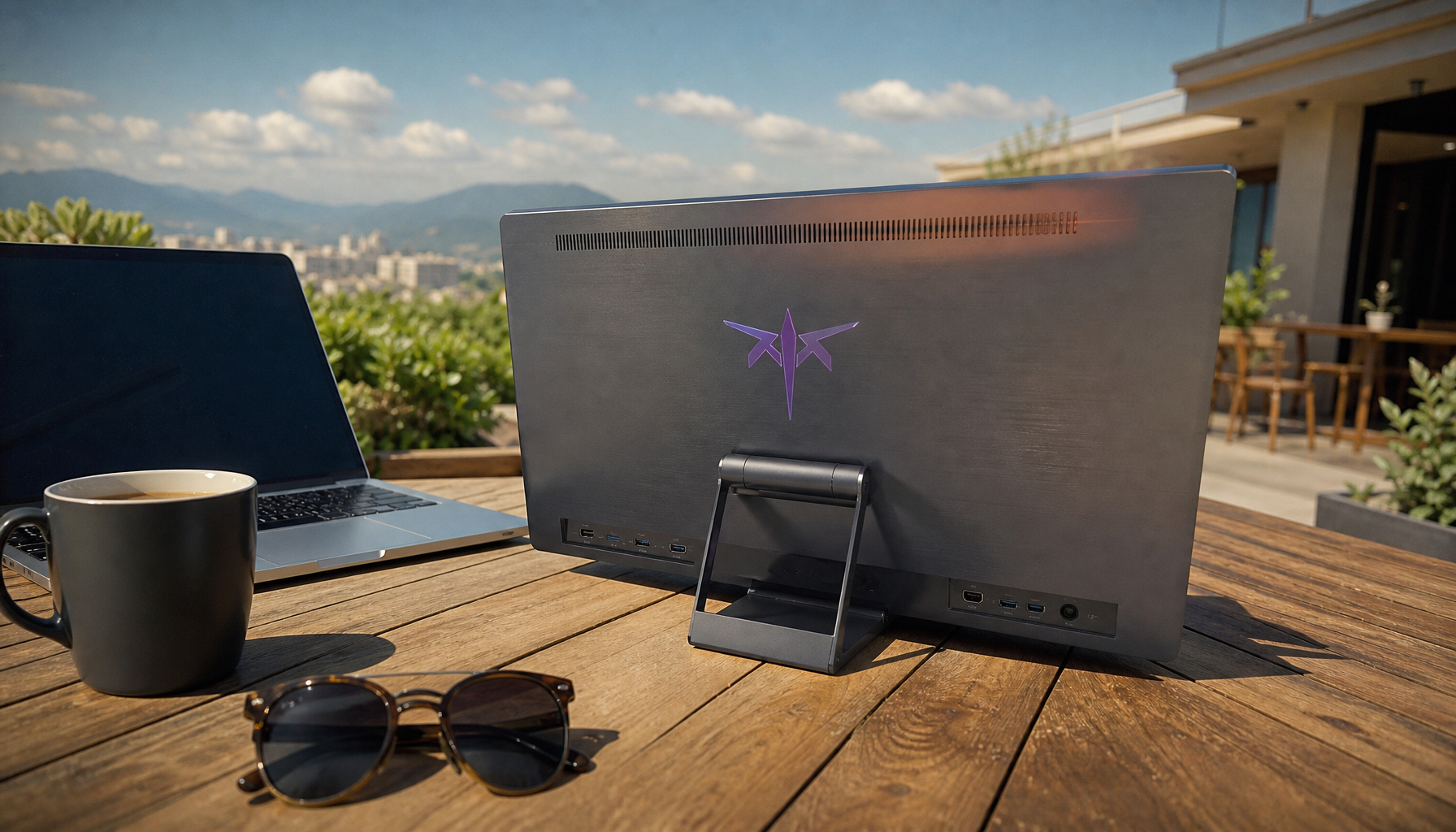
A simple desktop setup looks like this: HDMI from the graphics card to the monitor’s mini HDMI input, then USB-A from the PC or a USB wall charger to the monitor’s USB-C power port. If the screen turns on but says “No Signal,” the monitor input may still be set to USB-C instead of HDMI.
DisplayPort
DisplayPort is excellent when both devices support it, especially for higher refresh rates. Gaming-focused setups benefit from DisplayPort because it is commonly used for adaptive sync and high-refresh desktop monitors. Some portable monitors include mini DisplayPort, but many consumer models use mini HDMI instead, so check the exact port before buying a cable.
If your graphics card has DisplayPort but the portable monitor only has HDMI, use an active or properly specified DisplayPort-to-HDMI adapter. Direction matters. A cable labeled HDMI-to-DisplayPort may not work in reverse.
USB-A
USB-A is not a direct video output in the same way HDMI or DisplayPort is. However, USB-A can support external display adapters or docks that use their own display technology. That can work for spreadsheets, chat, documents, and browser-heavy office work, but it is not the best route for fast gaming or color-critical video editing.
A discussion about systems without USB-C or Thunderbolt points to a practical pattern: a USB docking station can drive additional monitors for productivity, but users should verify resolution and refresh-rate limits before relying on it.
The Best Connection Paths for a Desktop PC Without USB-C

Desktop Output |
Portable Monitor Input |
What You Need |
Best For |
Main Tradeoff |
HDMI |
Mini HDMI or HDMI |
HDMI cable plus USB power |
Most users |
Separate power cable |
DisplayPort |
HDMI |
DisplayPort-to-HDMI adapter plus USB power |
PCs with modern GPUs |
Adapter quality matters |
VGA or DVI |
HDMI |
Active converter plus USB power |
Older office PCs |
Lower quality or limits |
USB-A |
HDMI via dock/adapter |
USB display dock or adapter |
Office multitasking |
Not ideal for gaming |
Motherboard USB-C |
USB-C monitor |
Only if it supports video output |
Rare desktop cases |
Many ports are data-only |
For a clean desk, HDMI plus a short USB power cable is usually the value sweet spot. For a gaming desktop, prioritize the graphics card’s output, not the motherboard’s rear I/O. For an older business tower with VGA only, the converter must actively convert VGA to HDMI; a passive cable will not solve the signal mismatch.
Power Is the Part People Underestimate

Portable monitors are slim because they usually depend on an external device for power. With USB-C laptops, that power may arrive through the same cable as video. With a desktop HDMI connection, it usually will not.
Portable monitor support notes make the point clearly: some models have one USB-C port for power only and another for video, and HDMI setups require separate USB power. That matches what to check first when a screen lights up but stays black: which USB-C port is supplying power, which port is receiving video, and whether the monitor input menu matches the cable being used.
If your monitor flickers, dims, or disconnects when brightness rises, treat that as a power issue before blaming the graphics card. Use a wall charger with adequate wattage or a stable powered USB port. For a desk setup, a wall charger is often more reliable than drawing power from a weak front-panel USB port.
Windows Setup After the Cable Works

Once the portable monitor is connected and powered, Windows should detect it automatically. If it does not, right-click the desktop, open Display settings, and use Detect. Then choose Extend these displays instead of Duplicate if you want real extra workspace.
This matters because mirroring only copies the same image. For productivity, extension gives you a second canvas: code on the main 27-inch display, documentation on the portable screen, or a game on the primary monitor with Discord, OBS, or performance monitoring on the side. A setup article describes the core benefit of extra screen real estate as reducing the need to switch tabs and rearrange windows.
Set the portable monitor to its native resolution. A 15.6-inch 1080p portable display usually looks sharp at 100% or 125% scaling, while a small 4K portable monitor may need higher scaling to keep text readable. For work, 60Hz is fine. For gaming, use 120Hz, 144Hz, or higher only if the monitor, cable, adapter, and GPU all support it.
When a Dock or Adapter Makes Sense
A dock is worth considering when your desktop has limited video outputs or when you want a portable monitor plus other peripherals. For office productivity, a USB-A display dock can be acceptable. For gaming, it is usually the wrong tool because dock-based graphics paths can add latency and reduce GPU performance.
Dual-monitor setup advice emphasizes checking video output ports, monitor inputs, cable compatibility, and multi-display support before buying adapters. That principle applies just as strongly to desktops. A $12 cable is a bargain only if it sends the signal in the correct direction and supports the resolution you expect.
For example, if your GPU has one HDMI port already used by your main monitor and three DisplayPort outputs free, do not buy an HDMI splitter. A splitter generally mirrors one image rather than creating an independent second desktop. Use DisplayPort-to-HDMI for the portable screen instead.
Pros and Cons of Using a Portable Monitor With a Desktop
A portable monitor can be a smart desktop accessory when you need a compact side display for chat, timelines, monitoring dashboards, email, music controls, or a console preview. It uses less desk depth than a full monitor and can be packed away when not needed.
The tradeoff is ergonomics and brightness. A 15-inch portable screen is not a replacement for a good 27-inch productivity display if you spend eight hours writing, coding, or reviewing spreadsheets. Productivity monitor guidance highlights high resolution, useful desktop real estate, viewing comfort, anti-glare surfaces, and ergonomic adjustment as key productivity factors, and portable monitors rarely match the adjustability of a full desktop display.
For performance-minded users, the right role is important. A portable screen is excellent as a secondary command surface. Your primary gaming or office monitor should still be chosen for size, refresh rate, resolution, panel quality, and stand ergonomics.
Troubleshooting: What to Check First
The Monitor Has Power But No Picture
Confirm the HDMI or DisplayPort cable is connected to the graphics card, not the motherboard, unless your CPU and motherboard support integrated graphics output. Then open the monitor’s input menu and manually select HDMI or the correct source.
The Picture Appears But Looks Blurry
Set the monitor to native resolution in Windows Display settings. If text still looks wrong, adjust scaling rather than lowering resolution. Lowering a 1080p panel to 1366 x 768 usually makes text softer.
The Screen Flickers or Turns Off
Try a stronger power source, then try a shorter or better cable. Portable monitor connection guidance links poor setup with issues like flickering, lag, blurry text, and failure to reach advertised refresh rates, so treat the cable and power path as part of the performance chain.
Touch Does Not Work
If the portable monitor has touch, HDMI alone is not enough. HDMI carries audiovisual data, but touch usually requires a USB data connection back to the PC. That means HDMI for video plus USB-A to USB-C for touch and possibly power, depending on the monitor.
FAQ
Can I use a portable monitor with an old desktop PC?
Yes, if the old PC has a usable video output or can accept an adapter. HDMI is easiest, DisplayPort is strong, and VGA or DVI may require an active converter. Expect lower resolution or refresh-rate limits on very old hardware.
Can USB-A power a portable monitor?
Sometimes. Many portable monitors can run from USB-A power, but brightness and stability depend on the port’s output. If the screen flickers or shuts off, use a wall charger.
Can I game on a portable monitor connected by HDMI?
Yes, if the monitor supports the refresh rate and resolution you want over HDMI. For competitive play, check the monitor’s actual HDMI refresh-rate support rather than assuming the advertised maximum works on every input.
Final Word
A desktop PC without USB-C ports can absolutely run a portable monitor. Use the graphics card’s HDMI or DisplayPort for the image, give the monitor dependable USB power, set Windows to extend the display, and reserve docks or converters for cases where direct video output is not available. Done right, a portable screen becomes a compact performance panel instead of a cable puzzle.