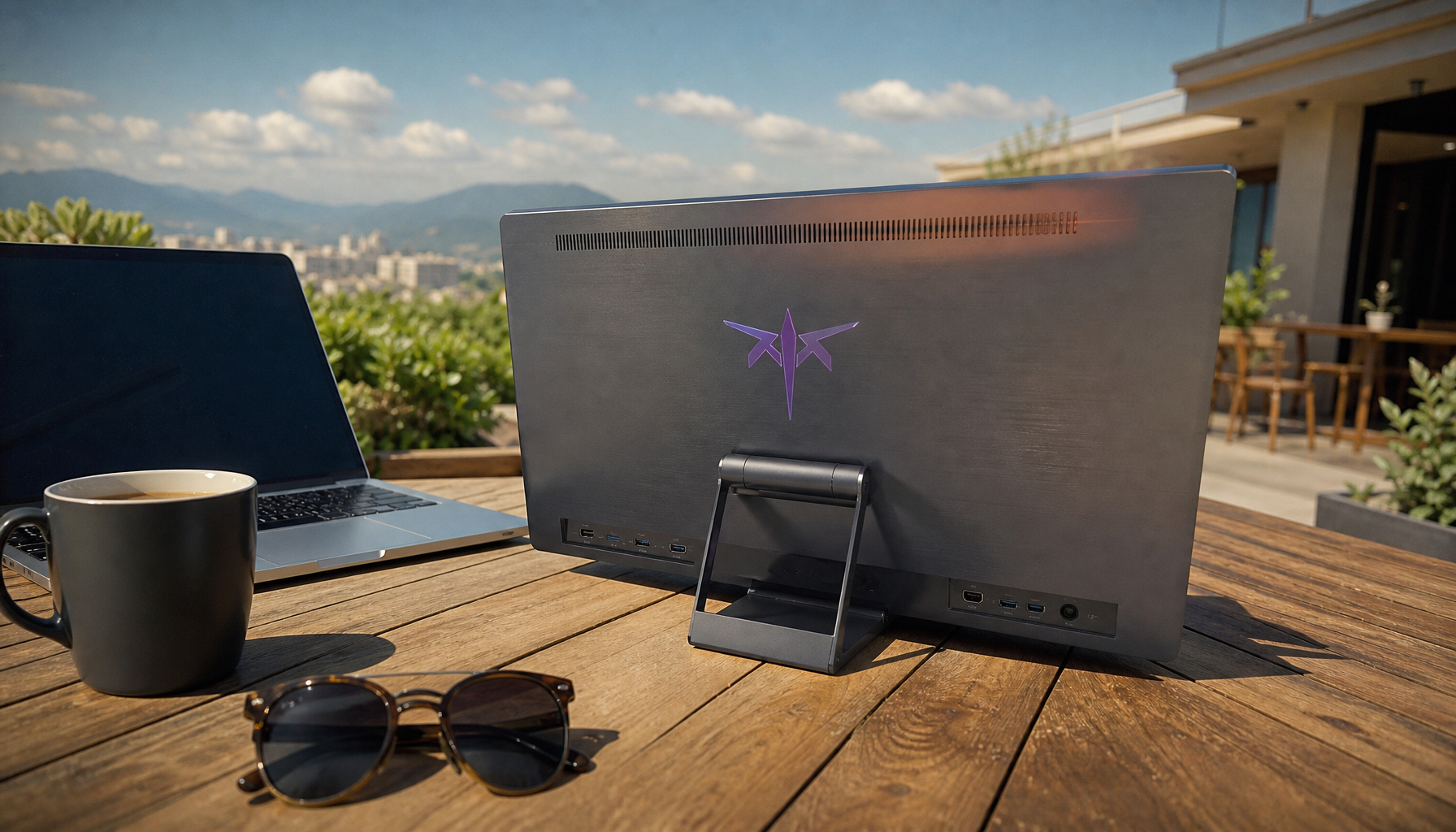
The KTC MegPad delivers impressive mobility with its built-in battery and Android operating system, but achieving true all-day runtime in real-world outdoor or roaming scenarios requires deliberate power management. Most users see the advertised 11-hour figure only under light indoor conditions at moderate brightness; high screen output, wireless features, or continuous app use can cut that to 4-6 hours. With the right Android tweaks, brightness discipline, and a compatible power bank, you can reliably reach or exceed 10 hours while protecting long-term battery health.

The Runtime Reality: Why All-Day Use Requires Planning
MegPad models such as the 25-inch A25Q5 and 32-inch A32Q7 Pro list up to 11 hours of battery life, yet this best-case number assumes 55% brightness, low volume, and minimal background activity. In practice, external factors quickly reduce endurance. Brightness, Wi-Fi casting, processor load from streaming or multitasking, and ambient heat are the biggest drains. All-day use exceeding 10 hours remains achievable, but it demands shifting from a plugged-in mindset to active power management that combines software optimization, strategic brightness, and supplemental external power when needed.
This planning is especially important for remote workers, students, RV users, or anyone working in cafes and patios without easy outlet access. Without it, you risk the device dying mid-session in direct sun or during extended productivity work.
The Brightness-to-Power Ratio: Finding Your Outdoor 'Sweet Spot'
Screen brightness is the single largest power consumer on these large portable displays. Reducing it from 100% to roughly 50% can more than double runtime in many scenarios, as this Android battery guide explains.
The relationship is non-linear: the jump from 80% to 100% often drains the battery about 60% faster due to exponential backlight power draw. For indoor productivity at moderate ambient light, 55% brightness typically supports the full 11-hour rating. In outdoor shade or bright cafes, capping at 80% serves as a practical ceiling that still delivers around 6-7 hours. Full 100% brightness should be reserved for short emergency visibility in direct sun, where runtime may drop to roughly 4 hours.
This chart helps visualize the likely pattern across common usage scenarios.
MegPad brightness trade-offs: visibility vs. battery life by usage scenario
Shows the likely pattern for planning MegPad brightness in common setups. Runtime is an estimate and can shift with battery age, temperature, apps, volume, or wireless casting.
View chart data
| Category | Typical runtime (hours) |
|---|---|
| Indoor All-Day | 11.0 |
| Outdoor Shade | 6.5 |
| Direct Sun | 4.0 |

These ranges come from product testing under controlled conditions and serve as planning guidelines. Actual results vary with battery age, temperature, audio volume, and active apps.
Optimizing Android Settings for Endurance
Android 14 on the MegPad includes powerful built-in tools that limit background drain without manual intervention. As Google's official battery guidance details, features like Adaptive Battery use machine learning to restrict power for apps you rarely use, making this the first setting to confirm is enabled.
Beyond that, several targeted toggles deliver outsized gains. The always-listening wireless casting or screencast feature can consume 10-15% of battery even when idle; disable it in settings when not actively mirroring. For productivity tasks, locking the refresh rate to 60Hz instead of higher options like 144Hz can add nearly 20% more runtime because the panel and processor work less hard.
Other high-impact steps include turning off always-on Wi-Fi scanning when roaming between rooms, reducing screen timeout to 30 seconds, and using dark mode where the display supports it. These changes compound: many users report extending practical endurance by 2-3 hours simply by auditing and restricting background processes rather than relying on generic battery-saver modes.
Choosing the Right Power Bank for MegPad Charging
You can safely charge or maintain the MegPad with an external power bank, but compatibility is critical. These displays require a 19V or 20V Power Delivery (PD) profile; standard 5V or 9V phone chargers under 45W typically fail to deliver enough voltage or wattage during active use and may show "no signal" or extremely slow charging.
A 65W PD power bank serves as the practical minimum for the smaller A25Q5 model to maintain charge under light load. For the larger A32Q7 Pro or when running demanding apps outdoors, a 100W PD bank is the safer recommendation because it supports simultaneous screen use and charging without draining the internal battery. Look specifically for banks labeled "laptop compatible" or those listing 20V output in their PD profiles.
This threshold eliminates most compact phone-centric banks. Investing in the right one upfront prevents the common frustration of buying a seemingly adequate accessory that cannot keep the display powered on the go. Quality PD controllers matter too; cheaper units may not negotiate the correct voltage handshake reliably.
For reference, explore our broader Mobile Touch Screen collection to see compatible models, or check the KTC MEGAPAD 32" 4K Android 14 Google EDLA Smart Touch Monitor with 9500mAh Battery for its power specifications.
Protecting Long-Term Battery Health and Standby Management
Lithium batteries in devices like the MegPad degrade fastest from extreme charge states and heat. Industry guidance, including this explanation of the 80/20 rule, recommends keeping daily charge cycles between 20% and 80% to minimize chemical stress and potentially double the effective lifespan compared with frequent full discharges or 100% charges.
For longer-term storage—such as seasonal RV use or weeks between trips—store the device at 40-60% charge in a cool, dry environment, as Battery University research confirms. Full 100% or 0% storage for extended periods risks permanent capacity loss.
Outdoor use adds another risk: high ambient temperatures accelerate degradation. Keep the back panel shaded during patio sessions, as this lithium battery storage analysis notes. Enable standby management by fully powering down rather than leaving the device in sleep mode for days, which still incurs small daily drain.
When to Use Battery Alone vs. External Power
Reserve the internal battery for short room-to-room movement, brief meetings, or indoor streaming sessions where you value complete cord freedom. Switch to a 65W or higher PD power bank for full outdoor daylight sessions, 8-plus hour workdays, or any scenario where you cannot risk interruption.
A practical hybrid approach often works best: run on battery for the first half of the day, then connect a power bank for a 30-minute top-up during lunch. This can bridge to a full 10-12 hour cycle without constant plugging and unplugging. Over time, matching your power source to the actual demand prevents unnecessary battery cycling and preserves capacity.
For deeper setup advice, see our guide on preventing accidental touch inputs when using a portable monitor in transit or how to build a mobile dual-screen gaming setup.
FAQs
Can any USB-C power bank charge the MegPad while the screen is on?
Most phone-oriented banks under 45W cannot maintain charge during active use due to insufficient voltage and wattage profiles. You need a laptop-class PD bank rated 65W or higher with explicit 20V support. Some lower-wattage units may trickle-charge only when the screen is off or in standby, but this is unreliable for all-day sessions.
What is the most realistic runtime I can expect outdoors at typical cafe brightness?
At around 80% brightness with moderate volume and a few productivity apps, expect 6 to 7 hours on a healthy battery. This is a conservative planning range; older batteries, high temperatures, or wireless casting can reduce it further. Treat 11-hour claims as indoor, low-brightness benchmarks only.
Does enabling Adaptive Battery on Android 14 make a noticeable difference for the MegPad?
Yes, particularly for mixed-use days with many background apps. Adaptive Battery learns your patterns and restricts power to rarely used apps, often adding 1-2 hours compared with default unrestricted behavior. Combine it with manual disables of wireless casting and high refresh rates for best results.
How should I store the MegPad if I won't use it for a month or longer?
Charge it to approximately 50% and power it completely off before storing in a cool location away from direct heat or sunlight. Avoid leaving it at 0% or 100% for extended periods, as both extremes accelerate chemical aging according to established battery storage protocols.
Will frequent power bank use damage the MegPad's internal battery over time?
Not if you follow good habits. Using external power for long sessions actually reduces cycling on the internal battery. The main risks remain heat exposure and consistently charging to 100% daily; the 80/20 practice and occasional full cycles help calibrate the battery gauge and maintain health.
Is there a bypass charging mode that lets the MegPad run directly from the power bank without using the internal battery?
Current MegPad models do not advertise a dedicated bypass mode. High-wattage PD banks (100W) can effectively power the device while simultaneously trickle-charging the battery, minimizing wear compared with lower-output chargers that force the battery to cycle constantly.