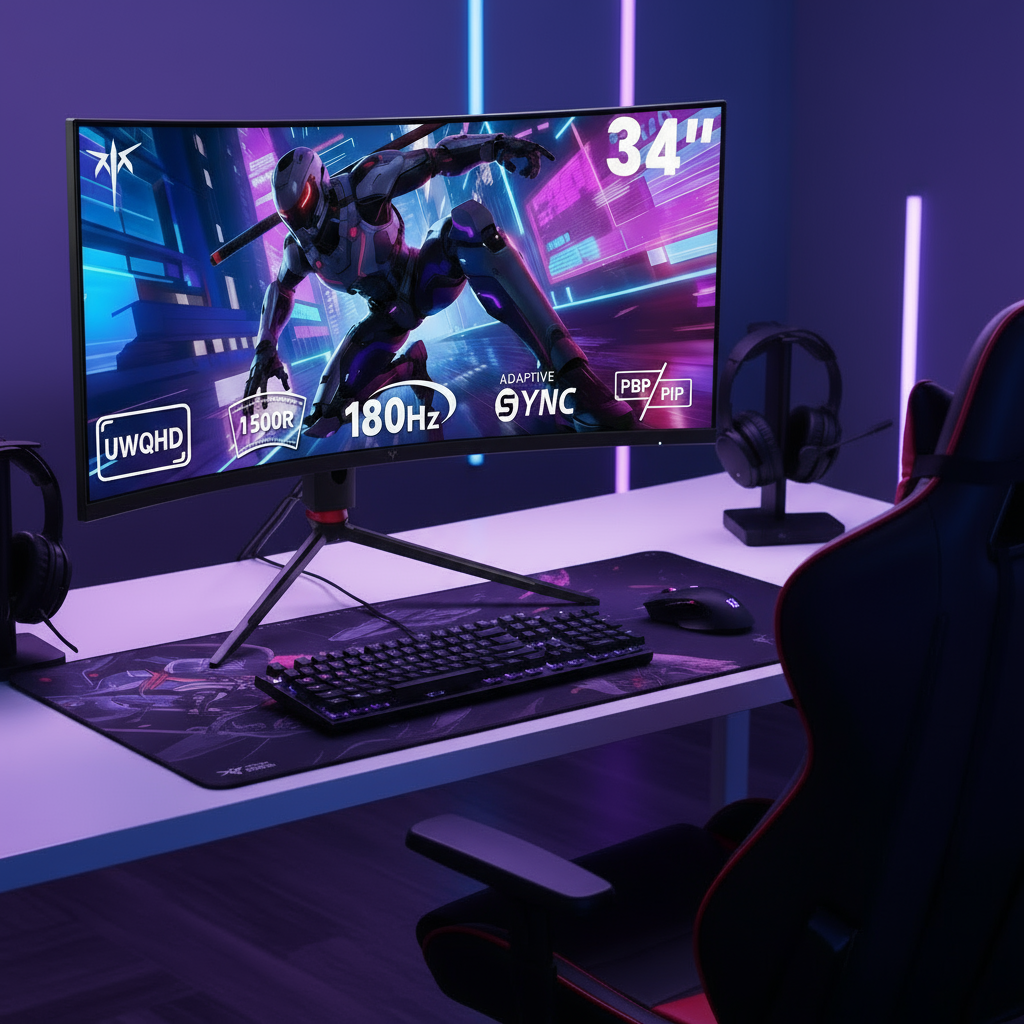




Console VRR can expose weak monitor overdrive tuning, especially when frame rates swing between 60 FPS and 120 FPS. The quickest fix is to lower the monitor’s overdrive setting, test VRR in real gameplay, and use VRR only in games where it reduces stutter without adding bright trails.
Ever pan the camera in a fast shooter or racing game and see pale halos, colored edges, or dark outlines following objects that should look clean? In many console setups, the fix takes less than 10 minutes: switch overdrive from “Fastest” or “Extreme” to “Normal,” then retest the same scene with VRR on and off. This guide shows how to identify the artifact, tune your gaming monitor, and decide when VRR is still worth using.
Why VRR Can Make Overshoot More Visible

VRR, or variable refresh rate, changes the monitor’s refresh timing to match the console’s frame output. That helps reduce tearing and stutter, but VRR synchronizes refresh timing; it does not make LCD pixels change color faster.
The problem usually comes from overdrive. Overdrive applies extra voltage to speed up pixel transitions, but if the monitor pushes too hard, pixels overshoot the intended shade and settle back. That creates inverse ghosting: bright halos, pale coronas, colored fringes, or dark outlines around moving objects.
Why It Happens During Frame-Rate Drops
At 120 Hz, each refresh window is about 8.33 ms. At 60 Hz, it is about 16.67 ms. An overdrive mode that looks sharp near 120 FPS may look overcooked when the game drops closer to 60 FPS because overdrive behavior is not always equally clean across the full VRR range.
This is why console players often report a strange pattern: VRR off looks slightly less smooth but cleaner, while VRR on removes stutter yet adds white trails or glowing edges in motion. The monitor is not necessarily broken; it may simply have aggressive fixed overdrive that does not adapt well as refresh rate changes.
Identify the Artifact Before Changing Settings

Overshoot and normal ghosting are different problems, so the right fix depends on what you see. Ghosting usually looks like a soft shadow or smear behind moving objects. Inverse ghosting looks sharper and more unnatural: a bright outline, pale duplicate, colored edge, or glowing trail.
A practical test is to load a repeatable scene: a dark hallway in a 60 FPS performance mode, a fast camera pan in a 120 FPS shooter, or a racing game with high-contrast signs passing by. If the trail is bright or colored, lower overdrive. If the trail is dark and smeary, a slightly stronger overdrive setting may help.
Console-Friendly Test Method
Use the same game, same map, same camera motion, and same display mode each time. Test three conditions: VRR off, VRR on with the current overdrive setting, and VRR on with overdrive reduced one level.
Browser tests can help when using a PC, and the variable refresh rate demo explains how VRR smooths changing frame rates, but console troubleshooting should rely on real gameplay. Console VRR artifacts often appear only in the exact frame-rate range your game hits during fast motion.
Best Monitor Settings to Try First
Start with the monitor’s overdrive setting. Many gaming monitors label this as Response Time, Overdrive, OD, motion response, or Motion Acceleration. The best setting is usually the fastest mode that stays visually clean, not the one with the most aggressive name.
For console gaming at 60 Hz or 120 Hz, start at Normal, Medium, or Low. Aggressive presets such as “Extreme” or “Fastest” may improve advertised response-time numbers but can make inverse ghosting more visible during real motion.
Recommended Setting Order
- Set the console to the game’s intended output mode, usually 60 Hz or 120 Hz.
- Enable VRR on the console and monitor.
- Set monitor overdrive to Normal or Medium.
- Test a fast-motion scene with high contrast.
- Lower overdrive if you see bright halos or colored trails.
- Raise overdrive only if motion looks dark, smeared, or slow.
- Disable blur-reduction or strobing modes while testing VRR.
Blur-reduction modes such as backlight strobing or “1 ms MPRT” can sharpen motion, but strobing modes often reduce brightness by 30% to 50%, may disable VRR, and can add flicker. For most console players, VRR plus moderate overdrive is the better first target.
Settings Comparison for Console VRR Problems

Setting or Choice |
Best Use |
Common Problem |
What to Try |
Overdrive: Low |
60 FPS games, dark scenes, VA panels |
May leave soft ghosting |
Use if Normal shows bright halos |
Overdrive: Normal/Medium |
Most 60 FPS and 120 FPS console games |
Usually the safest balance |
Start here for VRR testing |
Overdrive: Fast/Extreme |
Fixed high-refresh gameplay |
Can cause inverse ghosting during VRR drops |
Avoid if halos appear |
VRR On |
Games with fluctuating frame rates |
May expose poor overdrive tuning |
Keep on if motion is smooth and clean |
VRR Off |
Locked 60 FPS or 120 FPS games |
More tearing or stutter possible |
Use if VRR adds obvious artifacts |
Backlight Strobing/MPRT |
Fixed refresh competitive play |
Lower brightness, flicker, VRR conflict |
Use only when VRR is not needed |
Panel type matters, too. VA panels are often more prone to dark smearing, while fast IPS and TN panels usually handle motion transitions better. That does not mean every VA monitor is bad or every IPS monitor is perfect, but VA panels need closer testing in dark, fast-moving scenes.
When to Keep VRR On, Turn It Off, or Change Per Game
Keep VRR on when the game has uneven frame pacing, frequent dips, or visible tearing without it. Open-world games, performance modes with unlocked frame rates, and 120 FPS modes that fluctuate can benefit the most.
Turn VRR off for a specific game if the frame rate is already locked and motion looks cleaner without it. If a 60 FPS game holds steady but VRR introduces pale trails during camera pans, the smoother frame pacing may not be worth the added inverse ghosting.
Use Game Profiles When Possible
Some monitors let you save gaming profiles. A practical setup is one profile for 120 FPS shooters with VRR on and Normal overdrive, and another for locked 60 FPS games with VRR off or Low overdrive.
If your monitor has variable overdrive, it may adjust response behavior across refresh rates more gracefully. If it only has fixed overdrive modes, choose the cleanest setting during frame-rate dips rather than the sharpest setting at the monitor’s maximum refresh rate.
When the Monitor Is the Limitation
If every overdrive setting has a problem, the display may simply have weak response-time consistency. One mode may smear, the next may overshoot, and the fastest mode may look unusable with VRR. That is a monitor tuning issue, not a console setting mistake.
For console buying, prioritize a modern high-bandwidth console input, VRR support, strong 60 Hz and 120 Hz behavior, and clean overdrive tuning over extreme 240 Hz marketing claims. A 240 Hz gaming monitor can still look messy if its pixel transitions or overdrive presets are poorly tuned.
What to Look For in a Better Console Monitor

Look for reviews or specs that discuss motion clarity across the VRR range, not just maximum refresh rate. A good console monitor should look clean near 60 FPS, 90 FPS, and 120 FPS because those are common real-world zones for console performance modes.
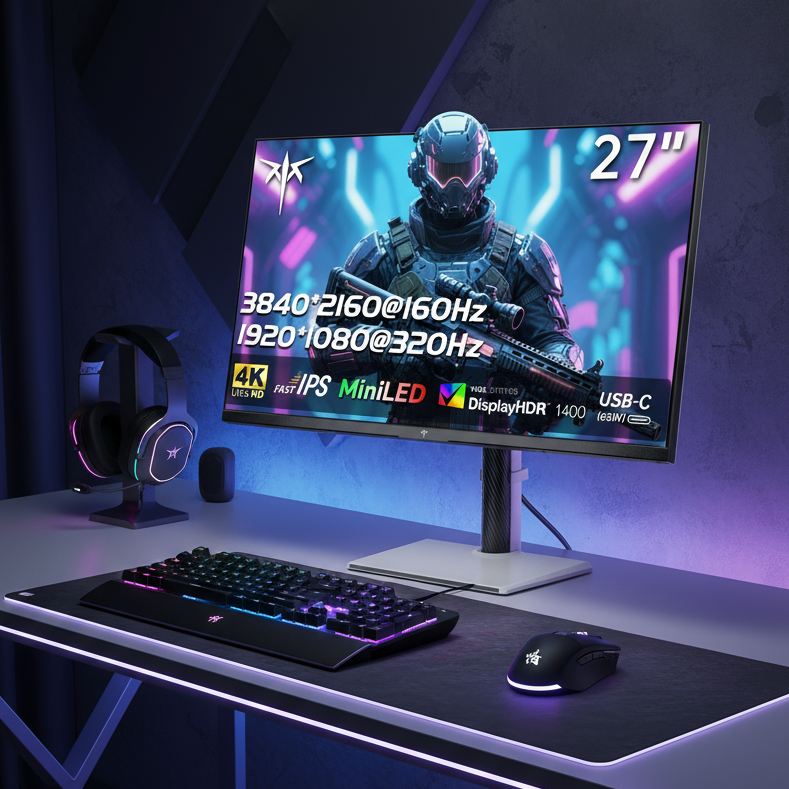
For most console players, 4K, a modern high-bandwidth console input, low input lag, VRR support, and stable overdrive are more useful than extra refresh-rate headroom that the console rarely uses. A model such as a 27” 4K 160Hz/1ms HDR gaming monitor can be checked against the basics: 4K output, 120Hz console support, adaptive sync support, and then overdrive behavior in reviews or hands-on testing. Motion clarity ratings from certification systems can also help narrow the search, but hands-on testing remains important.
FAQ
Q: Why does inverse ghosting appear only when VRR is enabled?
A: VRR changes the monitor’s refresh timing as the console frame rate changes. If the monitor’s overdrive is tuned too aggressively for lower refresh rates, frame-rate drops can reveal bright halos or colored trails that were less visible at a fixed refresh rate.
Q: Should I use “Fastest” overdrive for competitive console gaming?
A: Not automatically. “Fastest” can reduce blur on paper, but it often increases overshoot. For 120 FPS console games, Normal or Medium overdrive is usually the better starting point.
Q: Is VRR bad for gaming monitors?
A: No. VRR is useful when frame rates fluctuate because it reduces tearing and stutter. The issue is poor response-time consistency or overly aggressive overdrive, especially on displays that do not handle the full VRR range cleanly.
Practical Next Steps
Start with the simple fix: set overdrive to Normal or Medium, keep VRR on, and test the same fast-motion scene. If you see bright halos, lower overdrive. If motion becomes dark and smeary, raise it one step.
For games that run at a steady 60 FPS or 120 FPS, compare VRR on and off instead of assuming one setting is always better. The best console monitor setup is the one that keeps motion clean in the frame-rate range you actually play, not the one with the most aggressive spec sheet.
References
- Refresh Rate Overshoot: Causes, Problems & How to Fix It
- Monitor Overdrive Explained: Reduce Ghosting & Overshoot
- Monitor Overdrive: Response Time vs. Inverse Ghosting
- Variable Refresh Rate & Response Time Consistency Guide
- Variable Refresh Rate Demo — G-SYNC, FreeSync - UFO Test
- Gaming Monitor Specs: Refresh Rate, Response Time, VRR & HDR