Your cursor gets stuck because the operating system only lets it cross where the virtual monitor edges touch. Align the active screen areas first, then match that layout in display settings so the pointer has a clean path between screens.
Does your mouse slam into an invisible wall when you drag from your main 27-inch gaming monitor to a side display? In real multi-monitor setups, the most reliable fix is testable in minutes: align the active screen areas, open display settings, and drag the monitor rectangles until the cursor crosses at the same height your eyes expect. The result is smoother pointer movement, cleaner window travel, and a more immersive desktop.
Why the Cursor Gets Stuck Between Monitors
A multi-monitor desktop is not mapped by your plastic bezels, desk height, or monitor arms. It is mapped by the operating system’s virtual display layout. If the system thinks your left monitor sits half an inch higher than your right monitor, the cursor can only cross through the overlapping section of those two virtual rectangles.

That is why the problem often feels random. You may move the cursor from the middle of one screen to the next with no issue, then get blocked near the top edge. The cursor is not broken; it has reached a virtual boundary where the next display does not exist.
This matters more with mismatched monitors. A 27-inch 1440p gaming display beside a 24-inch 1080p office monitor may look close enough on the desk, but the active pixel area, scaling, bezel thickness, and vertical height can all disagree. KTC’s monitor-alignment advice separates the job into physical alignment and software alignment, which is the right way to think about this problem.

Start With the Physical Screens, Not the Settings Menu
Before changing display settings, look at the screens from your normal seated position. The goal is not to make the plastic frames look symmetrical. The goal is to make the visible pixels line up where your cursor, windows, and eyes actually travel.

For a productivity setup, align the top edges if you mostly read, code, edit documents, or compare browser windows. This makes toolbars, tabs, and document headers feel consistent when moving between screens. For mixed screen sizes, aligning the centerline may feel better because the cursor crosses near your natural gaze instead of forcing everything to match at the top. For gaming or simulator use, align the horizon or active pixel area so camera movement feels continuous.
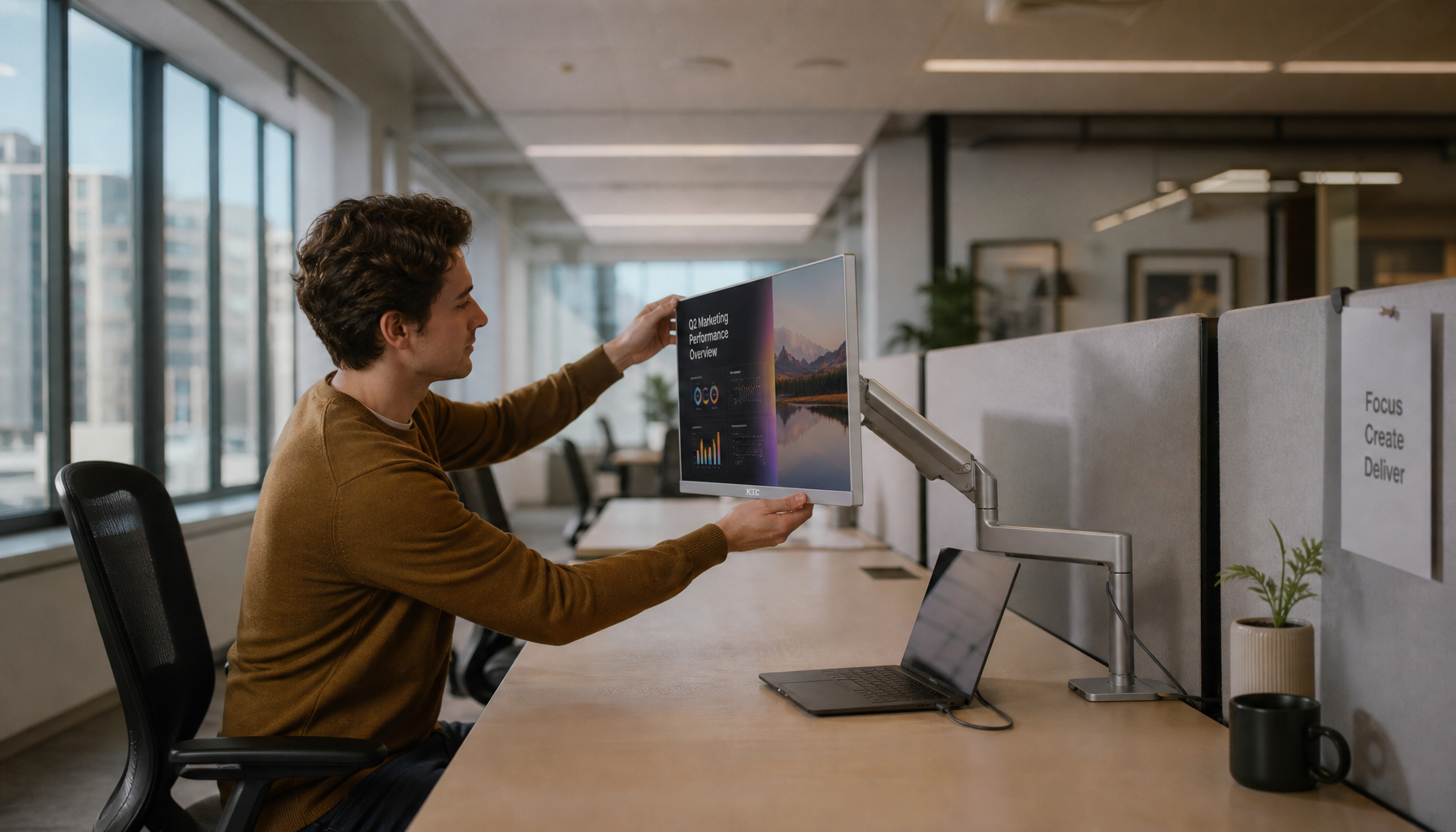
A simple real-world test works well. Open a blank white window on both displays and drag it across the seam. If the top of the window appears to jump upward or downward, your eyes are seeing the same discontinuity your cursor is experiencing. Raise or lower one monitor with its stand, riser, or arm until the active image area, not the outer frame, matches your target.
Monitor arms are useful here because they let you tune height, tilt, and distance without stacking books or accepting a fixed stand. Ergonomic guidance also supports this approach: the top edge of the monitor should sit at or slightly below eye level, with the primary screen directly in front of your body.
Match the Layout in Display Settings
Once the physical desk is close, fix the virtual layout. Open Settings, choose System, then Display. Select Identify so each physical monitor shows its number, then drag the rectangles in the display diagram until their order and height match the desk.

If monitor 1 is physically on the left, its rectangle should be on the left. If monitor 2 is slightly lower because it sits on a shorter stand, its rectangle should be slightly lower too. If the screens are side by side, the rectangles need to touch; even a small gap can create an invisible wall.
Dual-monitor setup advice emphasizes using the display arrangement screen correctly, because the operating system uses that arrangement to decide how the pointer and windows move. This is the key setting behind most cursor-sticking complaints.
After dragging the rectangles, click Apply and test immediately. Move the cursor slowly across the exact spot where it used to stick. Then test at the top edge, center, and bottom edge. If it crosses in the center but not near the top, the virtual top edges still do not overlap enough for your preferred movement path.
Understand Misalignment vs. Edge Protection
Not every stuck cursor is caused by a bad layout. The operating system can also resist cursor movement near screen corners so users do not accidentally overshoot hot corners or edge targets. One technical discussion describes this as behavior where the pointer can feel slightly stuck near the edge even when the monitors are arranged correctly.
The diagnostic is straightforward. Try crossing from display A to display B while rubbing the cursor along the top edge. Then do the same from display B back to display A. If it only sticks one way, the virtual layout is probably misaligned. If it sticks at the same corner in both directions, you may be feeling corner resistance rather than a true monitor-arrangement fault.
The practical workaround is to move the pointer slightly away from the very top or bottom edge before crossing. For fast gaming desks, this is annoying because muscle memory matters. For office users, it may be a minor adjustment. Repeated sticking in only one direction usually means you should keep tuning alignment, while symmetrical corner resistance may be normal behavior.
Use Native Resolution and Sensible Scaling
Cursor travel becomes harder to predict when one monitor is running at a non-native resolution or aggressive scaling. Use each display’s native resolution first, then adjust scaling so text appears comfortable. This keeps the image sharp and avoids making a physically large monitor behave like a smaller or oddly stretched display.
For example, a 27-inch 1440p primary monitor next to a 24-inch 1080p secondary monitor will not feel identical even if their physical top edges match. The 1440p screen has more pixels across the same general size, so the operating system has more virtual space to traverse. Scaling can make text and windows feel more consistent, but it does not make the two pixel grids the same.
This is also why matching monitor size and resolution makes life easier. It reduces the number of compromises among eye comfort, cursor movement, and window placement. For users building a new multi-screen desk, two similar displays are usually more reliable than one premium high-refresh monitor mixed with an older office panel.
Align for the Way You Work or Play
There is no universal perfect edge alignment because the best target depends on the job. A competitive player with chat, recording software, and a browser on the side monitor may want the primary gaming display centered and the secondary slightly angled inward. A spreadsheet-heavy office setup may feel best with two equal-use screens angled symmetrically, so the seam is centered in front of the user.
Dual monitors are often used to reduce window switching and keep different tasks visible at the same time, which is exactly why office productivity setups need predictable cursor travel. If your research window, email, and spreadsheet are always visible but the pointer catches at the seam, the hardware is giving you space while the layout is stealing flow.
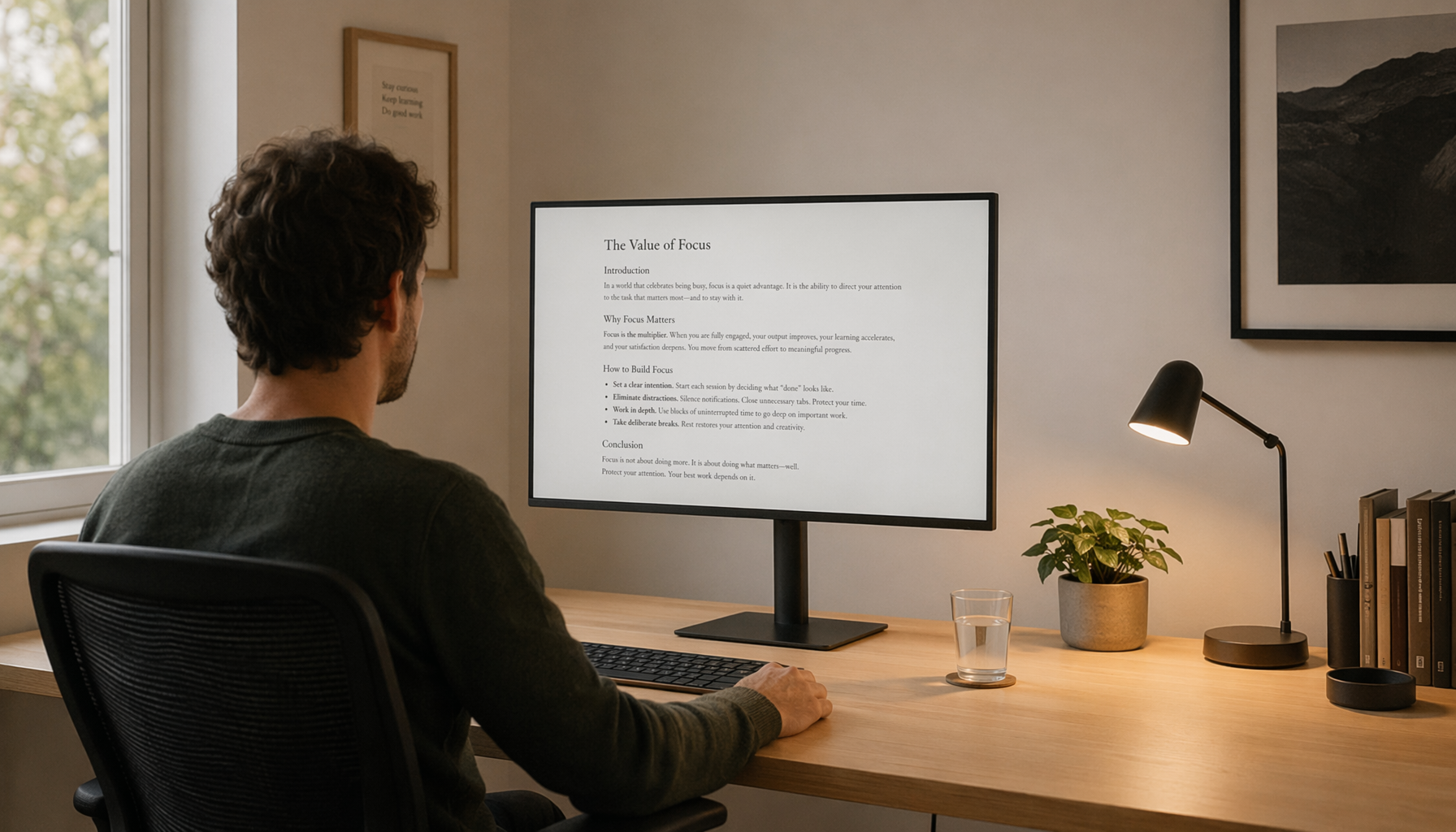
For long sessions, ergonomics should guide the final choice. Keep the primary screen in front of you, place the secondary at a slight inward angle, and avoid forcing your neck to rotate repeatedly. Monitor guidance often centers on a neutral posture where the user can see the full screen without constant head movement, with the display around arm’s length away.
Pros and Cons of Common Fixes
Fix |
Best For |
Pros |
Cons |
Dragging monitor rectangles in display settings |
Most stuck-cursor cases |
Fast, free, reversible |
Requires careful testing at multiple edges |
Physically raising or lowering one screen |
Mismatched stands or bezels |
Improves cursor travel and ergonomics |
May need a riser or monitor arm |
Matching resolution and scaling |
Mixed-size displays |
Makes windows and text feel more consistent |
Cannot fully erase pixel-density differences |
Moving cursor away from corners before crossing |
Edge resistance |
No setup changes needed |
Feels less precise for power users |
Buying matched monitors |
New multi-display builds |
Smoothest alignment and visual consistency |
Higher cost than adjusting current gear |
When to Consider a Utility or GPU Control Panel
If display settings are correct but the cursor still behaves poorly in a complex three-monitor or five-monitor layout, a dedicated display-management tool may help. Utilities can offer finer control over monitor boundaries, hotkeys, saved profiles, and cursor behavior. GPU control panels can also expose positioning or scaling options that matter when a display reports unusual dimensions.
Use this route only after the basics are clean. If the monitors are not touching in display settings, a utility is solving the wrong problem. If the desk height is uncomfortable, software cannot fix the strain. The most reliable sequence is physical alignment, virtual arrangement, native resolution, scaling, then advanced tools.
For portable monitors, the same rules apply. A 15.6-inch travel display beside a laptop can be excellent for documents, chat, or calendar work, but its virtual position must match its real position. Portable external monitors can preserve a two-screen workflow away from the desk, and that kind of multiple-monitor workstation still depends on clean arrangement.
Quick Diagnostic: What Your Symptom Means
Symptom |
Likely Cause |
Best First Fix |
Cursor crosses in the middle but not at the top |
Virtual top edges are misaligned |
Raise or lower rectangles in display settings |
Cursor sticks only moving left to right |
One-way layout mismatch |
Recheck monitor order and edge overlap |
Cursor sticks at the same corner both ways |
Edge resistance |
Cross slightly away from the corner |
Window jumps vertically between screens |
Physical or virtual active areas do not match |
Align active pixels, then match the software layout |
Cursor will not cross between two specific screens in a triple setup |
The two rectangles may not touch |
Drag those displays directly side by side |
FAQ
Should I align the top edge, bottom edge, or center of mismatched monitors?
Align the edge you use most. For coding, writing, browsing, and office work, top-edge alignment usually feels clean because tabs, menus, and document headers stay predictable. For mixed-size displays used equally, center alignment may reduce visual jumps. For immersive gaming or simulation, align the in-game horizon or active pixel area.
Do different refresh rates cause the cursor to get stuck?
Different refresh rates can make motion feel inconsistent, but cursor blockage is usually caused by virtual layout, scaling, or edge behavior. A 144 Hz gaming monitor beside a 60 Hz office display may feel uneven, but the cursor should still cross if the display rectangles touch correctly.
Why does the cursor get stuck even when the monitors look perfectly aligned?
The visible desk setup and the virtual layout may not match at the pixel level. Thick bezels, different resolutions, scaling, and monitor reporting can make two screens look aligned while their virtual rectangles are offset. Test by dragging a window across the seam and adjusting the display diagram until the movement feels natural.
A smooth multi-monitor setup is built twice: once on the desk and once in software. Align the active pixels, mirror that arrangement in display settings, and tune around your actual workflow so the cursor disappears as a problem and the screens feel like one high-performance workspace.