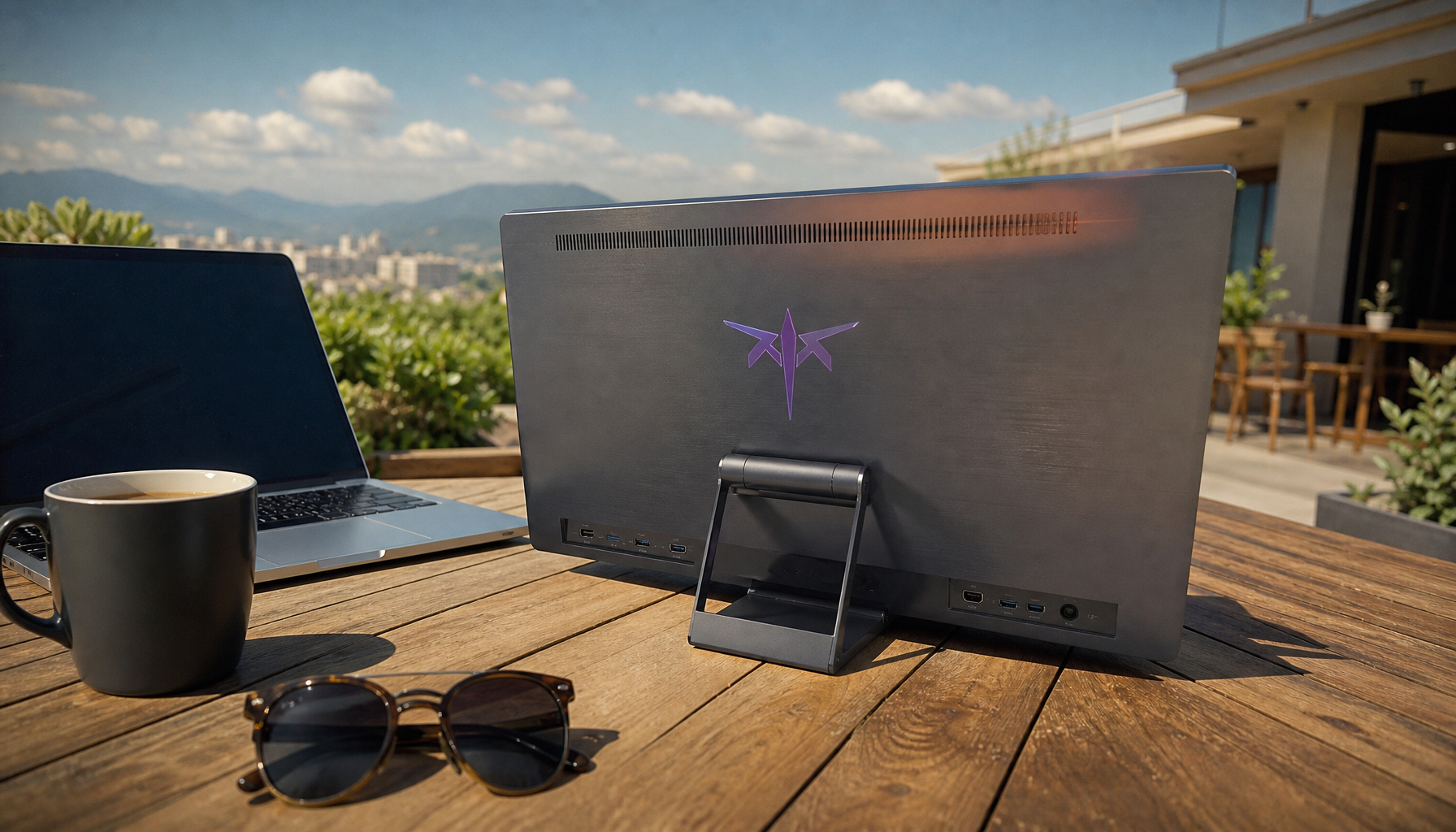
A USB-C port supports DisplayPort Alt Mode only if the device maker wired that port for video output and confirms it in the specs, marks it with a display-related icon, or it works in a direct monitor test with a video-capable cable.
Plugged your laptop into a sharp 4K monitor and got charging, but no picture? A five-minute check of the port label, product specs, and cable rating can prevent buying the wrong adapter or blaming a perfectly good display. Here is how to confirm whether your USB-C port can drive a monitor, projector, dock, or portable smart screen.
USB-C Is the Shape, Not the Promise
The most common mistake is treating every USB-C port as a full-featured display port. It is not. USB-C is a 24-pin reversible connector, while video support depends on the device, port wiring, cable, and display accessory.
DisplayPort Alt Mode is the feature that lets a USB-C connector carry DisplayPort audio and video. The DisplayPort standards group describes DisplayPort over USB-C as a way to send display signals through the USB Type-C connector, often alongside power and data when the whole setup supports it.
For a real workstation example, a laptop may have two USB-C ports that look identical. One may support charging and file transfer only, while the other supports charging, data, and external display output. That difference matters when you are trying to run a 27-inch office monitor, a high-refresh gaming panel, or a portable screen from one clean cable.
The Fastest Clues: Icons Near the Port

Port markings are useful, but not universal. A DisplayPort-style “DP” mark or D-shaped display icon near a USB-C port is the clearest visual clue. A lightning bolt usually points to Thunderbolt, which commonly includes display output support. Technical guidance on USB-C video capabilities notes that Thunderbolt and USB-C DisplayPort Alt Mode are common native video technologies for laptops.
A battery symbol is different. It usually signals charging, not display output. A plain USB trident icon may indicate data, but it does not prove video support. If there is no icon, do not assume failure; many thin laptops omit useful markings and leave the answer in the technical spec sheet.
Here is the practical rule I use when setting up displays: icons are quick evidence, documentation is stronger evidence, and a direct monitor test is the final proof.
Clue near USB-C port |
What it usually suggests |
Confidence |
DP or display icon |
DisplayPort Alt Mode video output |
High |
Lightning bolt |
Thunderbolt, usually with display support |
High |
Battery icon |
Charging support, not necessarily video |
Low for video |
No icon |
Unknown; check specs or test |
Unknown |
Check the Manufacturer Specs Before Buying Anything
The cleanest way to verify support is to search your exact laptop, tablet, mini PC, or phone model page for “DisplayPort Alt Mode,” “DisplayPort over USB-C,” “USB-C video output,” “Thunderbolt,” or “USB4.” The key buying point is clear in this USB-C explanation: manufacturers must connect the USB-C port to graphics hardware for video output to work.
Do not stop at a store listing that says “USB-C.” Look for the port section in the official specification sheet. A trustworthy listing might say “USB-C 3.2 Gen 2 with DisplayPort 1.4 and Power Delivery” or “Thunderbolt 4 with DisplayPort support.” A weaker listing might say only “USB-C 2.0” or “USB-C charging,” which is not enough for a monitor.
For an office display setup, this step saves money. If the laptop lacks DP Alt Mode, a USB-C to HDMI cable will not magically create a video signal. You would need a native HDMI port, a compatible dock, or a software-driven USB graphics adapter, which usually requires drivers and is better for productivity than competitive gaming.
Confirm the Cable Is Built for Video

Even when the port supports DP Alt Mode, the wrong cable can give you a black screen. Many charging cables, including some bundled with phones and laptops, are designed mainly for power and basic USB 2.0 data. USB-C cable specs can vary sharply, including video support, data rate, shielding, internal wiring, and certification.
A strong monitor cable listing should explicitly mention DisplayPort Alt Mode, USB-C video, USB-C to DisplayPort, USB4, or Thunderbolt 3/4. A 100 W charging claim alone does not prove video support. Power and display capability are separate features.
For practical buying, match the cable to the display target. A 1080p portable screen is relatively forgiving. A 4K 60 Hz productivity monitor needs a cable that states 4K 60 Hz support. A 1440p high-refresh gaming monitor or 4K high-refresh panel deserves USB4, Thunderbolt, or a clearly rated USB-C to DisplayPort cable with the required resolution and refresh rate in writing.
Use a Direct Hardware Test

The most reliable real-world test is simple: connect the device directly to a known working USB-C monitor or to a DisplayPort monitor using a proven USB-C to DisplayPort cable. Advice on USB-C ports used for displays emphasizes that the port, cable, and connected device all need the required video features.
If the monitor wakes up, shows the desktop, and appears in display settings, your port supports video output. If the laptop charges but the screen stays black, swap only one variable at a time. Try a different video-rated cable, another USB-C port on the same device, and another display. This avoids misdiagnosing a cable problem as a laptop limitation.
On Windows, open Display Settings and use Detect after connecting the monitor. Also check the graphics utility from your GPU vendor if your laptop uses one. On macOS, check Displays in System Settings. If nothing appears and the same cable works with another computer, your device port may not support DP Alt Mode.
Thunderbolt and USB4 Usually Make Life Easier
Thunderbolt and USB4 are not the same thing as ordinary USB-C, but they often reduce uncertainty for display users. Thunderbolt-capable USB-C ports commonly support demanding monitor setups, including multiple 4K displays depending on generation and device implementation.
USB4 is also a strong clue because it uses USB-C and can carry DisplayPort traffic through its architecture. Still, the final capability depends on the host, cable, dock, and monitor. For a high-performance desk with a gaming monitor, webcam, Ethernet, external SSD, and laptop charging through one dock, USB4 or Thunderbolt certification is often worth paying for because it reduces compatibility guesswork.
The tradeoff is cost. A basic DP Alt Mode cable can be the value pick for a single 4K 60 Hz display. A certified Thunderbolt or USB4 cable is the more reliable choice for premium portable smart screens, docking stations, and high-refresh display chains.
What If Your USB-C Port Does Not Support DP Alt Mode?

If your USB-C port is charge-only or data-only, a passive USB-C to HDMI or USB-C to DisplayPort adapter will not work. USB-C display output requires DP Alt Mode or equivalent video support, so the adapter cannot invent a signal the port never sends.
Your alternatives are still workable. Use the laptop’s HDMI or DisplayPort output if it has one. For office productivity, consider a software-based USB graphics adapter, understanding that it depends on software and is not ideal for latency-sensitive gaming. For conference rooms or lightweight screen sharing, wireless display hardware may be acceptable, though it will not match the responsiveness of a native cable connection.
Quick FAQ
Can every USB-C port connect to a monitor?
No. USB-C only describes the connector. The port must support DisplayPort Alt Mode, Thunderbolt, USB4 video, or another supported display path.
Does a USB-C charging cable support video?
Not necessarily. A cable can support high-wattage charging and still lack the wiring or certification needed for monitor output.
Is Thunderbolt the same as DisplayPort Alt Mode?
No. Thunderbolt uses the USB-C connector on modern devices and can carry display signals, but it is a broader high-bandwidth technology. DisplayPort Alt Mode is specifically about sending DisplayPort video through USB-C.
Will USB-A to USB-C make an old port support video?
No. Changing the connector shape does not add native display output. For USB-A, you need a software-based display adapter, and performance depends on the adapter and driver.
Final Word
For a reliable display setup, verify the port first, the cable second, and the monitor mode third. When the spec sheet says DisplayPort Alt Mode, Thunderbolt, USB4, or USB-C video output, and the cable states the resolution and refresh rate you need, USB-C becomes the clean one-cable display experience it was meant to be.