When your calendar will not give you fewer screen hours, the best defense is to control brightness, glare, focus distance, blink rate, display placement, and recovery breaks inside the schedule you already have.
Do your eyes feel dry by 2:00 PM, then turn into a headache by the last video call? Research on digital eye strain shows that continuous screen use can trigger symptoms in about two hours, while practical workstation changes can reduce the load without requiring a lighter workday. Here is a realistic screen-first system for staying sharper, more comfortable, and less visually drained when long hours are nonnegotiable.
Why Eye Fatigue Hits Hard When Your Schedule Is Fixed
Digital eye fatigue is not just “tired eyes.” Digital eye strain includes dry eyes, burning, watering, blurred vision, glare sensitivity, headaches, and neck or shoulder discomfort caused by prolonged use of computers, tablets, phones, and e-readers. The mechanism is practical: your eyes blink less, your focusing system works continuously at near range, and your workstation may add glare, reflections, or awkward posture.
In display testing and workstation setup, the fastest comfort wins usually come from basic controls: lower brightness, cleaner lighting, better viewing distance, and text that does not make you lean forward. A premium monitor can help, but a poorly placed premium monitor still punishes your eyes.
Many professionals cannot simply “take fewer meetings” or “stop using screens.” Accountants, analysts, designers, developers, radiologists, gamers who stream after work, and remote teams often live inside dense visual workflows. The goal is not to escape screens. The goal is to make every screen minute less expensive for your eyes.
Start With Brightness Before You Blame Blue Light

Screen brightness is the first setting to fix because it directly affects visual load. A common mistake is running a monitor at factory brightness in a normal office or home office. That can look vivid in a showroom but feel harsh after six hours of spreadsheets, code, or customer dashboards.
A practical test is simple: open a mostly white document and hold a piece of white paper beside the screen under your normal room lighting. If the screen looks like a light source instead of a work surface, reduce brightness. Office-focused guidance commonly lands around 120 to 150 cd/m² for standard office conditions. You do not need a meter to start; you need the screen to stop glowing aggressively against the room.
The blue-light conversation is more nuanced. Blue-heavy evening light can affect circadian timing because blue-sensitive retinal cells help regulate sleep signals, especially at night. That matters if you work late and then struggle to fall asleep. But during daytime office work, brightness, glare, blink rate, viewing distance, and font size often matter more for immediate eye fatigue than blue light alone.
The Pros and Cons of Blue-Light Modes
Low-blue-light modes are useful when you are reading, writing, reviewing PDFs, or working after sunset. They make the image warmer and may reduce the intensity of short-wavelength light that can interfere with sleep timing. The tradeoff is color accuracy. If you edit photos, grade video, design brand assets, or review product visuals, aggressive warm filters can distort judgment.
Hardware-based eye-care modes can be cleaner than heavy software filters because they may preserve a more usable image while reducing harsh output. Monitor eye-care features such as ambient brightness adjustment, low-blue-light modes, and flicker-free backlights are most valuable when they support your workflow instead of masking a bad setup. During the day, keep blue-light reduction mild or off for color-sensitive work. In the evening, increase warmth and lower brightness together.
Build Microbreaks Into Work You Cannot Pause

The 20-20-20 rule works because it interrupts continuous near focus: every 20 minutes, look at something 20 ft away for 20 seconds. The problem is that rigid rules fail during calls, queue work, trading sessions, gaming scrims, or deadline sprints. Attach the break to workflow transitions instead of perfect timing.
After sending a long email, look across the room before opening the next thread. After a spreadsheet calculation runs, soften your gaze out a window. Between meeting agenda items, look past the camera rather than at the participant grid. During a game queue, loading screen, or replay review, stop scanning the UI and focus on a distant object.
The science supports the habit. Digital eye strain research notes that blink rate can drop sharply during computer use, with studies reporting large reductions that contribute to tear-film instability and dry-eye symptoms. A 20-second distance break is not just rest; it resets focusing demand and gives you a cue to blink fully.
Add a Blink Reset
A strong display setup still fails if your eyes dry out. During high-focus work, people often stare without noticing. Use a blink reset whenever your screen changes context: close your eyes gently for one full second, open, then blink normally several times. Do not squeeze hard. The goal is to spread the tear film, not create pressure.
If your eyes burn late in the day, check environmental causes too. Direct airflow from a fan, vent, or heater can worsen dryness. In smoky or dusty conditions, eye irritation may include burning, redness, watering, dryness, or a gritty feeling, and preservative-free artificial tears can help rinse and lubricate irritated eyes. Persistent pain, vision changes, or symptoms that do not improve deserve professional eye care.
Fix Distance, Height, and Glare Like a Performance Setup

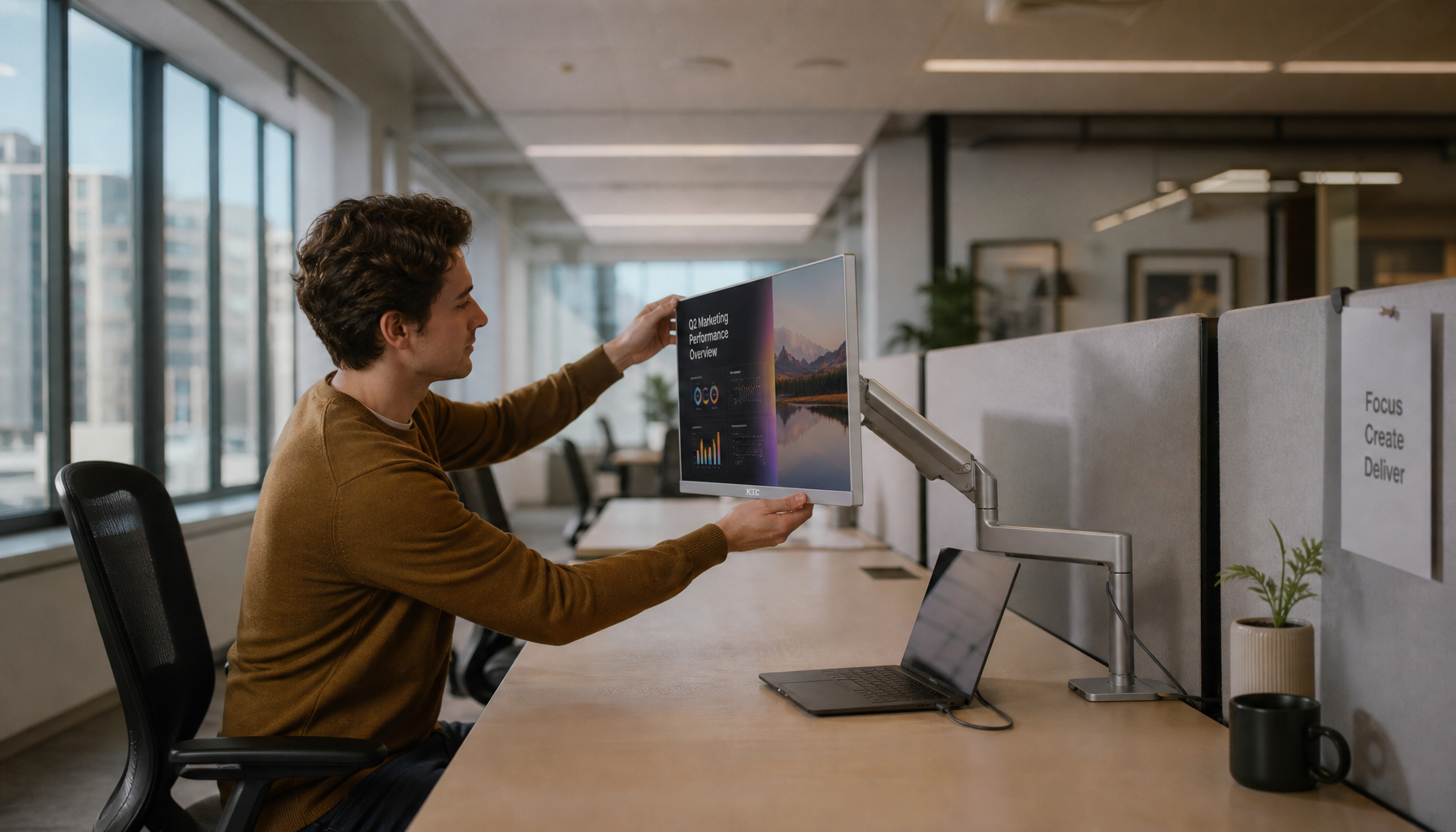
A monitor should sit about an arm’s length away for most office work, commonly around 20 to 28 inches depending on screen size, resolution, and vision correction. The top of the display should be at or slightly below eye level, so your gaze angles slightly downward. That angle helps reduce exposed eye surface and discourages the forward-head posture that turns eye fatigue into neck and shoulder fatigue.
For a 27-inch QHD monitor, many users can read comfortably at arm’s length with modest text scaling. A 32-inch 4K screen may need a deeper desk or monitor arm so the edges do not force constant refocusing and head movement. A portable screen should not sit flat beside a laptop like a tablet on a table; raise it with a stand so your eyes move horizontally, not down into your lap.
Glare is the silent performance killer. Office eye protection recommendations commonly include placing windows to the side of the monitor rather than directly in front of or behind it, reducing harsh indoor light, and using anti-glare surfaces when needed. A simple real-world check: turn off the monitor and look at the black screen. If you see a window, lamp, or bright wall reflected back at you, your eyes are fighting glare all day.
Choose Display Hardware That Reduces Visual Friction

If you can upgrade hardware, prioritize comfort features that solve actual causes of fatigue. A matte anti-glare panel helps in bright rooms. A height-adjustable stand matters more than a flashy spec sheet if your current monitor forces poor posture. Flicker-free backlighting or DC dimming can help users who are sensitive to pulse-width modulation. Higher resolution improves text clarity, especially for coding, finance, editing timelines, research, and dense office dashboards.
A dual-monitor setup can either reduce strain or increase it. Multiple monitors improve productivity mainly by keeping reference material visible and reducing window switching, which is useful for developers, analysts, designers, and healthcare workflows. But the comfort rule is strict: put your primary work directly in front of you, match brightness across screens, and keep secondary displays close enough that you are not repeatedly twisting your neck.
Setup Choice |
Best Use |
Comfort Advantage |
Tradeoff |
27-inch QHD |
Office work, coding, research |
Sharp text with manageable scaling |
Less workspace than 4K |
32-inch 4K |
Dashboards, spreadsheets, creative tools |
More visible information at once |
Needs more viewing distance |
Dual monitors |
Reference-heavy workflows |
Less window switching |
Can cause neck turning if poorly placed |
Portable screen |
Travel, laptop productivity |
Adds workspace anywhere |
Needs a stand for eye-level use |
Curved large display |
Immersive work and gaming |
More uniform viewing distance |
Less ideal for precision straight-line design |
Manage Dark Mode, Fonts, and Contrast
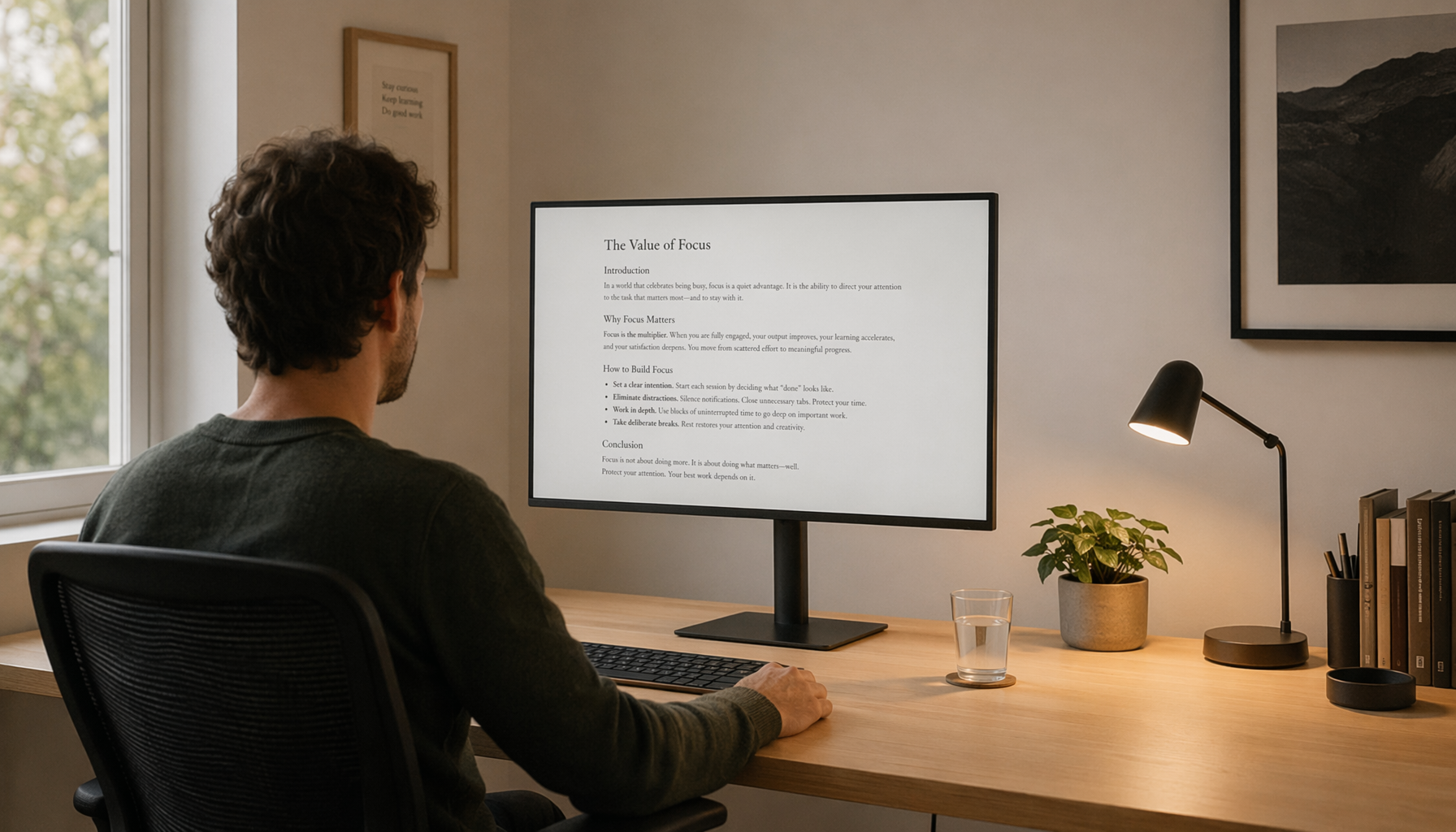
Dark mode is not automatically easier on the eyes. In a dim room, it can reduce glare and feel calmer. In a bright office, light text on a dark background can bloom or feel less crisp, especially for long reading. The more reliable rule is contrast comfort: text should be clear without making white backgrounds feel like a flashlight.
Use at least 12-point text for documents and interfaces when possible, and increase browser zoom instead of leaning forward. Set contrast high enough for clean edges but not so high that white panels feel harsh. If your job involves switching between a laptop, desktop monitor, and phone, align their brightness levels; jumping from a dim laptop to a bright external monitor forces repeated adaptation.
For late work, dim the room slightly but do not work in darkness. A monitor light bar or indirect desk lamp can illuminate your desk without reflecting on the panel. This is especially useful for programmers, writers, and analysts who need keyboard visibility without overhead glare.
When Schedule Control Is Impossible, Control the Recovery Window

If you cannot control work hours, protect the hour after work. Nighttime screen exposure can make sleep harder for some people, especially when brightness stays high. Lower brightness, use warmer display modes, and avoid bright white room lighting before bed. This is not about fear of screens; it is about preserving next-day performance.
Recovery also includes hydration, sleep consistency, and vision correction. If you wear glasses or contacts, your regular prescription may not be optimized for screen distance. Computer vision symptoms can persist when home ergonomics, dry eye, or uncorrected refractive errors add strain during long near-focus tasks. If symptoms last for weeks despite better setup, or if you have pain, double vision, new blur, or headaches that affect work, schedule an eye exam and tell the provider your actual screen distance.
A Practical Day Plan for Long Screen Shifts
Start the morning by matching screen brightness to the room before opening work apps. Put your main screen straight ahead, move the most-used window to the center, and increase text size before fatigue starts. During the day, use workflow-triggered distance breaks, blink resets, and glare checks when lighting changes. After sunset, lower brightness first, then add warmer color if you are not doing color-critical work. Before bed, let your eyes and sleep system exit performance mode.
Eye fatigue prevention is not one magic filter or one expensive monitor. It is a stack of small controls that make long screen hours less punishing: lower glare, correct brightness, stable posture, readable text, real blinking, and smarter display choices. When the schedule is fixed, the setup becomes the advantage.