Build breaks into the calendar before your monitor setup starts working against you: use 20-second eye resets during calls, 1- to 5-minute recovery blocks between calls, and a 15-minute screen break after about 2 hours of continuous display time.
Ever leave a string of video calls with dry eyes, a tight neck, and the odd feeling that your monitor is still “pulling” your attention after the meeting ends? For people working on large monitors, ultrawides, gaming displays, or portable second screens, the fix is usually not one dramatic change; it is a repeatable break structure paired with sane display settings. This guide shows how to plan those breaks around real calendar gaps, monitor brightness, screen placement, and call layouts.
Why Back-to-Back Video Calls Are Harder Than Normal Screen Work
Video calls create a different kind of screen load than writing, browsing, or gaming because they combine close focus, social attention, webcam awareness, and limited movement. Research on video-call fatigue describes symptoms such as sore eyes, exhaustion, stress before calls, body stiffness, and the mental strain of interpreting verbal and nonverbal cues through a screen. On a large monitor, those effects can feel amplified because faces may appear much larger than they would across a conference table.
The eye-strain side is also concrete. Digital eye strain can show up as irritated eyes, blurry vision, light sensitivity, headaches, and neck or shoulder soreness after prolonged computer use. A medical organization notes that looking at screens can reduce blinking to about 3 to 7 times per minute, which is far lower than normal and can make dry-eye symptoms worse during long call blocks.
The Monitor-Specific Problem
A 27-inch monitor, 32-inch 4K display, or 34-inch ultrawide is excellent for productivity, but it can encourage a fixed gaze. If your video-call window is full screen, your eyes may stay locked at one distance while your face is lit by a bright panel for 30 to 60 minutes at a time. A news organization’s summary of eye-strain guidance notes that prolonged close screen focus keeps the eye’s focusing muscle engaged for long periods and that a better desk setup can reduce discomfort.
The goal is not to avoid good displays. It is to stop using them in the most fatiguing way: oversized call windows, maximum brightness, constant self-view, no distance changes, and no transition time between meetings.
Use a Break Structure That Matches the Gap You Actually Have
The best screen break is the one that fits the calendar gap in front of you. A 10-minute walk is useful, but it is not realistic when your next call starts in 90 seconds. For monitor-heavy workdays, plan a ladder of breaks: quick eye-distance changes during calls, short resets between calls, and longer off-screen recovery after a block of meetings.

The 20-20-20 rule is the baseline: every 20 minutes, look at something about 20 ft away for about 20 seconds. Both an eye-care association and a medical organization recommend this kind of distance-change break for digital eye strain. For back-to-back calls, that means you should not wait for the meeting to end; you can look across the room while listening, especially when you are not presenting.
Break Options by Available Time
Available gap |
What to do |
Monitor/display action |
Best use case |
20-30 seconds |
Look 20 ft away, blink deliberately, relax your jaw and shoulders |
Keep the call open but look away from the panel |
During long calls when you cannot leave |
1 minute |
Stand, remove headset, look out a window or across the room |
Turn off self-view or minimize the video window |
Between 25- or 30-minute calls |
2-3 minutes |
Walk away from the desk, drink water, stretch upper back |
Let the monitor sleep or dim brightness |
Between calls where you only have a small buffer |
5 minutes |
Do a no-screen task: refill water, quick notes on paper, room reset |
Switch from full-screen video to a smaller window before the next call |
After two or three consecutive meetings |
10-15 minutes |
Leave the desk, move around, avoid checking your cell phone |
Turn off the display or use a blank screen |
After about 2 hours of continuous screen time |
The 25/50-Minute Meeting Rule
When you control the invite, schedule 25-minute meetings instead of 30 and 50-minute meetings instead of 60. A business publication’s guidance on video-call fatigue recommends shorter meeting blocks so people have time to stand up and move between sessions. That small calendar change is especially useful if you use a large external monitor because your recovery window needs to include both eye distance and posture change.
For a typical morning block, a practical rhythm might look like this: 9:00 AM to 9:25 AM call, 1-minute eye and headset reset, 9:30 AM to 10:20 AM call, 5-minute walk away from the monitor, then a short non-video task before the next camera-on meeting. The point is to build recovery into the meeting format, not rely on willpower when the next invite starts.
Tune Your Monitor Setup Before the Call Block Starts
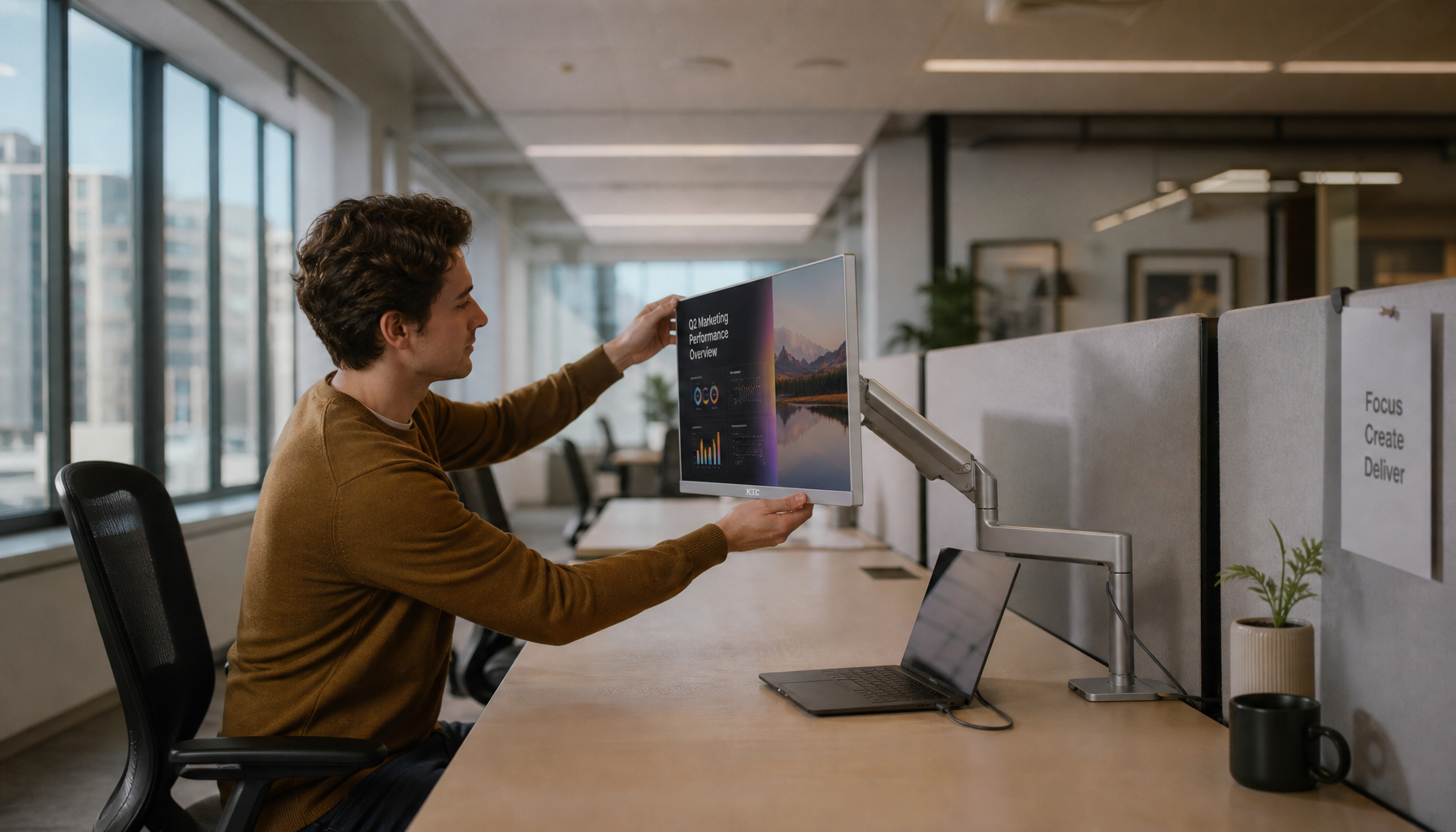
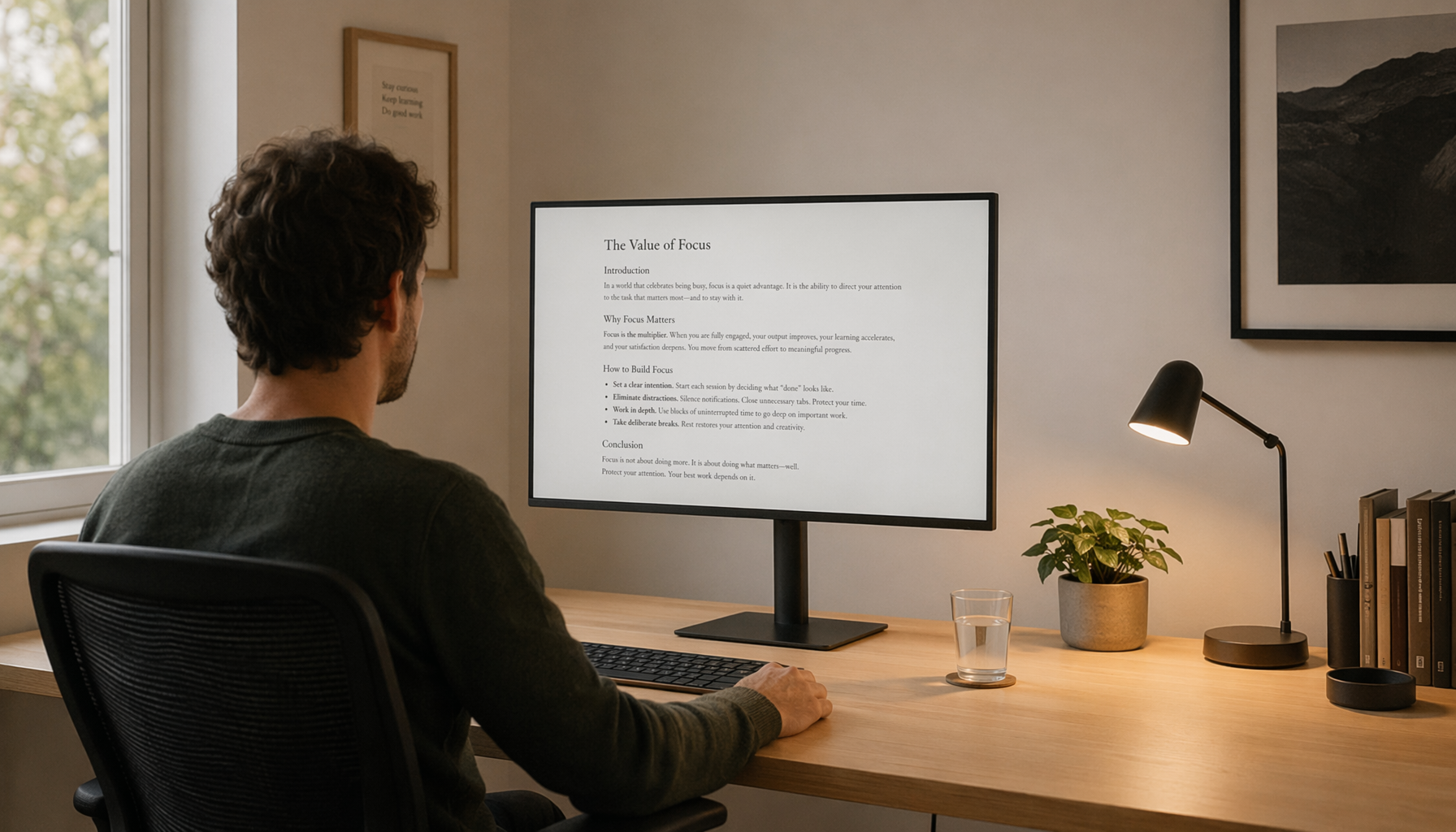
Screen breaks work better when your display is not creating extra strain in the first place. The monitor should sit roughly an arm’s length away, with your eyes looking slightly downward rather than up. Guidance summarized by a news organization recommends using a larger monitor where helpful, increasing font size, sitting about an arm’s length from the screen, and looking slightly downward to reduce strain.

Brightness deserves special attention during video calls because the monitor is also a light source on your face. A bright white document or meeting window can wash out your face, fight your desk lamp, and push the webcam’s auto exposure in the wrong direction. For professional calls, a practical display baseline is standard or sRGB mode, moderate brightness, no HDR, and a neutral white point; a brand’s video-call settings guidance suggests avoiding vivid, gaming, cinema, and HDR modes for monitor color settings.
A Call Preset for Most Monitors
Create a “video call” preset if your monitor allows custom profiles. Start with 40% to 60% brightness in a normally lit room, standard or sRGB color mode, gamma 2.2 if available, and a neutral white point. If your display lists luminance targets, 120 nits is a reasonable baseline for controlled office lighting, though you may need lower brightness in a dim apartment office or higher brightness near daylight.

Avoid using your gaming preset for calls. High contrast, boosted saturation, sharpness enhancements, and HDR can make games look punchy but can make white backgrounds feel harsh and skin tones look unnatural on camera. If you use a high-refresh-rate gaming monitor for work, keep the refresh rate you find visually comfortable, but treat brightness, glare, window size, and breaks as the bigger fatigue levers.
Arrange Large, Ultrawide, and Portable Displays for Recovery
Large monitors are not automatically worse for video-call fatigue. They become a problem when every meeting fills the entire panel. On a 32-inch display, a full-screen grid of faces can create constant gaze pressure; on a 34-inch ultrawide, a meeting app stretched edge to edge can force unnecessary eye travel. Keep the active speaker or shared content centered, and use the rest of the screen for notes only when needed.

The review literature on digital eye strain groups symptoms into eye-surface problems, focusing problems, and musculoskeletal discomfort. That matters for display choice: an ultrawide can reduce window switching, but it can also invite a fixed neck position if the call window sits on one side all day. A portable monitor can be useful for notes, but placing it too low or too far off-axis can create repeated neck rotation.
Display Layout Rules That Reduce Call Fatigue
Use the primary monitor for the call and keep it directly in front of you. If you use an ultrawide, set the video window to the center third or center half rather than full width. If you use a laptop plus external monitor, do not place the laptop camera far below your eye line and then stare downward for every meeting; either raise the laptop or use an external webcam near the top center of the main monitor.
For portable monitors, treat the second display as a temporary utility screen, not the main call surface. Put chat, agenda notes, or a reference document there, but move it close enough that you are not twisting your head repeatedly. If glare is present, place screens sideways to windows and balance desk lighting near the monitor brightness; a brand’s office monitor guidance recommends monitor distance around 20 to 26 inches and lighting changes to reduce digital eye strain.
Build Breaks Into the Meeting Workflow
The easiest screen-break system is one that does not require you to remember much. Put 25- and 50-minute defaults in your calendar app, add a 20-minute recurring eye-reset reminder if your calls often run long, and create a monitor preset you can switch on before client or team meetings. If you regularly host calls, make camera-off moments normal during long sessions, especially when people are listening rather than presenting.
Multitasking is not a good substitute for a break. A business publication notes that task switching can cost up to 40% of productive time, and video calls already require more focus than many people expect. Checking email on a second monitor while pretending to listen keeps your eyes on screens, splits your attention, and usually leaves you more tired.
A Realistic Back-to-Back Call Template
For a 3-hour call-heavy block, try this structure:
- 9:00 AM call: use gallery view only when needed; hide self-view after checking framing.
- 9:20 AM: look 20 ft away for 20 seconds while listening.
- 9:25 AM: end a 25-minute call, stand, remove headset, drink water.
- 9:30 AM call: keep the video window centered, not full-screen on an ultrawide.
- 10:20 AM: end a 50-minute call, walk away from the monitor for 5 minutes.
- 10:30 AM call: lower brightness if the room has dimmed or the screen is lighting your face.
- 11:00 AM: take a longer off-screen break before starting deep work.
That pattern keeps the calendar productive while giving your eyes multiple distance changes, your body several posture resets, and your display fewer chances to dominate the room.
Practical Next Steps
Start with the smallest changes that remove the most strain: shorter meeting defaults, a monitor preset, and a repeatable between-call routine. A medical organization recommends a 15-minute break every 2 hours of screen use, while an eye-care association also highlights 20-second distance breaks every 20 minutes and eye rest after 2 hours of continuous computer use. Those recommendations are simple enough to turn into calendar rules.
Screen-Break Checklist
- Set default meeting lengths to 25 or 50 minutes when you control the invite.
- During calls, look at something about 20 ft away for 20 seconds every 20 minutes.
- Between calls, remove your headset and stand up, even if you only have 1 minute.
- Keep the video window centered and smaller than full screen on large or ultrawide monitors.
- Use a call preset: standard or sRGB mode, moderate brightness, no HDR, no vivid mode.
- Place the monitor about an arm’s length away, with the top of the screen at or slightly below eye level.
- After roughly 2 hours of continuous screen time, take a 10- to 15-minute off-screen break.
The main test is simple: after one week, your eyes should feel less dry at the end of the day, your neck should feel less locked after call blocks, and your monitor should feel like a tool rather than a bright surface demanding constant attention.
FAQ
Q: What should I do if I only have 30 seconds between video calls?
A: Look away from the monitor toward something about 20 ft away, blink slowly several times, stand if possible, and remove your headset. Do not use that short gap to check another screen; your eyes need a distance change more than another notification.
Q: Are high-refresh-rate monitors better for video-call fatigue?
A: A higher refresh rate can make cursor movement and scrolling feel smoother, which some people find more comfortable. For video-call fatigue, however, the bigger factors are brightness, glare, viewing distance, window size, posture, blinking, and whether you take breaks.
Q: Is an ultrawide monitor a good choice for back-to-back calls?
A: It can be, as long as you do not run every call full screen. Keep the meeting window centered, place notes beside it only when needed, and avoid keeping chat, email, and dashboards open across the entire panel during camera-on meetings.
References
- Zoom Fatigue and How to Prevent It
- Computer Vision Syndrome: What It Is
- Screen Breaks and the Right Desk Setup Offer Relief From Work-Related Eye Strain
- Computer Vision Syndrome
- Monitor Color Settings for Professional Video Calls
- Digital Eye Strain: A Comprehensive Review
- How to Combat Zoom Fatigue
- Best Office Monitor for Eye Strain That Boosts Productivity