Yes, you can mix refresh rates across a multi-monitor setup, and for most productivity and gaming desks, it works well. The experience depends on your operating system, graphics driver, display mode, cables, and which screen is set as primary.
Does your 240Hz game feel sharp until a 60Hz side screen starts playing video, chat, or a browser animation? In real-world mixed setups, users have reported smooth pairings such as 240Hz plus 144Hz, while specialist testing still finds edge cases where secondary-screen motion can stutter. Here is how to build the setup so your fastest display stays fast and your support screens stay useful.
What Refresh Rate Mixing Actually Means
Refresh rate is how many times per second a monitor updates its image, measured in hertz. A 60Hz office display refreshes 60 times per second, while a 144Hz, 240Hz, or 360Hz gaming monitor can update far more often, making motion look smoother and reducing the delay between input and visible response.
A mixed-refresh setup simply means one PC is driving displays with different refresh rates. A common example is a 27-inch 1440p 240Hz gaming monitor in the center, paired with a 60Hz or 75Hz secondary display for chat, streaming controls, spreadsheets, documentation, or video. Modern desktop operating systems can support different display settings per monitor, and a multi-monitor desktop is designed to extend usable workspace across screens rather than force every panel to behave identically.
The practical benefit is obvious: you do not need to replace a perfectly useful side monitor just because your primary display is faster. That matters because high-refresh matched pairs can become expensive quickly. Gaming discussions often describe buyers weighing roughly $900 premium 240Hz monitors against roughly $300 144Hz alternatives, which is a major cost gap if the second screen is mostly for reference apps.
The Short Answer: It Usually Works, But Not Always Perfectly
For office work, mixed refresh rates are usually a non-issue. You can run a 144Hz primary monitor for fluid scrolling and a 60Hz secondary screen for email or documents without meaningful trouble. Multi-monitor productivity gains come from keeping related information visible, and multiple monitors improve productivity by reducing app switching and keeping reference material in view.
For gaming, streaming, and high-motion workloads, the answer becomes more conditional. The main risk is not that every monitor is permanently “locked” to the slowest refresh rate. The real risk is uneven frame pacing, dropped frames on a secondary video window, or a game behaving as if the wrong monitor’s timing is in charge.
This is why two users can report opposite experiences. One person may run 240Hz plus 144Hz without trouble, while another sees stutter with a 120Hz main screen and 60Hz side displays. The difference can come from operating system build, graphics driver, fullscreen mode, hardware-accelerated GPU scheduling, browser video playback, variable refresh rate behavior, or the app’s presentation mode.
Why Mixed Refresh Setups Can Stutter
Desktop Composition Can Be the Bottleneck
Modern desktop operating systems use a compositor to assemble what appears on the desktop. Mixed-refresh behavior improved after major updates in 2020, but specialist reports still show that some edge cases remain. A specialist forum analysis notes that multi-monitor behavior has improved, yet certain scenarios can still reproduce refresh-rate pacing problems.
The subtle part is that your mouse cursor may still look smooth while a browser window, video, or game capture on the side monitor drops frames. That is because the cursor can be handled separately from normal desktop composition. In practice, this can make the problem feel confusing: your hand movement feels fine, but the content underneath looks uneven.
A simple example is gaming on a high-refresh main monitor while a video plays on a 60Hz secondary screen. Some users may see the video drop frames when the game is active, especially with certain fullscreen, borderless, VSync, or variable refresh rate combinations. The game itself may still feel responsive, but the side content loses visual consistency.
Main Display Choice Matters More Than People Expect
The monitor set as the system’s main display can influence taskbar behavior, app defaults, and certain refresh-sensitive logic. For latency-sensitive gaming, the safest default is to set the fastest gaming monitor as the main display and run the game there.
This is especially important when using VSync, adaptive sync, or low-latency frame limiting. Testing notes suggest that low-latency frame limiting combined with adaptive sync and VSync can depend on the system’s main display, even when alternative presentation modes help the game avoid ordinary desktop composition limits. That is a narrow but decision-critical detail: if your competitive game feels capped or oddly paced on a side monitor, do not troubleshoot the entire desk first. Move the game to the main display, confirm the main display refresh rate, and retest.
Best Settings for a Reliable Mixed-Refresh Desk
Set Each Monitor to Its Native Resolution and Intended Refresh Rate
Start in your system display settings. Identify the monitors, drag them into the same physical arrangement you use on the desk, choose the extended desktop option, and set each panel to its native resolution and intended refresh rate. Correct display alignment prevents cursor jumps, dead zones, and awkward window movement, especially when resolutions differ.
If your center display is 2560x1440 at 240Hz and your side monitor is 1920x1080 at 60Hz, do not force them to match resolution. Keep each at native resolution, then adjust scaling so text and windows feel similar in physical size. This produces sharper text and makes cursor travel more predictable.
Use the Fastest Monitor as the Primary Gaming Display
For a gaming-first setup, place the high-refresh monitor directly in front of you, set it as the system’s main display, and use secondary screens for support roles. A practical layout would put the game on the 240Hz center screen, chat and streaming controls on a 60Hz or 75Hz side monitor, and hardware monitoring on a small portable display.

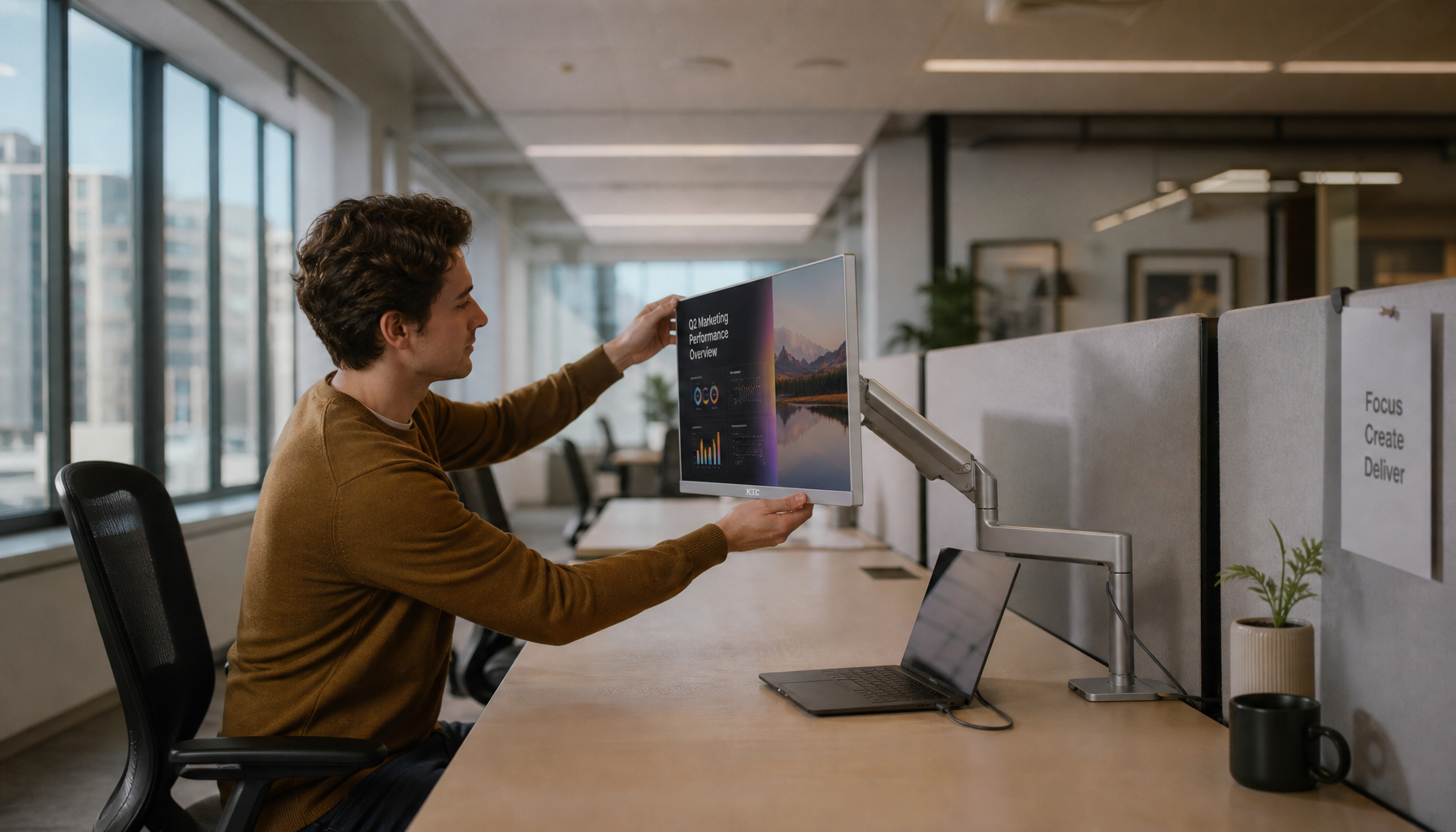
That layout also follows strong productivity ergonomics. A transition-focused multi-monitor setup should preserve the primary work position, with the main monitor centered and side displays assigned support tasks such as chat, dashboards, previews, and tools. A side monitor should reduce context switching, not become a second command center that constantly pulls your neck and attention away.
Prefer DisplayPort or High-Bandwidth HDMI for the Primary Screen
Your cable and port can limit what refresh rate is actually available. A modern gaming monitor may need DisplayPort or HDMI 2.1 to reach its advertised refresh rate at high resolution. Matching refresh rates can help avoid stuttering and inconsistent behavior, but the cable and connector still need enough bandwidth for the resolution and refresh rate you want.
A real-world comparison is useful here. A 4K 144Hz monitor pushes far more display data than a 1080p 60Hz side screen. If the high-refresh panel is routed through an old adapter, low-spec hub, or limited laptop port, the system may offer a lower refresh rate than the monitor supports. Put the performance display on the strongest direct connection first, then attach secondary monitors afterward.
Mixed Refresh Rates: Pros and Cons
Setup Choice |
Advantages |
Tradeoffs |
Mixed 240Hz plus 60Hz |
Saves money, keeps gaming smooth on the main screen, reuses existing displays |
Possible side-screen video stutter or uneven pacing in edge cases |
Matched dual 144Hz |
More consistent cursor feel and window movement, easier troubleshooting |
Higher cost if the second screen is only for static apps |
Matched dual 240Hz |
Maximum consistency for high-end gaming and motion testing |
Expensive and often unnecessary for chat, documents, or monitoring |
Ultrawide instead of dual monitors |
No bezel gap, simpler refresh behavior, immersive workspace |
Less flexible app separation and fewer independent screen roles |

When Matching Refresh Rates Is Worth Paying For
Matching refresh rates is most valuable when both displays handle motion-heavy tasks. If you edit high-frame-rate video on one screen while previewing on another, test games across displays, or regularly move active 3D windows between monitors, matched refresh rates reduce friction.
For most people, matching size and resolution matters more than matching refresh. Similar 27-inch 1440p monitors make text size, cursor movement, and window placement easier to manage. The right buying mindset is to pick the main screen for the task that demands performance, then choose support displays that make the workflow cleaner.
If your side screen mostly holds chat, music, email, a browser reference, or streaming controls, a 60Hz to 100Hz display is usually fine. If it holds fast video previews, live dashboards, or a second game, higher refresh becomes more valuable.
Troubleshooting Stutter in a Mixed-Refresh Setup
Start with the obvious checks. Confirm the high-refresh monitor is actually set to its rated refresh rate in your system display settings and graphics control panel. Make it the main display. Update your graphics driver. Test the game in exclusive fullscreen, borderless fullscreen, and windowed modes because each can use a different presentation path.
Then isolate the trigger. Play the game with the secondary monitor connected but empty. Add browser video, then chat, hardware monitoring, and capture software one at a time. If stutter appears only when a specific app is visible, the problem may be that app’s hardware acceleration or video playback path, not the monitors themselves.
If the issue only happens when gaming on a secondary display, move the game to the primary high-refresh monitor. Specialist testing suggests that alternative modes such as independent flip can allow each display to use its own refresh behavior, but relying on that is less predictable than putting refresh-sensitive games on the main screen.
Operating System Support Is Improving, But Hardware Still Matters
Recent operating system updates have expanded support for very high refresh displays, dynamic refresh rate, variable refresh rate, and lower-latency behavior for windowed and borderless games. However, OS support alone does not guarantee perfect operation because monitor firmware, graphics drivers, cable bandwidth, connector standards, and application support all have to align.
That staged reality is important. If your current setup works, do not chase updates just for the promise of better mixed-refresh behavior. If your setup stutters, updates are worth testing, but make one change at a time so you know what actually fixed it.
FAQ
Can a 60Hz Second Monitor Cap My 144Hz or 240Hz Gaming Monitor?
Usually, no. Your gaming monitor can still run at 144Hz or 240Hz while a second screen runs at 60Hz. The possible issue is frame pacing or composition behavior in specific app and display-mode combinations, not a universal hard cap.
Should I Buy Two Identical Monitors?
Buy identical monitors if you want the cleanest visual match, easiest calibration, and least troubleshooting. For value, a high-refresh primary monitor plus a less expensive secondary screen is often the smarter setup.
Is a Portable Monitor Okay as a Side Screen?
Yes, especially for travel, dashboards, chat, and reference material. Just expect many portable screens to run at 60Hz, which is fine for support tasks but not ideal for fast gaming.
Final Word
Mixing refresh rates is a practical, high-value way to build a stronger desk without overspending. Put the fastest screen in the center, make it the system’s main display, use the right cable, keep each monitor at native settings, and treat side displays as focused support surfaces. That gives you immersive speed where it matters and the extra workspace that makes a multi-monitor setup worth owning.