The 20-20-20 rule can give your eyes a useful pause, but lasting relief usually requires a better combination of monitor settings, display hardware, workstation ergonomics, and appropriate vision correction.
Do your eyes still feel dry, your head heavy, or your neck tight even though you regularly look away from the screen? A practical monitor adjustment can sometimes improve comfort within a single workday by reducing glare, making text easier to read, and stopping the forward lean that develops when a display is too distant or poorly positioned. Here is how to identify the source of screen fatigue and configure an office, gaming, ultrawide, or portable monitor for longer, more comfortable sessions.
Why the 20-20-20 Rule May Not Be Solving the Problem
The 20-20-20 rule asks you to look at something at least 20 ft away for 20 seconds every 20 minutes. That change in focus is useful, especially during sustained close work, but it only addresses one part of screen fatigue. If you return from each break to excessive brightness, reflected window light, tiny text, a low monitor, or an outdated prescription, the source of the discomfort remains.
Digital eye strain is not limited to the eyes. The common symptoms of computer vision syndrome include eyestrain, headaches, blurred vision, dry eyes, and neck or shoulder pain. Screen glare, poor lighting, reduced text contrast, improper viewing distance, poor posture, and uncorrected vision can all contribute. This explains why two people using the same monitor for the same number of hours may have very different experiences.
Breaks cannot correct a poorly positioned monitor
Imagine using a 27-inch monitor from 40 inches away while reading a dense spreadsheet at 100% scaling. If the text is too small, you may lean toward the screen without noticing. Looking across the room every 20 minutes gives your focusing system a short rest, but it does not stop the repeated forward head movement when work resumes.
Monitor placement can affect both visual and physical comfort. A workplace safety agency recommends a viewing distance of approximately 20 to 40 inches, with the screen directly in front of the user and its top line at or below eye level. A monitor that is too close can increase focusing demands, while one that is too far away can encourage leaning and awkward posture.

Screen use also reduces blinking
Dryness can persist even with scheduled distance breaks because people often blink less while concentrating on a display. Screen users may blink only three to seven times per minute, and reduced blinking contributes to irritation and dryness. Fast games, detailed design work, and long reading sessions can make this behavior especially noticeable.
Use the 20-second break as a blinking reset rather than merely staring at a distant object. Blink slowly several times, fully closing the eyelids, and briefly check whether a fan or air-conditioning vent is directing air toward your face.
Fix Brightness, Glare, Contrast, and Text First
Before buying a new monitor, correct the settings and environmental conditions that most directly affect visibility. A technically advanced display can still be uncomfortable when its brightness is mismatched to the room or its glossy surface reflects a window.
The goal is not to make the screen as dim as possible. It is to make white areas on the monitor feel similar to white paper under the same room lighting. If a blank document resembles a light source, lower the display brightness. If the screen looks gray, dull, or difficult to read, increase it moderately or reduce the room’s ambient light.
Control reflections before using software filters
A window or exposed lamp behind you can create reflections that compete with on-screen content. A bright window directly behind the monitor can also produce an uncomfortable brightness difference between the display and its surroundings. Because monitors both emit and reflect light, effective glare control may require dimmed overhead lighting, adjustable blinds, and better screen angles.
Place the monitor perpendicular to nearby windows when possible. Tilt it only enough to redirect reflections without changing your neck position; a workplace safety agency generally suggests limiting monitor tilt to about 10 to 20 degrees. For a glossy gaming monitor or portable display, test the setup with a dark screen because reflections are easier to detect on black or shadow-heavy content.

Make text legible without leaning forward
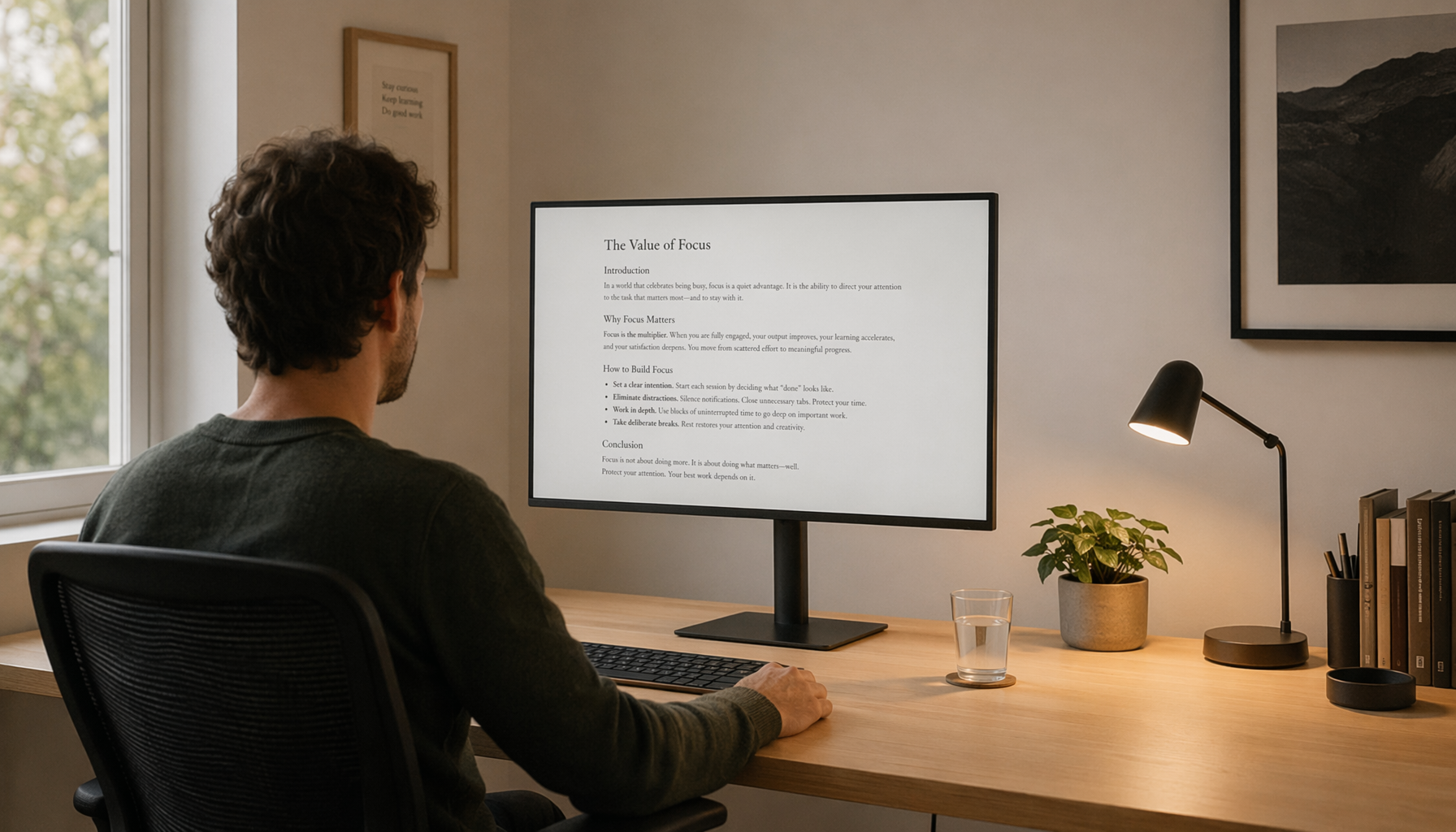
Small text is not a sign that you are using screen space efficiently if it forces you closer to the panel. Start with operating-system scaling, then adjust application zoom. On a high-resolution 27-inch or 32-inch monitor, 125% to 150% scaling may be more comfortable than forcing the desktop to remain at 100%.
For example, on a 27-inch 2K 100 Hz/120 Hz home and office monitor, use native 2K/QHD resolution with scaling, viewing distance, and the supported 100 Hz or 120 Hz refresh rate adjusted for comfortable desk work.

A practical minimum for sustained reading is at least 12-point text, while contrast should be strong enough that letter edges remain clear without appearing harsh. A healthcare organization recommends readable text and moderate contrast, including contrast settings around 60% to 70% as a starting point. The exact monitor value will vary because manufacturers do not calibrate their on-screen controls to the same scale.
Use dark mode only when it improves legibility in your environment. Light text on a black background can be comfortable in a dim room, but it may produce halos or make reflections more visible for some users. A neutral light theme often works better in a bright office, while a dark or charcoal interface may suit an evening gaming setup.
Treat blue light modes as an optional comfort setting
A warm color-temperature mode can make a bright display feel less harsh at night, but it does not fix glare, small text, poor posture, dryness, or an incorrect prescription. Use a monitor’s low-blue-light mode or the operating system’s nighttime setting if the warmer image feels more comfortable, particularly in the evening.
Do not judge a monitor’s eye-comfort performance from a blue-light marketing label alone. Brightness range, stable backlighting, surface reflections, text clarity, adjustability, and viewing distance usually provide more actionable buying criteria.
Decide Whether Refresh Rate and Flicker Control Matter

Refresh rate determines how often the monitor can update its image. A 60 Hz display updates up to 60 times per second, while 120 Hz, 144 Hz, and 240 Hz models can show motion in smaller time increments when the computer produces enough frames.
A controlled study using a 24.5-inch LCD found that higher refresh rates significantly increased motion-evoked brain responses across the tested motion frequencies. The researchers recommended at least 120 Hz for motion-perception experiments and 240 Hz for higher motion frequencies or velocities. This supports a real difference in motion presentation, but it does not prove that every person will experience less eye strain at 240 Hz.
When a high-refresh-rate monitor is useful
Moving from 60 Hz to 120 Hz or higher is most noticeable when content moves continuously. Scrolling text can appear clearer, cursor movement becomes smoother, and games with rapid camera motion are easier to track. People who divide their day between office work and gaming may therefore find a 120 Hz to 165 Hz monitor a practical middle ground.
A competitive player with a system consistently producing more than 200 frames per second may benefit from 240 Hz or higher. A writer working mostly with static documents is less likely to gain enough comfort from 240 Hz to justify sacrificing resolution, panel quality, or ergonomic adjustability. For general use, prioritize a clear panel and stable 120 Hz or 144 Hz operation before chasing the highest available number.
Why flicker-free backlighting deserves attention
Refresh rate and backlight flicker are different specifications. Refresh rate describes image updates; backlight flicker describes how the monitor controls its illumination. Some displays reduce brightness through pulse-width modulation, rapidly switching the backlight on and off. Users vary in their sensitivity, and the flicker may not be consciously visible.
Look for monitors advertised as flicker-free across their usable brightness range, preferably supported by independent testing. This is particularly important if discomfort becomes worse at low brightness, where some backlight-control systems change behavior. Also enable adaptive sync for gaming when supported, because matching display updates to rendered frames can reduce visible tearing and irregular motion.
Display factor |
Practical target |
Most relevant use case |
What it will not fix |
Refresh rate |
120–165 Hz for mixed work and gaming |
Scrolling, animation, fast games |
Glare, dryness, small text |
High competitive refresh rate |
240 Hz or higher when frame rates support it |
Fast-paced competitive gaming |
Poor posture or an incorrect prescription |
Flicker control |
Flicker-free throughout the brightness range |
Long sessions and low-brightness use |
Reflections and room-light imbalance |
Brightness |
Similar to the surrounding workspace |
Office work, reading, evening use |
Text that is physically too small |
Contrast |
Clear text without crushed shadows or glaring whites |
Documents, coding, dark game scenes |
Wrong viewing distance |
Resolution and scaling |
Native resolution with comfortable scaling |
Dense text, creative work, large screens |
A display positioned too far away |
Matte surface or glare treatment |
Chosen for the actual room lighting |
Bright offices and portable use |
Direct airflow or reduced blinking |
Low-blue-light mode |
Optional warmer setting for subjective comfort |
Evening work or gaming |
Most ergonomic causes of screen fatigue |
Position the Monitor for Its Size and Use Case
The best viewing position depends partly on screen size, but the same principle applies across display categories: you should see the entire working area without leaning forward, lifting your chin, or repeatedly turning your head.
A useful starting range is 20 to 28 inches from the eyes for a conventional desktop display. The recommended screen position is approximately 4 to 5 inches below eye level, measured around the display’s center, with a viewing distance that keeps text readable. Larger ultrawide monitors may require a little more distance, provided scaling is increased enough to prevent leaning.
Office and productivity monitors
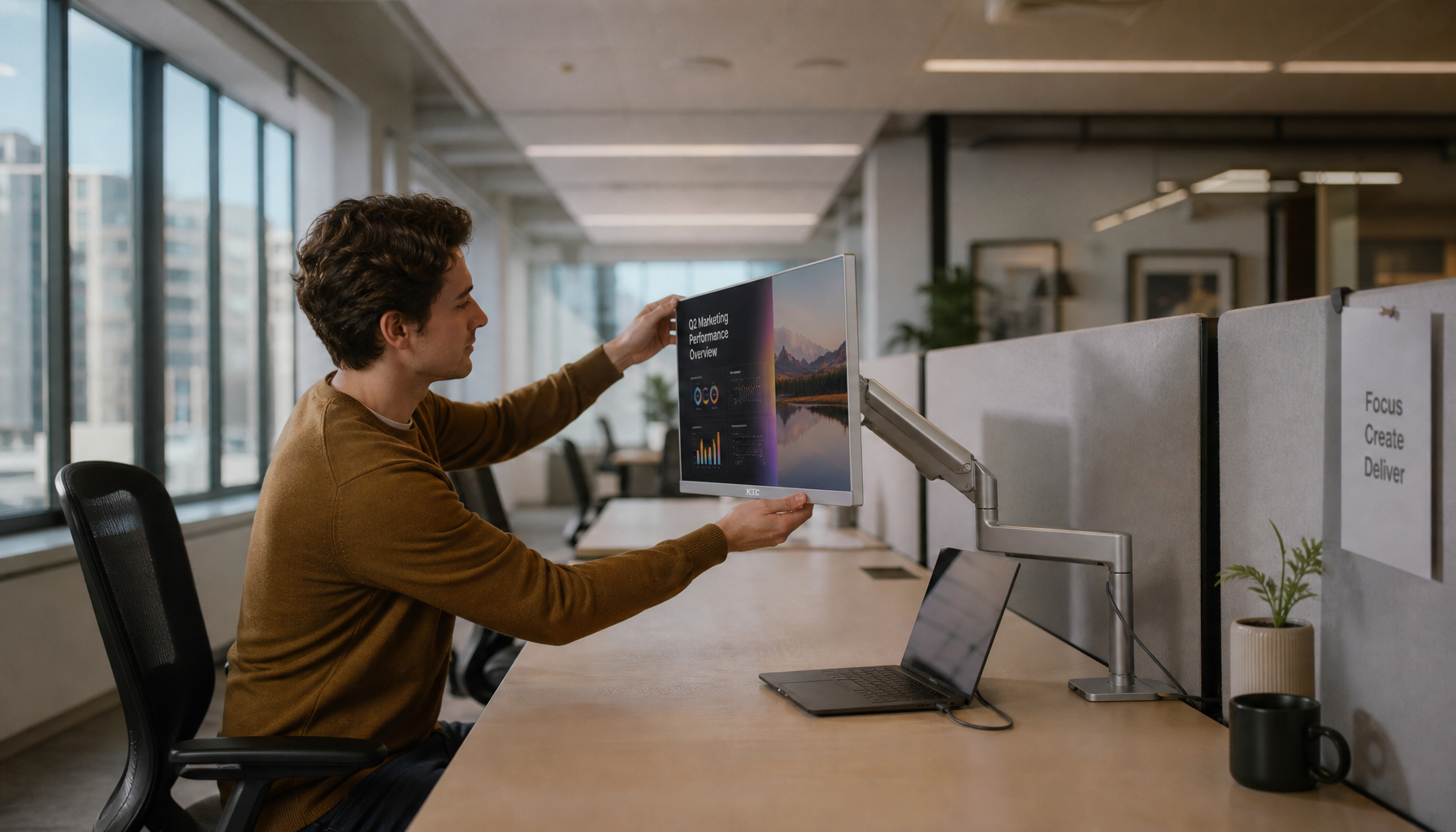
For a single 24-inch or 27-inch office monitor, center the panel on your body and place frequently used windows near the middle. Set the top edge at or slightly below eye level. If you wear progressive lenses, lowering the display further may reduce the need to tilt your head back, but an eye-care professional can help determine the right working distance and lens design.
For two monitors used equally, place their inner edges together and angle both slightly inward. Sit centered between them. If one display is primary, center that monitor on your body and move the secondary screen to the side; otherwise, you may spend hours with your neck rotated.
Gaming monitors
Position a gaming monitor so the center of the action falls naturally below horizontal eye level. Avoid placing a large display extremely close merely to fill more of your field of view. Increase game-interface scaling where available instead of moving your face closer to read menus, chat, maps, or subtitles.
Motion clarity also depends on the full signal chain. Confirm that the operating system is actually set to the monitor’s advertised refresh rate, use a compatible cable and port, and check that the game is producing an appropriate frame rate. A 165 Hz monitor accidentally running at 60 Hz will not deliver the motion performance you purchased.
Ultrawide and curved monitors
An ultrawide can replace a dual-monitor setup, but width increases the importance of viewing distance and window placement. Keep primary applications in the central region and use the outer areas for reference panels, communication tools, or secondary information. Constantly reading full-width text across a 34-inch or 49-inch display can cause unnecessary eye and head movement.
Curvature may help keep the outer edges at a more consistent distance from the eyes, especially on very wide screens. It is not automatically an eye-comfort feature, however. The curve should match your desk depth and typical seating position, and it cannot compensate for poor brightness, glare, or undersized text.
Portable monitors
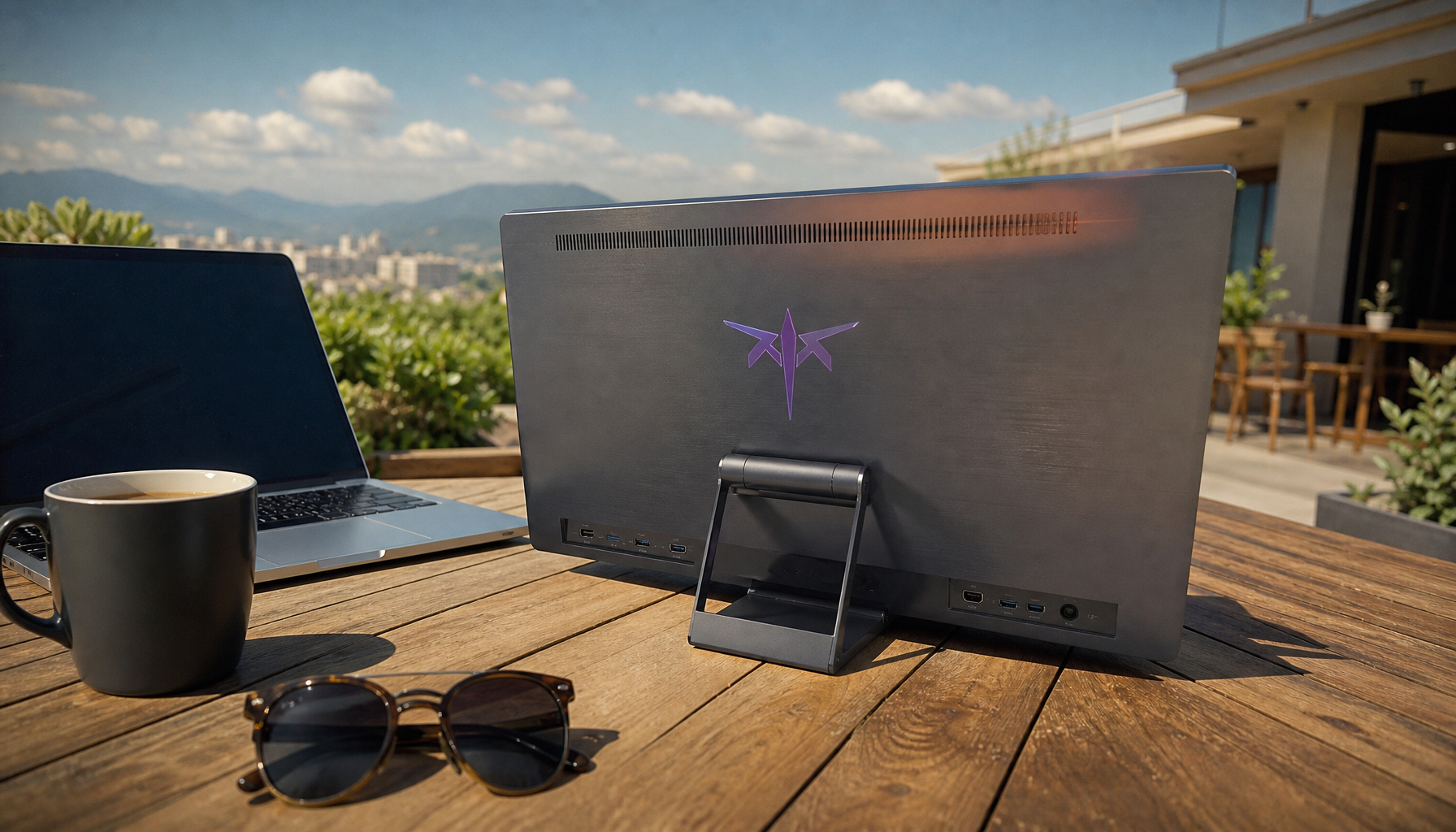
Portable monitors often sit too low because their folding stands rest directly on a desk. That position encourages downward neck flexion even if the screen itself looks comfortable. Raise the display on a stable stand and use an external keyboard and mouse when working for more than a brief session.
Brightness can also be a limitation. A portable monitor that is difficult to see in a bright room may tempt you to lean closer or increase contrast excessively. Choose a model with sufficient brightness for the intended environment, a matte or well-controlled reflective surface, and scaling that keeps text readable on the smaller panel.
Build a Break Routine That Goes Beyond 20 Seconds
The 20-20-20 rule works better as one layer of a broader routine. After every two hours of continuous screen use, an optometric association recommends a 15-minute rest. That longer interruption gives you time to stand, change posture, blink normally, and perform a task that does not require near focusing.

Break quality matters as much as timing. Switching from a monitor to a cell phone still requires close focus and may continue the same reduced-blinking behavior. During longer breaks, look through a window, walk across the room, refill water, or handle a task that does not involve another display.
A practical screen-comfort checklist
- Set the monitor directly in front of your primary seating position.
- Keep a conventional desktop monitor roughly 20 to 28 inches away, adjusting scaling before moving closer.
- Position the display center about 4 to 5 inches below eye level.
- Match screen brightness to the room and remove visible lamp or window reflections.
- Use the monitor’s native resolution, then enlarge text and interface elements until you can read without leaning.
- Take a 15-minute non-screen break after every two hours of continuous use, in addition to short distance breaks.
- Blink deliberately during intense work or gaming and redirect fans or vents that blow toward your eyes.
Test changes systematically. Adjust one factor, such as brightness or viewing distance, and keep it consistent for a work session. Record when symptoms begin and where they occur: dry eyes suggest a different intervention from neck pain, motion discomfort, or difficulty focusing on small text.
Know When a New Monitor Will Help
A monitor replacement makes sense when the current display cannot become comfortable through positioning and calibration. Relevant limitations include an insufficient brightness range, obvious flicker, persistent reflections, poor text rendering, an unstable stand, inadequate height adjustment, or a refresh-rate ceiling that does not suit motion-heavy use.
For a comfort-focused office monitor, prioritize sharp text at the intended size, a matte or controlled-glare surface, flicker-free brightness adjustment, a height-adjustable stand, and enough resolution for comfortable scaling. For a mixed-use gaming display, add a 120 Hz to 165 Hz refresh rate and adaptive sync. For an ultrawide, check stand depth, curvature, scaling behavior, and whether the entire panel remains visible without repeated head rotation.
When the monitor is not the underlying problem
Recurring symptoms can reflect an uncorrected prescription, focusing difficulty, eye-coordination issue, or dry-eye condition. Vision-related strain can also trigger postural compensation, linking eye comfort with workstation ergonomics. A more expensive monitor will not correct these issues.
Schedule a comprehensive eye examination if symptoms persist after practical setup changes, become severe, affect only one eye, or continue after screen use stops. An examination can evaluate visual sharpness, focusing, coordination, and whether your current glasses are suitable for the actual monitor distance. Computer-specific lenses may be useful in some cases, but they should be selected around a measured working distance rather than purchased from a generic label.
Frequently Asked Questions
Q: Why do my eyes still feel tired when I follow the 20-20-20 rule?
A: The rule briefly relaxes near focusing, but it does not correct excessive brightness, glare, reduced blinking, small text, poor display placement, or vision problems. Check whether you are leaning forward, squinting, lifting your chin, or working with reflections on the screen. Add a 15-minute non-screen break after every two hours of continuous use.
Q: Is a 144 Hz monitor better for eye comfort than a 60 Hz monitor?
A: A 144 Hz display can make scrolling, cursor movement, animation, and games look smoother than they do at 60 Hz. This may improve subjective comfort during motion-heavy use, but refresh rate is not a complete solution for digital eye strain. Brightness, flicker control, text clarity, viewing distance, glare, and posture remain important.
Q: Should I buy a blue-light monitor or special blue-light glasses?
A: A warmer display mode may feel more comfortable, especially at night, but it should be treated as an optional setting rather than the main remedy. First correct brightness, glare, text size, viewing distance, blinking, and break timing. If symptoms continue, have your vision and working distance evaluated before buying specialized glasses.
Practical Next Steps
Start with the free changes: remove reflections, match brightness to the room, increase text scaling, and place the monitor directly in front of you at a comfortable distance. Confirm that a gaming monitor is running at its intended refresh rate, and raise an ultrawide or portable monitor enough to prevent neck flexion.
Use the 20-20-20 rule as a reminder, not as the entire strategy. Combine short distance breaks with deliberate blinking, a 15-minute break every two hours, appropriate monitor hardware, and an eye examination when symptoms persist. The right display is not simply the one with the highest resolution or refresh rate; it is the one you can read clearly, position correctly, and use without changing your posture to accommodate it.
References
- Assessing the Effect of the Refresh Rate of a Device on Various Motion Stimulation Frequencies
- OSHA Computer Workstations: Monitors
- Colorado State University: Digital Eye Strain and Ergonomics
- Cleveland Clinic: Computer Vision Syndrome
- American Optometric Association: Computer Vision Syndrome
- Cedars-Sinai: Computer Vision Syndrome
- Canadian Centre for Occupational Health and Safety: Eye Discomfort in the Office