For story-driven games, the smoothest setup is usually variable refresh rate enabled with a frame-rate cap a few frames below your monitor’s maximum refresh rate. That combination reduces tearing, improves frame pacing, and preserves immersion better than running fully unlocked.
For story-driven games, the best behavior is usually variable refresh rate turned on, an FPS cap set a few frames below your monitor’s maximum refresh rate, and traditional vertical sync used only as a ceiling safeguard when needed. That setup preserves immersion, cuts tearing, and avoids the heavier latency and frame-pacing penalties of relying on vertical sync alone.
A beautiful single-player scene can lose its impact when a horizontal tear appears during a camera pan or motion starts to feel uneven as frame rate shifts. On a 175 Hz OLED setup, enabling variable refresh rate kept motion visibly steadier even when performance dropped from 160 FPS to 95 FPS, which matches what many players notice once frame pacing improves. The goal is simple: keep motion smooth, keep tearing low, and avoid unnecessary distractions.

The Short Answer: VRR On, Slight Cap, Full Unlock Rarely Wins
Matching the monitor’s refresh to frame output is exactly why variable refresh rate suits cinematic, story-heavy games with fluctuating performance. In practice, the smoothest result usually comes from enabling adaptive sync in both the monitor menu and GPU software, then setting an FPS cap slightly below the display’s refresh ceiling. On a 144 Hz monitor, that often means capping around 141 FPS; on 165 Hz, around 162 FPS.

That approach usually beats fully unlocked frame rates for single-player games because these titles rarely need every last possible frame the way competitive games might. Consistent frame pacing matters as much as headline FPS, and a small cap helps keep the game inside the monitor’s variable refresh window instead of repeatedly hitting the top edge. That means fewer visible transitions between smooth variable refresh behavior and the panel’s hard ceiling.
Why Story-Driven Games Benefit Most
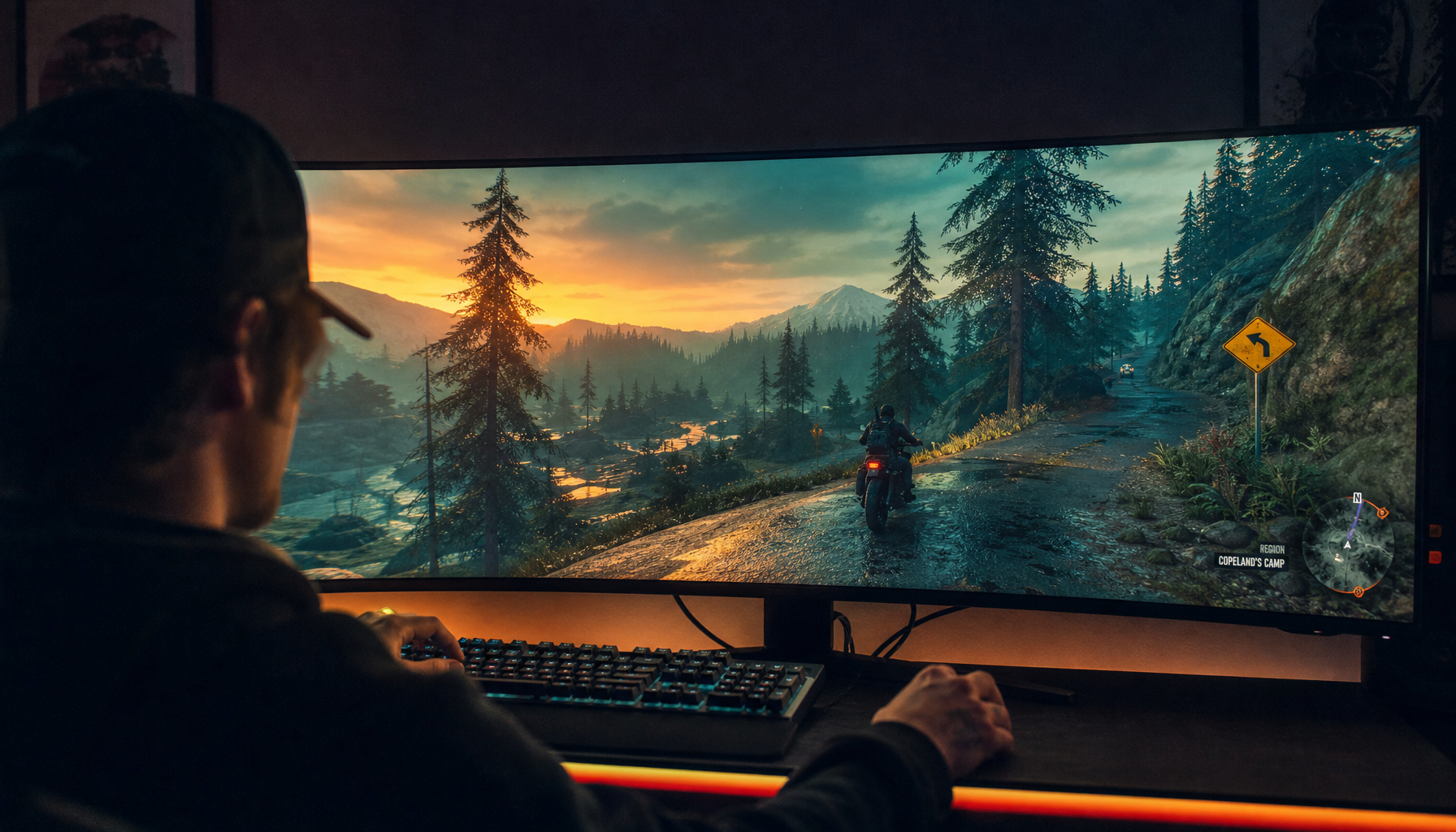
Variable refresh rate matters most during frame-rate drops, and that is common in story-driven games with heavy lighting, dense scenery, ray tracing, or uneven open-world traversal. A narrative game may hover between 72 FPS and 118 FPS depending on the scene, which is exactly the kind of range where variable refresh rate helps most. You notice the difference during slow camera turns, horseback travel, third-person traversal, or dialogue scenes with detailed backgrounds, because those are the moments when tearing and microstutter break immersion fastest.

Players focused on immersion usually want motion to feel stable and cinematic rather than merely fast. Traditional vertical sync can remove tearing but often, so it is usually a weaker first choice unless variable refresh rate is unavailable.
What Each Adaptive Sync Behavior Feels Like
Setup |
What it feels like in story games |
Main downside |
VRR off, FPS unlocked |
High average FPS can still look messy during camera movement |
Tearing is common |
V-Sync only |
Clean image when stable |
More lag and harsher stutter when performance dips |
VRR on, FPS fully unlocked |
Usually smoother than no VRR |
Can still hit the refresh ceiling and lose consistency |
VRR on, FPS capped a few below max |
Best balance of fluidity, stability, and low distraction |
Slightly lower peak FPS on paper |
Variable refresh rate offers little benefit once frame rate exceeds the monitor’s refresh rate, which is why fully unlocked FPS with VRR is not automatically ideal. If your GPU pushes 170 FPS on a 144 Hz panel, the monitor cannot display all of those frames cleanly in variable refresh mode once you move past its ceiling. In practice, that can create more inconsistency than a gentle cap.
A useful example is a 144 Hz 1440p monitor paired with a GPU that swings between 110 FPS indoors and 155 FPS outdoors. If you leave the game fully unlocked, the display spends part of its time in its ideal variable refresh range and part of its time at the limit. If you cap at 141 FPS, the whole experience usually feels more coherent, even though the average FPS number is lower.
Should You Leave V-Sync On Too?
Using vertical sync as a backup above the refresh ceiling is a common recommendation for VRR-capable displays. That advice exists because once frame rate rises above the panel’s maximum refresh rate, VRR alone cannot fully manage tearing. In that narrow case, vertical sync can act as a backstop instead of doing all the work.
The catch is that implementation varies by game engine, driver, and monitor. Some setups feel better with driver-level vertical sync on and in-game vertical sync off; others behave cleanly with both off as long as the frame cap stays below the ceiling. A safe starting point for story games is VRR on, a cap a few FPS below max refresh, and vertical sync tested only if you still see tearing during lighter scenes or menus.
What Matters More Than the Label
Different variable refresh standards now overlap heavily, so the best behavior is less about branding and more about implementation quality. For a story-game player, a well-implemented adaptive sync monitor often lands in the performance sweet spot without forcing you to pay extra for a premium sync tier.
Certification quality still matters because not all adaptive sync implementations behave the same way at low frame rates. A monitor with low-frame-rate compensation can keep VRR working below the panel’s normal lower bound by repeating frames intelligently, which is much better than falling out of sync during a demanding boss fight or a crowded city scene.
Broader advice sometimes sounds contradictory because “works” and “works best” are different standards. Cross-compatibility is common now, but low-FPS behavior, overdrive tuning, and artifact control still vary by model.
How to Set It Up for the Best Story-Game Experience
Spending your budget on panel quality, HDR, or resolution often matters more than paying extra for a sync label alone. For immersive single-player gaming, a good 27-inch 1440p display with solid VRR behavior is often a better upgrade than chasing the most expensive sync hardware.
Matching your frame target to your monitor refresh rate is the practical starting point, so first check your panel’s actual refresh setting in your operating system and GPU control panel. Then enable adaptive sync in the monitor menu, enable VRR in the driver, set an FPS cap a few frames below max refresh, and lower a few graphics settings if needed to hold that range more consistently. Story games usually look better with slightly reduced shadow quality and steadier frame times than with maxed-out settings and constant swings.
If your monitor is 120 Hz, try a cap around 117 FPS. If it is 144 Hz, try 141 FPS. If it is 165 Hz, try 162 FPS. The exact number matters less than staying just under the ceiling so VRR can work cleanly across the whole session.
When Fully Unlocked FPS Still Makes Sense
Variable refresh rate does not increase FPS directly; it improves perceived smoothness. That means there are still cases where fully unlocked frame rates make sense. Benchmarking, stress testing, or checking thermal headroom are valid reasons to remove the cap temporarily. If a game already stays well below your refresh ceiling and never spikes over it, an additional cap may change very little.
For actual play, though, especially in scenic third-person games, role-playing games, and cinematic shooters, fully unlocked FPS is usually less polished than a controlled cap. During a slow pan across a moonlit forest, what your eyes notice is not the peak number in the overlay. It is whether motion stays stable, tear-free, and believable.
The best story-game setup is the one that keeps the screen invisible and the world convincing. Turn on VRR, keep frames just under the panel’s ceiling, and let consistency carry the immersion.