Adaptive Sync can behave differently on HDMI and DisplayPort because port standards, driver support, monitor firmware, cable bandwidth, and certification all affect how reliably variable refresh rate signals reach the screen.
Does your game feel smooth on DisplayPort but choppy, capped, or unavailable over HDMI? A practical cable-and-settings check can often reveal whether the issue is bandwidth, support, or a driver toggle within minutes. Here is how to choose the right connection and tune it for smoother play, cleaner motion, and fewer display surprises.
What Adaptive Sync Actually Does
Adaptive Sync lets a monitor adjust its refresh rate in real time to match the frame rate coming from the graphics card. When your GPU sends 97 frames per second, the display can refresh near 97Hz instead of forcing those frames into a fixed 144Hz, 165Hz, or 240Hz rhythm.
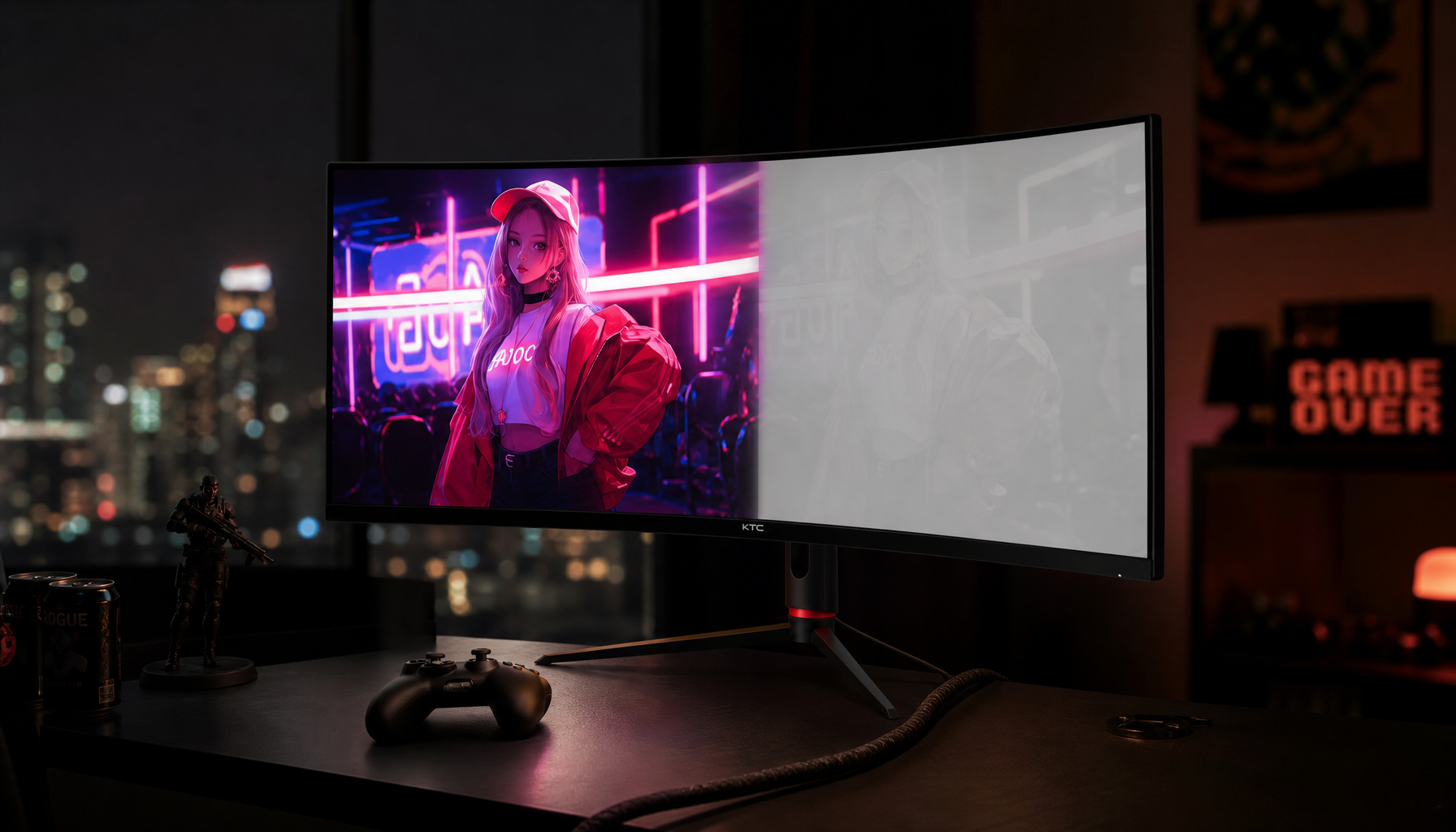
That matters because games rarely hold one perfect frame rate. A shooter might sit near 160 FPS in a quiet hallway, dip during explosions, then jump back up when the scene clears. Without variable refresh behavior, those changes can show up as tearing, stutter, or uneven motion.
Traditional V-Sync attacks tearing by making the GPU wait for the monitor’s fixed refresh cycle, but that waiting can increase latency. Adaptive Sync is more flexible: the screen follows the GPU within a supported range, which is why it often feels smoother without the heavy input-lag penalty of classic V-Sync.
Why DisplayPort Often Feels More Reliable on PC
DisplayPort was built primarily around PCs, monitors, high refresh rates, and workstation-style display setups. That history matters. VESA Adaptive-Sync is part of the DisplayPort ecosystem, and many PC gaming monitors expose their most complete variable refresh behavior through DisplayPort first.

In real setup work, this is why a 144Hz or 240Hz gaming monitor may show every advertised option over DisplayPort while HDMI only exposes a lower refresh rate, a narrower VRR range, or no compatible sync checkbox at all. The monitor may not be bad; the HDMI input may simply use a different controller path with different limits.
DisplayPort also tends to be stronger for multi-monitor productivity. DisplayPort’s strengths include high refresh rates, daisy chaining, Adaptive Sync support, and USB-C DisplayPort Alt Mode on many laptops. For a desk with a gaming monitor, a vertical chat display, and a portable screen, that flexibility can matter as much as raw bandwidth.
Why HDMI Can Be Excellent, But More Setup-Dependent
HDMI is dominant in TVs, consoles, soundbars, receivers, and living-room gaming. HDMI 2.1 added important gaming features such as VRR, higher bandwidth, 4K at 120Hz-class output, and home-theater features that DisplayPort usually does not target.
The catch is consistency. HDMI Adaptive Sync support depends heavily on the exact HDMI version, the display input, the console or GPU, the cable, and the display’s firmware. A TV with HDMI 2.1 VRR can be superb with a current-generation console or living-room PC. A monitor with older HDMI ports may still accept 144Hz video but not expose the same Adaptive Sync behavior it offers on DisplayPort.
This is why “HDMI supports VRR” is true, but incomplete. HDMI 2.1 VRR on a modern TV is not the same practical experience as Adaptive Sync over HDMI on a monitor, and neither is automatically equivalent to compatible sync over DisplayPort on a PC display.
Scenario |
Better First Choice |
Why It Usually Wins |
High-refresh PC gaming monitor |
DisplayPort |
More consistent Adaptive Sync and compatible VRR support |
Current-generation console on TV |
HDMI 2.1 |
Consoles and TVs are built around HDMI features |
Laptop to gaming monitor |
USB-C with DisplayPort Alt Mode or DisplayPort |
Often better for high refresh and multi-display docks |
TV, soundbar, receiver setup |
HDMI |
Supports home-theater features such as ARC/eARC and CEC |
Portable monitor for mixed work and gaming |
Depends on port support |
USB-C DisplayPort Alt Mode is often cleaner; HDMI is useful for broad device compatibility |
Bandwidth Is Only Part of the Story
DisplayPort and HDMI bandwidth numbers explain some differences, but not all of them. HDMI 2.1 can carry up to 48 Gbps, while DisplayPort 2.0 and 2.1 can reach an 80 Gbps class. DisplayPort 1.4 is lower on paper than HDMI 2.1, yet it remains extremely common on high-refresh PC monitors because it pairs well with Display Stream Compression and mature PC VRR support.
A simple example makes this clearer. A 4K 120Hz HDR signal needs far more data than a 1080p 144Hz signal. If the cable, port, or adapter cannot carry the full signal cleanly, the system may drop refresh rate, disable HDR, fall back to chroma subsampling, or make Adaptive Sync unstable.
Adapters are a common weak point. A DisplayPort-to-HDMI adapter may pass video while limiting refresh rate or VRR behavior. For high-refresh gaming, direct cable runs are the reliable choice: GPU DisplayPort to monitor DisplayPort, or console HDMI 2.1 to TV HDMI 2.1.

Sync Labels Matter
Sync labels are not just marketing badges; they describe different compatibility paths. Some systems historically used proprietary monitor hardware and validation. Others implement Adaptive Sync principles without a dedicated module.
That distinction affects ports. Many Adaptive Sync monitors support variable refresh over both DisplayPort and HDMI, but compatible VRR support has often been strongest and most predictable through DisplayPort on PC monitors. Some HDMI VRR setups work well, especially with newer GPUs and displays, but support should be verified model by model.
Support guidance points users toward checking the GPU control software for Adaptive Sync or related toggles. That is practical advice: if the option does not appear in the graphics control panel or the display’s own menu, the cable path probably is not exposing the feature correctly.
Input Lag: The Real Trade-Off
Adaptive Sync input lag is usually lower than traditional V-Sync because frames do not have to wait for a rigid refresh cycle. It does not increase FPS, fix CPU spikes, or improve game-engine latency, but it can reduce display-side timing friction and remove distracting tear lines.
For competitive play, the best setup often depends on your frame rate relative to your monitor. If you have a 240Hz display and your game fluctuates between 180 and 235 FPS, Adaptive Sync can be extremely useful. If you run a lightweight esports title at 360 FPS on a 240Hz monitor, the screen cannot show every rendered frame, so some players prefer V-Sync off and accept tearing for the lowest possible latency.
A balanced configuration is usually to enable Adaptive Sync, use the monitor’s highest refresh rate, and cap FPS slightly below the display ceiling. On a 144Hz display, a cap around 141 FPS is a common practical target. On a 240Hz display, a cap around 237 FPS keeps the game inside the VRR window and reduces the chance of bouncing into normal V-Sync behavior at the top end.

Why the Same Monitor Can Behave Differently on Each Port
The monitor may use separate internal processing paths for HDMI and DisplayPort. One input might support the full refresh range, HDR, and Adaptive Sync together, while another supports only a subset. That difference is especially common on budget displays, older high-refresh monitors, and portable screens with compact input boards.
Cable quality can also make a stable feature look broken. Certified cables are recommended for full HDMI 2.1 or DisplayPort 2.1 performance because weak cables can cause black screens, flicker, signal drops, or missing refresh-rate options. If Adaptive Sync works at 120Hz but fails at 144Hz, the cable is one of the first things worth testing.
Firmware and driver behavior are the last layer. GPU drivers may allow certain monitors, expose compatible sync only on specific ports, or handle borderless-window VRR differently from exclusive fullscreen. That is why two users with similar monitors can report different results if one is using DisplayPort from a desktop GPU and the other is using HDMI through a laptop dock.
Best Practical Setup for Gaming Monitors
For a desktop gaming PC, start with DisplayPort when the monitor has it. Use the shortest high-quality cable that comfortably reaches the desk, set the operating system to the monitor’s maximum refresh rate, enable Adaptive Sync in the monitor menu, then enable compatible VRR in the GPU driver.
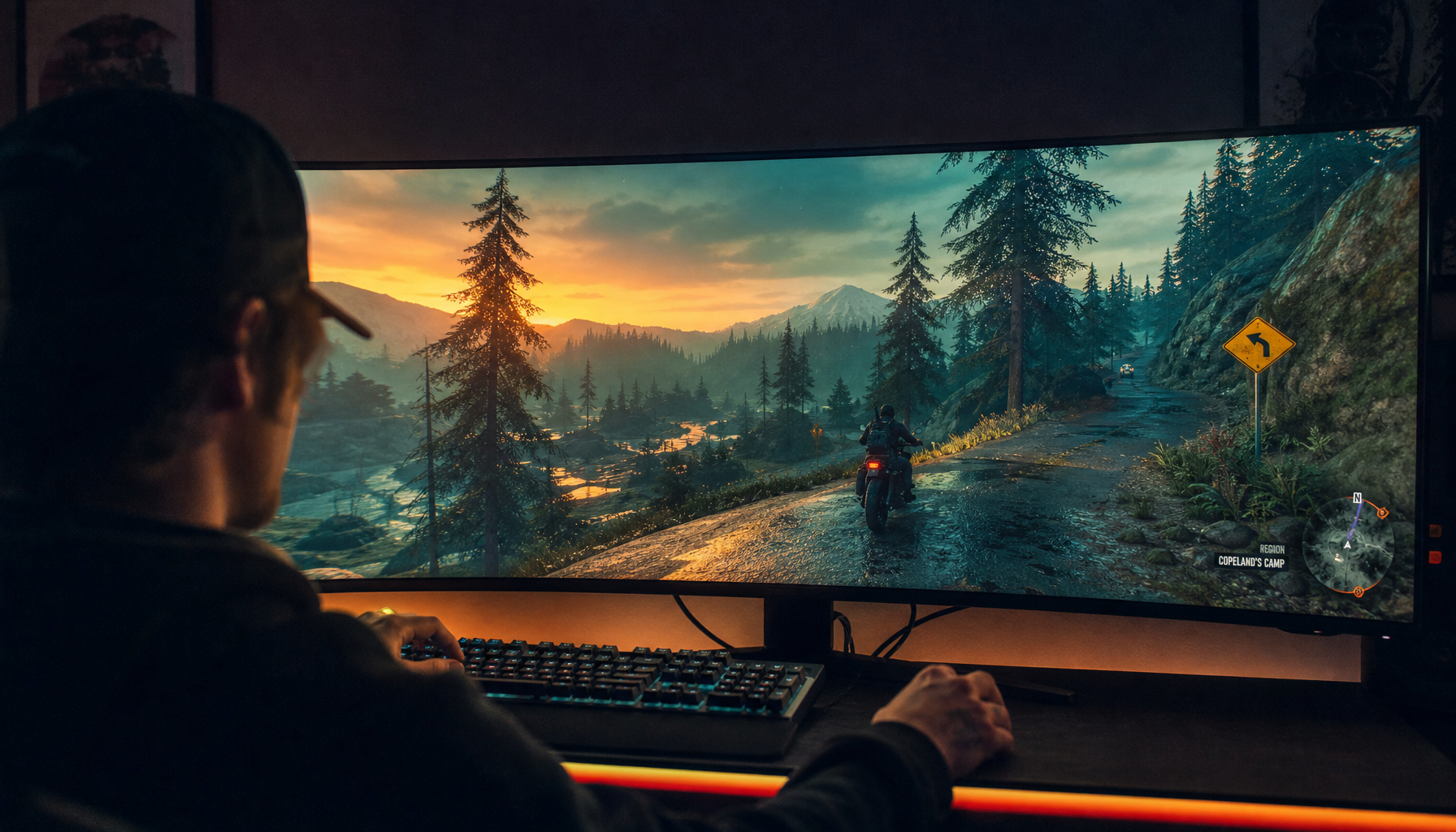
After that, test with a real game instead of only a desktop motion demo. Watch for tearing during fast camera pans, stutter during frame-rate dips, and flicker in dark menus. If the game keeps jumping above the monitor’s maximum refresh rate, cap it a few frames below the ceiling.
For consoles and TVs, use HDMI 2.1 where available. Enable Game Mode on the TV, turn on VRR in the console settings, and avoid heavy image processing such as motion smoothing. A TV may advertise VRR but still add delay if the wrong picture mode is active.
For office productivity displays and portable smart screens, the answer is less about winning benchmarks and more about stable motion. Adaptive Sync can make timeline scrubbing, window dragging, video playback, and mixed refresh-rate setups feel cleaner. If your portable display supports USB-C DisplayPort Alt Mode, that connection is often simpler than stacking HDMI adapters.
HDMI vs. DisplayPort: Pros and Cons for Adaptive Sync
Connection |
Pros |
Cons |
DisplayPort |
Strong PC monitor support, mature Adaptive Sync behavior, high refresh options, useful for multi-monitor desks |
Rare on TVs and consoles, less useful for home-theater audio features |
HDMI |
Excellent for TVs, consoles, receivers, and soundbars; HDMI 2.1 supports strong VRR use cases |
VRR behavior varies more by device, port version, cable, and monitor firmware |
USB-C DisplayPort Alt Mode |
Clean for laptops, docks, and portable displays when supported |
Dock quality and USB-C port capabilities vary widely |
Adapters |
Useful for compatibility in a pinch |
May reduce refresh rate, HDR, audio, or VRR support |
Quick Troubleshooting When Adaptive Sync Feels Wrong
If Adaptive Sync is missing, check the cable path first. A direct DisplayPort connection is the cleanest test for a PC monitor. If you are using HDMI, confirm both the source and display input support the needed HDMI version and VRR mode.
If the feature appears but motion still feels uneven, cap FPS below the refresh ceiling and compare with V-Sync off, driver-level V-Sync, and in-game V-Sync. If the issue only happens in one game, especially during combat, heavy effects, or crowded scenes, the cause may be game load, CPU spikes, add-ons, or frame-time instability rather than the monitor connection.
If you see flicker, flashing, or black screens, reduce the refresh rate temporarily and retest. A stable 144Hz signal with VRR is better than an unstable 165Hz signal that drops out mid-match.
FAQ
Should I always use DisplayPort for Adaptive Sync?
For PC gaming monitors, yes, DisplayPort is usually the best first choice. HDMI may work perfectly on newer monitors and TVs, but DisplayPort remains the more predictable route for high-refresh PC Adaptive Sync.
Is HDMI 2.1 better than DisplayPort 1.4?
Not automatically. HDMI 2.1 has higher raw bandwidth than DisplayPort 1.4, but DisplayPort 1.4 is still widely trusted for PC monitors because of mature Adaptive Sync support and Display Stream Compression. The better choice depends on the exact monitor, GPU, resolution, refresh rate, and VRR support.
Does Adaptive Sync improve FPS?
No. Adaptive Sync changes how the display times refreshes; it does not make the GPU render more frames. Its value is smoother presentation when frame rates fluctuate.
Should competitive players turn Adaptive Sync off?
Some esports players chasing the lowest theoretical latency prefer V-Sync off and very high FPS. For most serious players, Adaptive Sync with a near-ceiling FPS cap gives a stronger real-world balance: low lag, cleaner motion, and fewer tear lines.
Final Call
Use DisplayPort first for high-refresh PC monitors, use HDMI 2.1 for consoles and TVs, and avoid adapters when you care about VRR reliability. The best Adaptive Sync setup is not the most expensive one; it is the one where the port, cable, GPU, monitor, and frame cap all stay inside the same performance envelope.