Ambient light can make the same HDR monitor look dramatic at night and underwhelming during the day. For monitor buyers, room lighting changes perceived contrast, shadow depth, and highlight impact as much as the panel itself.
 Ever launch an HDR game at noon and wonder why the image looks flatter than it did the night before? Large monitor test programs and controlled HDR studies show that room light can lift blacks, increase reflections, and shrink the visual gap between SDR and HDR, especially on weaker implementations. This guide will help you match HDR monitor specs, room setup, and buying priorities so the picture you pay for is the picture you actually see.
Why the Same HDR Monitor Looks Different From Day to Night
Ambient light raises the black floor
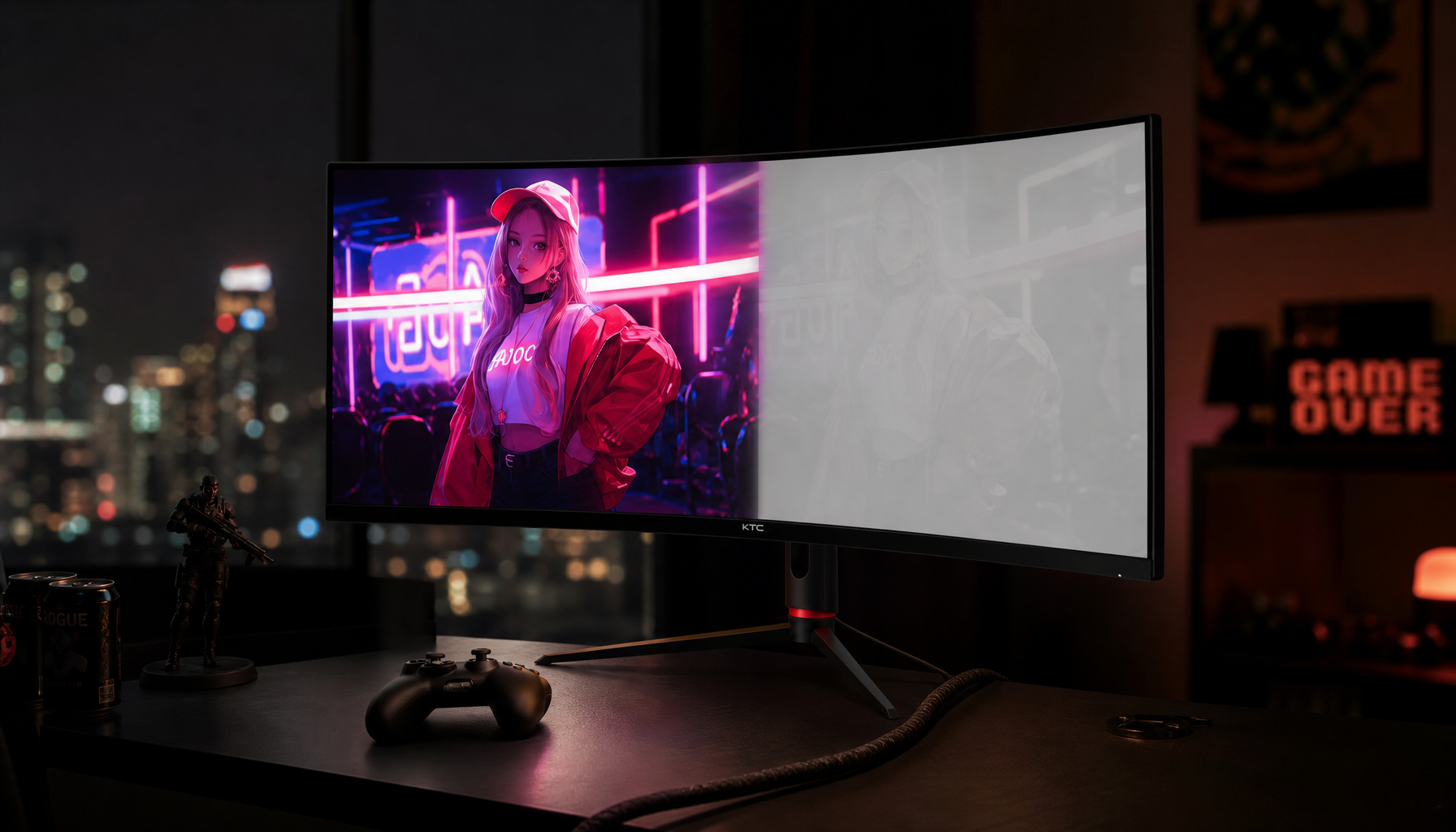
In real rooms, ambient light reduces visible HDR contrast because reflections off the screen raise the apparent black level. That matters most in dark scenes: when blacks stop looking truly black, bright highlights no longer stand out as strongly, so HDR loses much of its “pop” even if peak brightness has not changed.
The effect is easy to spot on premium gaming monitors. Recent bright-room monitor testing shows that some OLED models with perfect blacks in a dark room lose that advantage in a well-lit space, and some QD-OLED panels can even make blacks look purple. By contrast, brighter Mini-LED LCDs often hold up better in daylight because they can push through glare and keep highlights more visible.
Small quality losses are visible, not imaginary
Controlled HDR perception research shows viewers can consistently detect subtle image-quality differences on capable HDR displays. In the AIC-HDR2025 study, 151 participants across four labs produced 34,560 ratings, which is a useful reminder that when HDR looks washed out after the sun comes up, the change is not just subjective mood; the viewing environment is changing what your eyes can resolve.
That also explains why HDR can feel inconsistent across use cases. Enthusiast user reports from gaming and desktop setups repeatedly describe HDR as most impressive for full-screen games and video, but much less convincing for everyday desktop work under normal office lighting. Once the room gets brighter, you often need a higher SDR white point just to keep the desktop comfortable, and that eats into the contrast headroom that makes HDR noticeable.
Why Peak Brightness Alone Does Not Save HDR
Brightness helps, but strong HDR needs control
For desktop displays, 1,000+ nits is where HDR starts to look meaningfully stronger, while sub-600-nit panels are far easier to wash out in daylight. A bright monitor can preserve highlight sparkle in sun reflections, explosions, or racing-game headlights, but only if it also has the contrast performance to keep nearby dark areas from turning gray.
That is why local dimming is a core HDR requirement rather than a bonus spec. A monitor that only accepts an HDR signal without effective backlight control may show brighter whites, yet still flatten dark scenes and wash out shadow detail. Buyers often notice this on entry-level gaming monitors labeled with basic HDR certifications, where the logo suggests HDR support but the experience is still much closer to SDR than true cinematic HDR.
Panel type and finish change the outcome
Current HDR monitor rankings show why panel choice matters as much as brightness numbers. OLED and QD-OLED panels usually look best in darker rooms because pixel-level light control keeps halos away and dark detail intact, while Mini-LED displays are often the safer pick for bright rooms because they sustain higher brightness and fight glare better.
Room reflections still matter even on high-end models. Practical HDR setup advice recommends avoiding direct light in front of or behind the display, because even a strong panel loses contrast when a window, lamp, or white wall starts bouncing light back at the screen. In other words, glossy versus matte is not the whole story; the room layout decides whether the coating helps or just hides a bigger lighting problem.
 Matching Monitor Type to Your Room and Use Case
High-refresh-rate gaming monitors
On a fast gaming setup, high-refresh HDR monitors need more than a great refresh rate to impress. Smooth motion and low lag matter for competitive play, but HDR quality still comes from contrast, local dimming, brightness, and color volume. If you mostly play during the day, a bright Mini-LED panel is usually the safer choice, and buyers comparing that category in brighter rooms may look at options such as the a 27-inch 4K 160Hz HDR1400 Mini-LED gaming monitor. If you mostly play at night, OLED remains the cleaner-looking option for deep blacks and precise highlights.
That tradeoff becomes obvious in darker titles and cinematic single-player games. Community HDR gaming impressions describe standout gains in titles like a flight simulator game, where HDR adds brighter skies, deeper cockpit shadows, and more believable sunlight. Those benefits shrink quickly if the room is bright enough to lift the whole black floor.
 Ultrawide monitors and mixed-use desks
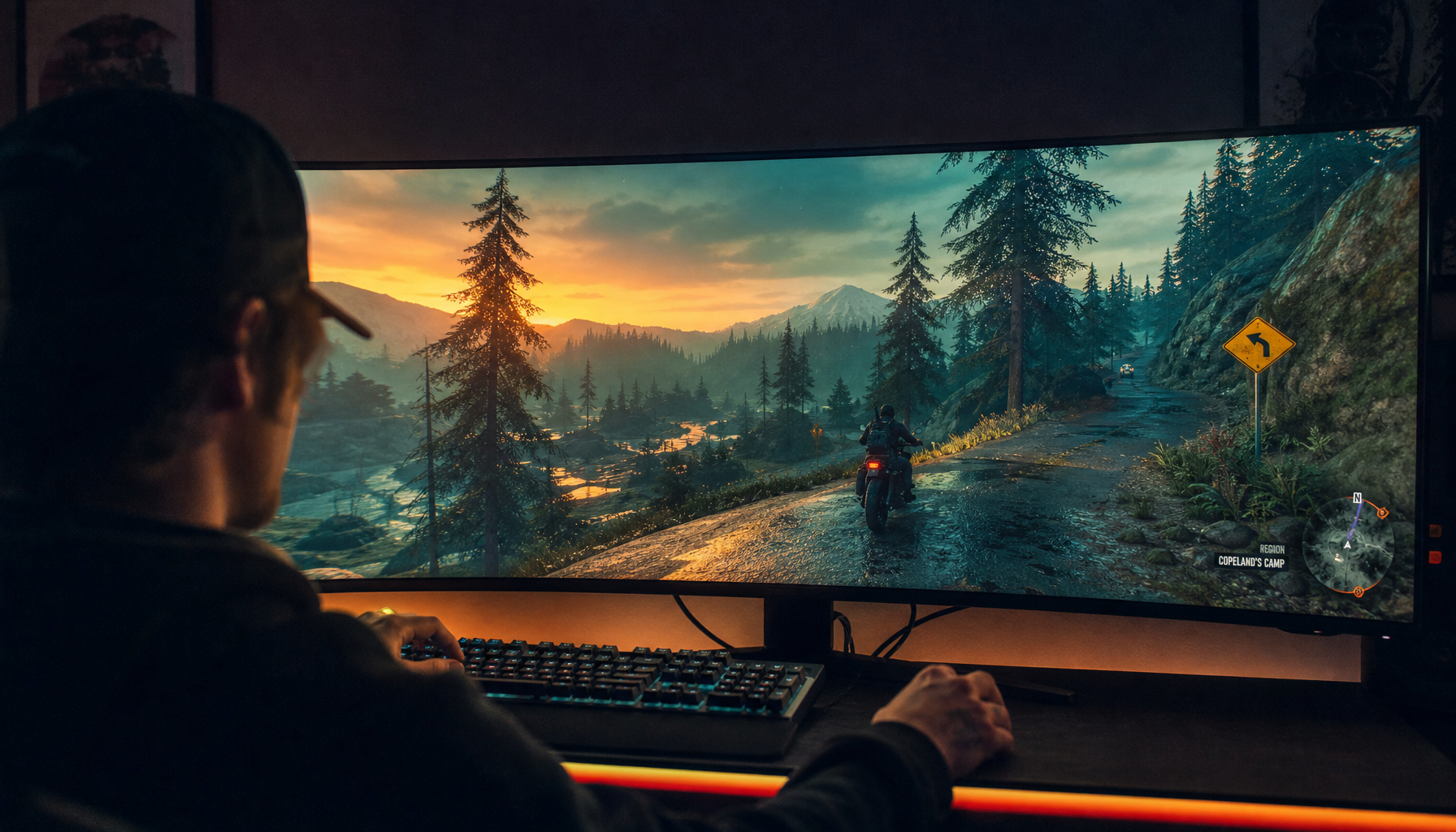
On ultrawide monitors, the room can influence HDR even more simply because the display fills more of your field of view. The same true-HDR buying guidance applies here: if the panel lacks strong local dimming or enough brightness, the extra width does not rescue dark-scene performance. For sim racing, flight, and cinematic gaming, ultrawide HDR is best when you can control the light hitting the panel.
For mixed work-and-play setups, many HDR-capable monitors still trail TVs in HDR impact, so it is worth being selective. If your ultrawide spends eight hours on spreadsheets and two hours in games, prioritize clean SDR text, consistent brightness, and easy HDR toggling. If the desk is used mainly for evening gaming or movies, then paying more for OLED or a strong Mini-LED backlight makes more sense.
Portable monitors and travel setups
The same brightness-first HDR logic applies to portable monitors, but the margin for error is smaller. A compact display used in a hotel room, airport lounge, or bright shared workspace will often face stronger overhead light and fewer placement options than a desktop monitor, so usable brightness and reflection control usually matter more than an HDR badge on the box.
For that reason, portable-monitor buyers should treat basic HDR support as secondary unless the panel can clearly outperform SDR in real lighting. A thin 15-inch or 17-inch travel display with limited brightness may still be fine for editing, dashboards, or a second-screen gaming setup, but you should expect far less HDR impact than from a desktop monitor with true local dimming and higher peak output.
What to Prioritize Before You Buy
A practical comparison table
The HDR certification performance tiers are a useful starting point, but they only become meaningful when you pair them with room conditions and panel behavior.
Monitor option |
Best room condition |
Real HDR outcome |
What to prioritize |
Basic HDR IPS gaming monitor |
Controlled or dim room |
Small step above SDR; limited highlight punch |
Value, SDR usability, refresh rate |
Mid-tier OLED / deep-black class |
Dim to moderately lit room |
Strong dark-scene contrast, limited daylight tolerance on some models |
Black depth, response time, evening gaming |
High-brightness Mini-LED |
Bright or mixed lighting |
Best chance of preserving highlights in daylight |
Peak brightness, local dimming quality |
QD-OLED ultrawide |
Dim room |
Excellent color and dark-scene HDR, but weaker black appearance in bright rooms |
Immersion, cinematic gaming, light control |
Portable monitor with basic HDR |
Highly variable lighting |
HDR label matters less than general brightness and glare handling |
Brightness, portability, connection options |
Use the room as part of the spec sheet
The most reliable real-world monitor advice is simple: buy for the room you actually use, not the review photo taken in ideal darkness. A bright home office with windows behind you rewards Mini-LED brightness and careful desk placement. A night-focused gaming room rewards OLED black depth. A mixed-use apartment desk usually benefits more from balanced SDR/HDR behavior than from chasing the most aggressive HDR logo.
The signal path matters, too. The basic HDR setup checklist includes enabling HDR in the operating system, confirming the monitor’s HDR mode in the on-screen menu, updating GPU drivers, and using a connection that can actually carry the format and refresh rate you want. A monitor can look “bad at HDR” when the real problem is that HDR is off, the wrong display is selected, or the cable path is limiting the mode.
Getting Better HDR From the Monitor You Already Own
Fix the room before you replace the panel
The fastest HDR image-quality improvement usually comes from changing lighting, not buying hardware. Move the monitor so no direct light source sits in front of or behind it, close a blind during midday sessions, and reduce bright white surfaces near the screen if possible. Even small changes can restore enough perceived contrast to make HDR look substantially better.
 If you want a quick sanity check, the HDR setup process suggests comparing SDR and HDR images in the operating system’s HDR display settings and verifying that peak white in HDR content actually looks brighter than SDR. A colorimeter is ideal, but even a phone lux app can help you understand whether the room is much brighter than you assumed.
Know when to turn HDR off
Real-world desktop HDR impressions make one point consistently: HDR is often worth keeping on for games and full-screen video, but not always for general desktop use. If your monitor needs aggressive brightness changes to stay comfortable during the day, or if dark UIs start looking hazy, disabling HDR for work and enabling it only for supported content can be the more practical choice.
That is especially true on monitors that advertise HDR but do not have the hardware to render it convincingly. When the display lacks brightness, local dimming, or shadow control, forcing HDR all day can make the desktop look worse without adding meaningful highlight detail. In that case, clean SDR is the better mode, and saving HDR for the right content is not a compromise; it is good display hygiene.
Practical Next Steps
The strongest buying outcome for bright-room HDR usually comes from matching panel type to lighting first and features second. If your monitor sits in a sunny office, prioritize brightness and local dimming. If you mostly game at night, prioritize black control and reflection management. If you travel or work in changing locations, prioritize consistent visibility over a marketing-heavy HDR label.
- Bright daytime room: Look for a true HDR monitor with high peak brightness, ideally around 1,000 nits, plus effective local dimming.
- Mostly evening gaming: OLED or QD-OLED usually gives the cleanest HDR image, especially on high-refresh-rate and ultrawide gaming monitors.
- Mixed work and play: Favor monitors with good SDR behavior, easy HDR toggling, and honest performance above entry-tier HDR basics.
- Portable setup: Treat brightness, glare handling, and connection support as higher priorities than the HDR badge.
FAQ
Q: Does enabling HDR reduce gaming performance?
A: Most PC HDR discussions treat the performance cost as small compared with heavy features like ray tracing, because much of HDR is handled by the display pipeline and game tone mapping. In practice, any frame-rate or lag change is usually minor compared with switching resolution, refresh rate, or advanced rendering settings.
Q: Is a basic HDR 400-tier certification enough for a gaming monitor?
A: The basic, mid-tier, and high-tier HDR certification levels are not equal in real use. A basic tier can be enjoyable, but it is usually a modest improvement over SDR, while mid-tier hardware is safer and high-tier hardware is where HDR becomes easier to appreciate in normal rooms.
Q: Should I choose OLED or Mini-LED for a bright room?
A: In most bright-room HDR recommendations, Mini-LED is the safer pick because it sustains more brightness and resists washout better. OLED still wins for black depth in darker spaces, but ambient light can erase part of that advantage unless the room is well controlled.
References
- Fine-Grained HDR Image Quality Assessment From Noticeably Distorted to Very High Fidelity
- HDR Setup Guide - a certified HDR standard
- Video Viewing Preferences for HDR Displays Under Varying Ambient Lighting
- Recommended HDR monitors for photography
- Create and edit true HDR images
- Monitor with best HDR support discussion
- HDR monitor discussion on a tech discussion platform
- The best HDR monitors
- The best HDR gaming monitors
- HDR gaming performance discussion