For most competitive gamers, 16:9 provides the best overall advantage without distortion because it has the broadest game support, predictable framing, and clean native resolutions across high-refresh-rate monitors.
Ever feel like enemies look wider than they should, your aim feels slightly off, or your HUD is pushed too far to the edges on an ultrawide screen? The practical difference is not just screen width: a 3440 x 1440 ultrawide drives almost 5 million pixels, compared with just under 3.7 million pixels on 2560 x 1440, so the monitor choice can affect both visibility and frame rate. This guide breaks down which aspect ratio makes sense for esports, ultrawide gaming, super ultrawide setups, and portable displays without forcing a stretched image.
The Short Answer: 16:9 Is Still the Competitive Default
For ranked shooters, MOBAs, battle royale games, and high-refresh-rate play, 16:9 is the safest competitive aspect ratio. The main reason is consistency: modern PC monitors, consoles, streaming platforms, game capture tools, and many competitive rule sets are built around 16:9, and the format became the dominant computer display standard around 2010 modern standard. If your goal is clean geometry, broad compatibility, and fewer surprises, a 24-inch or 27-inch 16:9 gaming monitor is still the baseline recommendation.
The practical sweet spots are 1920 x 1080 at 24 inches for maximum frame rate and 2560 x 1440 at 27 inches for a sharper competitive image. Those resolutions map cleanly to the screen shape, which means circular crosshairs stay circular, character models do not become wider, and mouse tracking feels visually consistent. A 240 Hz or 360 Hz 16:9 monitor also gives you a more direct competitive benefit than extra horizontal width in games that limit ultrawide field of view.
Where 21:9 Fits
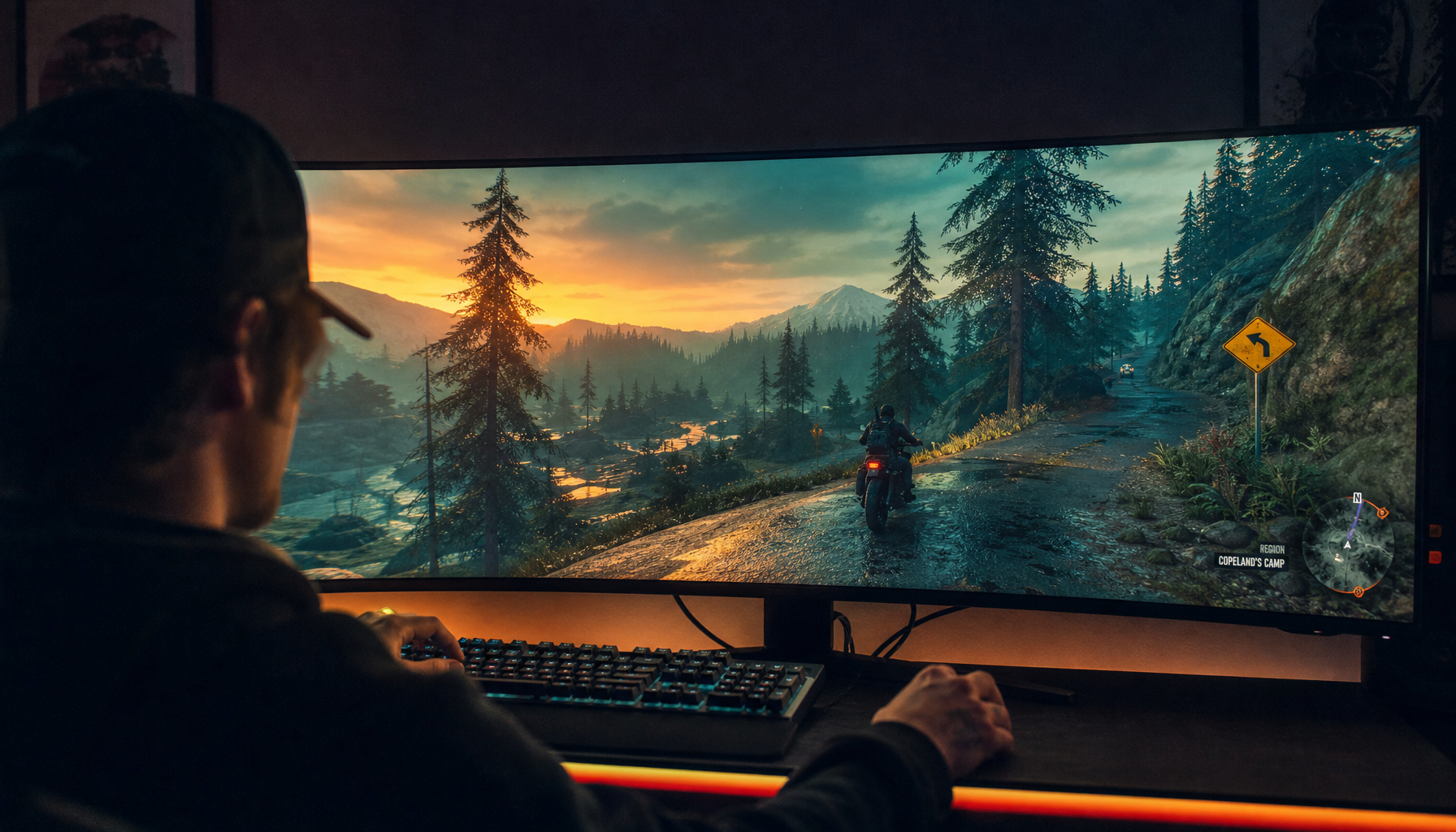
A 21:9 ultrawide can provide a real advantage in supported games because it may show more horizontal scene information. That can help in racing games, open-world games, flight games, extraction shooters, and slower tactical titles where peripheral awareness matters. The tradeoff is that some competitive games lock the image to 16:9, add black bars, stretch the image, crop vertical space, or place HUD elements too far from the center.
Where 32:9 Fits
A 32:9 super ultrawide is best treated as an immersion and productivity format, not the default competitive format. In games that support it well, the view can feel expansive, but the same extra width can create edge distortion, inconsistent UI placement, or fairness restrictions. For serious ranked play, many users end up running a 32:9 monitor in a centered 16:9 mode with black bars, which gives up the main reason they bought the wider panel.
Why Distortion Happens: Aspect Ratio, Resolution, and Scaling Must Match
Aspect ratio is the shape of the display, while resolution is the number of pixels used to draw the image. A 1920 x 1080 screen is 16:9, a 1920 x 1200 screen is 16:10, and a 1280 x 1024 screen is 5:4; distortion appears when the source image and the monitor shape do not match and the display stretches the signal to fill the panel width-to-height relationship. On a gaming monitor, that mismatch can make enemies, scopes, maps, and UI elements look subtly wrong even when the frame rate is high.

A common example is using 1280 x 960 on a 16:9 monitor. That resolution has a much squarer shape than 1920 x 1080, so if the monitor forces it to full screen, the image expands horizontally and objects look wider than intended stretches the image. Some competitive players intentionally use stretched resolutions, but that is a preference tradeoff, not an undistorted setup.
The Clean Setup Rule
Use the monitor’s native resolution whenever possible. For common gaming monitors, that usually means 1920 x 1080 on a 24-inch Full HD display, 2560 x 1440 on a 27-inch QHD display, 3840 x 2160 on a 4K display, or 3440 x 1440 on a 34-inch ultrawide. Then set the monitor aspect mode to Auto, Original, 1:1, or Aspect instead of Full or Wide if you are feeding it a non-native signal.
Scaling Is Not the Same as Stretching
Operating system scaling changes the size of text and interface elements without changing the actual shape of the image. That matters in mixed-monitor setups, such as a 27-inch 1440p main display beside a 15.6-inch portable monitor, because the wrong scaling can make menus awkward without necessarily distorting the game. For competitive play, keep the game resolution native first, then adjust UI scale inside the game if the HUD feels too large or too far away.
Aspect Ratio Comparison for Gaming Monitors
Aspect ratio |
Common resolution examples |
Best use case |
Competitive advantage |
Main distortion or support risk |
4:3 |
1024 x 768, 1280 x 960 |
Legacy PC games, intentional stretched esports setups |
Can make targets appear wider when stretched |
Distorts heavily on 16:9 unless displayed with black bars |
5:4 |
1280 x 1024 |
Older office monitors and older games |
Limited modern gaming value |
Poor match for most modern titles |
16:10 |
1920 x 1200, 2560 x 1600 |
Portable monitors, laptops, productivity plus gaming |
Slightly more vertical room than 16:9 |
Some games add small bars or frame for 16:9 |
16:9 |
1920 x 1080, 2560 x 1440, 3840 x 2160 |
Esports, console gaming, streaming, high refresh rates |
Best compatibility and predictable framing |
Less horizontal view than supported ultrawide |
21:9 |
3440 x 1440, 2560 x 1080 |
Immersive PC gaming and multitasking |
Wider view in supported games |
Black bars, stretched edges, HUD distance, higher GPU load |
32:9 |
5120 x 1440, 3840 x 1080 |
Simulation, racing, multitasking, showcase setups |
Very wide peripheral view when supported |
Strong support variance, edge distortion, fairness limits |
The important buying lesson is that a wider aspect ratio does not automatically mean a better competitive advantage. A 23-inch 4:3 display has more total screen area than a 23-inch 16:9 display at the same diagonal, which shows why diagonal size alone can be misleading total screen area. For monitor shopping, compare actual width, height, resolution, refresh rate, and game support instead of relying only on the advertised diagonal size.
For most players, the table points to a simple hierarchy. Choose 16:9 if you mainly care about winning, choose 21:9 if you split your time between competitive and immersive gaming, and choose 32:9 only if your favorite games are known to handle super ultrawide properly. If you are buying one monitor for both work and gaming, a 34-inch 3440 x 1440 ultrawide can be excellent, but it should not be assumed to outperform a fast 27-inch 1440p 16:9 display in ranked play.
Does Ultrawide Actually Give a Competitive Advantage?
Ultrawide can help when the game increases horizontal field of view without cropping the top and bottom of the image. In those cases, a 21:9 monitor can show more side information than a 16:9 monitor, which may help you notice movement, track vehicles, or read the environment sooner. Some gaming communities recognize this exact issue: user discussions around store pages often ask publishers to disclose whether games support 21:9 or 32:9 properly because vague ultrawide support labels do not explain whether the image scales, crops, or stretches supported aspect ratios.

The advantage becomes weaker in tightly balanced competitive titles. Some games lock ranked play to 16:9 so ultrawide users do not gain extra viewable area, while others show 16:9 cutscenes with side bars or stretch the edges of the image lock the aspect ratio. Even when the game technically supports 21:9, the HUD may sit far to the left and right, forcing extra eye movement during fights.
Field of View Can Help or Hurt
Field of view is where ultrawide gets complicated. A wider field can reveal more of the scene, but excessive FOV can create a fish-eye effect at the edges and make distance judgment harder. In one multiplayer game discussion, ultrawide users debated 90 versus 120 FOV on a 5120 x 1440 display, with one commenter describing 90 to 120 as a 30% view advantage while others raised distortion and fairness concerns 90 versus 120 FOV.
GPU Load Matters Too
A wider monitor also asks the graphics card to render more pixels. Moving from 2560 x 1440 to 3440 x 1440 increases the pixel load from just under 3.7 million to just under 5 million pixels. If that causes your frame rate to drop below your monitor’s refresh rate, the theoretical visibility advantage can be offset by worse motion clarity and higher input latency.
Best Aspect Ratio by Player Type
For esports-focused players, the best choice is a 16:9 monitor at 24 or 27 inches. A 24-inch 1080p high-refresh-rate display keeps the whole screen easy to scan, which is one reason it remains common for competitive shooters. A 27-inch 1440p model is better if you want sharper visuals without jumping to a much heavier 4K workload.

For players who want both competitive gaming and immersion, a 34-inch 21:9 ultrawide at 3440 x 1440 is the balanced upgrade. It works well for cinematic games, racing titles, RPGs, and multitasking, but you should check your top five games before buying. If two or three of those games use black bars, crop the image, or lock ranked modes to 16:9, a 27-inch 1440p 16:9 monitor is usually the smarter purchase.
Portable and Secondary Monitor Setups
Portable monitors often use 16:9 or 16:10, and both can work well as secondary displays. For travel gaming, 16:9 is still easier because it matches most game and console output. For work beside a gaming monitor, 16:10 can be more comfortable because the extra vertical space helps with chat, guides, messaging apps, monitoring tools, and browser windows.
Console and Capture Setups
If you use a console, capture card, or streaming workflow, 16:9 is the least complicated option. Most console output, video platforms, and overlays expect 16:9 framing, so a 21:9 or 32:9 monitor often needs black bars or cropping for clean recording. For anyone who posts gameplay clips or streams, that compatibility can matter more than extra screen width.
How to Avoid Distortion on Any Gaming Monitor
Start by matching the game resolution to the monitor’s native resolution. If the correct resolution is missing, update the graphics driver, check the cable, and confirm that the monitor is connected through a port that supports the desired resolution and refresh rate. For example, a 1440p high-refresh-rate monitor may not expose every mode through an older cable or limited adapter.
Next, check the monitor’s built-in aspect controls. Modes named Aspect, Original, Auto, or 1:1 usually preserve the image shape, while Full or Wide may stretch a mismatched image across the whole screen. In competitive games, use Full only when the selected resolution already matches the monitor’s aspect ratio or when you deliberately want a stretched look.

Quick Diagnostic Example
If a 16:9 monitor looks stretched at 1280 x 960, switch to 1920 x 1080, 2560 x 1440, or another true 16:9 resolution supported by the panel. If the game is old and only supports 4:3, use aspect-preserving scaling so the image appears with side bars instead of stretching. That preserves geometry, even though it does not fill the entire screen.
Settings Order That Usually Works
Fix the display before fine-tuning the game. Set the operating system to the monitor’s recommended resolution, confirm refresh rate, choose the correct scaling behavior, then adjust the in-game resolution, aspect ratio, FOV, and HUD scale. This order prevents you from chasing game settings when the real problem is a system-level display mode.
Key Takeaways
The best competitive aspect ratio without distortion is 16:9. It gives the strongest mix of clean geometry, high refresh rate availability, broad game support, easy capture, and predictable UI placement. Ultrawide can be better for immersion and can help in supported games, but it is not the most reliable choice for ranked competitive advantage.
Use this checklist before buying or configuring a monitor:
- Choose 16:9 for serious esports, ranked shooters, console play, or streaming.
- Choose 21:9 only after confirming that your main games support it without cropping, stretching, or HUD problems.
- Treat 32:9 as a specialty format for simulation, racing, multitasking, and immersion.
- Set your monitor to its native resolution before judging image quality.
- Use Aspect, Original, Auto, or 1:1 scaling when playing older or mismatched games.
- Check frame rate after moving to ultrawide, because extra pixels can reduce motion clarity.
- Keep a 16:9 fallback mode available on ultrawide monitors for competitive titles.
FAQ
Q: Is 16:9 better than 21:9 for competitive gaming?
A: Usually, yes. 16:9 is better for competitive consistency because it has wider game support, simpler streaming and capture, predictable HUD placement, and fewer distortion risks. A 21:9 monitor can help in games that properly expand horizontal field of view, but many competitive titles limit or adjust ultrawide output.
Q: Does stretching a 4:3 resolution give an advantage?
A: It can make character models appear wider on a 16:9 screen, which some players prefer, but it is distortion by definition. The image no longer preserves its original geometry, and your horizontal and vertical perception will not match a native 16:9 image. For an undistorted setup, use a resolution that matches the monitor’s aspect ratio or use black bars.
Q: What is the best resolution for a 16:9 competitive monitor?
A: For maximum frame rate, 1920 x 1080 on a 24-inch monitor is still practical. For a sharper image with strong competitive performance, 2560 x 1440 on a 27-inch monitor is the better all-around choice. 4K can look excellent, but it requires a much stronger graphics card to maintain very high refresh rates.