Yes, a monitor can be too big for competitive gaming if it forces extra eye or head movement, lowers frame rates, or makes key UI elements harder to track. For most esports players, 24 to 27 inches remains the practical range, with 24-inch 1080p high-refresh displays still favored for pure speed.
Ever lose a duel because your eyes were chasing the minimap, crosshair, and enemy movement across too much screen? A well-sized gaming monitor keeps the action inside your natural scan area while still giving you enough clarity to spot targets quickly. This guide breaks down when bigger helps, when it hurts, and how to choose the right size for ranked shooters, esports, and mixed gaming.
Why Bigger Is Not Always Better for Competitive Play
Large monitors can feel impressive, especially in open-world games, racing sims, and cinematic titles. But competitive gaming rewards fast scanning more than spectacle. A 24-inch screen keeps more of the display inside central vision, which can reduce the need to move your head during fast FPS matches.
The issue is not simply screen size. It is the relationship between size, viewing distance, resolution, refresh rate, and game UI. A 32-inch monitor placed too close can make the minimap, ammo count, health bar, and enemy movement sit farther apart than they would on a 24-inch display. That extra scanning distance can matter in games where reaction windows are measured in fractions of a second.
Central Vision Matters

Competitive players often prefer 24- to 24.5-inch monitors because key information stays within a tighter field of view. A 24-inch competitive setup is described as fitting important HUD information within roughly a 30- to 40-degree central vision cone.
In practical terms, that means less visual travel between your crosshair, corners, radar, and status indicators. If you play a tactical shooter, tactical shooter-style games, hero shooter-like arena games, or battle royale modes at a high level, that tighter scan area can feel more controlled than a larger, more cinematic display.
Best Monitor Sizes for Competitive Gaming
The best size depends on what you prioritize: pure competitive speed, sharper image detail, or a mix of gaming and everyday work. For most ranked FPS players, 24 inches is still the safest choice. For players who want better sharpness and also play RPGs, strategy games, or single-player titles, 27 inches can be the better balance.
A 27-inch 1440p monitor is commonly treated as a balanced setup because it improves detail while still supporting high frame rates on a capable PC. The tradeoff is that a 27-inch panel usually requires slightly more eye movement than a 24-inch panel, especially when placed close.
Monitor Size |
Best Use |
Recommended Resolution |
Practical Viewing Distance |
Competitive Notes |
24 to 24.5 inches |
Esports, ranked FPS, high-refresh play |
1080p |
20 to 28 inches |
Easiest to scan quickly; common pro-style size |
27 inches |
Mixed competitive and immersive gaming |
1440p |
24 to 30 inches |
Sharper than 24-inch 1080p; slightly more eye travel |
32 inches |
Casual competitive, 4K gaming, desk use |
4K |
30 inches or more |
Better for detail, less ideal for fast HUD scanning |
34-inch ultrawide |
Immersive gaming, racing, multitasking |
3440×1440 |
30 to 40 inches |
Wider view, but more GPU load and eye movement |
49-inch super ultrawide |
Sim racing, flight sims, productivity |
5120×1440 |
36 to 42 inches |
Requires deep desk or monitor arm; not ideal for most esports |
24 Inches: The Esports Default

A 24-inch 1080p monitor is still popular because it is easy to drive at very high frame rates. The screen is compact, the UI is easy to scan, and 1080p remains light enough for 240Hz or 360Hz targets on many gaming PCs.
For a more compact high-refresh example, the a brand’s 24” FHD 165Hz/180Hz 1000R curved gaming monitor fits the same basic priority: a 24-inch FHD screen for players who care more about visibility and frame rate than a larger canvas.
Pixel density is also acceptable at this size. A 24-inch 1080p monitor is about 93 PPI, which is not ultra-sharp, but it is clear enough for competitive play and helps reduce the hardware burden compared with higher resolutions.
27 Inches: The Balanced Choice
A 27-inch 1440p monitor gives a noticeable sharpness upgrade. At about 109 PPI, it usually looks cleaner than 24-inch 1080p while still being realistic for high-refresh gaming.
The weak point is 27-inch 1080p. At about 81 PPI, it can look visibly softer at close range. If you want 27 inches, 1440p is usually the better match unless your only goal is maximum frame rate on a limited GPU.
Refresh Rate and Response Time Can Matter More Than Size
A larger monitor will not help much if it drops your frame rate or adds display blur. For competitive gaming, refresh rate and response time are core buying specs. A 240Hz display is aimed at esports use, while 1ms or lower response time is commonly recommended to reduce ghosting.
This is where 24-inch 1080p monitors keep winning. They are easier for the GPU to drive, which helps players hold high frame rates more consistently. A smooth 240Hz 1080p experience can be more useful in a competitive shooter than a larger 4K screen running at unstable frame rates.
Resolution Has a Performance Cost
The jump from 1080p to 1440p or ultrawide 1440p increases GPU workload. A standard 2560×1440 display renders about 3.7 million pixels, while 3440×1440 renders almost 5 million pixels, meaning an ultrawide monitor requires about 34% more GPU work than standard 1440p.
That extra load can reduce frame rates unless your graphics card has enough headroom. If you are buying for ranked play, test whether your PC can hold your target FPS at the monitor’s native resolution before choosing a larger or wider screen.
Ultrawide Monitors: Great for Immersion, Risky for Ranked FPS

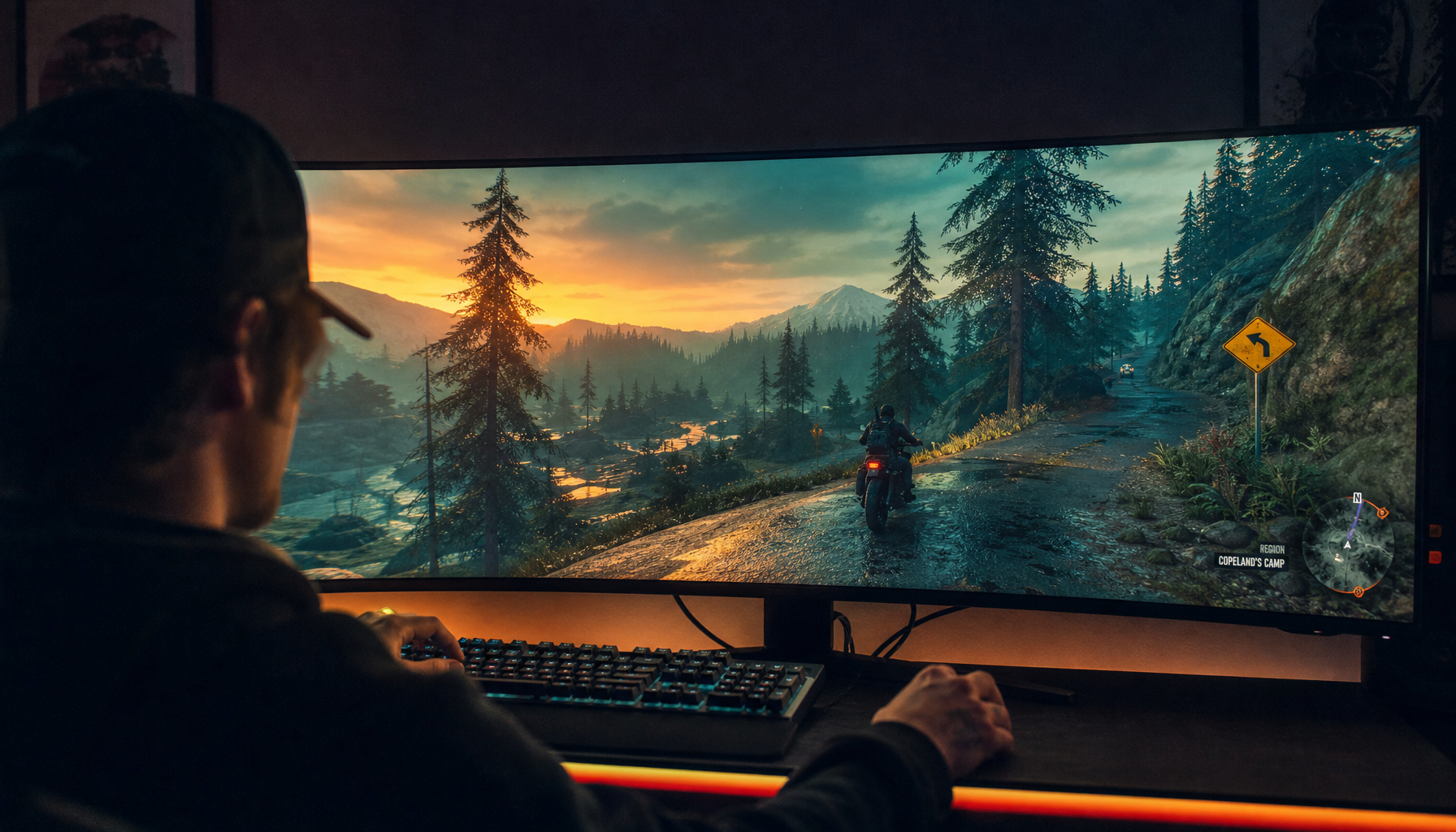
Ultrawide monitors are excellent for certain genres. Racing, flight simulators, adventure games, and open-world titles can benefit from wider peripheral scenery. A 32:9 super ultrawide is roughly like placing two 16:9 monitors side by side, which can also help with multitasking.
For competitive shooters, the tradeoffs are more complicated. Some games do not support 21:9 or 32:9 properly, and unsupported titles may show black bars or stretched visuals. Some competitive games may lock the aspect ratio to 16:9 to prevent ultrawide users from gaining a field-of-view advantage.
Extra Width Can Split Attention
More screen is not always more useful information. In ranked FPS matches, extra width can pull your attention away from the center of the action. If enemies, UI elements, and peripheral motion are spread across a wider canvas, you may need more eye movement to process the same fight.
A 34-inch ultrawide can be excellent if you mostly play immersive games and occasionally queue ranked. But if competitive shooters are your main priority, a 24-inch or 27-inch 16:9 high-refresh monitor is usually the more disciplined choice.
Viewing Distance and Desk Depth Can Make or Break the Setup

A monitor that feels too big may simply be too close. For 24- and 27-inch displays, a viewing distance around 20 to 28 inches is a practical starting range. Larger monitors need deeper desks so your eyes are not forced to scan across an oversized image at close range.
For a 49-inch ultrawide, the recommended range is much farther back. A 49-inch ultrawide is often best viewed from 36 to 42 inches away, with about 40 inches as a practical starting point.
Monitor Stands Reduce Real Distance
Desk depth can be misleading. A 30-inch-deep desk does not always give you 30 inches of eye-to-screen distance because the monitor stand may push the panel several inches forward. With large screens, a monitor arm can help reclaim distance and make the setup more comfortable.
Set the screen so the top edge is at or slightly below eye level, then use a slight downward viewing angle. If you find yourself leaning forward to read text, adjust scaling or UI size before moving a large monitor closer.
Action Checklist for Choosing the Right Size
- Choose 24 to 24.5 inches if ranked FPS and esports performance are your top priority.
- Choose 27 inches with 1440p if you want sharper visuals and still care about competitive play.
- Avoid 27-inch 1080p unless budget or frame rate matters more than image sharpness.
- Use 32 inches mainly for 4K gaming, slower-paced titles, or mixed desk work.
- Pick ultrawide only if your favorite games support it well and your GPU can handle the extra pixels.
- Measure your real eye-to-screen distance, not just desk depth.
- Prioritize 144Hz minimum, 240Hz or higher for serious competitive shooters, and fast response time.
FAQ
Q: Is a 32-inch monitor too big for competitive gaming?
A: It can be. A 32-inch monitor usually works better for 4K gaming, single-player games, and mixed use than for fast ranked FPS. If it sits too close, you may need more head and eye movement to track the full screen.
Q: Is 24 inches or 27 inches better for FPS games?
A: For pure competitive FPS, 24 inches is usually better because it keeps the full screen easier to scan. For players who want better detail and also play non-competitive games, 27-inch 1440p is a strong middle ground.
Q: Are ultrawide monitors bad for competitive gaming?
A: Not always, but they are less predictable. Some games support ultrawide well, some show black bars, and some competitive titles restrict aspect ratios. Ultrawide is better for immersion than for the most focused esports setup.
Final Takeaway
A monitor becomes too big for competitive gaming when it makes you slower: slower to scan the HUD, slower to acquire targets, or slower because your GPU cannot maintain high frame rates. For most competitive players, a 24-inch 1080p high-refresh monitor is still the cleanest choice, while 27-inch 1440p is the best compromise for players who want sharper visuals without giving up too much speed.
References
- KTC: Monitor Size: How to Choose for Gaming and Home Office
- KTC: Ideal Viewing Distance for a 49-Inch Ultrawide Monitor
- KTC: Why Gamers Are Switching to Ultrawide Monitors
- KTC: How to Choose a Gaming Monitor for Your PC
- KTC: 24-Inch vs 27-Inch Gaming Monitor: Size Guide 2026
- XDA Developers: 4 Things I Wish I Knew Before Buying an Ultrawide Monitor