









Curved gaming monitors do not create motion blur on their own, but they can make blur feel stronger by putting more fast-moving image area into your field of view, especially on large ultrawides with slower LCD pixel transitions.
Ever snap your aim in a shooter or turn into a corner in a racing game and feel like the whole screen goes soft, even though the frame rate looks high? That is a common complaint on big curved displays, and one real-world triple 32-inch 240Hz setup still looked blurry during fast cornering at about 185 FPS. You will leave with a practical way to tell whether the problem is the curve, the panel, or the monitor settings before you choose your next gaming display.

What You Are Actually Seeing
Motion blur and ghosting are not the same problem
What many players call blur is often sample-and-hold blur, where an LCD holds each frame until the next one arrives and your eyes smear that motion while tracking it. That is why a 60Hz screen, which holds each frame for about 16.7 ms, looks much softer in motion than a 240Hz screen, which cuts that window to about 4.2 ms.
A second issue is ghosting, which comes from pixels changing too slowly and leaving a visible trail behind moving objects. In practice, that is why dark scenes on some VA gaming monitors can show black smear even when the refresh rate spec looks impressive on the box.

The symptom is easy to recognize in real play. A longtime competitive player on a forum described difficulty identifying targets and even reading player names during mouse movement, which is exactly the kind of motion-clarity failure that matters on gaming monitors for shooters.
Why Curvature Can Make Blur Feel Stronger
A curved ultrawide puts more motion at the edges of your vision
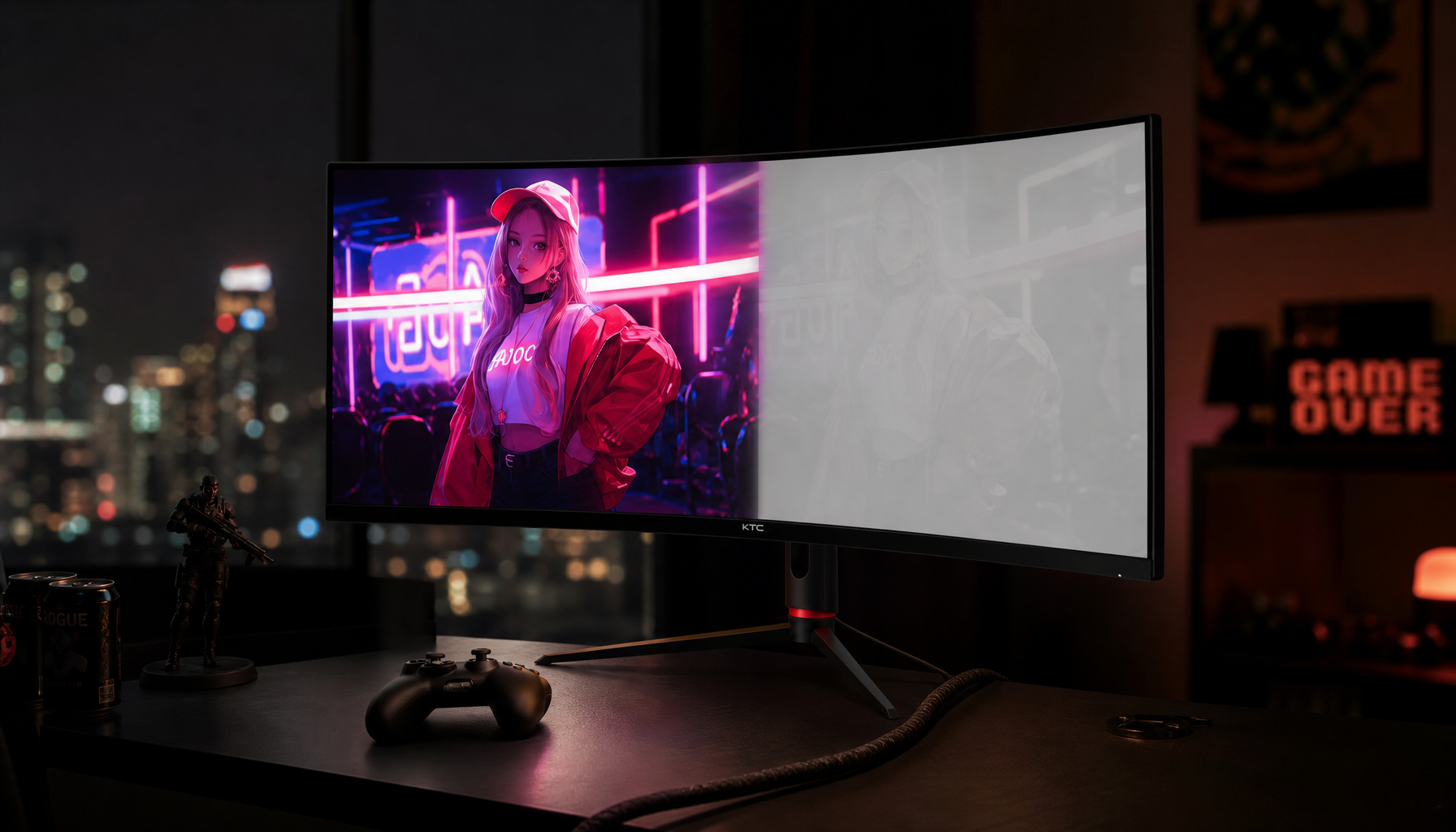
Large curved displays change how motion is distributed across your view. On curved ultrawides, the edges wrap toward you, which improves immersion but also means fast pans send more image detail through your peripheral vision at once.

That matters most on 21:9 and 32:9 gaming monitors because wide fields of view increase edge motion during flicks, strafes, and cornering. A curved monitor setup with a tight 1000R or 1500R curve can feel more enveloping, but that same geometry can make softness at the edges easier to notice in fast-paced games.
The key point is that the curve usually changes perception more than it changes the underlying blur source. Panel type, response time, and refresh rate still do most of the real work, but curvature can make the weakness easier to see because more of the screen is engaged during rapid camera movement.
Why Panel Type Usually Matters More Than the Curve
VA smearing is often the real reason a curved monitor looks blurry
Many curved gaming monitors use VA panels, and VA motion handling is the weak point for fast motion. VA screens can land in the 5-10 ms range for response behavior, with dark-to-dark transitions being the most likely to smear.
A practical example comes from forum testing, where a user running 3x curved 32-inch VA monitors at 7680x1440 and 240Hz still reported blur during fast cornering at about 185 FPS. The important takeaway from the replies was that adaptive sync was helping smoothness and tearing, not motion clarity, and that the panel’s blur-reduction behavior was the real bottleneck.
The cleaner alternative is usually a faster panel. OLED response times can drop to around 0.02 ms, which is why OLED and QD-OLED ultrawides look so much sharper in fast motion than many curved VA LCDs. Fast IPS is the next safest choice if you want a curved monitor without as much black smear risk.
Which Specs and Settings Matter Most
High refresh rate is necessary, but it is not enough
A higher refresh rate does reduce persistence blur, but high FPS alone does not guarantee sharp motion. If the panel transitions are slow, overdrive is poorly tuned, or the monitor’s blur-reduction mode is weak, a 240Hz display can still look softer than expected in actual gameplay.
Blur-reduction modes matter more than many buyers realize. Backlight strobing modes such as a blur-reduction mode, a blur-reduction mode, a blur-reduction mode, and a blur-reduction mode can improve clarity dramatically, but they usually work best when frame rate and refresh rate stay matched and stable. In strobed use, even being 1-2 FPS off the target refresh can visibly reduce detail during motion.
Buying priorities by use case
Overdrive tuning and frame-rate control also affect what you see. Too little overdrive leaves trails behind moving objects; too much creates bright inverse ghosting halos. For VRR play, a sensible frame cap around 90% of max refresh often produces cleaner delivery than letting frame rate bounce at the ceiling. If motion clarity is the top priority, it also helps to compare large curved options against a smaller 25-inch 300Hz IPS model such as a monitor model, since screen size and panel behavior often matter as much as the curve.
Priority |
Competitive FPS monitor |
Immersive curved ultrawide |
What to watch for |
Panel type |
Fast IPS, TN, or OLED |
OLED first, fast IPS second, VA only if well-reviewed |
VA dark smear and slow dark transitions |
Screen size |
24-27 inches |
34-45 inches |
Larger screens magnify edge motion |
Shape |
Usually flat |
Usually curved |
Curve can amplify perceived edge blur |
Refresh rate |
240Hz+ preferred |
165Hz+ is a solid floor |
Refresh alone does not fix slow response |
Response behavior |
1-2 ms class or better in real use |
Sub-5 ms, ideally far lower |
Marketing GtG numbers can be optimistic |
Blur reduction |
Useful if frame rate is locked and stable |
Useful for racing and shooters if supported well |
Often conflicts with VRR |
GPU demand |
Moderate at 1080p or 1440p |
High at ultrawide 1440p and above |
Resolution can keep you away from the monitor’s sweet spot |
Who Should Buy Curved and Who Should Stay Flat
Match the screen to the games you actually play
For esports-style play, flat 24-26 inch monitors still make the most sense because they keep lines straight, simplify aim references, and avoid adding more edge motion to your view. That is one reason most professional competitive setups stay flat and relatively small.
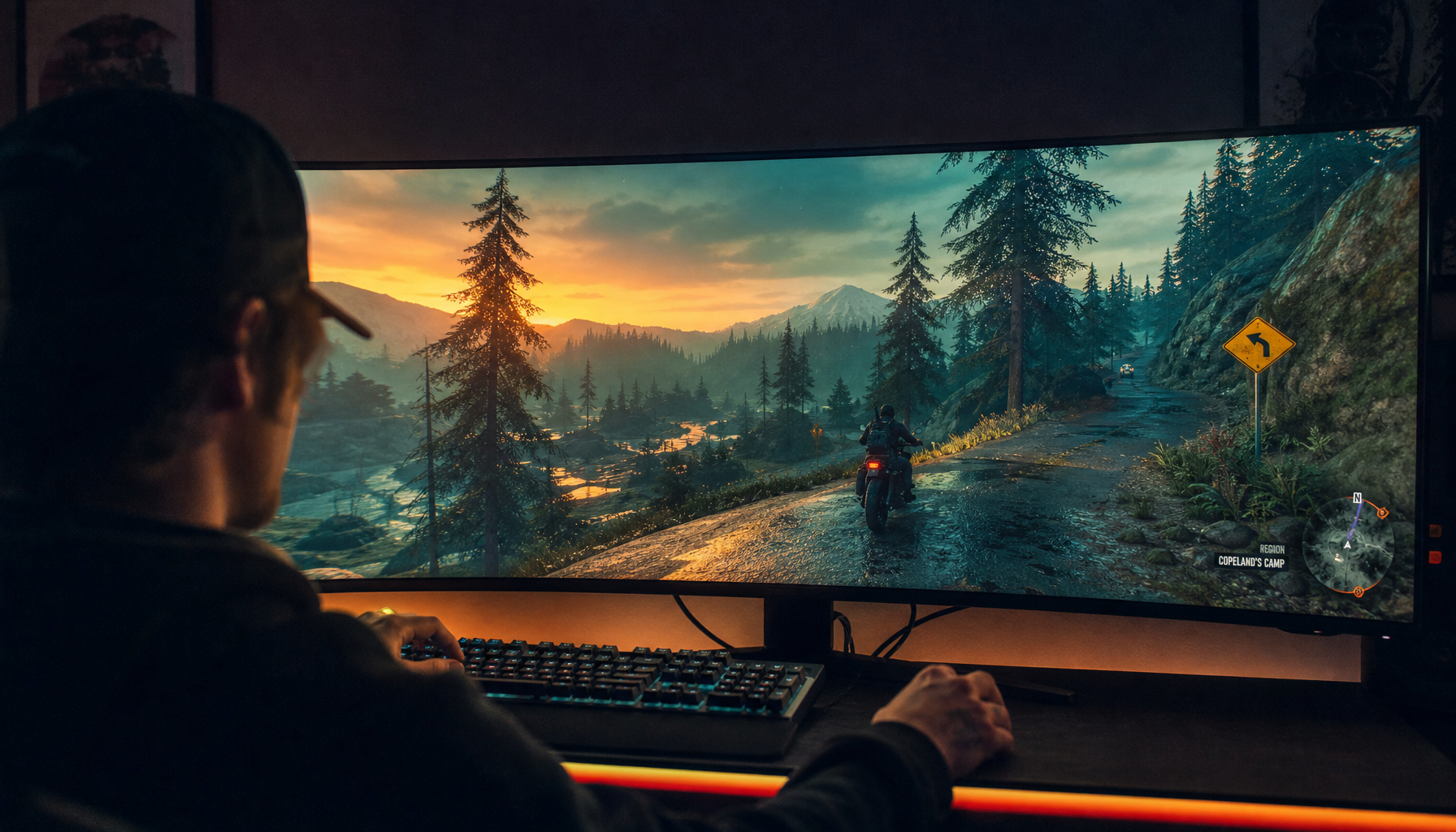
For racing, flight, and open-world gaming, curved ultrawides can be worth it because they make the image feel more natural across a wide span and reduce the need to turn your head toward the edges. The tradeoff is that once you move into 34-inch, 39-inch, or 49-inch territory, any weakness in motion handling becomes easier to spot during fast camera movement.
Hardware load also changes the decision. A super-ultrawide like 5120x1440 can demand a very strong GPU to stay near the refresh ceiling, and if your frame rate falls well below the monitor’s ideal range, the extra immersion may come with softer-feeling motion.
FAQ
Q: Does a curved screen itself cause motion blur?
A: No. The blur mainly comes from sample-and-hold persistence and pixel response behavior. The curve can make that blur feel more obvious because more edge motion reaches your peripheral vision on large ultrawides.
Q: Will adaptive sync fix blur on a curved gaming monitor?
A: Usually not by itself. VRR helps tearing and smoothness, but multiple forum replies noted that it does not directly reduce motion blur. For actual clarity gains, response tuning and blur-reduction modes matter more.
Q: What is the safest curved monitor choice for fast-paced games?
A: A curved OLED is the safest premium option, and a well-tuned fast IPS is the safer LCD option. Curved VA monitors can still be fine for slower or more cinematic games, but they need stronger motion handling reviews before they are a safe buy for shooters.
Practical Next Steps
If you want immersion without making fast motion look worse, buy around panel behavior first and curve second.
- Pick panel type before curvature: OLED first, fast IPS second, VA only with proven low-smear reviews.
- Stay at 165Hz or higher for curved ultrawides, and prefer 240Hz+ for competitive shooters.
- Test overdrive in the monitor OSD instead of assuming the default mode is best.
- Use blur-reduction modes only when you can keep frame rate tightly matched to refresh.
- Cap frame rate slightly below max refresh in VRR mode to improve consistency.
- Run a motion test such as a tracking test before deciding a monitor is “sharp enough.”
- If competitive FPS is the priority, choose a flat 24-27 inch display before a large curved ultrawide.


%20and%20slow%20pixel%20response,%20...
)