Aspect ratio affects more than screen shape. It changes composition, atmosphere, and how naturally a game’s camera language translates to your display.
Aspect Ratio Is a Framing Tool, Not Just a Spec

A display’s aspect ratio is the relationship between width and height, but in story-driven games it also acts as a framing rule before you ever touch brightness, HDR, or resolution. A 16:9 screen presents scenes in the shape most modern games target by default, while 21:9 expands the horizontal canvas and changes how space, isolation, and environmental detail are perceived. That matters because narrative games often borrow visual language from film, where different aspect ratios are used deliberately to shape emotional scale.
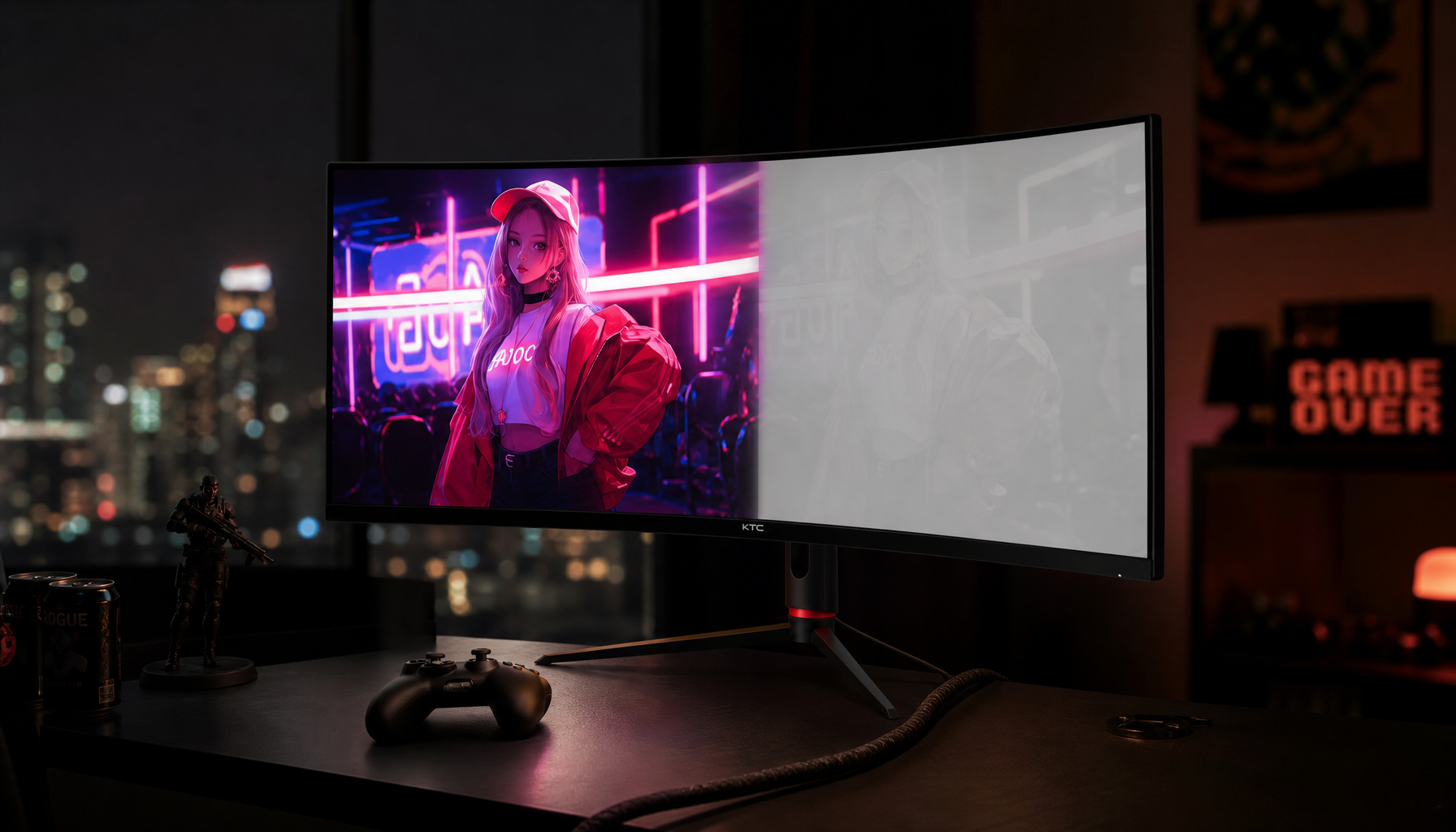
In practice, the difference is easy to feel. On a 27-inch 16:9 display, a close conversation in a cinematic RPG tends to focus your attention on faces and body language. Move that same scene to a 34-inch 21:9 panel and the characters often stay the same height, but the world around them gains breathing room. Hallways feel longer, horizons stretch wider, and negative space becomes part of the storytelling rather than dead margin. That is the key shift: wider ratios can make a game feel less like a window and more like a composed shot.
Film references help explain why. cinema aspect ratios such as 1.85:1 and 2.39:1 were not chosen for technical novelty alone; they changed composition, subject spacing, and perceived scale. Story-driven games use the same logic when cameras linger on a character crossing a valley, entering a ruined city, or standing alone in an empty apartment. A wider display can support that intent, but only if the game’s camera, UI, and cutscene pipeline were built to use the width well.
Why 16:9 Feels Neutral and 21:9 Feels Cinematic
The shape between older TV and theatrical formats became dominant because it sits between older 4:3 television and wider theatrical formats. That compromise is exactly why 16:9 feels so neutral in games. It rarely looks wrong, and it works with almost everything, but it does not push framing toward intimacy or spectacle on its own. It is the safe baseline.
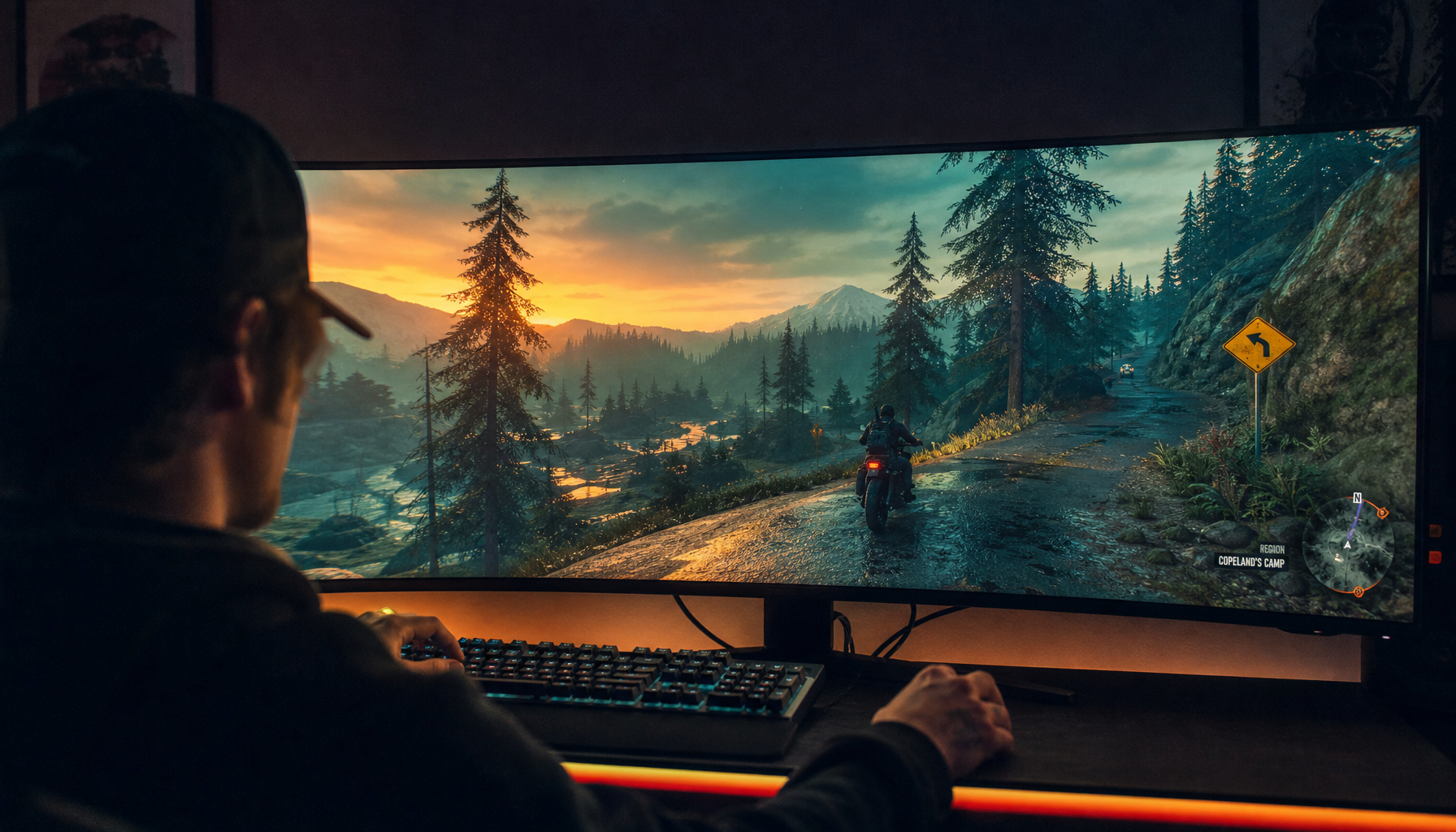
By contrast, a wider field of view can expose more peripheral world detail. In story-led games, that wider field is most effective when the environment is part of the emotional beat. A detective scene gains tension when you can read the apartment around the suspect. A western gains scale when empty plains occupy more of the frame. A sci-fi corridor can feel more oppressive when side walls slide farther into view and emphasize depth.
The catch is that more image is not always better framing. Some games use ultrawide space intelligently, revealing architecture, weather, or crowd motion that strengthens the scene. Others simply extend the edges with low-priority scenery while keeping the dramatic action unchanged in the middle. That can still feel pleasant, but it is not the same as truly cinematic composition.
The Hidden Variable: The Game’s Camera Design
A common way developers preserve framing across mismatched screens is letterboxing or pillarboxing rather than stretching the image. That choice tells you something important: the intended composition often matters more than using every inch of panel space. If a cutscene was blocked for a fixed frame, forcing it to fill a wider monitor can weaken the shot by changing subject position, headroom, or visual balance.
That is why some story-driven games look brilliant in gameplay on ultrawide but revert to black bars in pre-rendered or tightly scripted scenes. The developers are protecting framing. From a viewing standpoint, that is usually the right decision. Cropping can cut off visual cues, and stretching can make characters and spaces look unnatural. Black bars are not a flaw by themselves; they often show that the image is preserving its original intent.
There is a useful parallel in film production. aspect ratio decisions before shooting usually matter because changing the ratio later can damage composition. Games face the same problem through a different pipeline. If the world camera, UI safe zones, subtitles, and cutscene blocking were authored around 16:9, ultrawide support may be technically present but artistically shallow. If the game was framed with widescreen breadth in mind, the effect is obvious the moment you start walking.
Wider Is Not Better if Contrast and Panel Quality Fall Behind

A higher static contrast ratio often does as much for cinematic immersion as extra width, especially in dark story games. This is where many buyers misread the hierarchy. A 21:9 monitor with weak blacks can flatten mood, hide shadow nuance, and make night scenes look gray. A strong 16:9 display with deeper contrast can deliver a more convincing, film-like image even without the wider frame.
This shows up immediately in games built around darkness, candlelight, neon, or fog. On panels around 1,000:1, especially typical IPS implementations, black-heavy scenes can lose depth in a dim room. Around 3,000:1 on a good VA panel, or effectively much higher on OLED, silhouettes separate more clearly from backgrounds and light reads with more drama. In narrative terms, that means fear lands harder, interiors feel richer, and subtle facial lighting carries more emotion. Aspect ratio changes composition; contrast changes atmosphere.
A practical buying rule is simple. If your budget forces a tradeoff between a mediocre ultrawide and a better-balanced 16:9 or 16:10 display, the stronger panel often wins unless the games you play are known for excellent ultrawide support. Width impresses in screenshots. Contrast earns its keep every night.
Where Ultrawide Really Pays Off

The usable horizontal space is real, but it does not add vertical room. That matters when judging ultrawide value. On a 34-inch 3,440 x 1,440 screen, you gain width for panoramas, side scenery, and wider UI layouts, but you do not gain extra screen height over a standard 2,560 x 1,440 panel. So ultrawide helps most when a game’s storytelling benefits from lateral composition, not when you need bigger faces or a taller viewing area.
That is why cinematic adventure games, open-world RPGs, walking sims, and slower horror titles tend to benefit more than menu-dense strategy games or text-heavy interfaces. Wider framing lets environmental storytelling do more work. You notice storm fronts, ruins on the horizon, companions walking just outside center frame, and the uneasy empty space around a lone character. It feels closer to the visual grammar of a scope film.

There is also a comfort factor. Larger single-player setups generally work best in the 27-inch to 32-inch range, with wider formats becoming more compelling as screen size increases and desk distance allows it, a point echoed in screen size and resolution targets. If you sit too close to a very wide monitor, the composition can stop feeling cinematic and start feeling tiring. You end up scanning the edges instead of absorbing the scene.
When 16:10 and 16:9 Are the Smarter Choice
The shift toward 16:9 happened partly because it aligned with television, desktop content, and manufacturing efficiency. For players, that legacy means the safest path is still a high-quality 16:9 display. You get the least friction with game support, video playback, screenshots, streaming overlays, and subtitle placement. For a mixed-use desk that handles work by day and long story sessions at night, it remains the most reliable all-around choice.
A 16:10 screen also deserves more attention than it usually gets. It is not more cinematic in the classic widescreen sense, but the extra height can make interfaces, dialogue boxes, inventory screens, and text logs easier to live with. If you split time between office productivity and story-driven gaming, 16:10 often feels more balanced than ultrawide. You give up some lateral drama, but gain a shape that is easier to use for everything else.
Resolution matters too. 1440p-class displays remain a strong sweet spot because they preserve detail without pushing GPU load as hard as 4K. In story-heavy games, stable frame pacing plus strong image quality usually matters more than chasing the most exotic screen shape.
Retro and Re-Releases Need Extra Caution

The difference between display aspect ratio and pixel aspect ratio becomes important when you play retro games, remasters, or retro-styled releases. Older systems often used non-square pixels, overscan quirks, or display assumptions that do not map neatly to modern panels. That means correct framing is not always as simple as forcing 4:3 or filling a widescreen monitor.
Some analysis of older games argues that they often need case-by-case treatment because their apparent shape on modern screens can differ from what original players actually saw. For players, the practical lesson is straightforward: if a retro title looks too wide, too tall, or strangely cropped, the problem may be historical display behavior rather than bad art. In those cases, preserving the intended frame with bars is usually better than stretching it to fill the panel.
Choosing the Right Screen for Story-Driven Games
If your goal is the strongest cinematic framing, 21:9 is worth it when the games you love already support ultrawide well and you can pair that width with solid contrast and enough desk depth. If your goal is reliability across every launcher, cutscene, and genre, a quality 16:9 display remains the safer investment. If your setup also handles writing, editing, or long office hours, 16:10 can be the most sensible compromise because it supports both immersion and daily usability.
The best display for story-driven games does not just show more. It frames better, preserves mood in dark scenes, and keeps the world believable from gameplay to cutscene. When the screen shape matches the game’s camera language, the result is not simply wider vision. It is stronger presence.