Spatial awareness improves most when your display helps you catch motion earlier, read distant detail clearly, keep the HUD inside your scan zone, and avoid tearing, blur, or dark-scene crush that hides threats.
Ever lose a fight because an enemy seemed to appear from nowhere at the edge of your screen? A properly matched 144Hz or 240Hz setup can make tracking, peeking, and target confirmation feel more immediate when your PC can feed it enough frames. Here is how to choose and tune the display features that actually help you notice movement, read terrain, and react with confidence.
Why Spatial Awareness Depends on the Display
Battle royale games punish late information. You are not just aiming at one opponent; you are scanning rooftops, tree lines, doors, storm edges, loot glints, building edits, muzzle flashes, and the minimap while up to 99 other players may be rotating around you. Survival advice for Fortnite highlights that audio, damaged objects, abandoned structures, and movement toward the center can reveal enemy presence, which means your screen has to preserve small visual signals instead of burying environmental awareness in blur or eye strain.
The best battle royale monitor is not always the biggest or sharpest one. It is the one that lets your eyes gather useful information quickly. That usually means a high refresh rate, clean pixel response, appropriate screen size, readable resolution, stable frame pacing, and settings that prioritize visibility over cinematic effects.
Refresh Rate: The First Upgrade for Tracking Movement

Refresh rate is how many times per second the monitor updates the image. A 144Hz display refreshes far more often than a 60Hz display, while 240Hz shortens the visible gap between frames even further. The practical bottleneck is simple: if a GPU outputs 240 FPS but the monitor is 60Hz, the player only sees 60 visible updates, making refresh rate a core part of the system, not a cosmetic spec.
For spatial awareness, higher refresh helps because moving players, gliding targets, recoil patterns, and camera pans stay easier to track. In a close-range build fight or a late-zone slide across uneven terrain, smoother motion reduces the guesswork between frames. The practical sweet spot for many battle royale players is 144Hz to 165Hz if the PC usually holds that frame rate, while 240Hz is valuable when the system can stay near 240 FPS without constant dips.
The tradeoff is cost and GPU load. A 240Hz monitor does not create awareness by itself if your game runs at 120 FPS with stutter. KTC’s guidance makes the value case well: if your PC is closer to 144 FPS, a strong 144Hz to 180Hz panel is usually smarter than buying a 240Hz display you cannot fully use for competitive gaming.
Response Time and Motion Clarity: Seeing the Target, Not the Trail

Response time describes how quickly pixels change from one shade to another. For battle royale games, poor response behavior shows up as ghosting, dark smearing, or inverse ghosting around fast-moving targets. That matters when an opponent crosses a doorway for a fraction of a second or when you flick from a minimap glance back to a ridgeline.
Monitor testing shows that OLED has become a major force because it combines strong color, deep blacks, and very fast responsiveness, while high-refresh esports monitors can push extreme speed for players who can drive the frames on gaming monitors. IPS remains the value-oriented balanced choice for many players because modern panels can be fast while maintaining good viewing angles and color consistency. VA can look rich in dark scenes, but some models smear darker transitions, which can hurt awareness in shadowed interiors.
Overdrive settings deserve careful tuning. Many monitors offer Normal, Fast, and Extreme modes. The fastest labeled setting is not always the clearest, because excessive overdrive can create bright halos or inverse ghosting behind moving objects. Practical tuning advice recommends avoiding overly aggressive overdrive and using a mode such as Normal or Fast to reduce artifacts in monitor settings. In real play, test by strafing past fence posts, windows, and tree trunks; if edges leave a bright or dark shadow, back off one overdrive level.
Size, Resolution, and Scan Distance

Spatial awareness is partly eye travel. A huge screen can feel immersive, but if the minimap, ammo count, kill feed, and far-left movement require head movement, you may react late. Smaller 24-inch to 25-inch monitors are popular in competitive shooters because they keep key information inside the natural scan zone. KTC notes that this size can help players watch the crosshair, HUD, and enemy positions faster.
A 27-inch 1440p display is often the best mixed-use choice for battle royale players who also work, stream, or play visually rich games. It gives more target detail than 1080p without the heavy GPU demand of 4K. Moving from 1080p to 1440p can reduce performance by roughly 15% to 30%, so the extra clarity must be weighed against FPS stability.
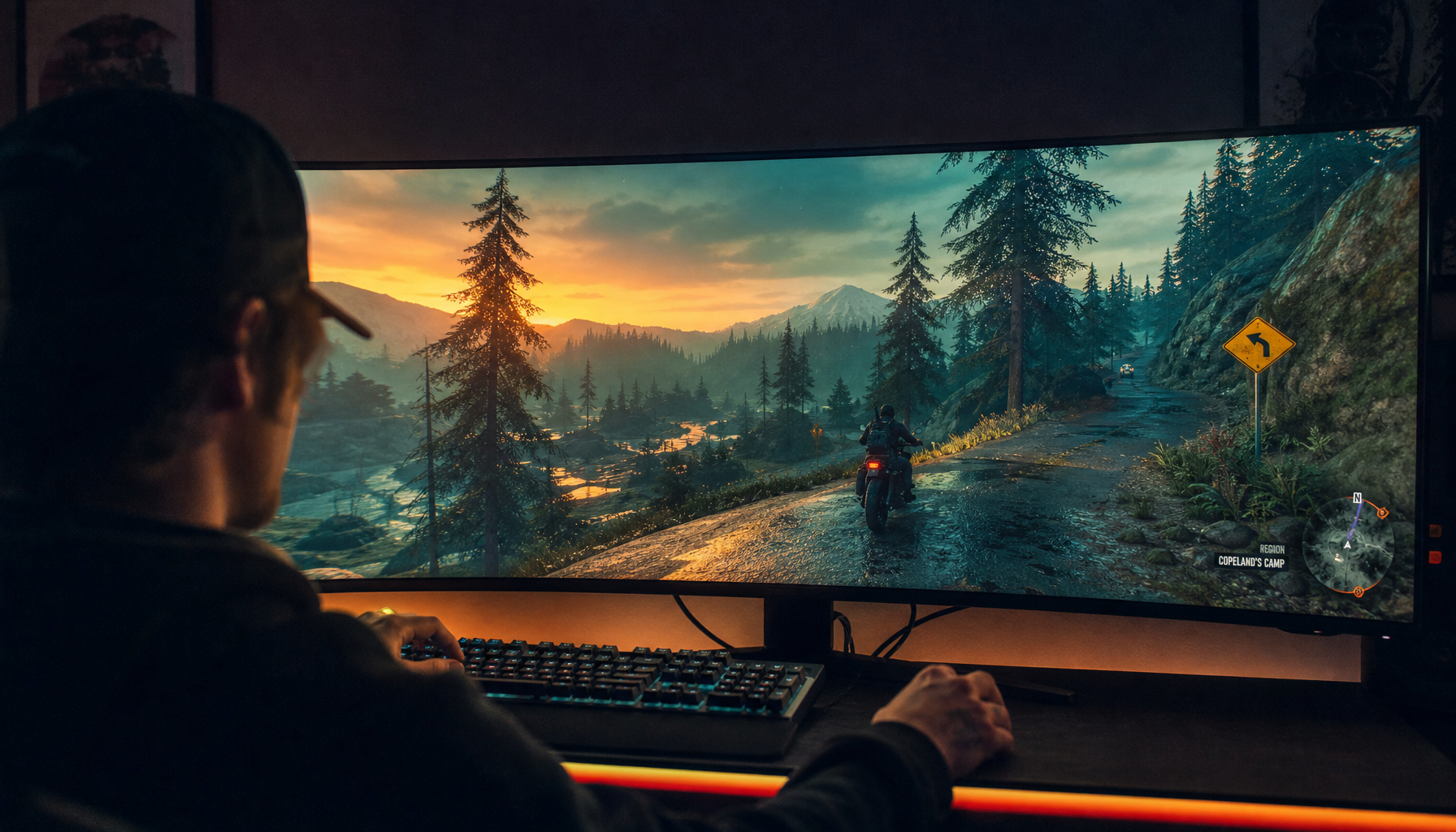
Ultrawide can improve horizontal awareness in supported PC games, but it is not automatically better. Sim racing benefits heavily from expanded field of view, and wide or triple-display setups can create a much broader sense of surroundings through field of view. Battle royale games are more sensitive to GPU load, HUD placement, and game support. If 3440 x 1440 drops your FPS enough to increase stutter, the wider view may cost more awareness than it adds.
Player Type |
Practical Display Fit |
Awareness Benefit |
Main Tradeoff |
Ranked-focused battle royale |
24-inch to 25-inch 1080p, 144Hz to 240Hz |
Fast scanning and high FPS |
Less distant detail |
Mixed gaming and productivity |
27-inch 1440p, 144Hz to 180Hz |
Better target clarity with manageable speed |
Higher GPU load than 1080p |
Immersion-first PC setup |
34-inch 3440 x 1440 ultrawide |
Wider peripheral scene in supported games |
More pixels, more desk space, possible HUD stretch |
Contrast, Brightness, and Dark-Area Visibility

Awareness is not only about speed. You also need to distinguish a player crouched in a doorway, a head peeking over a hill, or movement inside a shaded building. Contrast affects how clearly bright and dark elements separate. VA and OLED panels usually deliver stronger blacks than typical IPS panels, while IPS often offers more consistent color from different viewing angles.
Use brightness, contrast, black equalizer, and color temperature deliberately because these settings affect dark-scene visibility, eye strain, and target separation. For battle royale, avoid crushing blacks so aggressively that interiors become unreadable. A good starting point is moderate contrast, neutral color temperature, and a black equalizer setting that reveals shadow detail without washing the whole map gray.
There is a clear downside. Too much sharpening or black boosting can make grass, fences, and distant textures shimmer, which creates false motion and visual fatigue. The goal is not to make the image loud; it is to make enemy silhouettes and terrain edges legible.
Adaptive Sync and Frame Pacing

Variable refresh rate technologies help the monitor match the GPU’s changing frame output. In battle royale games, frame rate often dips when landing in dense areas, rotating through effects-heavy zones, or fighting near builds and explosions. Adaptive sync can reduce tearing and stutter during those swings, which helps your eyes keep tracking direction and distance.
Monitor refresh should be set to the highest supported rate, while game settings may need to be lowered if the GPU cannot maintain that output through PC gaming optimization. That advice is critical for value. Lowering shadows, post-processing, ray tracing, and heavy effects often improves awareness more than leaving visual presets on Ultra, because stable motion beats prettier blur during a final circle.
Fortnite-focused optimization advice also prioritizes performance settings, fullscreen mode, reduced visual effects, and high refresh targets for competitive play through Fortnite PC settings. The practical rule is simple: if a setting makes enemies harder to see, adds delay, or destabilizes frame time, it belongs below cosmetic fidelity.
Panel Type: Choose the Awareness Tradeoff You Can Live With
Panel choice shapes motion, contrast, and color. IPS is the reliable all-rounder for many battle royale players because it offers good speed, strong viewing angles, and color consistency. OLED is the premium awareness panel when budget allows, especially for near-instant response and deep contrast, though burn-in risk and brightness behavior matter for users who leave static HUDs or productivity windows on screen for long sessions. VA is attractive for contrast and value, but slower dark transitions on some models can reduce motion clarity.
The major panel tradeoffs across TN, IPS, VA, and OLED come down to speed, contrast, color, cost, and burn-in considerations. For most performance-driven buyers, a fast IPS 1440p panel is the safe balanced recommendation. For pure ranked play, a smaller high-refresh IPS or OLED makes sense. For cinematic immersion with occasional battle royale, OLED or a strong VA can be compelling, provided motion handling is tested carefully.
Practical Setup for Better Awareness
Start by setting Windows and the game to the monitor’s native resolution and maximum refresh rate. Then verify that the game is actually running near that refresh target using its FPS counter. If the display is 144Hz and the game swings between 90 and 130 FPS, reduce visual settings before blaming the monitor.
Next, tune for readable motion. Use fullscreen or the game’s best low-latency display mode, disable motion blur, reduce heavy post-processing, and test adaptive sync. Competitive players often lower graphics settings to improve frame rates, reduce distractions, and prioritize visibility through visual clarity. That matches real desk testing: fewer cinematic effects usually means faster target confirmation.
Finally, place the monitor so your eyes land slightly below the top edge and the full HUD fits comfortably in peripheral vision. If you keep missing minimap information, move the display a little farther back or reduce screen size. If distant enemies blur into terrain, move from 1080p to 1440p only if your GPU can keep frame rates stable.
Short FAQ
Is 4K better for spotting enemies?
4K can improve fine detail, but battle royale awareness usually suffers if the GPU cannot sustain high FPS. A fast 1440p monitor is often the better performance and clarity balance.
Is 240Hz worth it for battle royale games?
It is worth it when your PC can stay close to 240 FPS and you play competitively. If your frame rate is usually around 140 FPS, a quality 144Hz to 180Hz display is the better value.
Should I use HDR in battle royale games?
Use HDR only when the game and monitor handle it well. Poor HDR can crush shadows or blow out highlights, while good HDR can improve contrast and scene readability.
The strongest battle royale display is not the most expensive spec sheet. Choose speed you can actually drive, motion clarity you can trust, and image settings that reveal information without adding distraction; that is the setup that turns more screen space into real awareness.