Display-referred HDR tone mapping adapts an image to a specific screen’s limits, while scene-referred HDR tone mapping starts from the brightness relationships of the original scene or rendered world before deciding how they should land on a display.
Does HDR look dazzling in one game, muddy in another, and strangely dim when you drag the same window onto a second monitor? A practical calibration pass can make shadows easier to read, keep highlights from turning into flat white patches, and reduce the “why does this screen look different?” problem. Here is how to understand both tone-mapping approaches and choose the right settings for gaming monitors, office displays, projectors, and portable screens.

The Core Difference
HDR tone mapping fits a wider brightness and color range into what your display can reproduce, so highlight detail, shadow visibility, and midtone contrast survive the trip from content to screen. A 1,000-nit HDR master, for example, cannot be shown at full intensity on a 400-nit portable monitor, so the display or software must decide what to compress, preserve, or let clip; tone mapping is that decision-making step.

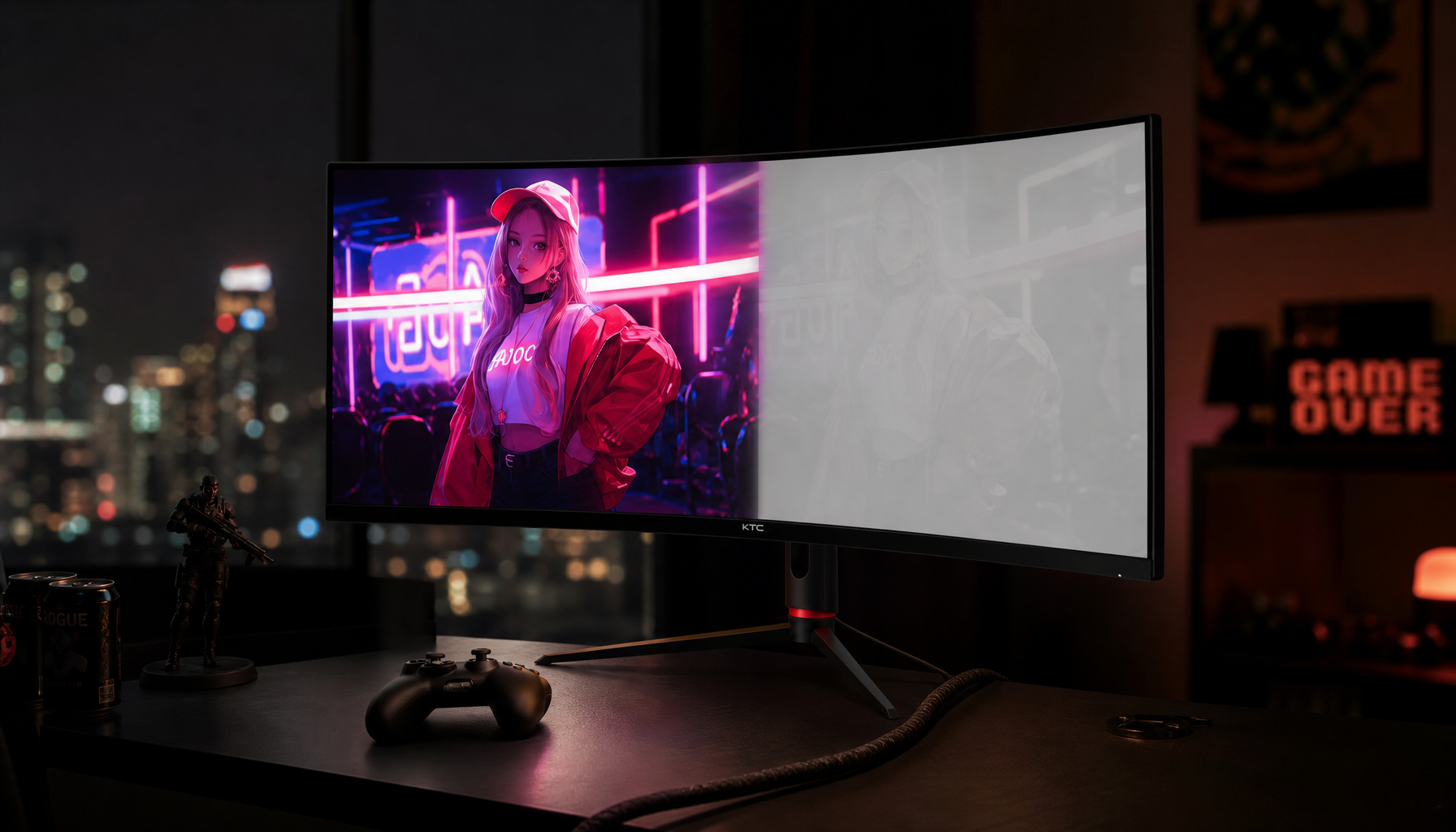
Display-referred tone mapping starts with the display as the reference. The algorithm asks: “Given this monitor’s peak brightness, black level, color volume, local dimming behavior, and HDR mode, how should this content be reshaped?” That is why the same HDR movie can look punchy on a mini-LED desktop monitor, soft on an HDR400 office display, and muted on a USB-C portable screen.
Scene-referred tone mapping starts earlier. It treats the source image or rendered game world as a representation of scene light before the final display conversion. In real-time graphics, the pipeline often simulates incoming light, applies exposure, and then maps those values into display output; HDR game rendering commonly uses this kind of scene-light-to-display pipeline.
Approach |
Reference Point |
Best Fit |
Main Risk |
Display-referred |
The target screen’s real output limits |
TVs, monitors, projectors, desktop HDR use, consumer playback |
Can vary strongly from screen to screen |
Scene-referred |
The original scene, camera capture, or rendered light values |
Games, CGI, photography, grading, creative pipelines |
Needs a final display transform or it may not look right on actual hardware |
Display-Referred HDR: Screen First, Hardware Reality First
Display-referred tone mapping is what most monitor buyers encounter first. Your screen receives HDR content, reads metadata or signal characteristics, then compresses brightness and color into its own capabilities. Some HDR formats rely on static metadata, while others can use dynamic metadata to adapt more precisely over time; HDR formats differ partly because of how much tone-mapping guidance they carry.
This approach is practical because displays are not equal. An HDR1000-class gaming monitor has far more highlight headroom than a 400-nit productivity monitor. A projector has a harder job because its light is spread across a large reflective surface, so HDR mastered for 600, 1,000, or 4,000 nits often needs aggressive adaptation on a 100-inch to 150-inch image; projector tone mapping exists because screen size and room light change perceived brightness dramatically.
The advantage is reliability. Display-referred mapping can protect you from clipped clouds, blown-out weapon flashes, unreadable office charts, and gray-looking dark scenes. The downside is inconsistency. If one monitor prioritizes highlight sparkle and another prioritizes midtone brightness, the same HDR source may feel like two different masters.
For office productivity displays, this matters when HDR is enabled globally at the operating-system level. SDR spreadsheets, browser windows, HDR video, and game launchers may all share the desktop compositor. System-level tone mapping can help with mixed windows, but it can also make HDR brightness feel less direct than a full-screen TV-style pipeline.
Scene-Referred HDR: Preserve the World Before the Screen
Scene-referred tone mapping is more natural for creators, game engines, and HDR photography workflows. Instead of asking what one monitor can show immediately, it preserves the relative brightness of the scene first: a candle, a face, a neon sign, and the sunlit sky all occupy different light relationships before a display curve compresses them.
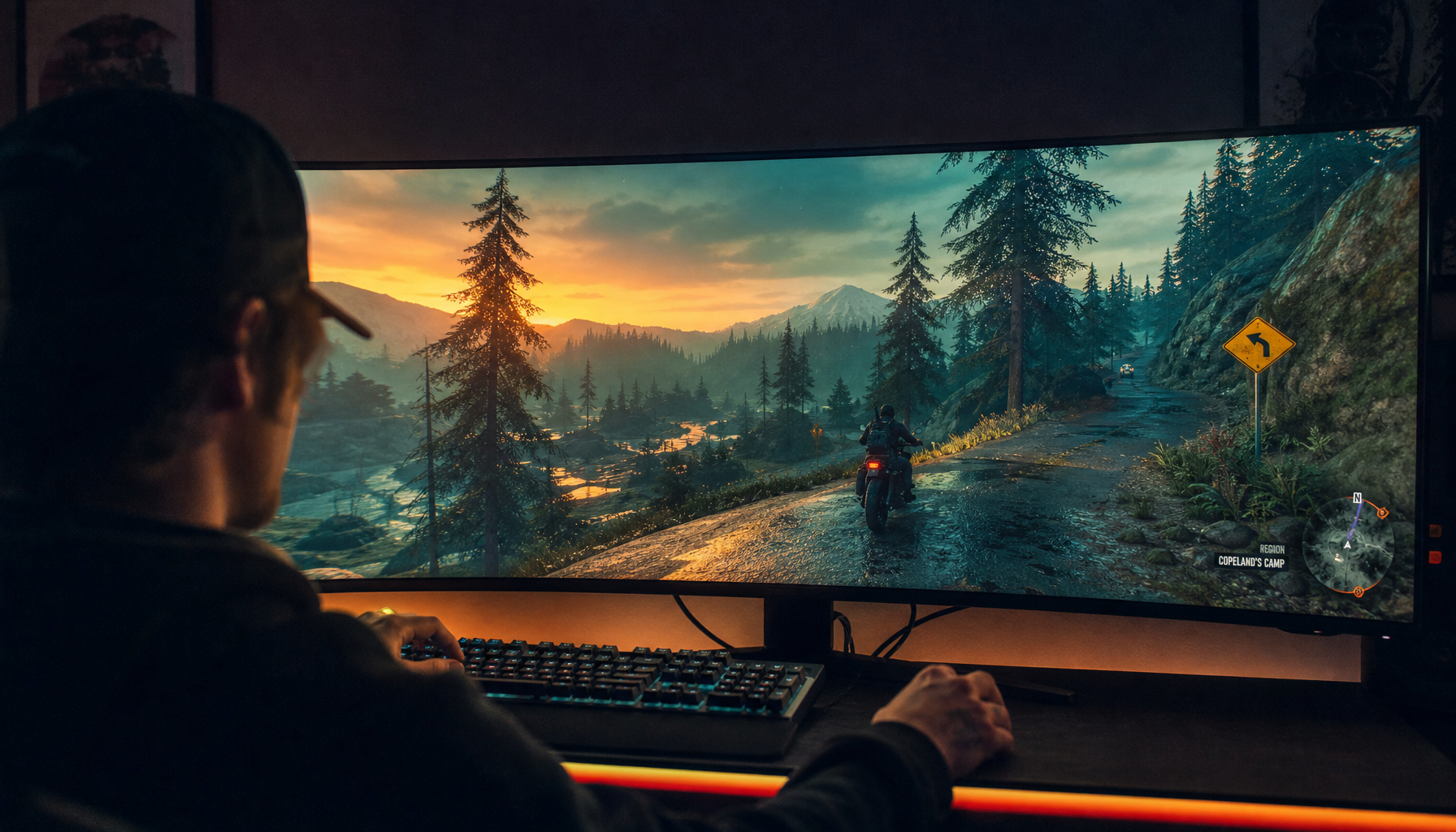
That is why scene-referred workflows are powerful in games. A night race can keep headlights intense without forcing the whole road surface to glow. A tactical shooter can expose a dim hallway while still letting a muzzle flash spike briefly. The tone curve becomes part of image rendition, not just compatibility. Filmic curves, Reinhard-style operators, and local exposure methods can each preserve or reshape contrast differently, and tone curve comparisons show that detail preservation and cinematic contrast often involve tradeoffs.

In HDR photography, the same idea appears through bracketed exposures. A photographer may combine darker and brighter shots, then tone map the merged result into a final image. Practical HDR photo workflows warn against treating presets as finished answers because every scene has different shadow and highlight demands; HDR tone-mapping tips recommend using presets only as starting points and watching for unnatural sky color or oversaturation.
The advantage is creative control. Scene-referred workflows can protect intent before display adaptation happens. The downside is that the final image still needs a smart output transform. A beautiful scene-referred render can look too dim, too flat, or too saturated if the display-referred stage is poorly calibrated.
Static, Dynamic, Global, and Local Tone Mapping
Static tone mapping applies one curve across an entire movie, episode, or image. It is simple and stable, but it can compromise difficult content. If one sci-fi battle has extremely bright explosions, a static curve may darken the rest of the title more than necessary.
Dynamic tone mapping adapts scene by scene or frame by frame. For HDR content on projectors, that can make a clear difference because a dark cave scene and a sunny landscape need different compression behavior. Dynamic tone mapping is especially useful when the display has limited brightness but the content swings between very dark and very bright sequences.
Global tone mapping changes the whole image with one mapping behavior. It is fast and predictable, which is why it can feel clean in games and monitors with low-latency priorities. Local tone mapping adapts based on nearby pixels, which can preserve texture and local contrast, but it may introduce halos, brightness pumping, or an artificial sharpened look if the implementation is heavy-handed.
For a practical example, imagine a 400-nit portable monitor showing a 1,000-nit HDR game. Static global mapping may keep the image stable but reduce sparkle in neon signs. Dynamic local mapping may recover sign detail and window reflections, but if the algorithm is poor, brightness may pulse when you pan the camera across a dark street.
Which Is Better for Gaming?
For cinematic single-player games, scene-referred rendering plus careful display-referred output is usually the ideal pairing. The game engine can preserve the authored light relationships, while your monitor’s HDR calibration tells the final stage where your real black floor and peak brightness sit.
For competitive play, the answer is less romantic and more practical. HDR itself usually does not slow the physical pixel response of a monitor, but HDR mode can trigger extra processing, local dimming behavior, overdrive changes, or refresh-rate drops. A drop from 120 Hz to 60 Hz changes scanout delay from about 4.17 ms to about 8.33 ms before other latency is counted, so HDR gaming performance depends heavily on the full signal chain.
The best move is to enable HDR, confirm the refresh rate did not fall, keep Game Mode or Instant Mode active, and compare the same dark scene in SDR and HDR. If HDR makes enemies easier to see without adding delay or smearing, keep it. If it crushes blacks, disables your preferred motion mode, or forces a lower refresh rate, SDR may be the sharper competitive choice.
Console-style HDR calibration is also worth using when available because it reduces unnecessary display-side tone mapping and lets the console or game calibration define the HDR range. On very bright monitors, that can improve consistency. On projectors or dim portable screens, it may look too dark if the game does not provide enough adjustment.
Which Is Better for Office Displays and Portable Screens?
For office productivity, display-referred tone mapping matters more than dramatic HDR impact. You want stable whites, readable text, natural charts, and predictable SDR-to-HDR behavior. A display that chases bright highlights but makes spreadsheets gray or browser windows inconsistent is not helping productivity.
Portable smart screens face tougher limits. Many have lower peak brightness, limited local dimming, and bandwidth constraints over USB-C. In that class, HDR support can be useful for compatibility, but aggressive tone mapping may make the image look closer to enhanced SDR than true high-impact HDR. The buying priority should be measured brightness, color accuracy, clean scaling, and reliable HDR switching rather than the HDR badge alone.
For a work-and-play desk setup, treat HDR as a mode you validate, not a spec you trust blindly. A 27-inch gaming monitor with strong local dimming can make HDR video and games feel immersive. A slim travel display may still be excellent for coding, dashboards, presentations, and streaming, but it should not be expected to reproduce the same highlight intensity.
Practical Setup Advice
Start with the display’s most accurate HDR mode, usually Cinema, Filmmaker, Creator, or a well-tuned Game HDR mode. Avoid extra contrast enhancers if skin tones, subtitles, clouds, or UI elements fluctuate. HDR is supposed to expand contrast and preserve detail, not make every scene scream.
Use your operating system’s HDR calibration or your console’s HDR setup whenever available. Match the calibration to the lighting where you actually use the screen, because a dark room and a sunlit office demand different comfort levels. HDR can look less impressive in a bright room because the value of HDR comes from contrast between darker scene areas and bright highlights, not from making the entire screen bright; HDR brightness behavior is often misunderstood for this reason.

For projectors, reduce ambient light, use an appropriate screen, and leave dynamic tone mapping on for standard HDR content unless it creates obvious instability. For gaming monitors, check refresh rate, input lag mode, overdrive behavior, and local dimming after enabling HDR. For portable screens, prioritize stable brightness and color over aggressive HDR presets.
Pros and Cons in Real Use
Method |
Pros |
Cons |
Display-referred tone mapping |
Adapts to real monitor limits, protects highlights, improves compatibility across consumer screens |
Can change the creator’s intent, varies by display maker and mode, may add processing |
Scene-referred tone mapping |
Preserves scene relationships, supports creative exposure, works well in games and production pipelines |
Needs a final display transform, can look wrong on weak HDR hardware, requires calibration discipline |
Static tone mapping |
Stable, predictable, low processing demand |
Struggles with content that shifts from very dark to very bright |
Dynamic tone mapping |
Better scene-by-scene adaptation, useful for projectors and varied HDR movies |
Can pump brightness or increase processing if poorly implemented |
FAQ
Is display-referred HDR the same as HDR10?
No. HDR10 is a content format with static metadata, while display-referred tone mapping is an adaptation process. A monitor can use display-referred tone mapping on HDR10, dynamic HDR formats, or mixed desktop content.
Is scene-referred tone mapping only for professionals?
No. You experience it whenever a game engine renders HDR lighting before converting it to your screen. Professional colorists and photographers use more controlled forms of the same principle, but gamers see the result in exposure, bloom, shadow detail, and highlight roll-off.
Why does HDR look different on every monitor?
HDR looks different because every display has different peak brightness, black level, color volume, local dimming, processing, and calibration. Tone mapping cannot create hardware capability that the panel does not physically have.
Final Word
Display-referred tone mapping is the practical bridge to your screen; scene-referred tone mapping is the creative bridge from the original light. For the best HDR experience, especially on gaming monitors and portable displays, judge the full chain: content, calibration, display hardware, room lighting, and latency. The winning setup is the one that keeps the image immersive without sacrificing readability, control, or trust.