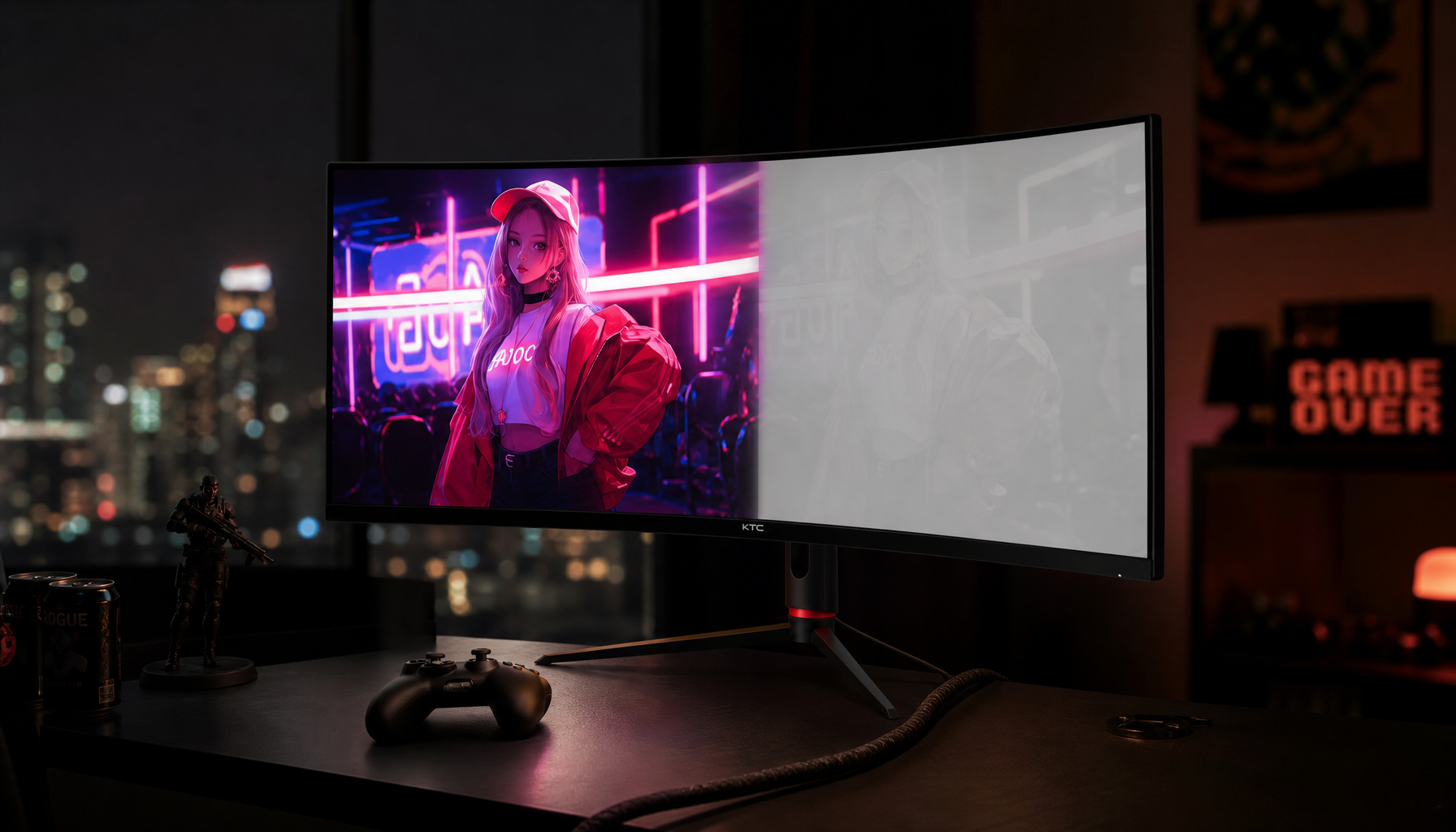
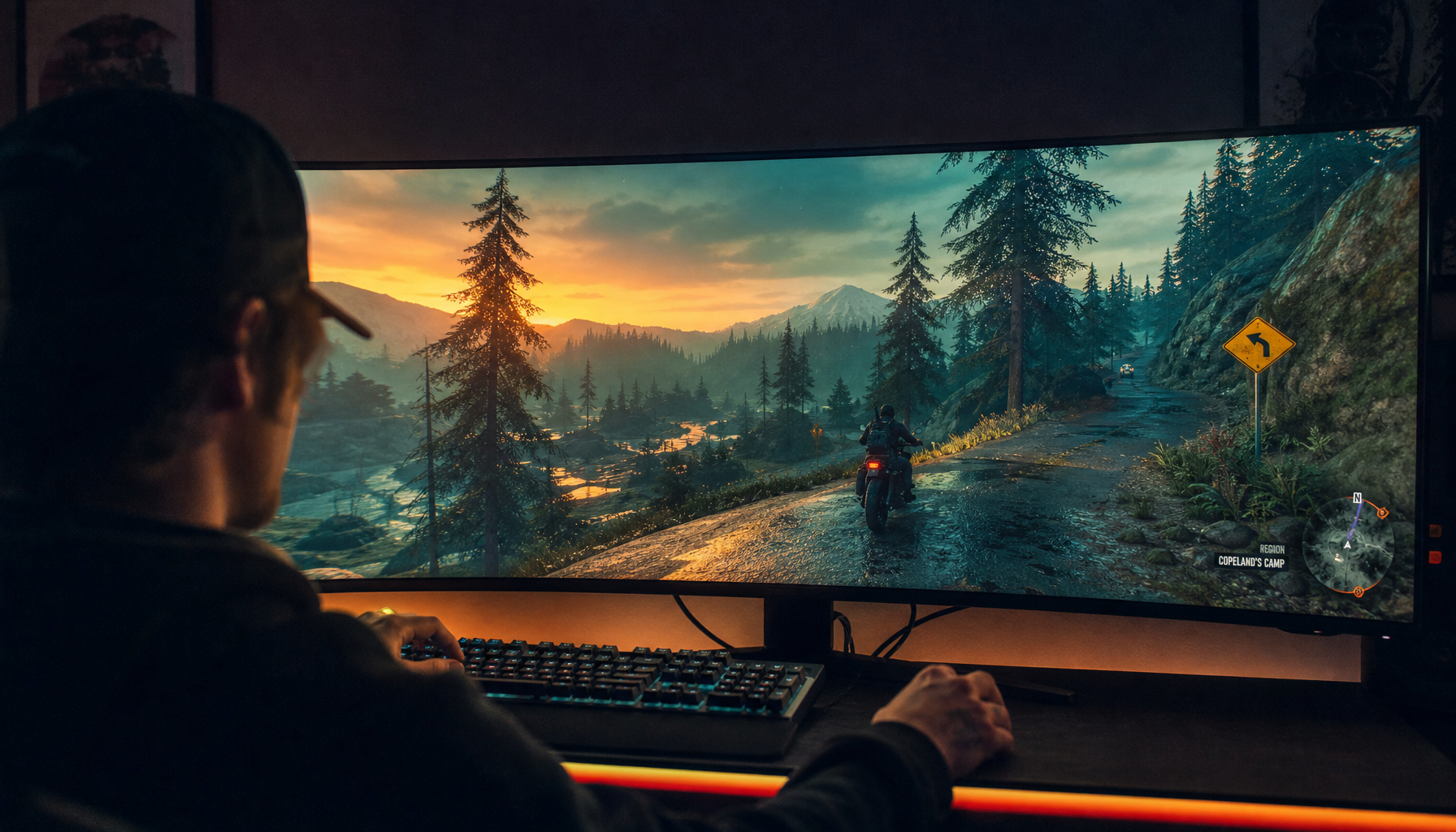
Gamma changes how visible midtones and shadow detail appear, so the right setting can reveal enemies in dark corners without making the whole image look flat or washed out.
Do you ever clear a room, miss a player tucked beside a doorway, and only notice them after the death recap? A stable gamma baseline around 2.2, followed by small in-game adjustments, gives you a testable way to improve shadow visibility while preserving the contrast cues your aim and movement rely on.
What Gamma Actually Changes
Gamma is not the same as brightness. Brightness usually shifts the black level, contrast pushes the white level, and gamma reshapes the tones between black and white. In practical FPS terms, gamma mostly affects the nearly dark areas where enemies hide: stairwells, tunnels, corners, smoke-adjacent shadows, night maps, and interiors with bright windows.

A monitor calibration overview describes gaming monitor calibration as the process of adjusting resolution, refresh rate, brightness, contrast, color temperature, and gamma for better visual accuracy and responsiveness, with a common recommendation of gamma around 2.2. That matters because 2.2 is the baseline most PC content expects. If your monitor, graphics driver, and game are all pushing gamma in different directions, you are no longer tuning visibility; you are stacking corrections blindly.
In actual play, raising effective gamma usually makes dark midtones easier to see. The downside is that too much gamma lift makes dark corners gray, reduces object separation, and can make enemy outlines blend into low-contrast textures. A slightly brighter corner is useful. A washed-out map is slower to read.
Why Dark-Corner Visibility Improves
Competitive FPS visibility depends on contrast more than raw brightness. A hidden opponent becomes easier to detect when their model separates from the background. Gamma can help by lifting the midtone range where many map shadows live, but it cannot recover detail if the game engine, monitor black level, or video compression has already crushed the shadow into near-black.

A flight-sim tuning discussion is useful because it isolates the same display problem: overly bright scenes and overly dark cockpit areas improved when the author treated monitor settings as the first variable, not just in-game gamma. The suggested baseline was brightness and contrast near 50%, a darker monitor gamma mode around 2.2 to 2.5, then in-game gamma around 2.0 to 2.2, with the result described as a major visual improvement in monitor and gamma settings.
For a shooter, the same logic applies. If your monitor ships in a vivid store-demo mode, blacks may be crushed, whites may clip, and color temperature may be cold enough to make gray interiors look harsh. Before changing several FPS settings, put the display into a standard, sRGB, custom, or gaming mode that lets you control brightness, contrast, and gamma predictably.
The Best Starting Point for Competitive FPS
Start with monitor gamma at 2.2 when available. Leave graphics driver gamma at default unless you have a specific reason to change it. Then use the game’s own brightness or gamma calibration to lift dark areas only as much as needed.

This order matters. Monitor gamma affects everything. Driver gamma can affect broad output behavior. In-game gamma is usually the safest final adjustment because it applies to that title’s lighting, maps, and art style. If one game has readable shadows and another has muddy interiors, you do not want a global driver change damaging both.
A practical FPS test is simple. Load a map with a dark hallway, a room corner, and a bright exterior or skybox. Stand still and check whether dark walls still show texture, whether player silhouettes separate from the background, and whether bright areas retain detail. If the corner becomes readable but the whole image loses depth, back gamma down and raise black equalizer or in-game brightness slightly if your monitor supports it.
Setting Area |
Good Starting Point |
What to Watch For |
Monitor gamma |
2.2 |
Natural shadows with visible midtone detail |
Monitor brightness |
Room-dependent, often moderate |
Eye strain or gray blacks |
Contrast |
Near default or 40-50% baseline |
Clipped whites or harsh edges |
Driver gamma |
Default |
Avoid global washout |
In-game gamma |
Small adjustment after monitor setup |
Better visibility without a flat image |
Pros and Cons of Raising Gamma
The main advantage is faster detection in shadow-heavy fights. Enemies sitting in corners, under catwalks, or inside buildings become less dependent on lucky motion cues. On VA panels with strong native contrast, a slight gamma lift can make dark scenes more playable without destroying the whole image.
The cost is reduced visual hierarchy. If you raise gamma too far, walls, player models, loot, muzzle flash, and UI elements all move closer together tonally. That can make the screen look brighter but not actually more readable. Competitive players often confuse “I can see more gray detail” with “I can identify threats faster.” Those are related, but not identical.
There is also a map-design problem. A flight-sim discussion about spotting enemies makes the useful point that there is no universal best visibility preset because results depend on hardware, display setup, configuration, and personal tuning; it also separates best-looking graphics gameplay visibility. FPS games have the same issue. A setting that works on a clean indoor map may be too flat on a foliage-heavy or high-saturation map.
Room Lighting Changes the Correct Setting
The common “adjust until the logo is barely visible” screen is only a rough starting point. It often assumes controlled lighting. If you play beside a bright window, under overhead lighting, or on a glossy screen, the barely visible logo may disappear for reasons that have nothing to do with the game’s intended gamma.
A forum thread about the “barely see the logo” prompt highlights the core problem: that calibration method can fail when room lighting and display conditions do not match the developer’s assumption about gamma calibration. For competitive play, calibrate in the same room lighting you actually use during ranked sessions. A daytime setting and a late-night setting may need to be different.
This is especially relevant for portable smart screens and office-gaming hybrid setups. A portable display in a cafe, dorm, hotel, or bright office can need more brightness and a slightly more visibility-focused profile than the same game on a fixed desk monitor in a dim room. The goal is not cinematic accuracy; the goal is stable target recognition without eye fatigue.
Gamma Versus Black Equalizer, Brightness, and FOV
Gamma is one visibility tool, not the whole stack. Brightness changes the floor of the image. Contrast affects separation between light and dark. Black equalizer features lift shadow zones more selectively than global gamma on many gaming monitors. Sharpness can help edge clarity, but too much creates halos. FOV changes target size and peripheral awareness.
The FOV tradeoff is a good reminder that visibility is not always solved by showing more. In one shooter settings discussion, the author argues that higher FOV can make enemies smaller and harder to track, while the default 70 FOV may make targets easier to see for some players. That advice is subjective, but the decision logic is sound: if you increase information on screen while shrinking enemies, you may reduce practical visibility.
For dark corners specifically, tune in this order: stabilize monitor brightness and contrast, set gamma near 2.2, adjust in-game brightness or gamma, then test black equalizer if available. Change one variable at a time. If you change gamma, FOV, sharpness, HDR, and color saturation together, you will not know what helped.
Monitor Choice Still Matters
A strong competitive monitor gives gamma tuning more room to work. Fast refresh, low response time, good contrast, and predictable presets all affect whether shadow detail appears clean or smeared during movement. Independent gaming monitor testing emphasizes brightness, color accuracy, visual clarity, refresh rates, response times, and real gaming performance across competitive and cinematic titles, which is exactly the mix that determines whether a display feels fast and readable.

For FPS, 144Hz should be treated as the practical floor, with 240Hz and above offering smoother tracking when your PC can feed those frames. Resolution also matters. A 24- or 25-inch 1080p esports monitor can make targets large and motion clean. A 27-inch 1440p display gives sharper enemy edges and better desktop productivity. A 4K office-gaming monitor can look outstanding, but only if your system maintains competitive frame rates.
Panel type changes the gamma experience. VA often gives deeper blacks, which can help immersion but may hide detail if tuned too dark. IPS usually offers consistent viewing angles and balanced color, making it reliable for hybrid productivity and FPS use. OLED has excellent contrast and response, but aggressive brightness behavior, reflections, or burn-in concerns can matter on a desk used for static office work.
A Reliable Competitive FPS Gamma Workflow
Use one repeatable test scene per game. Pick a map area with a dark corner, a midtone wall, and a bright highlight. Set your monitor to native resolution and highest refresh rate first. Put brightness at a comfortable level for the room, keep contrast near default unless highlights clip, and choose gamma 2.2 if your monitor exposes numeric presets.
Then enter the game and adjust its brightness or gamma until the darkest useful details are visible, not glowing. An enemy model should stand apart from the corner when moving or peeking, but the wall should still look like a shadowed wall. If the whole image looks pale, reduce gamma and use a more targeted shadow feature if the monitor offers one.
Save separate profiles when possible. A ranked FPS profile can prioritize visibility, response mode, and moderate black equalization. A work profile should return to neutral gamma, comfortable brightness, and accurate grayscale so text, charts, documents, and creative tools do not look distorted. A story or HDR profile can favor deeper contrast and cinematic tone.

Common Mistakes That Make Enemies Harder to See
The most common mistake is maxing brightness and gamma together. That makes the image brighter but can erase the contrast that helps your brain identify shapes quickly. Another mistake is using someone else’s exact settings without matching their monitor, room lighting, panel type, and game. A third is leaving HDR on in an SDR competitive title when the monitor’s HDR implementation makes midtones unpredictable.
Driver-level gamma is another trap. It can be useful, but it is broad. If you raise driver gamma to fix one dark FPS map, your browser, desktop apps, videos, and other games may all look wrong. Keep global controls restrained unless you are correcting a known display issue.
Finally, do not ignore comfort. If your visibility setting gives you watery eyes or headaches after a few matches, it is not a competitive advantage. Lower brightness for dark rooms, avoid extreme cold color temperature, and keep the screen positioned so reflections do not sit over the center of the image.
FAQ
Should I use gamma 2.2 or 2.4 for FPS?
Use 2.2 as the starting point. Gamma 2.4 can look richer in a dim room, but it often darkens midtones enough to hide enemies in shadow. For competitive FPS, 2.2 plus small in-game adjustment is usually more reliable.
Is higher gamma cheating?
Using normal monitor or in-game calibration is part of display setup. The line is game-specific, so avoid third-party filters or tools that violate competitive rules. Built-in brightness, gamma, and black equalizer controls are commonly available, but tournament rules may restrict some settings.
Should I change graphics driver gamma?
Usually, leave it at default and tune the monitor plus in-game settings first. Driver gamma is a global lever, so it can fix one problem while creating several others.
Does gamma affect input lag?
Gamma itself is a tone setting, not a motion setting. Input lag is more affected by refresh rate, response mode, sync settings, frame rate, and monitor processing. Still, using heavy image-processing modes can sometimes add latency, so favor low-lag gaming presets.
Calibration Judgment
Gamma helps you see enemies in dark corners by lifting the tones where shadow detail lives, but the winning setting is the lowest adjustment that reveals threats without flattening the image. Start at 2.2, tune under your real room lighting, test in the maps you actually play, and save separate profiles for ranked gaming and daily work.