GPU memory bandwidth becomes a practical limit when a gaming monitor asks the graphics card to move more pixel, texture, and frame data than the card can feed smoothly. The jump from 1080p to 1440p, 4K, ultrawide, or high-refresh 4K can expose that limit even when the GPU still looks powerful on paper.
You upgrade to a sharper monitor, load the same game, and suddenly the motion feels less consistent even though nothing else changed. In one real ultrawide upgrade from 2560 x 1440 to 3440 x 1440, the extra pixels produced an estimated performance drop in the 20% range on a high-end graphics card. This guide explains why that happens and how to choose a monitor that fits your GPU instead of forcing it into a constant bandwidth fight.
Why Higher Monitor Resolution Stresses GPU Memory Bandwidth
GPU memory bandwidth is the rate at which a graphics card can move data between the GPU and its VRAM. That matters because every rendered frame needs color data, depth data, textures, lighting information, anti-aliasing samples, and post-processing buffers to move quickly enough for the next frame to start; when data cannot move fast enough, the GPU can spend time waiting instead of rendering.
Resolution increases this pressure in a direct, visible way. A 1920 x 1080 monitor draws about 2.1 million pixels per frame, 2560 x 1440 draws about 3.7 million, and 3840 x 2160 draws about 8.3 million. That is why 4K gaming is not just “a little sharper” than 1080p; it is roughly four times the pixel count, which means far more data has to be shaded, stored, read, and written for every frame.

The Bandwidth Problem Behind the Frame Rate Drop
A powerful GPU core can still be constrained if its memory subsystem cannot feed it quickly enough. At higher resolutions, the card must handle larger render targets, bigger texture reads, larger frame buffers, and more frequent memory access from effects such as ray tracing, high-quality shadows, screen-space reflections, and heavy anti-aliasing.
This is why monitor upgrades can feel harsher than expected. Moving from a 1080p 144 Hz monitor to a 1440p 144 Hz monitor asks the GPU to render about 78% more pixels per frame while still trying to hit the same frame pacing target. Moving from 1440p to 4K adds another major jump, and high texture settings can make the VRAM and memory bandwidth load even more noticeable.
VRAM Capacity and Bandwidth Are Related, but Not the Same
VRAM capacity is how much data the card can hold at once. Memory bandwidth is how quickly the card can move that data. A GPU can have enough VRAM to load a game’s assets but still struggle to move data fast enough for high-resolution, high-refresh rendering.
The difference matters for monitor buyers. If a game stutters when panning the camera, loads textures late, or shows inconsistent 1% lows at a high resolution, the issue may not be average FPS alone. It may be the combined pressure of VRAM capacity, memory bandwidth, shader load, and the monitor’s refresh target.
Resolution, Refresh Rate, and the Real Workload
Resolution decides how much work is in each frame. Refresh rate decides how often the GPU has to finish that work. A 60 Hz display gives the system about 16.67 ms to present each refresh, while a 144 Hz display gives only about 6.94 ms, so a higher refresh-rate gaming monitor narrows the margin for slow frames.
This is where memory bandwidth becomes more than a spec-sheet number. A 4K 60 Hz monitor is demanding because each frame is large, but a 4K 144 Hz or 4K 240 Hz monitor is demanding because the GPU has to move that large frame workload many more times per second. Smooth gameplay is best when FPS closely tracks refresh rate, and a 144 Hz monitor receiving only 30 FPS will repeat frames instead of using its full motion potential.
Why High Refresh Makes Bandwidth Limits More Visible
At 60 FPS, a slightly slow memory path may still produce acceptable frame pacing in many games. At 144 FPS, 165 FPS, or 240 FPS, the GPU has much less time to fetch textures, write render targets, process effects, and prepare the next frame. Limited bandwidth can show up as microstutter, uneven frame delivery, or poor 1% lows rather than a simple hard FPS ceiling.
For a gaming monitor, this is why average FPS is not enough. A stable 200 FPS can feel smoother than 300 FPS with large delivery spikes, especially on fast esports panels where frame-time consistency is obvious. When comparing monitor upgrades, look at 1% lows and frame-time graphs, not just the best-case number in a benchmark overlay.
Practical Monitor Matching by Resolution
For most buyers, the practical match still follows a familiar pattern: entry-level GPUs are usually better suited to 1080p, mid-range GPUs are more comfortable at 1440p, and high-end GPUs are needed for high-refresh 4K. That advice is not only about GPU core speed; it reflects how quickly pixel count, texture quality, and refresh targets compound at higher resolutions.
A 27-inch 2K 180 Hz display such as a 27-inch 2K 180Hz/1ms 1500R curved gaming monitor can be a useful comparison point: if your GPU has comfortable headroom at that 2560 x 1440-class target, then 4K or ultrawide benchmarks will show how much extra load the next step adds.

Variable refresh rate helps when the GPU cannot hold the monitor’s maximum refresh all the time. VRR allows the display to follow the GPU’s changing frame output within its supported range, reducing tearing and stutter. It does not create more GPU memory bandwidth, but it can make a bandwidth-limited system feel smoother when frame rates fluctuate.

The Ultrawide Trap: More Pixels Than 1440p Buyers Expect
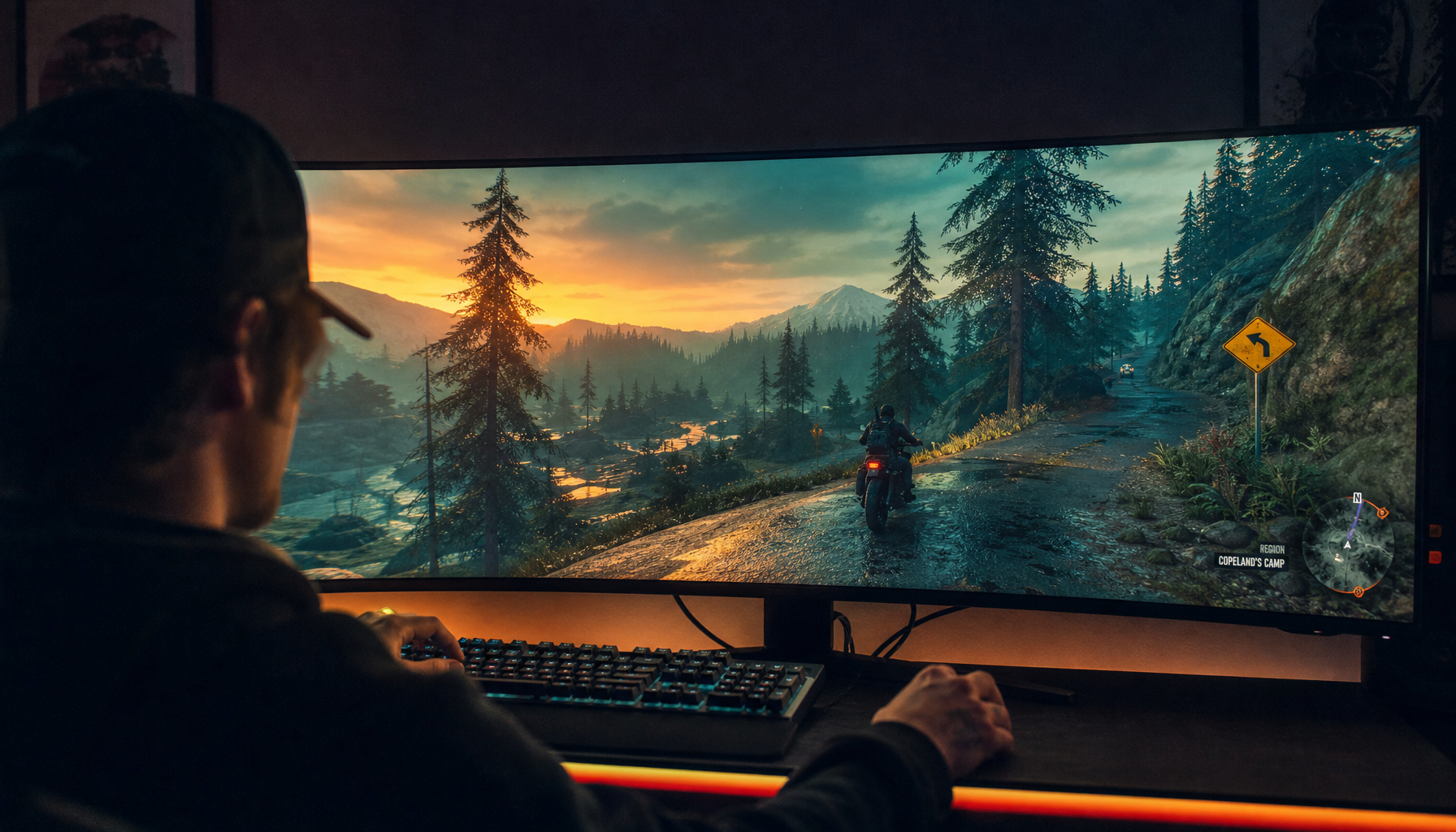
Ultrawide monitors often look like a moderate step up because they keep the same vertical resolution as familiar 1440p displays. In practice, a 3440 x 1440 ultrawide has about 35% more pixels than standard 2560 x 1440, and one high-end graphics card owner reported that the higher pixel count caused an estimated performance drop in the 20% range after moving to a 34-inch QD-OLED ultrawide monitor.

That example is useful because it matches a common monitor-shopping mistake. A buyer sees “1440p” in both displays and expects similar performance, but the ultrawide panel is closer to a midpoint between standard 1440p and 4K. The GPU has to fill more pixels every frame, and the memory system has to move more data to support the wider image.
Why Ultrawide Can Expose VRAM Limits
Ultrawide gaming also tends to encourage higher visual settings. A larger field of view, high-resolution textures, and cinematic AAA games all increase memory pressure. In the high-end graphics card ultrawide example, the card’s 10 GB framebuffer began to feel restrictive, with texture-loading delays and noticeable stutters when VRAM limits were reached.
For monitor buyers, this means a 3440 x 1440 high-refresh ultrawide should not be treated like a simple 1440p purchase. If you play newer AAA games at High or Ultra settings, especially with ray tracing, check benchmarks at 3440 x 1440 specifically. Standard 2560 x 1440 benchmarks can overstate what your system will feel like on an ultrawide panel.
When Ultrawide Still Makes Sense
An ultrawide monitor can be an excellent choice when you value immersion, productivity space, or cinematic field of view more than maximum FPS. It often makes more sense than 4K for players who want a wider image but are not ready for the full 8.3-million-pixel load of 3840 x 2160.
The best fit is a GPU that can hold your preferred refresh range at the ultrawide resolution in the games you actually play. For example, a 144 Hz ultrawide may be a better match than a 240 Hz ultrawide if your GPU usually lands around 90-140 FPS in demanding games. You still get smooth VRR behavior without paying for refresh headroom the card cannot use.
Do Not Confuse GPU Memory Bandwidth With Display Cable Bandwidth
GPU memory bandwidth and display output bandwidth are separate limits. GPU memory bandwidth affects how fast the card can render frames internally, while display bandwidth determines whether the finished signal can travel through the GPU port, cable, and monitor input at the selected resolution, refresh rate, color depth, and HDR setting.
This distinction matters because a PC can render a high frame rate but still fail to output the desired monitor mode. A 3840 x 2160 monitor at 160 Hz with 10-bit color needs about 35.8 Gbps before extra HDR metadata or higher bit depth is considered, while a common display interface standard offers about 25.9 Gbps of effective uncompressed bandwidth.
Why a Monitor Can Get Stuck at 60 Hz
If your new monitor only appears at 60 Hz, the GPU may not be the only suspect. The cause can be the wrong cable, the wrong port, an older display standard, a long or uncertified cable run, a dock that cannot pass the full signal, display stream compression behavior, or too many high-resolution displays sharing the same GPU display engine.
This is common with high-refresh 4K, ultrawide, and multi-monitor setups. A monitor box may advertise 4K 160 Hz, but your actual chain still has to support it: GPU output, cable rating, monitor input, color depth, HDR mode, and operating system display settings. One weak link can force the system into a lower refresh option.
Output Standards That Matter for Gaming Monitors
One common display interface standard is still widely used and can handle many gaming monitor setups, but it often needs display stream compression for high-refresh 4K with 10-bit color. A newer TV and monitor interface standard provides up to 48 Gbps and supports native 4K 120 Hz 10-bit with enough headroom for 160 Hz on many panels. A newer high-bandwidth display interface standard reaches up to 80 Gbps, giving more room for high-refresh 4K and multi-monitor setups.
For 2026-class 4K 240 Hz builds, a newer high-bandwidth display interface monitor and matching cable are the safer path if you want full capability from the latest high-end GPUs. The same source positions a current high-end graphics card more naturally around 4K 144-165 Hz gaming, while a flagship graphics card setup targets 4K 240 Hz with a newer high-bandwidth display interface, AI upscaling, or frame generation in demanding games through GPU-monitor pairing.
Choosing the Right Monitor for Your GPU
The best monitor choice is not always the highest resolution or highest refresh rate you can afford. It is the display mode your GPU can drive consistently in your main games without forcing constant compromises in settings, color depth, or connection mode.
Use the table below as a practical starting point. The ranges assume modern games, typical High settings, and a goal of smooth frame pacing rather than best-case benchmark numbers.
Monitor Type |
Pixel Load |
Typical GPU Pressure |
Best Fit |
Main Bandwidth Risk |
1920 x 1080 at 144-240 Hz |
About 2.1 million pixels |
Low to moderate |
Competitive gaming, entry-level to mid-range GPUs |
CPU limits or high FPS frame-time spikes |
2560 x 1440 at 144-180 Hz |
About 3.7 million pixels |
Moderate |
Balanced gaming monitors, mid-range GPUs |
GPU memory bandwidth and shader load in AAA games |
3440 x 1440 at 144-175 Hz |
About 5.0 million pixels |
Moderate to high |
Immersive ultrawide gaming, stronger mid-range or high-end GPUs |
VRAM use, texture loading, reduced 1% lows |
3840 x 2160 at 120-165 Hz |
About 8.3 million pixels |
High |
High-end GPUs, detail-first gaming |
Memory bandwidth, VRAM, display output bandwidth |
3840 x 2160 at 240 Hz |
About 8.3 million pixels at very high cadence |
Very high |
Flagship GPU builds |
GPU rendering limits plus newer high-bandwidth display output needs |
Portable 1080p or 1440p display |
Varies |
Low to moderate |
Travel, secondary screens, laptop gaming |
Reversible display-capable port mode, dock limits, shared display bandwidth |
Resolution vs. Refresh Rate: Which Should You Prioritize?
Choose resolution first if you play slower single-player games, edit photos or videos, read dense documents, or sit close enough to benefit from sharper text. A 4K 144 Hz monitor can feel excellent for mixed use, but only if your GPU can keep your favorite games in a stable VRR range.

Choose refresh rate first if you play competitive shooters, racing games, rhythm games, or fast action titles where input feel and motion clarity matter more than maximum pixel density. A 1440p 240 Hz monitor often gives a stronger real-world gaming experience than a 4K 240 Hz monitor paired with a GPU that cannot deliver frames consistently.
Where Upscaling and Frame Generation Fit
Upscaling technologies can reduce the internal rendering resolution while outputting a sharper final image to the monitor. That can relieve GPU memory bandwidth pressure because the card is doing less native-resolution work per frame, which is why AI upscaling is often useful at 3440 x 1440 and 4K.
Frame generation can improve perceived smoothness on supported GPUs and games, but it does not replace real frame-time stability. If your base FPS is already low or stuttery because of VRAM or memory bandwidth pressure, generated frames may not fix the underlying input feel. Treat it as a helpful tool, not a reason to ignore GPU-monitor matching.
Action Checklist Before You Buy or Tune a High-Resolution Monitor
Before buying a monitor, check the actual resolution and refresh combination you plan to use. A 4K 240 Hz spec, a 3440 x 1440 OLED panel, and a 1440p 240 Hz esports display create very different workloads, even if all three are sold as premium gaming monitors.
Use this checklist to avoid the most common mismatch: buying a display whose headline spec your GPU cannot sustain in your games.
- Check benchmarks at your target resolution, not just at 1080p or standard 1440p.
- Compare 1% lows, not only average FPS, especially for 144 Hz, 165 Hz, and 240 Hz monitors.
- Confirm your GPU has enough VRAM for your preferred texture settings at that resolution.
- Verify the port standard on both the GPU and monitor, especially for 4K 144 Hz and above.
- Use a certified cable that supports the monitor’s advertised mode.
- Enable the advertised refresh rate in the operating system or your GPU control panel after setup.
- Turn on VRR, then cap FPS slightly below maximum refresh if frame pacing feels uneven.
After setup, test one demanding game and one fast competitive game. If the demanding game stutters, lower resolution scale, ray tracing, shadows, or texture quality first. If the competitive game feels inconsistent, cap FPS to a value your GPU can hold steadily instead of chasing peak numbers.
FAQ
Q: Does higher resolution always mean GPU memory bandwidth is the bottleneck?
A: No. Higher resolution increases memory bandwidth demand, but performance can also be limited by shader power, CPU performance, VRAM capacity, game engine behavior, ray tracing load, or display output bandwidth. The clue is consistency: if average FPS looks acceptable but frame times spike, textures load late, or 1% lows collapse at higher resolution, memory bandwidth or VRAM pressure may be part of the problem.
Q: Is 4K 144 Hz easier to run than 1440p 240 Hz?
A: It depends on the game and settings. 4K 144 Hz has a much larger per-frame pixel load, while 1440p 240 Hz has a much tighter frame-time target. For AAA games, 4K is usually the heavier GPU memory and rendering challenge; for competitive games, 1440p 240 Hz may expose CPU limits and frame pacing issues because the system must deliver frames so quickly.
Q: Should I buy a 4K monitor if my GPU cannot hit the refresh rate?
A: You can, but it should be a deliberate tradeoff. A 4K monitor still improves desktop sharpness, media clarity, and slower games, but a GPU that cannot stay in the monitor’s VRR range may feel less smooth in fast titles. If gaming performance is the priority, a strong 1440p high-refresh monitor or 3440 x 1440 ultrawide may be a better match than underusing a 4K 240 Hz display.
Key Takeaways
GPU memory bandwidth limits performance at higher monitor resolutions because sharper displays require the graphics card to move more data per frame. High refresh rates multiply the problem by demanding more of those frames every second, and ultrawide monitors can surprise buyers because their pixel counts sit well above standard 1440p.
The practical buying rule is simple: match the monitor to the frame rate your GPU can actually hold. For many gamers, 1440p high refresh is the balanced choice, 3440 x 1440 is the immersive step that needs more GPU headroom, and 4K high refresh belongs with genuinely high-end graphics cards, careful cable selection, and realistic expectations about settings.
References
- GPU Monitor Pairing Guide for High Refresh Rate Displays
- Calculating GPU Bandwidth: How Many Monitors Can Your PC Drive
- Calculating GPU Bandwidth: How Many Monitors Can Your PC Drive
- GPU Can’t Keep Up With Monitor? How to Fix FPS Mismatch
- My New Ultrawide Monitor Humbled My GPU Almost Instantly
- Why You Should Care About the Memory Bandwidth of Your Graphics Card