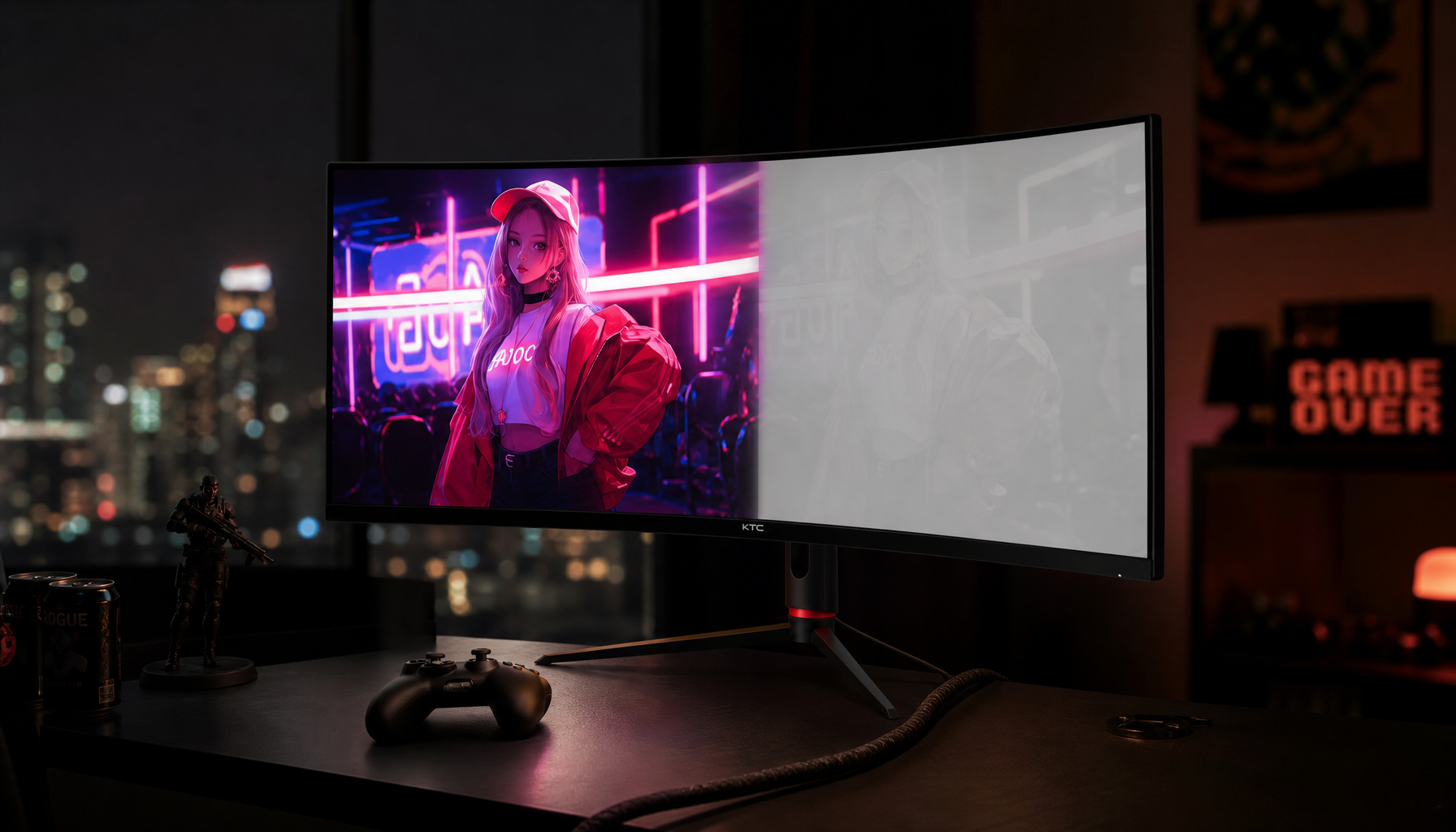
HDR does not create a special kind of blue light, but it often drives a monitor to higher brightness than SDR, which can increase nighttime light exposure.
If your late-night gaming monitor leaves you feeling more alert than tired, HDR can look like the obvious villain. In practice, many displays make HDR feel harsher at night mainly because it is brighter, while weaker HDR monitors often add less picture improvement than buyers expect. You’ll get a practical way to separate marketing from monitor behavior and choose settings that protect sleep without wasting a good display.
HDR Changes Brightness More Than the Type of Light
HDR does not invent a new blue wavelength
Blue light on monitors comes from the same red, green, and blue subpixels whether you are looking at white documents, SDR video, or HDR games. That means HDR mode does not switch your gaming monitor, ultrawide, or portable monitor into a different class of light source; it changes how the display uses brightness, contrast, and color range.
The HDR-to-SDR difference is mainly about how luminance is encoded and reproduced. HDR commonly uses absolute luminance targets, wider color spaces such as DCI-P3 or BT.2020, and 10-bit color, while SDR is usually mastered around narrower BT.709 expectations. For sleep concerns, that matters because the issue is usually higher displayed brightness and more vivid highlights, not a brand-new “HDR blue light.”
Why that matters on a desk monitor
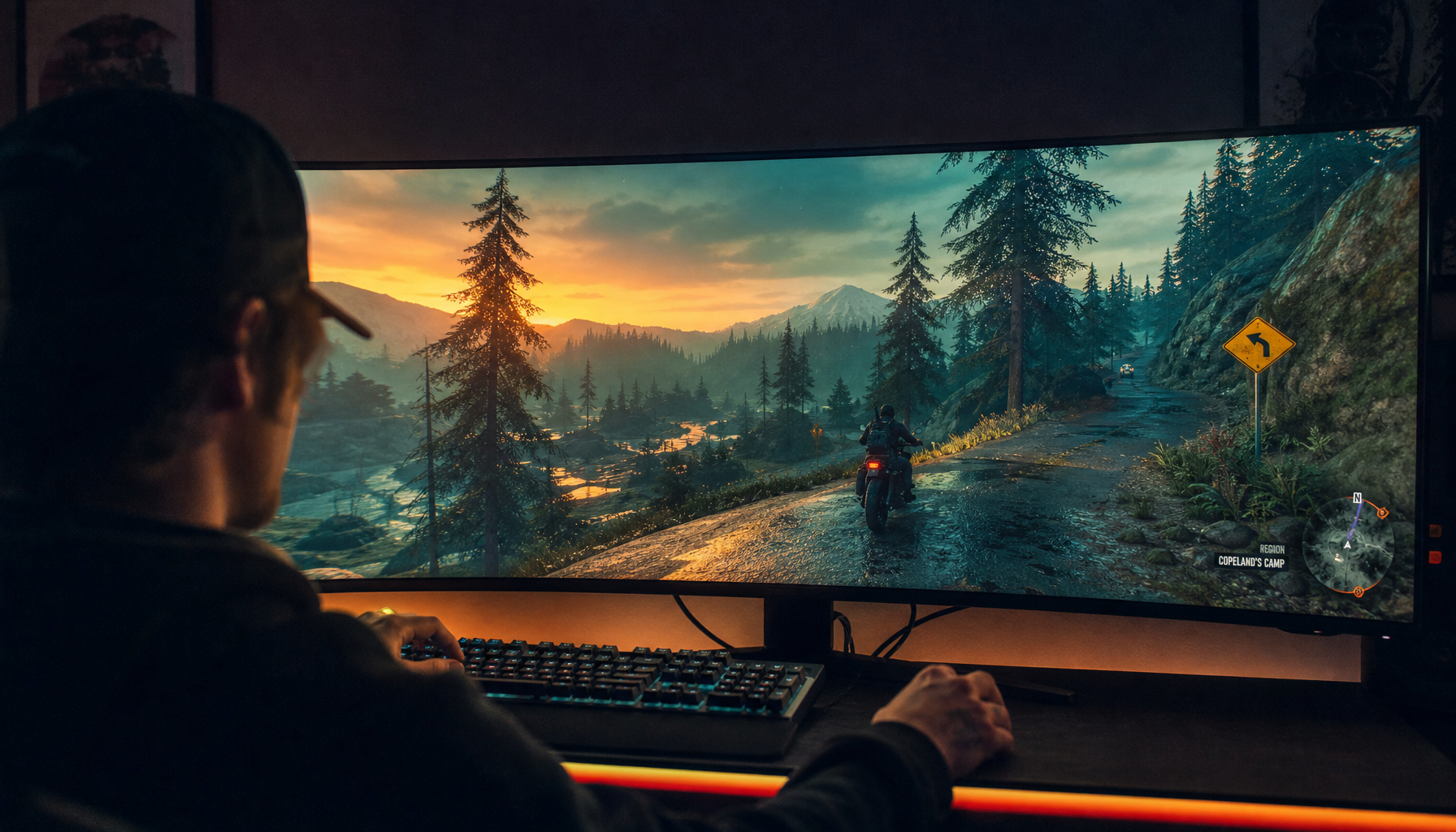
HDR on a platform is explicitly meant to look brighter, more vibrant, and more detailed than SDR on a capable display. That is great for cinematic games and HDR video, but it also means an HDR monitor used in a dim room at 11:00 PM can deliver a stronger light load than the same panel showing SDR content more conservatively.

For display buyers, the useful question is not “Does HDR emit bad blue light?” but “Does HDR keep my screen brighter, later, and longer than I need?” On a high-refresh-rate desktop monitor that you sit close to for hours, that practical difference matters more than the label on the video signal.
Why HDR Can Still Feel Worse at Night
Brightness is the more believable culprit
Platform HDR behavior already points in this direction: a company says HDR content may need lower brightness in darker viewing conditions to preserve effective dynamic range and contrast. That is a strong hint for buyers that nighttime comfort and HDR presentation are tied to brightness management, not just color gamut.
A real-world monitor example from January 17, 2025 makes the same point in plain language. The owner described HDR and SDR as broadly similar on that HDR400 monitor, with HDR mainly looking brighter, while citing about 414 nits real-scene brightness and 439 nits peak brightness. That is exactly the kind of midrange gaming monitor case where sleep impact can rise faster than visual payoff.
Blue light is still part of the story, just not the whole story
A review site’s blue light filter testing notes that screens before bed can negatively affect sleep and also shows that monitors emit blue light even when the image is not visibly blue. In other words, a bright white browser window on an HDR-capable monitor can still be relevant, even if you are not watching a neon-saturated game trailer.
The practical takeaway is simple: if HDR mode makes your 27-inch esports monitor or 34-inch ultrawide much brighter for a late session, that is the more credible reason it may feel more sleep-disruptive than SDR. HDR is not “extra harmful” by definition, but a brighter HDR setup can absolutely be more intrusive at night.
Not Every HDR Monitor Carries the Same Tradeoff
“HDR support” and “good HDR” are not the same thing
A review site’s HDR buying guidance is clear that HDR support alone does not guarantee strong HDR performance. A monitor needs deep blacks, bright enough highlights, and vivid color to make HDR worthwhile. That matters for sleep decisions because a premium OLED or Mini LED can produce much more dramatic highlight intensity than a basic IPS panel with a weak HDR badge.
The flip side is that cheaper HDR monitors often fail in the opposite way. They may accept an HDR signal and run brighter, but without the contrast control or local dimming needed to make the image meaningfully more lifelike. In those cases, buyers can end up paying the nighttime comfort cost of HDR without getting the real HDR benefit.
Real buyer scenarios look different by monitor class
That same monitor case is useful because it reflects what many shoppers actually experience on HDR400 displays: a modest image change, slightly better shadow visibility, and a noticeable jump in brightness. If that sounds like your current monitor or your target budget, SDR can be the smarter late-night mode.
By contrast, a better HDR display can justify its tradeoffs. A strong OLED or Mini LED gaming monitor is far more likely to give you deep blacks, highlight pop, and convincing HDR color in ways that make the mode worth saving for evening movies or single-player games rather than leaving on all day.
Mode or setup |
Typical brightness behavior |
Image upside |
Nighttime downside |
Best fit |
SDR in a calibrated mode |
Usually lower and easier to control |
Predictable desktop color and UI |
Less HDR impact |
Late-night work, browsing, competitive gaming |
HDR on a basic HDR400 monitor |
Often brighter without major contrast gains |
Some extra highlight punch |
More light exposure for limited benefit |
Casual HDR testing, mixed use |
HDR on a strong OLED or Mini LED |
Bright highlights with much better contrast |
Best-looking HDR games and movies |
Can feel intense in a dark room |
Intentional evening media use |
SDR plus a warm display mode |
Lower blue output and warmer image |
Better wind-down comfort |
Worse color accuracy |
End-of-night desktop use |
What Settings Reduce Sleep Disruption Without Throwing Away HDR
Start on the platform, not with accessories
A platform includes HDR brightness controls for balancing SDR and HDR content, and a company specifically suggests using HDR in a darker area with a fairly low brightness setting for better results. For most monitor owners, that is the first adjustment to make before deciding HDR is unusable at night.
A review site found a platform warm mode more effective than many built-in monitor low-blue-light modes, though the tradeoff is warmer color and weaker accuracy. That makes a warm mode a better fit for late-night web use, office tasks, and chat windows than for HDR movies, photo work, or games where color intent matters.
Setup details matter on multi-monitor desks
A company’s HDR guidance also notes that HDR does not work when displays are duplicated and recommends one digital video connection over another in some problem cases. If you run an ultrawide gaming monitor next to a portable monitor, keeping the HDR screen in extended mode and properly configured can prevent brightness or color issues that users sometimes mistake for “bad HDR.”

A practical routine works better than a one-time tweak. Leave your brighter HDR preset ready for games and movies, then keep a second SDR or warm preset for the last hour before bed. On most desktop monitors, that switch is faster and more effective than chasing specialty “eye care” branding.

When Should Buyers Use HDR, and When Should They Switch Back to SDR?
Leave HDR on when the panel earns it
A review site’s tested HDR recommendations show why premium HDR monitors cost more: the better ones actually combine deep blacks, strong highlight brightness, and vivid color. If you bought that class of display for immersive gaming or HDR video, it makes sense to use HDR when content is specifically mastered for it.
That is especially true for evening sessions that are about image quality rather than endurance. A story-driven game, a movie, or a short HDR showcase on a well-tuned OLED is a very different case from leaving HDR active on a desktop for hours of browser tabs, spreadsheets, and launcher windows.
Switch back to SDR when comfort matters more than spectacle
SDR is usually the better choice for late-night productivity, competitive games with lots of bright UI, and long desk sessions that run close to bedtime. On many monitors, especially entry-level HDR400 models, the image improvement is small enough that reduced brightness and steadier desktop behavior matter more.
For buyers, this is the key decision point: if sleep sensitivity is a major concern, do not reject HDR outright. Buy a monitor with genuinely good HDR only if you will use that strength intentionally, then expect to rely on SDR, lower brightness, or a warm display mode for routine night use.
FAQ
Q: Does HDR mode emit more blue light than SDR?
A: Not inherently. The same monitor still uses the same subpixels and backlight system. HDR usually becomes more relevant at night because it often drives higher brightness and stronger highlights.
Q: Is HDR worse for sleep on a gaming monitor?
A: It can be, but usually because the screen is brighter or used longer before bed, not because HDR creates a unique harmful spectrum. The risk is more obvious on bright monitors in dark rooms than on weaker HDR screens.
Q: Should I buy a low-blue-light monitor instead of an HDR monitor?
A: Not necessarily. A review site found an OS-level warm mode more effective than many built-in monitor blue-light modes. If HDR quality matters for games or movies, buy the better display first and manage night comfort with settings.
Practical Next Steps
Treat HDR as a brightness-management question, not a blue-light myth. Keep HDR for games, movies, and monitor demos that genuinely benefit from it, but lower brightness and switch to SDR or a warm display mode when the goal shifts from spectacle to winding down.
For most buyers, the best compromise is a monitor that is excellent at HDR when you want it and easy to tame when you do not. That gives you the value of a fast gaming display or premium ultrawide without forcing every late-night session into full-intensity showroom mode.