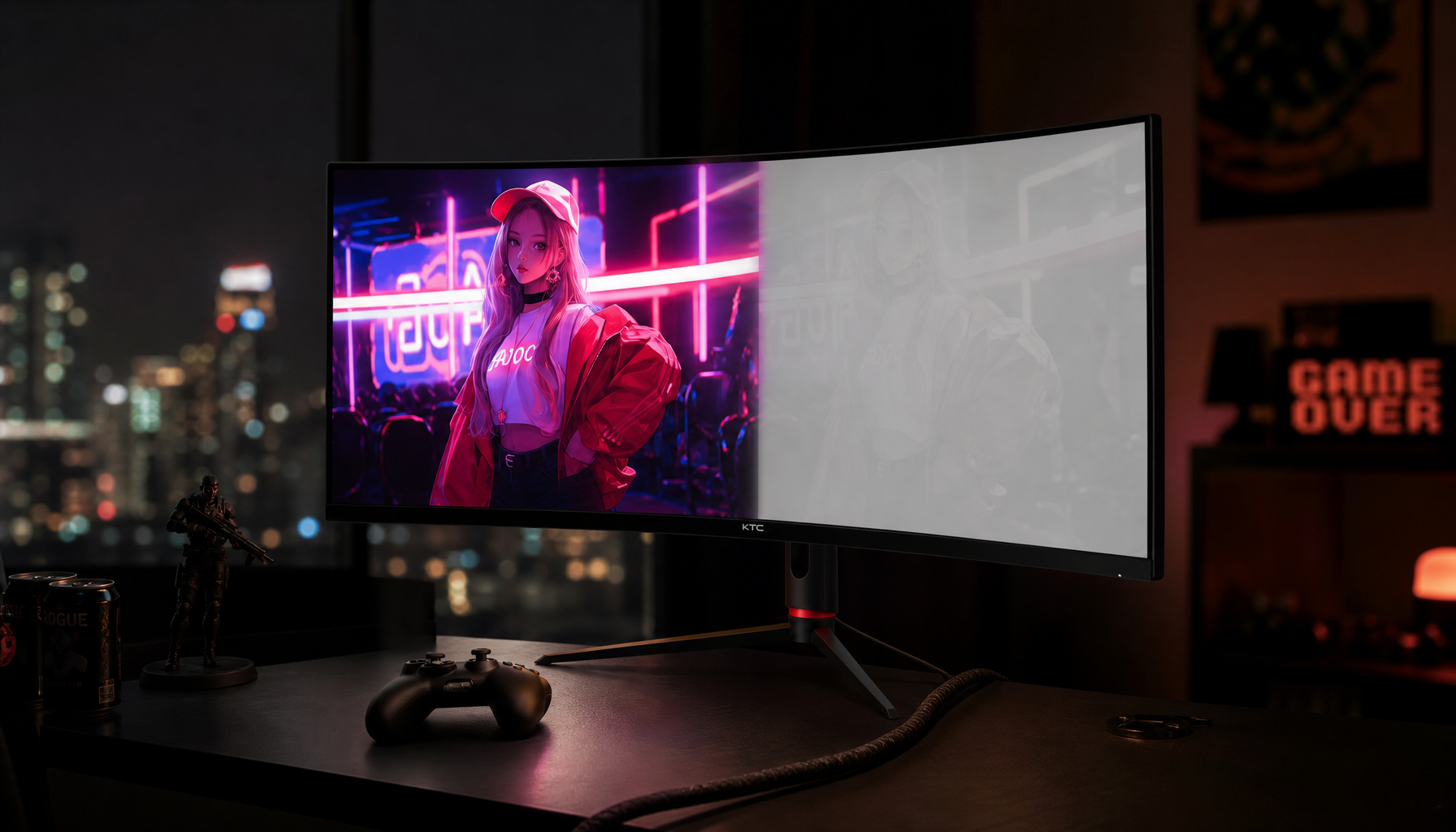
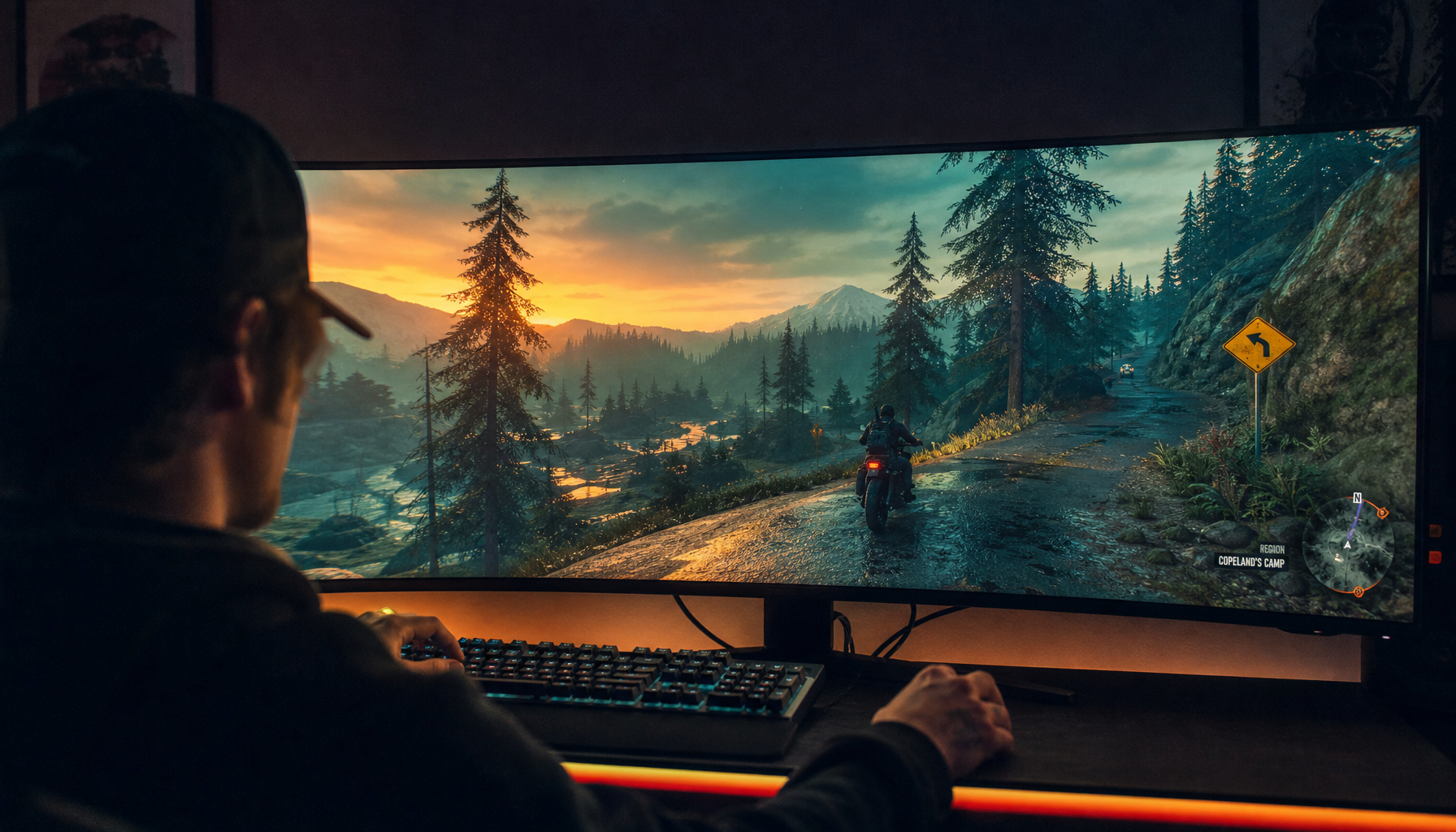
Monitor bezels do not create true input lag by themselves, but frame design can make a display feel slower or faster by changing what your peripheral vision sees during motion, aiming, scrolling, and multi-screen transitions.
Does your aim feel slightly late even when your FPS counter looks clean and your monitor spec sheet says 1 millisecond? Controlled research on temporal contrast at the edge of vision shows that peripheral perception behaves differently from central vision, so the visual frame around the panel can change how responsive motion feels. Here is a practical way to separate real latency from frame-induced perception and tune your setup for sharper control.
The Short Answer: Bezels Influence Perception, Not Signal Delay
A bezel is the physical border around the active display area. Input lag is the delay between an action and the first visible screen response, while response time describes how quickly pixels change once the monitor begins updating. The bezel is not part of the electronics pipeline, so it does not usually add measurable delay the way scaling, image processing, low refresh rate, or a slow display mode can.
The catch is that gaming does not happen only at the center of your screen. Your eyes track motion, your peripheral vision samples edges and contrast, and your brain judges timing from the whole scene. Research on peripheral visual perception shows that off-center vision responds differently to temporal contrast changes than central vision, especially across wide fields of view. That makes bezel width, color, thickness, screen gap, and alignment relevant to perceived responsiveness even when the stopwatch says the monitor is fine.
Why Peripheral Vision Can Make Lag Feel Worse
Central vision is where you read crosshairs, text, and small targets. Peripheral vision is the off-center field that detects motion, flashes, contrast changes, and spatial continuity. In fast games, it helps you sense enemy movement, camera rotation, and whether your view is tracking cleanly.
A thick, bright, glossy, or uneven frame can interrupt those cues. On a single monitor, this may show up as a subtle boxed-in feeling when whipping the camera in an FPS. On a triple-monitor racing or flight setup, mismatched bezels can break a road line, cockpit edge, or horizon, making motion appear less continuous. The delay is not necessarily electrical; it is a perception penalty created by discontinuity.

The effect is easiest to notice in high-motion scenes. If a 240 Hz panel updates every 4.16 milliseconds, but a black side frame keeps pulling your attention during horizontal movement, the display can feel less fluid than its refresh rate suggests. On sample-and-hold displays, refresh rate is the dominant factor in perceived motion blur, but frame cues can still shape how cleanly you interpret that motion.
Real Input Lag vs. Perceived Input Lag
True input lag lives in the input-to-display chain: mouse, keyboard, operating system, game engine, GPU, cable, monitor processing, refresh behavior, and panel update. Perceived input lag is the user’s felt delay after the visual system interprets movement, blur, stutter, tearing, and spatial alignment.
That distinction matters because a bezel complaint can hide a performance problem. If your mouse feels late only when using a multi-monitor layout, the frame gap or software alignment may be the trigger. If it feels late on every screen, even with one display connected, the cause is more likely frame pacing, sync behavior, game settings, monitor processing, or peripheral latency.
Factor |
Can Add Measured Lag? |
Can Change Perceived Lag? |
Practical Read |
Bezel width |
Usually no |
Yes |
Affects edge continuity and immersion |
Bezel color or gloss |
Usually no |
Yes |
Can pull peripheral attention during motion |
Monitor scaling |
Yes |
Yes |
Use GPU scaling or native resolution when possible |
Refresh rate |
Yes, indirectly |
Yes |
Higher Hz shortens visible update intervals |
Poor frame pacing |
Yes in practice |
Yes |
Feels worse than average FPS suggests |
Multi-monitor misalignment |
No |
Yes |
Causes cursor jumps and broken visual lines |

Single-Monitor Gaming: When Frame Design Matters
For a single competitive monitor, bezel design matters most when it changes contrast around the active image. A very light frame around a dark shooter scene can make the screen edge more noticeable. A glossy frame can catch desk lighting and create motion-adjacent reflections. A thick bottom chin can make the image feel visually lower than expected, especially when the monitor is close.
The practical fix is simple. Sit at a stable distance, dim distracting light sources near the display edge, and use a matte, neutral frame if you are choosing a new monitor. For esports, the performance hierarchy still starts with refresh rate, low processing lag, clean overdrive tuning, and stable frame pacing. A thin bezel helps immersion, but it will not rescue a 60 Hz display from the responsiveness limits that come with slower refresh intervals.
This is also where strobing and motion clarity enter the decision. Strobe backlights can reduce perceived blur by flashing frames briefly, but brightness often drops and VRR compatibility may be limited. A thin-bezel 240 Hz panel with poor overdrive can still trail; a slightly thicker-framed 240 Hz panel with cleaner tuning may feel more precise.
Multi-Monitor Setups: Bezels Become a Bigger Deal
Bezel effects become much more important when the image spans multiple screens. In a racing sim, flight sim, trading setup, or panoramic productivity layout, your peripheral vision constantly crosses physical borders. If the left and right monitors sit at different heights or the operating system layout is off, a moving cursor, window, road stripe, or horizon can jump at the border and feel like latency.

Multi-monitor alignment has both physical and software parts. KTC’s setup guidance emphasizes aligning the lit active pixel area instead of only the plastic casing when displays have different bezels, because the casing can look tidy while the actual pixels remain mismatched. For office work, aligning top edges often feels best; for mixed-size monitors, aligning screen centers is usually more natural; for sims, the horizon or game centerline should drive the setup.
Bezel correction can help in games that support it. It hides a small slice of the rendered image behind the physical gap so lines look continuous across displays. The tradeoff is that some content is intentionally concealed, so it is better for cockpit, racing, and panoramic scenes than for productivity tasks where every pixel of a spreadsheet or timeline matters.
Portable Smart Screens and Office Displays
Portable displays are often used close to the face, beside a laptop, or in tight desk setups. That makes frame thickness, stand angle, and brightness more obvious. A chunky frame beside a thin laptop bezel can make cursor movement feel uneven, especially if scaling and display rectangles are not matched in the operating system.
For productivity, perceived lag often appears as cursor hesitation, inconsistent window dragging, or eye fatigue during long sessions. The American Optometric Association describes computer vision issues such as eye strain, dryness, and blurred vision in sustained screen use, and those symptoms can make a display feel less responsive even when latency is normal. A comfortable setup starts with moderate brightness, native resolution, correct scaling, and screen placement near arm’s length.
Portable smart screens also benefit from restrained picture modes. Aggressive game presets may increase brightness, sharpening, or shadow boost, which can improve target visibility briefly but make edge contrast harsher. For mixed office and gaming use, a custom mode with balanced brightness and normal or warm color temperature is usually more reliable than a high-contrast preset.
A Practical Test Before You Blame the Bezel
Use a controlled comparison. First, run one monitor only at native resolution, with game mode enabled and unnecessary image processing off. Keep the same mouse, cable, refresh rate, game, and frame cap. If the display feels responsive in that condition, add your second or third display back and test whether the lag feeling returns during cursor crossing, camera pans, or edge-heavy scenes.
Then isolate frame perception. Reduce room reflections near the bezel, temporarily darken the wall behind the monitor, and move the screen slightly farther away. If perceived lag improves without any change in FPS or hardware, the issue is likely visual comfort or peripheral distraction rather than true delay.
Forum discussions can be useful for generating hypotheses, but they should not replace measurement. A monitor discussion on disabling screens, brightness, and perceived input lag includes subjective reports of improved mouse feel, yet the reported improvements are not backed by controlled latency numbers. Treat those reports as troubleshooting ideas, then verify with repeatable tests, a high-speed camera if available, and consistent settings.
Buying Advice: What Frame Design Should You Prioritize?
For competitive gaming, choose low measured input lag, high refresh rate, strong frame pacing support, and clean motion tuning first. After that, prefer a matte, narrow, low-contrast bezel that disappears in your peripheral field. Avoid judging performance from the 1 millisecond label alone, because GtG response claims do not fully describe sample-and-hold blur or real motion clarity.

For multi-monitor immersion, prioritize uniform bezel size, adjustable stands or mounting arms, matching panel size, matching resolution, and similar pixel density. A thin-bezel monitor is valuable here because every physical gap becomes part of the image. Still, alignment quality matters as much as bezel width; two thin-bezel screens placed at different heights can feel worse than thicker screens aligned correctly.
For office productivity and portable smart screens, frame design should support comfort. A slim frame helps when pairing displays side by side, while a sturdy frame and stable stand may matter more for travel. If text scaling, brightness, and viewing distance are wrong, the cleanest industrial design will still feel tiring.
Pros and Cons of Thin Bezels
Design Choice |
Pros |
Cons |
Ultra-thin bezel |
Better immersion, cleaner multi-monitor layouts, less peripheral interruption |
Can reduce grip area on portable screens and may increase fragility |
Moderate matte bezel |
Stable, less reflective, often better for office durability |
Less seamless for surround gaming |
Thick or glossy bezel |
Can feel sturdy and may lower cost |
More visible edge distraction during motion |
Asymmetric frame |
Common on budget or portable displays |
Can make visual centering feel off |
The Bottom Line
Bezels and frame design can affect perceived input lag through peripheral vision cues, especially in wide, close, or multi-monitor setups. They do not replace the fundamentals: high refresh rate, stable frame pacing, low processing lag, good overdrive, correct alignment, and comfortable brightness. Choose the monitor that measures fast, then make the frame disappear from your attention; that is where responsiveness starts feeling real.