Curvature can help comfort and edge awareness on large gaming monitors, but it usually does not improve raw aiming precision in competitive shooters. For most esports players, a flat 24-inch to 27-inch high-refresh display remains the safer choice.
If your crosshair feels perfect in practice but less reliable once the action spreads to the edges of the screen, the panel shape may be part of the story. Tests on 1000R displays found less eye pain and smaller focus changes than flat screens during visual tasks, while competitive guidance still leans flat for the most repeatable aim. The goal is to separate immersion benefits from true aiming benefits so you can buy the right monitor for your play style.
What Curvature Actually Changes
Peripheral vision becomes more active
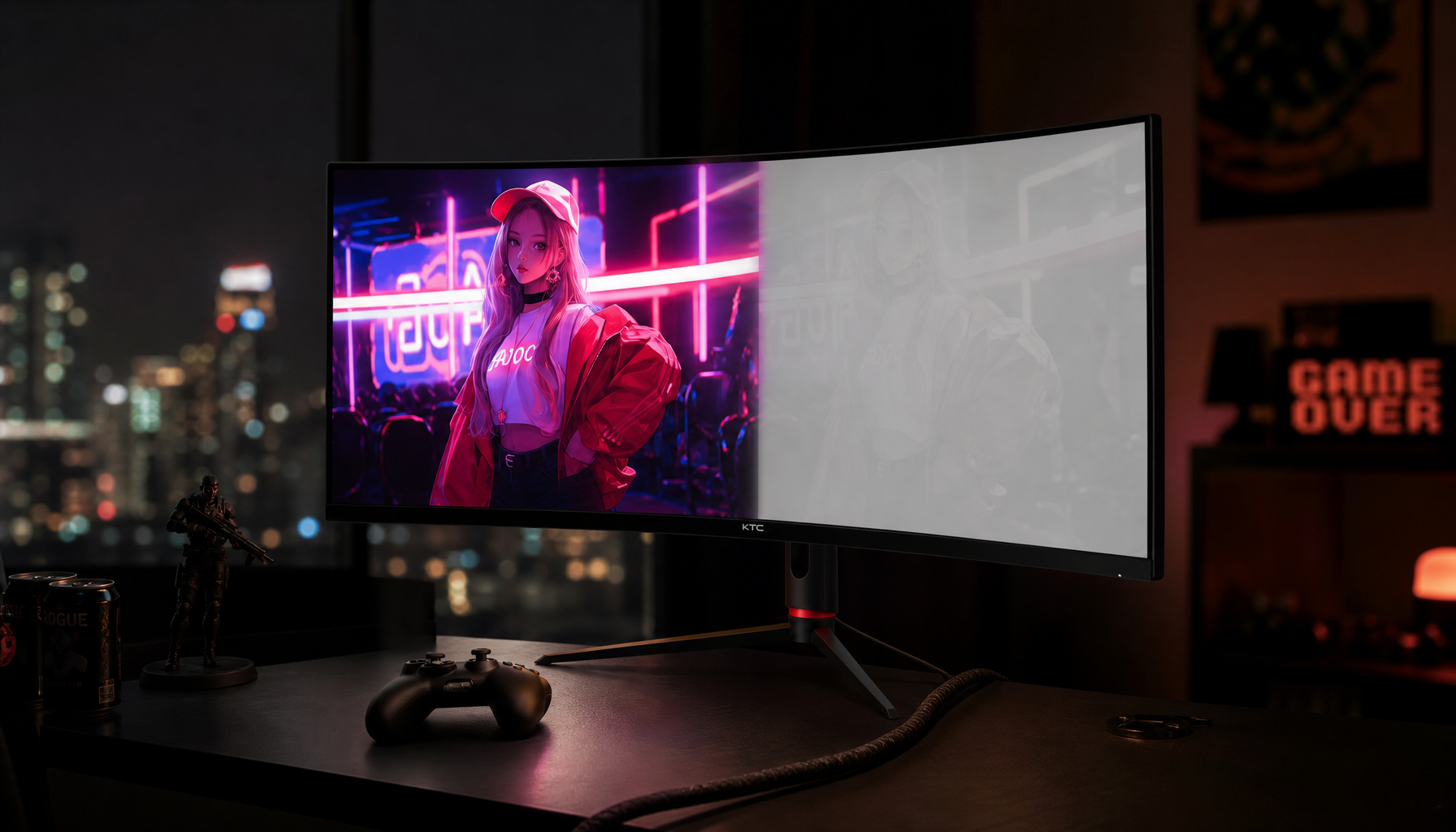
Curved screens can make the outer image feel more natural on wide monitors because the edges sit closer to your field of view instead of feeling pushed away. That can help on 34-inch and 49-inch ultrawide gaming monitors, where HUD elements, radar, or targets near the edges are easier to notice without the screen feeling as flat and stretched.

Correct field of view matters more than curvature alone for aiming, and the actual FOV change from the arc of a curved panel is usually only a few degrees. In practice, that means curvature can improve how a wide image feels, but it does not suddenly turn a missed flick into a hit.
Geometry becomes less uniform
Flat monitors remain the safer option for competitive FPS and RTS play because straight lines stay straight and image behavior stays predictable from center to edge. That matters when you are judging recoil lines, holding narrow angles, or snapping to targets with muscle memory built on uniform geometry.
The advantage of a curve is also much smaller on a 24-inch esports display than it is on a 34-inch ultrawide. On smaller 16:9 monitors, the edges are already close enough to the center that most players gain more from refresh rate, response time, and input lag improvements than from changing the panel shape.
When Curvature Can Help
Large ultrawides benefit the most
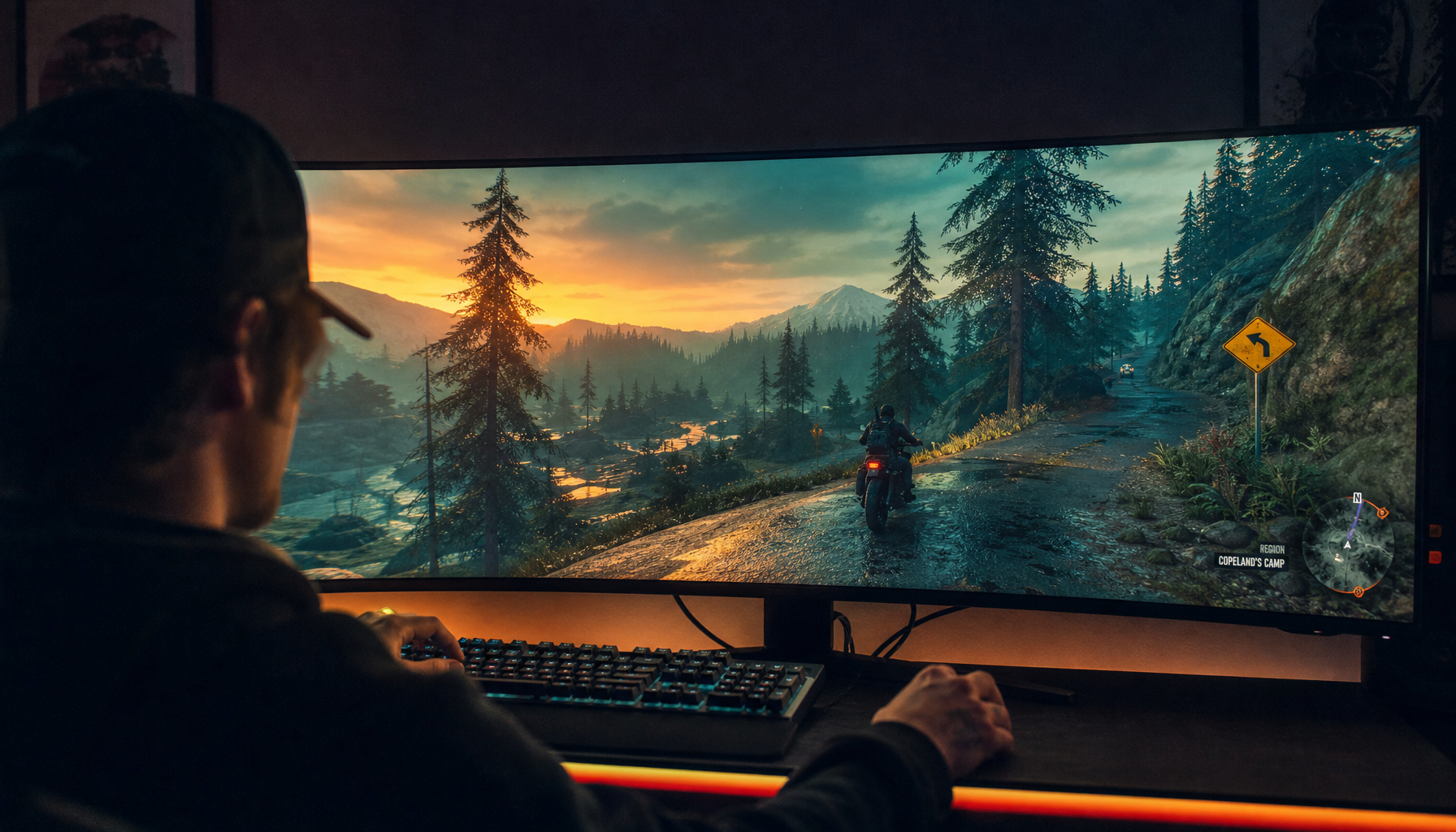
Curvature is most useful on 21:9 and 32:9 gaming monitors because it keeps the outer edges from feeling too far away and pulls side information deeper into peripheral vision. On a 49-inch super-ultrawide, a 1000R curve creates the strongest wraparound effect; on a 34-inch ultrawide, many users prefer 1500R as the more balanced option.

Matching the curve to your seating distance improves the effect. A 1000R screen generally makes the most sense around 3.0 to 3.6 ft away, while 1500R feels more natural around 4.3 to 5.6 ft. Sit much closer than about 3 ft to an aggressive 1000R panel and the curve can start to feel tight, especially in desktop tasks or games with lots of straight-line visual references.
Comfort can support late-session consistency
A prospective study on curved monitor fatigue found that 1000R produced the smallest change in near point of accommodation, while flat screens produced the largest increase in near point of convergence and higher eye pain scores after viewing tasks. The study only included 20 healthy adults and 30-minute sessions per monitor, but the direction is clear: a strong curve can reduce visual strain under some conditions.
Reduced refocusing demand is one of the practical reasons curved monitors feel easier during long sessions. That does not mean your aim becomes mechanically more accurate; it means you may feel less visual fatigue after hours of scanning minimaps, ammo counters, and edge targets on a large display.

When Curvature Can Hurt Competitive Precision
Fast shooters reward predictable geometry
Flat panels are still commonly preferred for fast-paced competitive gaming because they avoid image distortion and keep the whole screen visually consistent. If you mainly play competitive shooters or aim trainers, that predictability usually matters more than any immersion gain from a curved panel.
Curved monitors trade geometric precision for immersion as the curve becomes more aggressive. One comparison rated flat screens at 9/10 for geometric precision, 1500R at 7/10, 1000R at 5/10, and 1000R ultrawides at 4/10. Those are not lab-grade accuracy scores, but they reflect a real buying pattern: deeper curves feel better for presence than for line-perfect precision.
Aggressive curves can clash with normal desk setups
1000R setups often need about 24 to 26 inches of desk depth to feel properly centered and comfortable. If your desk is shallow, or if you sit unusually close because you play low-sensitivity shooters, the curve can exaggerate edge wrap and make the panel feel less neutral than a flat 16:9 screen.
Curved screens are also mainly designed for one centered viewer and generally take more physical depth than flat monitors. That is fine for a dedicated gaming desk, but it matters if your display also serves as a work monitor, a shared screen, or a wall-mounted setup.
Blur complaints usually come from panel behavior, not the curve itself
Curvature does not create motion blur by itself; it can only make blur feel more obvious because more fast-moving image area sits in peripheral vision on a wide screen. The bigger technical causes are frame persistence, response time, overdrive tuning, and panel type.
Refresh rate and panel response dominate motion clarity. A 60Hz display holds each frame for about 16.7 ms, while a 240Hz display cuts that to about 4.2 ms. Many curved monitors use VA panels with roughly 5 to 10 ms response behavior and more dark-scene smear, while OLED at roughly 0.02 ms and fast IPS LCDs are much safer choices if you care about tracking clarity.

The Specs That Matter More Than Curvature
Start with refresh rate and response time
For competitive shooters, refresh rate and panel speed matter more than curvature. A flat 240Hz to 360Hz panel with low input lag will usually improve tracking and flick consistency more than switching from flat to curved at the same refresh rate. On curved ultrawides, 165Hz is a practical floor, but 240Hz still makes more sense if shooters are a major priority.

Panel choice should come before shape. If you are choosing between a curved VA and a flat fast IPS for ranked play, the IPS often wins on motion handling. If you can afford OLED without burn-in concerns for your use case, it is the sharper motion choice regardless of curvature.
Size and aspect ratio change the answer
The benefit of a curve grows as the monitor gets larger and wider. On a 24-inch 16:9 esports monitor, the effect is minor. On a 27-inch panel, it becomes noticeable. On 34-inch 21:9 and 49-inch 32:9 ultrawide monitors, it becomes part of the core viewing experience.
Curvature also does not add panel area, sharpness, or text clarity. Resolution, pixel density, scaling, and tuning still determine how clean targets and HUD elements look. That is why a well-tuned flat 27-inch 1440p 240Hz monitor can outperform a more immersive curved display for actual hit consistency.
Quick comparison
Monitor setup |
Raw aim precision |
Edge awareness |
Best fit |
Main compromise |
|
Flat 24-inch to 27-inch 16:9, 240Hz+ |
High |
Moderate |
Good |
Pure esports and aim training |
Less immersive |
Flat 27-inch 1440p, 240Hz |
High |
Moderate |
Good |
Mixed competitive play and general use |
Wider screen feel is limited |
Curved 34-inch 21:9, 1500R, 165Hz to 240Hz |
Medium-high |
High |
High |
Hybrid play: shooters plus immersive games |
Less uniform geometry |
Curved 49-inch 32:9, 1000R, 240Hz |
Medium |
Very high |
High |
sims, racing, space, multitasking-heavy setups |
Too wide and too curved for many esports players |
How to Choose Based on Your Games and Desk
If competitive shooters come first
Flat monitors are still the most practical recommendation for competitive FPS players because they keep the aiming environment consistent across the whole screen. If you play mostly tactical shooters, arena shooters, or aim trainers, a flat 24-inch to 27-inch 16:9 display with high refresh, low input lag, and a fast panel is the cleanest buying decision.
Smaller esports displays also reduce the need for curvature in the first place. The edges stay close, the center remains dominant, and your training transfers more directly between games, VOD review, and practice tools.
If you split time between ranked play and immersive games
A 34-inch ultrawide with a moderate curve is the most reasonable compromise if you want one monitor for both shooters and cinematic games. A 1500R model gives you more peripheral wrap than flat without pushing as hard into the geometric compromises of a deep 1000R curve.
Curved monitors make more sense when your game list includes sims, racing, open-world titles, or space games. In those cases, comfort and edge visibility are part of the value, even if the monitor is not the absolute best tool for pure tournament-style precision.
If you want one display for work and gaming
Flat panels remain better for straight-line tasks such as spreadsheets, CAD-style layouts, and measurement-sensitive work. If your monitor spends half the day as a productivity display, a flat 27-inch high-refresh model often lands in the sweet spot between work clarity and gaming performance.
Deep curves are easier to justify when the screen is primarily a gaming monitor. The more your setup shifts toward ultrawide entertainment and long-session immersion, the more defensible a curved purchase becomes.
FAQ
The short version is that curvature changes how a monitor feels more than it changes your raw aim ceiling.
Q: Does a curved monitor improve aim accuracy in competitive shooters?
A: Usually not. Curvature can improve comfort and edge awareness on larger displays, but flat monitors still offer the most predictable geometry for precise crosshair placement and repeatable flicks.
Q: Is 1000R too aggressive for competitive gaming?
A: It can be, especially on a normal desk or in games where you want a neutral image. On large ultrawides used for mixed gaming, 1000R can feel excellent, but for pure esports it is often more curve than you need.
Q: What should I prioritize over curvature when buying a gaming monitor for aim?
A: Prioritize refresh rate, response time, input lag, panel type, and size first. After that, decide whether you want the uniformity of flat or the comfort and immersion benefits of a curve.
Practical Next Steps
For competitive aiming, curvature is a secondary choice, not a primary performance upgrade. Buy the monitor that supports your game type, desk depth, and session length instead of assuming a curved panel will sharpen your mechanics.
- Choose flat 24-inch to 27-inch 16:9 if ranked shooters are your main use case.
- Choose 1500R 34-inch ultrawide if you want a balanced monitor for shooters plus immersive games.
- Avoid deep 1000R curvature unless you have enough desk depth and actually want the wraparound effect.
- Prefer 240Hz+ for serious shooter play and at least 165Hz on ultrawide gaming monitors.
- Put OLED or fast IPS ahead of VA if motion clarity and target tracking matter most.
- Test seating distance, crosshair comfort, and edge distortion during real matches, not just desktop use.
References
- https://us.ktcplay.com/blogs/buying-guides/optimal-curvature-space-simulators?srsltid=AfmBOopsTLsEk-Zo5PNsq1Gy0dzeGOBPILy5UEgZp3za9Q_-ZyZRbSZQ
- https://us.ktcplay.com/blogs/buying-guides/optimal-curvature-space-simulators?srsltid=AfmBOopsTLsEk-Zo5PNsq1Gy0dzeGOBPILy5UEgZp3za9Q_-ZyZRbSZQ
- https://us.ktcplay.com/blogs/buying-guides/optimal-curvature-space-simulators?srsltid=AfmBOopsTLsEk-Zo5PNsq1Gy0dzeGOBPILy5UEgZp3za9Q_-ZyZRbSZQ
- https://us.ktcplay.com/blogs/buying-guides/optimal-curvature-space-simulators?srsltid=AfmBOopsTLsEk-Zo5PNsq1Gy0dzeGOBPILy5UEgZp3za9Q_-ZyZRbSZQ
- https://pmc.ncbi.nlm.nih.gov/articles/PMC5049768/
- https://us.ktcplay.com/blogs/buying-guides/optimal-curvature-space-simulators?srsltid=AfmBOopsTLsEk-Zo5PNsq1Gy0dzeGOBPILy5UEgZp3za9Q_-ZyZRbSZQ