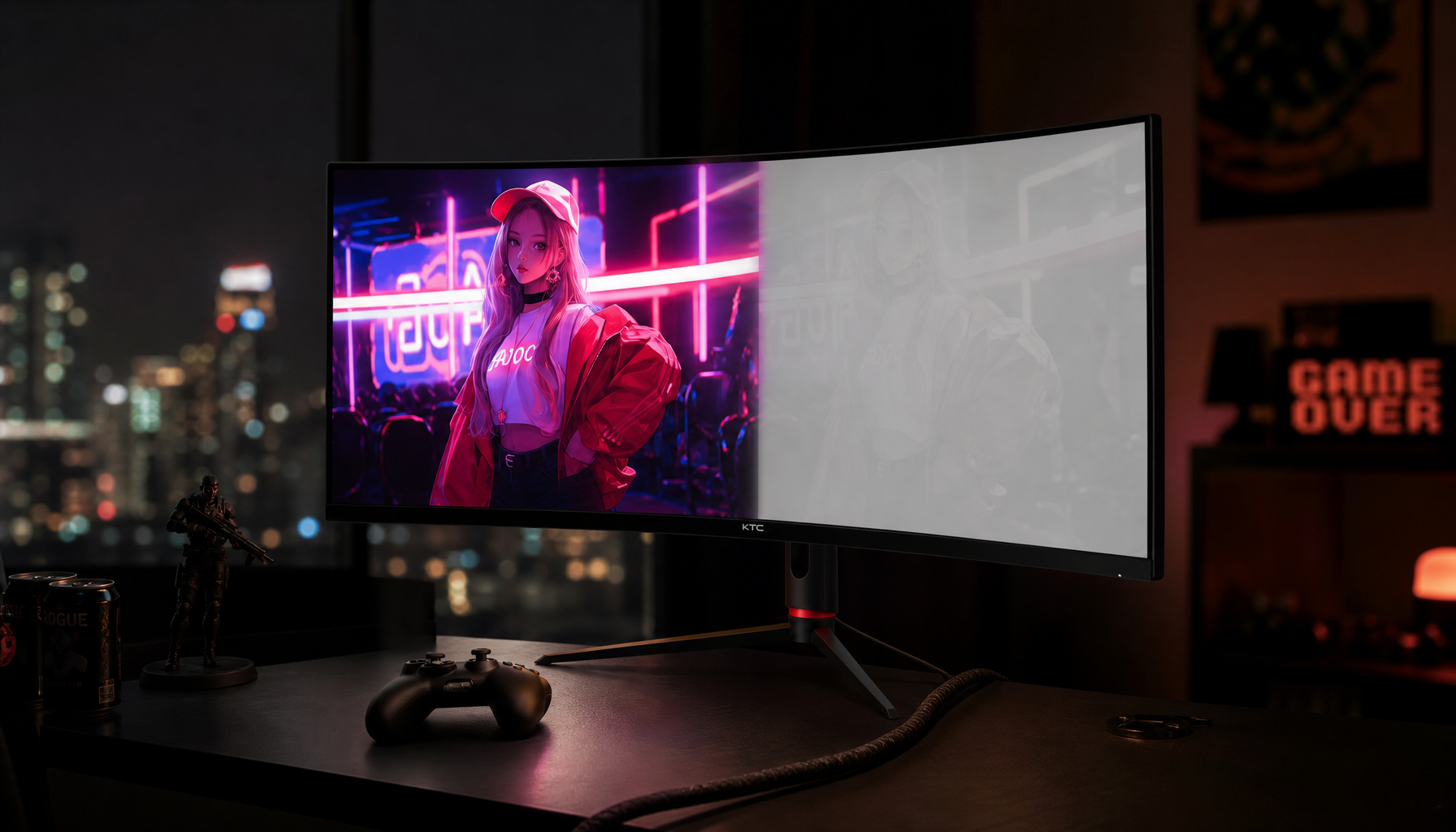
Viewing angle measures how far off-center you can look before image quality drops below a defined threshold, not how far you can look with zero visual change.
You lean a little in your chair during a game, and suddenly blacks look gray and colors feel flat at the edges. Lab testing now rotates monitors up to 70° and scores how quickly color, brightness, and contrast fall off, which is why two screens with the same headline spec can look very different. This guide breaks down what that number really means and how to use it when buying gaming, ultrawide, or portable monitors.

What Viewing Angle Measures (and What It Doesn’t)
The engineering definition
A monitor viewing angle is the off-center range where the image is still acceptable to the user, with best fidelity typically near straight-on center.
Many LCD datasheets define that limit using a contrast-ratio threshold, usually when contrast falls to 10:1 or 5:1. Contrast ratio here means white luminance divided by black luminance, so the spec is about minimum legibility, not perfect color or brightness.
In practice, this is better understood as a 3D viewing cone, not one single number. Left, right, top, and bottom can behave differently, especially on LCD panels that show stronger vertical shifts.
Why this matters for monitor buyers
A wide angle spec tells you the image remains visible; it does not guarantee accurate tones for editing, consistent shadows in games, or stable UI contrast while moving around your desk. That gap between “visible” and “accurate” is the source of most buyer confusion.

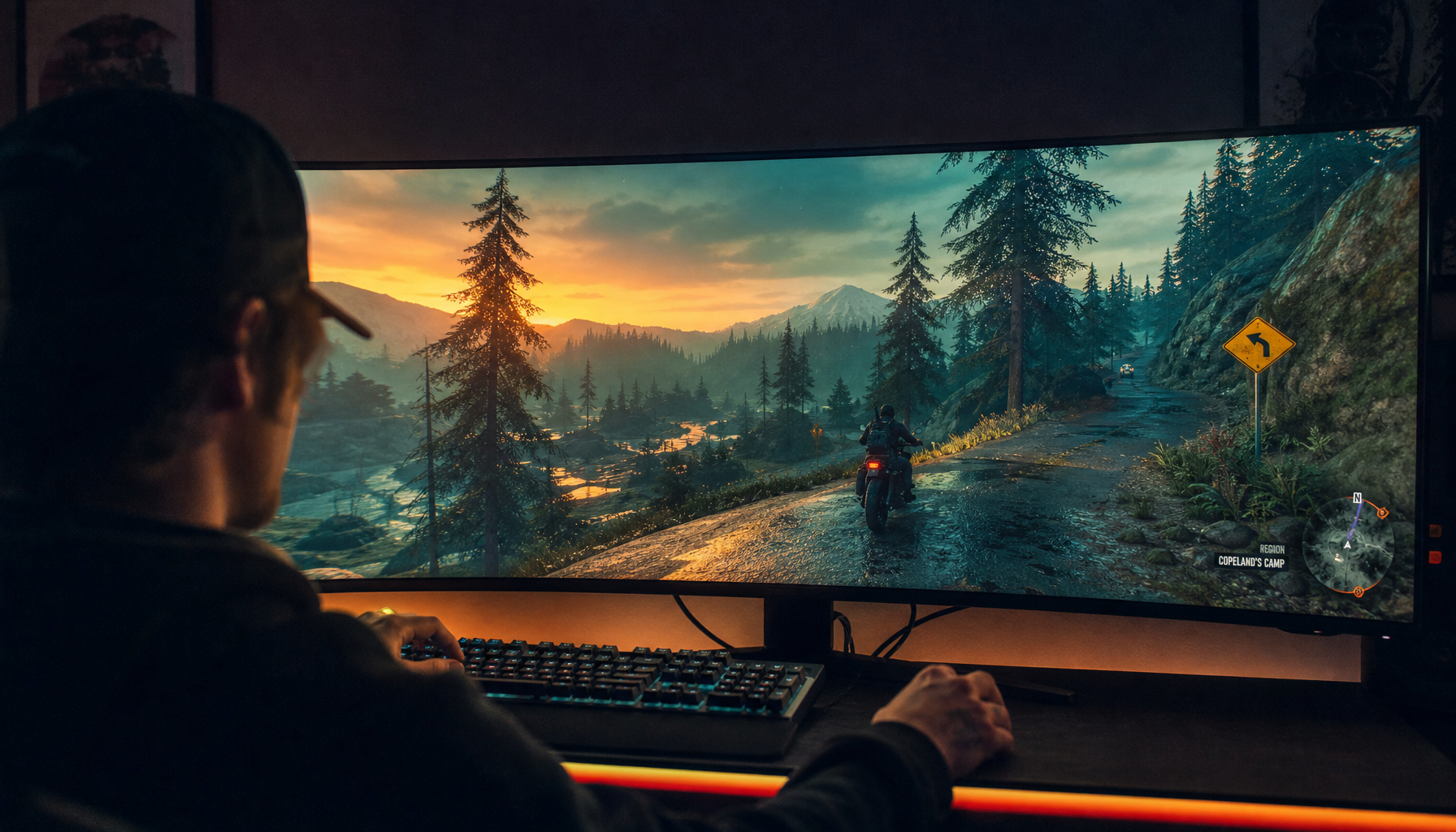
For gaming monitors and ultrawides, this matters because your eyes naturally hit the panel edges at steeper angles than on a smaller flat screen. For portable monitors, stand height and tilt can put you off-axis faster than expected, even with decent panel hardware.
Why “178°” Can Still Mislead
Spec-sheet optimism vs real use
Common headline values like 178°/178° are often measured at a minimum contrast endpoint, so they describe survival of the image, not quality retention.
Two monitors can both claim 178° and still look very different near the edges because one may hold color better while the other shifts early in grays or skin tones. The center can remain excellent while side areas lose punch.

What usually breaks first off-axis
As viewing angle increases, contrast generally drops, and you can also see brightness loss, color washout, and in some directions even stronger inversion-like behavior on weaker panels.
Real usability often feels best within roughly ±30° from center on many displays, and quality can fall faster above or below eye level than it does side-to-side. This is why seating position and monitor height matter almost as much as panel type.
Panel Type Tradeoffs for Gaming and Content Work
Panel trends in current monitors
Panel structure drives viewing-angle behavior more than any single OSD setting. In broad terms, TN is narrowest, VA is middle, IPS is strong, and OLED is strongest for off-axis consistency.

Panel comparisons in gaming-focused guidance are directional, not absolute: individual models can outperform category expectations, but the trend still helps you shortlist quickly.
Panel type |
Off-angle behavior (typical) |
Gaming tradeoff |
Best fit |
TN |
Faster color/contrast shift, especially vertically |
Very fast response and high refresh options |
Esports-first, single centered seating |
VA |
Better than TN, but side washout can appear |
Strong contrast, possible smearing on some models |
Movies, mixed gaming, darker-room use |
IPS |
Wide and more consistent off-axis |
Balanced speed and image quality |
All-around gaming, creator work, shared viewing |
OLED |
Widest and most stable off-axis |
Premium pricing, burn-in management needed |
High-end gaming and color-sensitive workflows |
Measured differences are not subtle
Independent testing shows large measurable gaps between panel families: example color washout around 70° on OLED, low-40s on IPS, and high-20s on VA, with about 10° already visible as a noticeable difference.
For high-refresh-rate buyers, this means speed specs alone are incomplete. A 240Hz or 300Hz monitor can still feel inconsistent if off-axis contrast or color falls apart during normal movement in your chair.
Setup Factors That Change Perceived Viewing Angle
Ergonomics and line of sight
Screen placement affects perceived image stability because vertical angle shifts can intensify brightness and color errors. A practical target is screen center around eye level to about 30° below your line of sight.
Picture controls also influence how angle issues feel in real use. Brightness, black level, contrast, and gamma tuning can improve readability and shadow detail, but they do not rewrite the panel’s native off-axis limits.
Curved ultrawides and edge perception
Curved and flat screens show the same source data, but curvature changes eye-to-panel geometry across the surface. Stronger curves can make center and edge perception less uniform for color-critical tasks.

For ultrawides used for gaming plus editing, milder curvature tends to be easier to manage than aggressive curvature. Keep critical judging work near the center area and treat edges as less reliable for precision color calls.
Portable monitor reality
Portable monitor buying coverage shows testing emphasizes brightness, contrast, and color coverage, while many product pages still under-explain angle behavior.
Hands-on field checks report matte panels and stable stands improve practical visibility in mixed lighting, especially outside a fixed desk setup. In portable use, stand design and glare control can matter as much as published angle numbers.
How to Evaluate Viewing Angle Before You Buy
Use measured behavior, not just labels
A robust lab approach measures off-axis image changes by sub-metric, including color washout, color shift, brightness loss, black-level raise, and gamma shift, rather than relying on one headline degree value.
If you compare models, prioritize where each degradation starts, not just the final advertised angle. For shared viewing, multi-monitor setups, and ultrawides, earlier-onset shift is often the deciding factor.
A 10-minute desk check you can actually do
Start with native resolution, sit at normal distance, and display full-screen neutral grays plus saturated colors. Move left/right and slightly up/down while watching for black lift, hue drift, and brightness falloff at edges.
Then tune only the basics using a practical calibration sequence: set brightness for your room, adjust black level to keep near-dark detail visible, and avoid overdriving contrast into clipped highlights.
Finally, test in your real use pattern: a fast game scene, a web page with small text, and a dark movie frame. If the image changes too much with normal posture shifts, the monitor is effectively narrow-angle for your workflow.
FAQ
Q: Does 178°/178° mean no color or brightness shift?
A: No. A 178° spec is usually a limit threshold, not a promise of unchanged image quality at that angle.
Q: Is viewing angle still important if I sit alone at a desk?
A: Yes, because off-axis consistency affects edge quality even for one user, especially on larger screens and ultrawides where edges are naturally viewed at steeper angles.
Q: Can calibration fix poor viewing angles?
A: Calibration improves center-view accuracy and tone control, but it cannot remove panel-geometry limits that cause off-axis shift.
Practical Next Steps
Use these checks before committing to a monitor for gaming, ultrawide productivity, or portable work:
- Match panel type to seating reality: IPS/OLED for shared or off-center viewing, VA/TN only if you stay centered and accept tradeoffs.
- Treat 178° as a screening spec, then verify measured off-axis behavior from independent tests.
- Set monitor height so your natural gaze lands slightly downward; avoid placing the screen too high.
- Tune brightness, black level, and contrast for your room before judging panel quality.
- For portable monitors, prioritize matte finish and stand adjustability so angle and glare stay manageable in real environments.
References
- Tom’s Hardware: monitor viewing angle definition
- Touchwindow: LCD viewing angle and contrast ratio threshold
- Lenovo glossary: viewing angle basics
- Riverdi: viewing angle practical aspect and viewing cone
- RTINGS: monitor calibration settings
- Corsair: panel types explained
- BenQ: TN vs VA vs IPS for gaming
- RTINGS: monitor viewing-angle test methodology
- Drawell: curved vs flat perception effects
- PCMag: portable monitor testing focus
- SFGATE: portable monitor field-use visibility notes