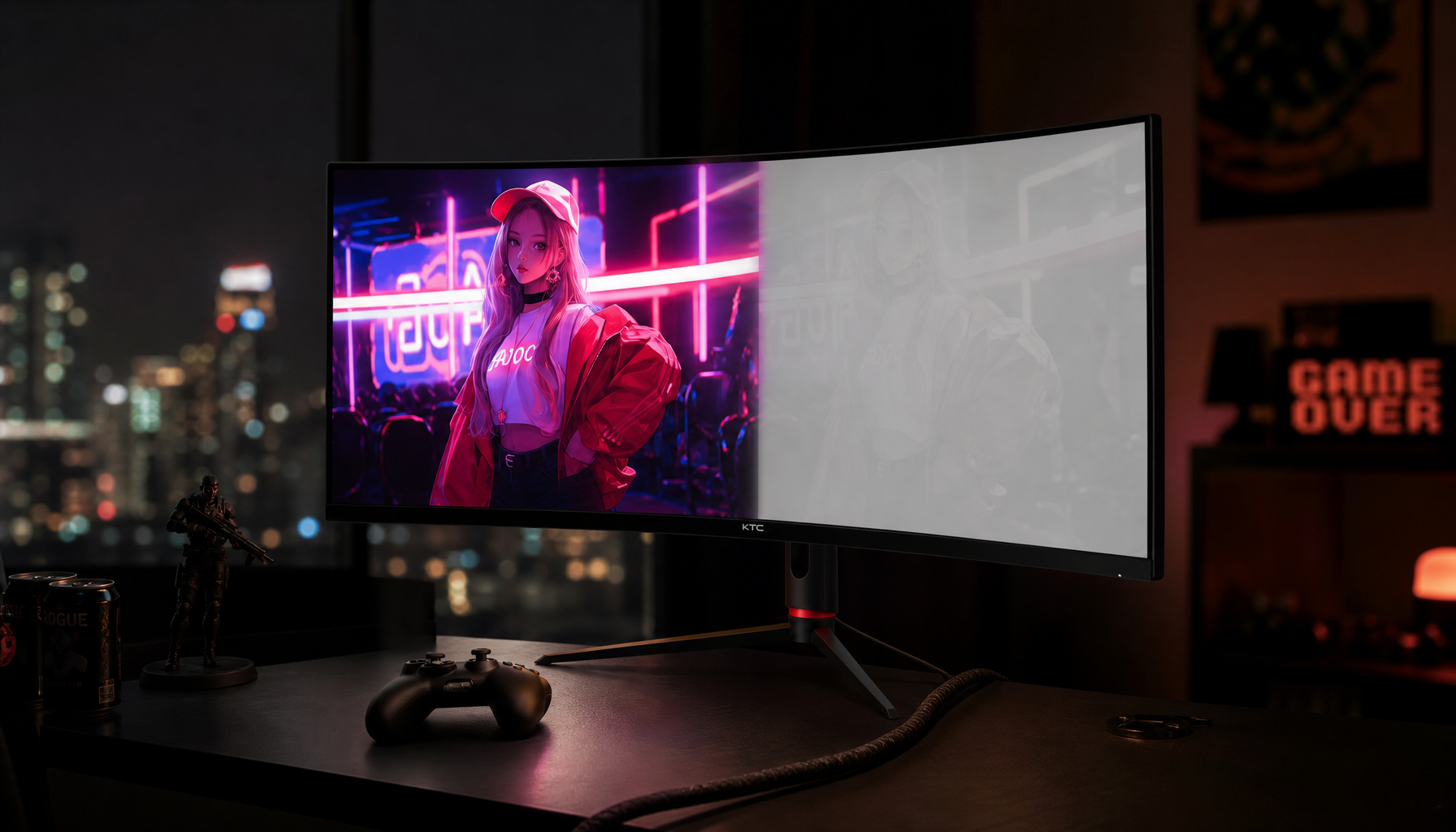
Yes. Motion blur reduction can make motion clearer, but in games with smoke, fog, sparks, glass, HUD transparency, or alpha-blended effects, it can also expose flicker, double images, shimmer, strobe crosstalk, and edge instability.
Do explosions look sharper when you enable blur reduction, but smoke suddenly feels choppy or “cut out” during fast camera pans? A practical test is simple: if the artifact appears only when strobing or black frame insertion is enabled, and mostly around translucent effects, the monitor mode is likely amplifying a timing or blending issue rather than proving the game is broken. You’ll learn what is happening, when the tradeoff is worth it, and how to tune the display for cleaner motion without hurting immersion.
Why Motion Blur Reduction Changes the Way Particles Look
Motion blur reduction, often called MBR, backlight strobing, black frame insertion, or similar display modes, works by shortening the visible time of each frame. Standard LCD and OLED displays behave like sample-and-hold screens: each frame remains visible until the next one arrives, so your eyes smear motion while tracking a moving object. Motion blur reduction attacks that persistence blur by inserting darkness or flashing the backlight at carefully timed intervals.

That is powerful for competitive clarity. A strafing opponent, fast crosshair sweep, or racing apex can look dramatically easier to track. The catch is that particles and transparency are not clean, solid objects. Smoke, sparks, muzzle flash, fog, magic effects, water spray, glass overlays, and transparent UI layers are often built from alpha blending, depth sorting, soft edges, lower-resolution buffers, and temporal effects. When the display shows each frame in short pulses, small inconsistencies that were previously hidden by blur become more visible.
The result is not always input lag or bad response time. It can be a temporal artifact, meaning a visual defect that appears across time rather than in one still frame. If you pause the game, the image may look fine. When you pan, flick, or track across the scene, the translucent layer may shimmer, pulse, separate, or leave a faint duplicate.
The Main Artifacts You May See
The most common symptom is double imaging. With strobing enabled, a bright particle trail or transparent object may appear in two positions during motion, especially if the frame rate does not match the strobe timing. This is often described as strobe crosstalk, where remnants of one refresh remain visible during another. A 240 Hz display has a refresh interval of about 4.2 ms, and high-refresh strobing can keep latency low when implemented well, but the timing still has to be clean.

Shimmer is another frequent issue. Particle systems often use semi-transparent textures, and their edges may depend on filtering, wrapping, depth fading, or animated noise. If a flame texture has edge bleed, for example, smooth filtering can blend unwanted pixels into the visible sprite. The display’s blur reduction mode does not create the bad texture coordinates, but it can make the mistake much easier to see during movement.
You may also see flicker in fog, smoke, or rain. This is especially noticeable when the game renders particles at a lower internal resolution and composites them back into the main image. GPU particle techniques often use reduced-resolution buffers to save performance because smoke, fire, dust, and fog can create heavy overdraw. That strategy is valid, but low-resolution particles can produce blockiness or scintillation when fast motion and sharp visibility pulses make the frame-to-frame changes stand out.
Particle Effects and Transparency Are Harder Than Solid Geometry
A solid wall is easy for the display to show. A translucent smoke cloud in front of that wall is harder because the game engine must decide how to blend colors, depth, and edges. Soft particles often fade near geometry to avoid hard intersections, while alpha-blended particles may need special accumulation rules so the final image looks natural.
This matters because blur reduction reduces visual persistence, not rendering complexity. A monitor cannot fix alpha sorting, low-resolution particle buffers, texture edge bleed, compression artifacts, or unstable temporal anti-aliasing. It can only change how long each finished frame is visible. That shorter exposure can make the frame look sharper, but it also removes the masking effect that blur used to provide.
The same principle appears outside gaming: visual artifacts are often not the real object but a side effect of the capture or processing method. In video work, compression artifacts can become obvious in dark gradients even when the original preview looked clean. In measurement science, laser diffraction artifacts can be mistaken for real particle populations unless checked with another method. For displays, the equivalent sanity check is comparing the same scene with MBR off, MBR on, different refresh rates, and a stable frame cap.
When MBR Helps More Than It Hurts
Motion blur reduction is usually worth trying in games where targets are solid, motion is fast, and the frame rate is stable. Competitive shooters, rhythm games, racing titles, and side-scrollers can benefit because clearer motion may help you track aim, judge spacing, or read fast-moving detail. The value is highest when your GPU can hold a frame rate that matches the monitor’s strobe refresh.
It becomes riskier in games with heavy transparency. Large smoke grenades, volumetric fog, particle-heavy boss fights, transparent foliage, glass-heavy environments, and post-processing-heavy scenes are more likely to reveal artifacts. If you play a tactical shooter where smoke readability matters, blur reduction can be a competitive advantage in one moment and a distraction in the next.
Scenario |
MBR Likely Helps |
Artifact Risk |
Fast aim tracking on solid targets |
High |
Low to medium |
Racing with stable FPS |
High |
Medium at screen edges |
Smoke-heavy tactical fights |
Medium |
High |
Foggy open-world scenes |
Medium |
High |
Transparent HUD overlays |
Low to medium |
Medium |
Unstable frame rate below refresh |
Low |
High |
The Frame-Rate Match Is Critical
Strobing works best when the game frame rate and monitor refresh rate are tightly aligned. If your monitor strobes at 144 Hz but the game swings between 118 and 144 FPS, each flash may reveal uneven frame pacing. That is where smoke can look like it is pulsing, sparks can appear to jump, and transparent overlays can feel less stable.

A practical setup is to choose a strobe refresh your system can hold comfortably. If your monitor supports strobing at 120 Hz, 144 Hz, and 240 Hz, do not assume the highest number is best. Many systems produce cleaner MBR at 120 Hz or 144 Hz because the GPU can maintain the target more consistently. Backlight strobing is most convincing when frame delivery is steady, and even small deviations can reduce motion detail.
For example, if a game averages 165 FPS but dips to 132 FPS during explosions, using a 144 Hz strobe mode may still produce visible disruption in exactly the scenes with the most particles. A 120 Hz strobe mode with a firm 120 FPS cap may look cleaner, even though the refresh number is lower. The sharper mode is the one your system can actually feed.
How to Tune Your Monitor and Game Settings
Start by disabling the game’s own motion blur before judging the monitor’s blur reduction. Game-engine motion blur and display-level strobing solve different problems, and stacking them can create a muddy, inconsistent result. Then set the operating system and the game to the same refresh rate you plan to test, because a monitor advertised as 240 Hz may still be running at a lower desktop refresh if the system setting was never changed.
Next, pick a fixed refresh mode and cap the game slightly below or exactly at the intended target, depending on how your monitor’s strobe mode behaves. If the display requires exact sync, use a strict cap at 120, 144, or 240 FPS. If you are using VRR without strobing, a cap around the upper stable range can improve consistency, but many monitors cannot combine VRR and strobing cleanly.
Adjust overdrive separately from MBR. Monitor ghosting comes from pixel transitions that are too slow, while inverse ghosting comes from overdrive pushed too hard. MBR may make both easier to see, so the best overdrive setting with strobing may be different from the best setting with strobing off. In practice, Medium or Normal often beats Extreme when particles and transparent highlights start showing bright halos.

Finally, test real scenes, not only synthetic motion patterns. Load a smoke-heavy map, a night scene with fog, a racing track with particle spray, and a bright UI overlay. Pan the camera slowly, then quickly. If the artifact is only visible in one game or one effect, it may be an engine-side transparency issue. If it appears everywhere with strobing enabled, the monitor mode or refresh match is the likely culprit.
Pros and Cons for Particle-Heavy Games
The upside is genuine. MBR can reduce persistence blur, sharpen moving targets, improve panning readability, and make high-speed play feel more direct. On a strong gaming monitor with low-lag strobing, the clarity improvement can be large enough to matter in competitive play.
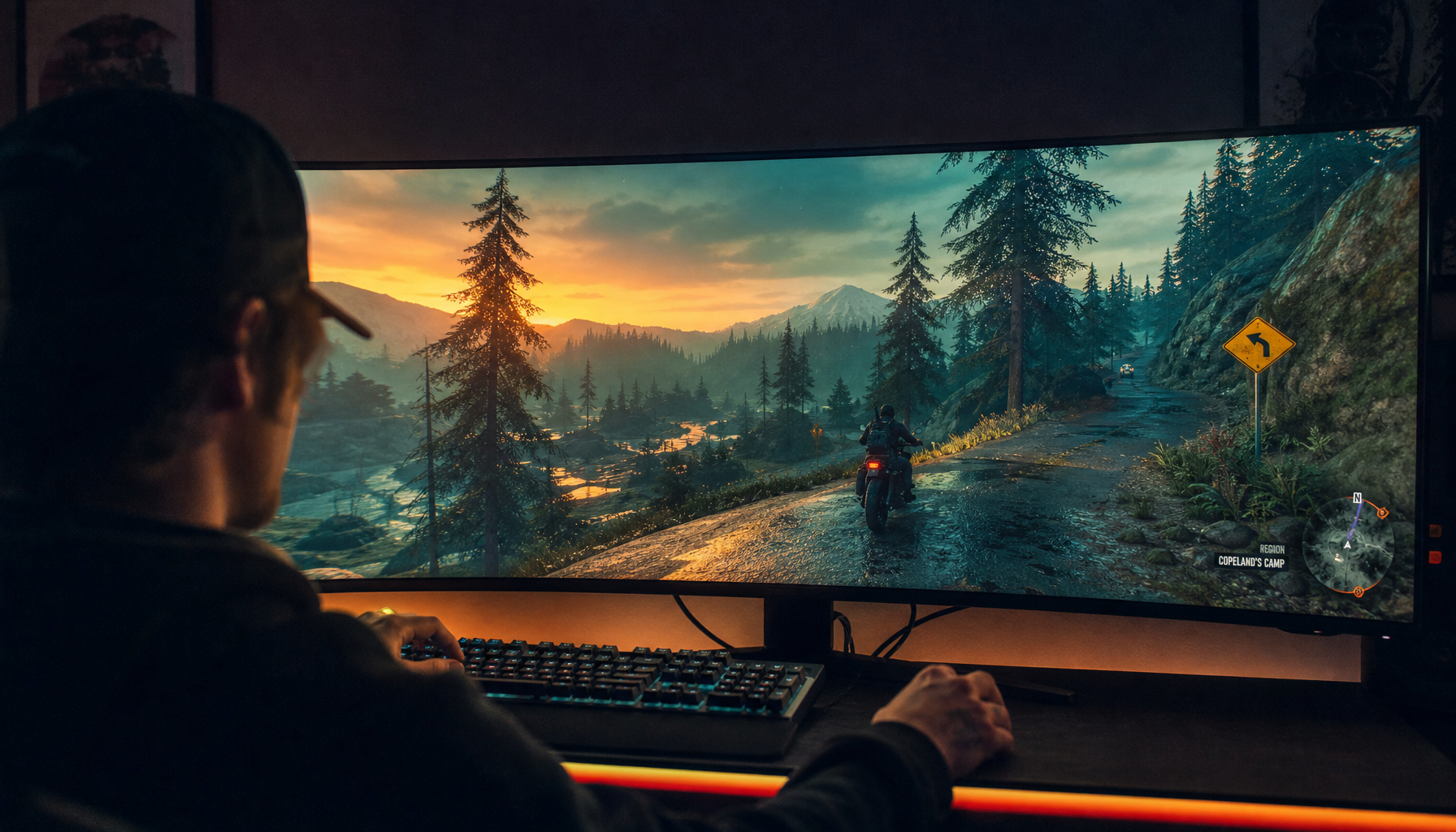
The downside is equally real. You may lose brightness, notice flicker, see double images, reveal particle shimmer, or lose VRR compatibility. On some displays, the bottom or top of the screen may show worse crosstalk than the center. Curved ultrawide displays can make the issue feel stronger because more motion fills your peripheral vision, especially in racing and flight games.
Should You Leave Motion Blur Reduction On?
For esports, leave it on only if it improves your actual read of the game. If you track enemies better, land shots more consistently, and the artifacts do not distract you, MBR is doing its job. If smoke, glass, sparks, or transparent effects become unstable, switch to a lower strobe refresh, reduce overdrive, lock frame rate more tightly, or turn MBR off for that title.
For immersive single-player games, the value depends on taste. A clean 144 Hz or 240 Hz non-strobed image with VRR may feel smoother and more cinematic than a strobed image with flicker and particle shimmer. For productivity displays and portable smart screens, MBR is usually unnecessary outside gaming because text clarity, brightness comfort, and stable scrolling matter more than strobe-driven motion sharpness.
The reliable approach is to treat motion blur reduction as a per-game performance mode, not a permanent badge of monitor quality. Use it when it gives you cleaner decisions on screen; disable it when it turns smoke, fog, transparency, or particles into visual noise.