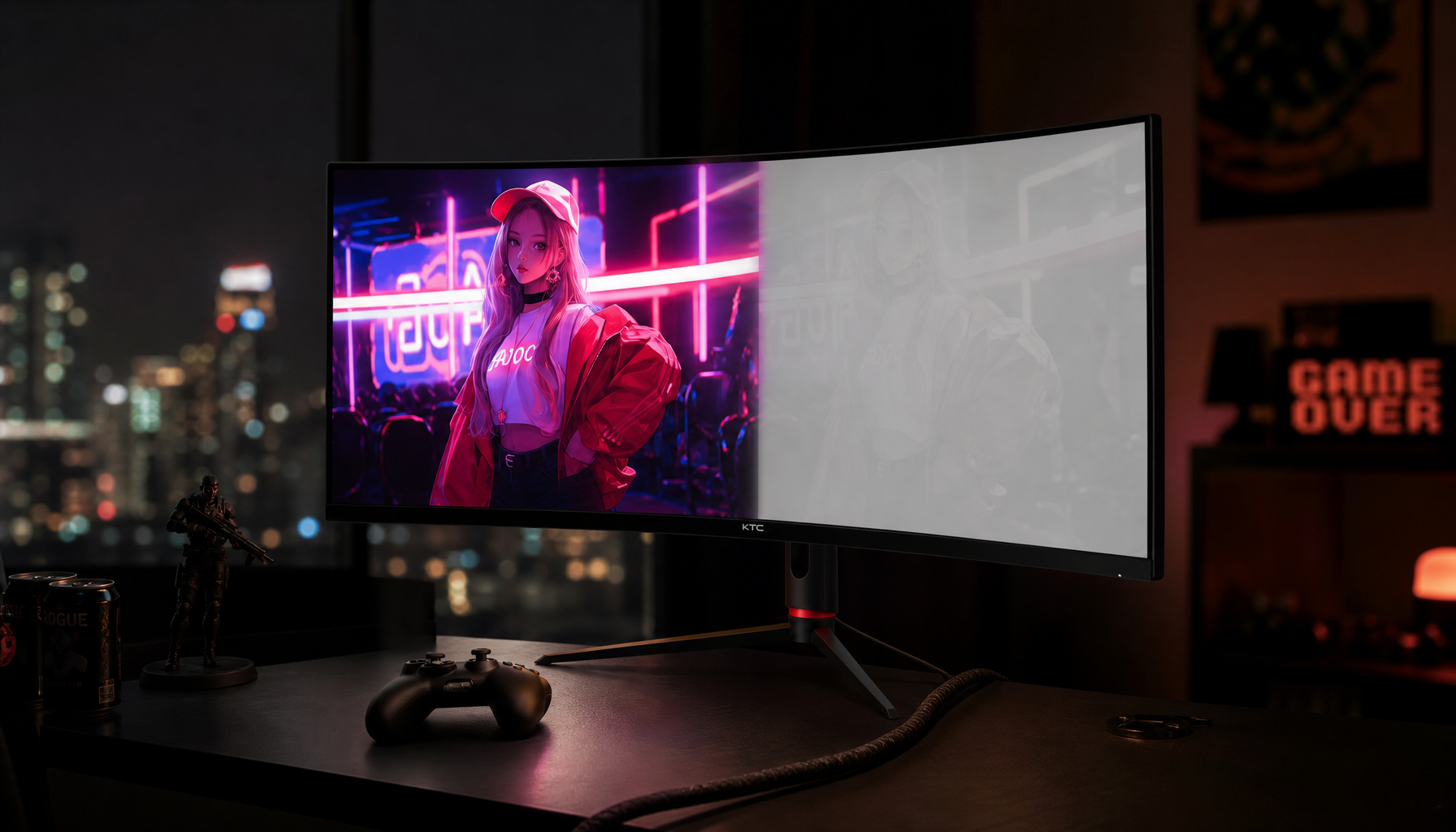
Quantum dot films are moving from cadmium-based materials to indium phosphide because display makers need wide color, high brightness, and a cleaner regulatory path without relying on a toxic heavy metal.
Does your premium monitor look vivid in a demo reel but raise questions once you think about daily use, disposal, and long-term product safety? The practical advantage is clear: indium phosphide helps manufacturers keep the quantum dot color benefit while reducing the cadmium concern that complicates consumer displays. Here is how the shift affects image quality, reliability, sustainability, and what to look for when buying a QLED, QD-OLED, productivity monitor, or portable screen.
The Display Problem Cadmium Solved First
Quantum dots earned their place in displays because they solve a real performance problem. Conventional LCD backlights can waste light through broad-spectrum filtering, while quantum dots can be tuned by size and composition to absorb and emit light with high precision. For a monitor, that means cleaner red and green output, stronger HDR highlights, and better color separation for games, creative work, and multi-window productivity.

In a typical quantum dot LCD stack, blue LEDs excite a quantum dot enhancement film, often called QDEF, which converts part of that blue light into narrower red and green wavelengths. A common TV implementation uses a 450 nm blue LED with green-emitting dots around 527 nm and red-emitting dots around 638 nm. That kind of spectral control helps saturated HUD elements, product photos, and cinematic lighting look less washed out.
Cadmium selenide and related cadmium compounds were attractive because they delivered strong optical performance early. They could produce narrow emission peaks, high efficiency, and wide color coverage. For a gaming monitor, that translates into punchier neon signs in night maps and cleaner team-color separation; for an office display, it means charts and brand assets can stay vivid without pushing brightness to uncomfortable levels.
Why Cadmium Became a Liability
The issue is not that cadmium-based quantum dots failed visually. The issue is that cadmium is a toxic heavy metal, and cadmium-free quantum dots were developed to reduce concerns linked to cadmium ion release from conventional quantum dot materials such as CdTe, CdSe, and CdS.
That matters for displays because monitors, TVs, signage panels, and portable screens are not lab samples. They are mass-market products that ship by the millions, sit in homes and offices for years, and eventually enter recycling or waste streams. Even when quantum dots are sealed inside films, product teams have to think beyond first-week brightness: they need supply chain durability, certification, disposal risk, regional restrictions, and consumer trust.

The toxicity discussion is also broader than a single ingredient label. Quantum dot behavior can change with core material, shell material, coating, size, solubility, exposure time, and environmental conditions. That is why a “cadmium-free” display should be understood as a lower-toxicity design direction, not a magic phrase that eliminates all testing.
Why Indium Phosphide Became the Leading Replacement
Indium phosphide, often shortened to InP, is compelling because it offers a cadmium-free semiconductor core that can still be engineered for display-relevant color. InP quantum dots often use a wider-band-gap shell such as ZnS because bare InP tends to have lower photoluminescent intensity and quantum yield than more optimized core-shell structures.
That shell requirement is important. The modern shift is not simply “replace cadmium with indium phosphide and keep everything else the same.” It is a materials-engineering move involving InP cores, shell growth, surface passivation, ligand control, and film encapsulation. In plain terms, the dot has to be built so it emits efficiently, survives heat and moisture, and stays stable across the display’s expected service life.
For real screens, that stability is just as important as peak color. A 32-inch 4K gaming monitor running HDR at a bright desk may sit near a window, cycle through warm and cool states, and display static interface elements for hours. A portable smart screen may be packed in a bag, charged by USB-C, and used in variable lighting. In both cases, the quantum dot film has to keep converting light predictably instead of drifting, dimming, or losing color accuracy.

What Changes for Picture Quality?
The viewer-facing goal remains the same: high brightness, wide color gamut, and efficient light conversion. Quantum dot displays can improve LCD color because narrower red and green spectra allow the screen to waste less light in color filtering and produce more accurate RGB mixtures.
Cadmium-based dots historically had an edge in performance maturity. InP has had to catch up through better synthesis, thicker or graded shells, and tighter control over particle size distribution. That is why two products can both say “quantum dot” but look very different in a side-by-side HDR test. The useful buyer question is not only whether the panel uses quantum dots, but whether it has enough quantum dot material, strong encapsulation, reliable calibration, and credible color-volume claims.
Here is the practical comparison for display buyers and product teams:
Factor |
Cadmium-Based Quantum Dots |
Indium Phosphide Quantum Dots |
Color performance |
Historically strong and efficient |
Competitive when well engineered |
Toxicity profile |
Higher concern due to cadmium |
Lower cadmium-related concern |
Regulatory comfort |
More complicated |
Easier path for consumer products |
Engineering burden |
Mature optical behavior |
Needs careful shell and surface design |
Best fit today |
Less attractive for mass consumer displays |
Strong fit for QLED films and future devices |
The Sustainability Tradeoff Is Not One-Dimensional
The cleanest story would be “InP is cadmium-free, therefore it is automatically greener.” The evidence is more nuanced. A cradle-to-gate assessment comparing indium phosphide and cadmium selenide quantum dot displays found that InP QD-enabled displays can be more energy intensive to produce, even though they reduce cadmium-related toxicity concerns.
That does not mean the shift to InP is wrong. It means the best display strategy has to account for both hazard and manufacturing impact. A monitor that avoids cadmium but requires inefficient synthesis, excessive material waste, or weak yield control may solve one problem while increasing another. For manufacturers, the next performance race is not only higher color volume; it is cleaner chemistry, better batch consistency, stronger encapsulation, and lower-energy production.
For buyers, this nuance supports a practical rule: treat “cadmium-free” as a meaningful positive, then still evaluate the whole display. Look at warranty length, brightness stability, color certification, power use, panel type, and whether the product comes from a manufacturer with credible quality control. For a $1,299.00 creator monitor, a vague quantum dot badge is not enough; you want measured color coverage, factory calibration, and stable HDR behavior.
How Quantum Dot Film Design Affects Reliability
Quantum dot films are not just dust sprinkled into a screen. They are optical layers made from nanocrystals, ligands, host materials, barrier films, and adhesives. Research on colloidal quantum dot films shows that film optical constants depend on the inorganic core, organic ligands, voids, particle packing, and film thickness.
For displays, small material choices can become visible screen behavior. If dot size distribution is loose, color purity suffers. If encapsulation is weak, oxygen, moisture, and heat can degrade performance. If film thickness is inconsistent across a large panel, uniformity problems can show up as tint shifts, especially on gray backgrounds or white productivity screens.
This is why office users and gamers should care about engineering details that sound invisible. A spreadsheet-heavy user may notice uneven whites faster than a movie watcher. A competitive gamer may care about brightness consistency across the panel because dark-scene visibility and HUD clarity depend on predictable luminance. A portable-screen user may care about thermal stability because slim chassis designs leave less room for heat management.
What to Look For in a Quantum Dot Monitor or Smart Screen
Start with the use case, because the best quantum dot display for HDR gaming is not automatically the best one for spreadsheets, travel, or photo review. For gaming, prioritize refresh rate, response time, adaptive sync, HDR peak brightness, local dimming behavior, and color volume. Quantum dots help most when the rest of the panel can actually use the wider color and brightness range.
For office productivity, avoid chasing saturation alone. A strong productivity display should offer readable text, stable whites, low glare, sensible brightness controls, and accurate sRGB or DCI-P3 modes. Quantum dot color is valuable when it is controlled; oversaturated icons and skin tones are not a productivity upgrade.
For portable smart screens, focus on brightness per watt, USB-C power behavior, coating quality, and color presets. A quantum dot portable panel can be excellent for presentations or travel editing, but only if it stays readable under room lighting and does not drain a laptop battery aggressively.
FAQ
Are indium phosphide quantum dots completely safe?
No material should be treated as automatically safe without testing. InP removes the cadmium-specific concern, but quantum dot safety still depends on core composition, shell design, coatings, stability, exposure route, and disposal conditions.
Does cadmium-free mean worse image quality?
Not necessarily. Early cadmium systems were performance leaders, but InP-based quantum dots have improved through better core-shell structures and surface engineering. A well-built InP quantum dot monitor can deliver excellent brightness and color, while a poorly implemented “QLED” product may show little real benefit.
Is QLED the same as true self-emissive quantum dot display?
No. Most commercial QLED monitors and TVs use quantum dot films with LED backlights. True electroluminescent quantum dot displays, where quantum dots emit light directly as the subpixels, remain a more difficult next-generation target.
The Bottom Line for Better Screens
Quantum dot films are shifting from cadmium to indium phosphide because the display industry needs performance that can scale responsibly. The smart move is not to buy the loudest “QLED” label; it is to choose a screen where quantum dots are backed by credible color performance, strong film engineering, cadmium-free materials, and reliability that fits how you actually work, play, and travel.