A 34-inch 21:9 ultrawide monitor can feel smaller than expected because it is much wider than a 27-inch 16:9 display, but almost the same height.
Did your new 34-inch ultrawide look huge in the product photos, then feel strangely familiar once it landed on your desk? The practical difference is specific: a typical 34-inch 21:9 screen adds about 7.8 inches of width and about 108 sq in of screen area over a 27-inch 16:9 monitor, but only about 0.2 inches of height. Here is how to judge the size correctly before buying your next gaming monitor or productivity display.
The Diagonal Number Is Misleading
A monitor’s advertised size is measured diagonally, not by width, height, or usable workspace. That matters because screen size does not describe the shape of the rectangle; a tall 27-inch display and a wide 34-inch ultrawide can have very different physical proportions even when the diagonal number makes one sound dramatically larger.

For monitor buyers, this is the core trap: a larger diagonal does not automatically mean larger text, taller documents, bigger game HUD elements, or a more imposing screen in front of your face. The 34-inch ultrawide uses its diagonal to stretch horizontally, while the 27-inch 16:9 monitor uses more of its diagonal in a balanced width-to-height layout.
The Real Size Difference
Using standard screen-size calculations, a 34-inch 21:9 monitor is about 31.3 inches wide, 13.4 inches tall, and 420 sq in in screen area. A 27-inch 16:9 monitor is about 23.5 inches wide, 13.2 inches tall, and 312 sq in in screen area, based on screen dimensions. For a real-world reference point, a 27-inch 2K 100Hz/120Hz home-office monitor is a 27-inch 2K/QHD home-office monitor, so its desk feel belongs much closer to the 27-inch comparison column than to the wider 34-inch ultrawide column.
That means the ultrawide is genuinely bigger, but not in the way many buyers expect. It is about one-third wider and has about 35% more total area, yet it is almost the same vertical size. If you expected a 34-inch monitor to make everything feel larger, the disappointment usually comes from confusing diagonal growth with height growth.
Monitor Type |
Approx. Width |
Approx. Height |
Approx. Area |
What Feels Bigger? |
27-inch 16:9 |
23.5 inches |
13.2 inches |
312 sq in |
Balanced height and width |
34-inch 21:9 |
31.3 inches |
13.4 inches |
420 sq in |
Much wider workspace |
Practical difference |
+7.8 inches |
+0.2 inches |
+108 sq in |
Side-to-side space, not vertical scale |
Why the 34-Inch Ultrawide Feels Short
The reason a 34-inch ultrawide can feel “smaller” is that human perception often reacts strongly to height. A 34-inch 21:9 panel has a screen height close to a 27-inch 16:9 panel, and diagonal alone does not fully describe perceived screen size when aspect ratios differ.
On a desk, your eyes notice whether the top of the display rises higher, whether documents show more vertical lines, and whether game menus or web pages appear larger. A 34-inch ultrawide does not usually deliver that kind of vertical upgrade from 27 inches. It gives you more horizontal canvas for timelines, side-by-side windows, racing games, flight sims, and cinematic games.
Vertical Content Does Not Grow Much
If you use a 27-inch 1440p monitor and switch to a 34-inch 3440 x 1440 ultrawide, the vertical pixel count stays at 1,440 pixels. The physical height also stays nearly the same. So spreadsheets, code editors, web pages, and documents do not suddenly show larger text or more vertical content unless you change scaling.

This is why a 34-inch ultrawide can be a fantastic workspace upgrade without feeling like a physically larger monitor. You can place a browser and document side by side more comfortably, but a single maximized web page may feel nearly the same height as it did on your 27-inch display.
“21:9” Is a Shape, Not a Size Promise
The 21:9 label is also less exact than it sounds. In consumer displays, 21:9 is a marketing term for ultrawide formats rather than one fixed mathematical ratio, and common ultrawide resolutions include 2560 x 1080, 3440 x 1440, 3840 x 1600, and 5120 x 2160.
For shoppers, the practical point is simple: always check width, height, resolution, and pixel density. A 34-inch 3440 x 1440 ultrawide and a 34-inch 2560 x 1080 ultrawide may share the same physical size, but they will not feel equally sharp. The lower-resolution model spreads fewer pixels across the same width, which can make text and UI elements look less refined.
What Actually Improves With a 34-Inch 21:9 Monitor
A 34-inch ultrawide shines when the task benefits from width. For gaming, the extra horizontal field can make supported titles feel more cinematic and immersive. For work, the extra space makes it easier to keep two or three windows visible without the bezel gap of a dual-monitor setup.

This is the upgrade many buyers really get: not a taller screen, but a wider command center. In a typical desk setup, that can be more useful than raw size if you edit video timelines, compare documents, keep chat next to a dashboard, or play games where peripheral vision adds value.
Gaming Benefits
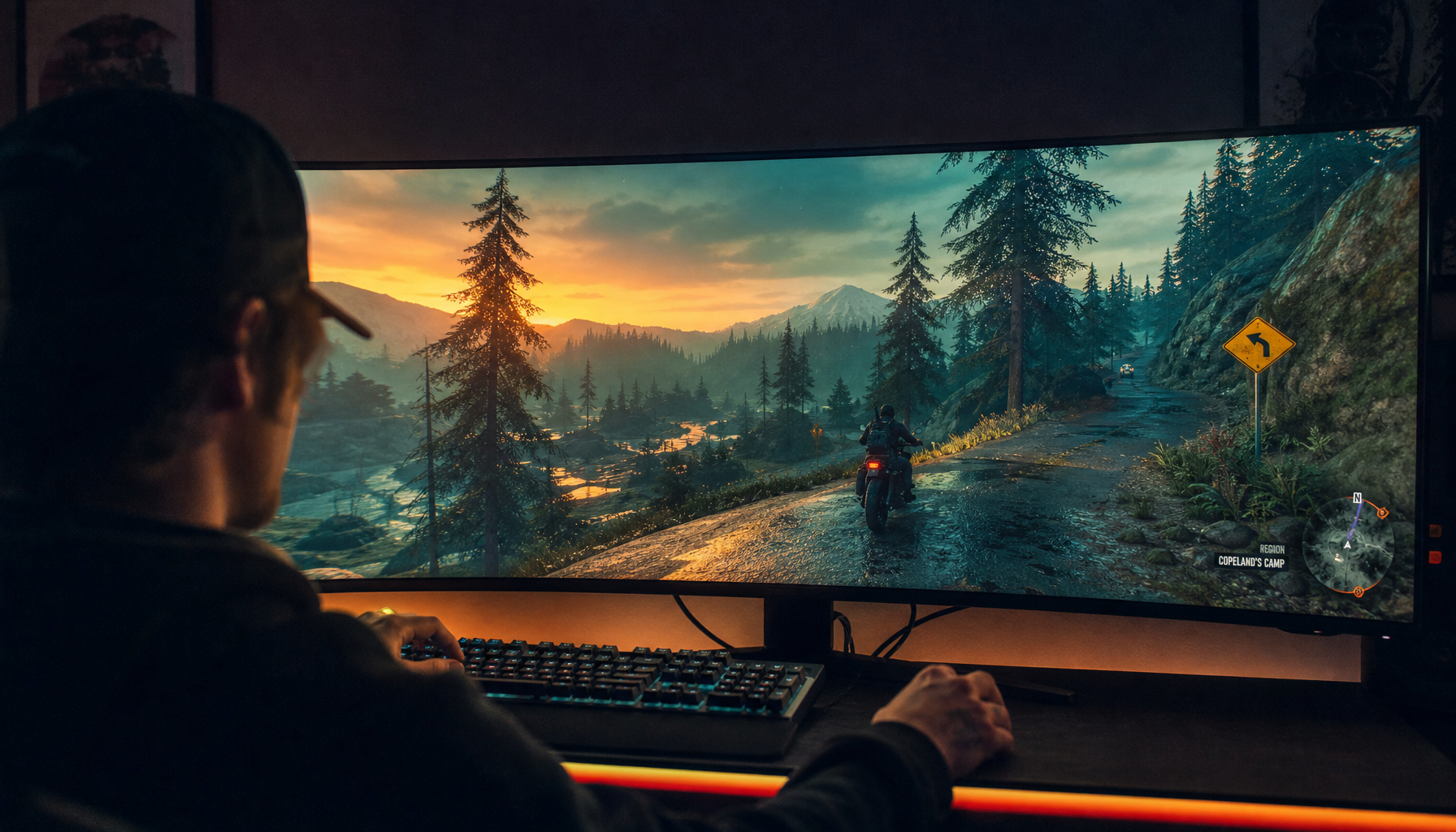
In supported computer games, 21:9 can expand the horizontal view and reduce the boxed-in feel of 16:9. Racing games, open-world games, flight sims, strategy games, and some RPGs benefit especially well because the wider frame adds context around the player.

The tradeoff is that not every game handles ultrawide perfectly. Some competitive games limit field of view, some cutscenes show black bars, and some menus are designed around 16:9. If your main priority is high-refresh competitive gaming, a fast 27-inch 16:9 monitor may still feel more natural, especially if you sit close and want all UI elements inside a smaller eye-travel zone.
Productivity Benefits
For productivity, a 34-inch ultrawide is often more comfortable than two smaller screens because the workspace is continuous. You can keep a main window in the center and supporting apps on the sides, which is useful for research, writing, coding, trading dashboards, and content editing.
However, it does not replace vertical screen space. If your daily work involves long documents, tall spreadsheets, coding with many visible lines, or reading dense reports, a taller monitor, a 32-inch 16:9 display, or an ultrawide with more vertical resolution may feel like a bigger upgrade.
Viewing Distance Can Make It Feel Even Smaller
Desk distance changes perceived size. A large ultrawide placed too far back can feel less imposing, while one placed too close can require too much eye and head movement. For very wide displays, viewing distance becomes part of the buying decision, not just a comfort adjustment.

A 49-inch ultrawide is often discussed around 36 to 42 inches from the eyes, with about 40 inches as a practical starting point. A 34-inch ultrawide usually sits closer on a standard desk, but the same principle applies: if the monitor stand pushes the panel back and your real eye distance ends up long, text and UI elements can feel smaller than expected.
Desk Depth Matters More Than Product Photos
Many monitor stands take up desk space and reduce usable viewing distance. A desk may look deep on paper, but once the stand, keyboard, speakers, and accessories are in place, your real eye-to-screen distance may land around 28 to 34 inches.
That range can work well for a 34-inch ultrawide, but only if you center the screen and keep the top edge at or slightly below eye level. If you are leaning forward to read text, the issue may not be the monitor size alone. It may be a combination of viewing distance, scaling, resolution, and stand position.
Arm Mounts Can Change the Experience
A monitor arm can make a 34-inch ultrawide feel better because it frees desk depth and lets you position the panel precisely. Moving the screen a few inches closer can make text easier to read without increasing operating-system scaling, while moving it slightly farther back can reduce side-to-side eye travel during games.
For many buyers, this is the cheapest fix before replacing the monitor. If the screen feels wide but not immersive, test the panel at different distances for a few days. Small position changes can reveal whether the problem is the monitor format or the setup.
How to Choose the Right Upgrade From 27 Inches
If you are moving from a 27-inch 16:9 monitor, decide what kind of “bigger” you actually want. A 34-inch 21:9 display is the right upgrade if you want more horizontal space. It is the wrong expectation if you want a screen that looks much taller, makes everything visibly larger, or feels like a dramatic physical jump.
For a true size upgrade, compare height first. A 32-inch 16:9 monitor is noticeably taller than a 27-inch 16:9 display. A 38-inch ultrawide with 3840 x 1600 resolution also gives more vertical presence than a 34-inch 3440 x 1440 model. A 49-inch super ultrawide is much wider again, but it needs more desk space and careful viewing distance.
Buy Based on Use Case
If your priority is immersive single-player gaming, a 34-inch 3440 x 1440 high-refresh ultrawide is one of the best sweet spots because it adds width without becoming overwhelming. Look for a refresh rate that matches your graphics card, adaptive sync support, and a panel type that fits your game mix.
If your priority is work, check whether your apps need width or height. A video editor, music producer, or multitasking-heavy user may love 21:9. A writer, programmer, analyst, or legal-document reviewer may prefer more vertical space, sharper text, or a larger 16:9 display.
Check Resolution Before Size
A 34-inch ultrawide should usually be 3440 x 1440 for a balanced modern desktop experience. A 2560 x 1080 ultrawide can still be usable for gaming, but on a 34-inch panel it may look soft for text-heavy work. A higher-resolution ultrawide can look sharper, but it also requires more GPU power, especially at high refresh rates.
For a gaming monitor, size is only one part of the equation. Refresh rate, response performance, adaptive sync behavior, panel coating, brightness, curve, port selection, and ergonomics all influence whether the display feels like an upgrade after the first week.
Action Checklist Before You Buy
- Measure the height of your current 27-inch monitor, then compare it with the listed height of the ultrawide you are considering.
- Check the resolution, not just the diagonal size; prefer 3440 x 1440 over 2560 x 1080 for most 34-inch desktop use.
- Confirm your desk can support a comfortable viewing distance without forcing you to lean forward.
- Decide whether you need width for multitasking and gaming immersion, or height for documents, code, and reading.
- Test your main games for ultrawide support before buying for gaming.
- Consider a monitor arm if the included stand pushes the screen too far away.
- If you want a clearly taller upgrade from 27 inches, compare 32-inch 16:9, 38-inch ultrawide, and larger high-resolution options.
FAQ
Q: Is a 34-inch ultrawide actually bigger than a 27-inch monitor?
A: Yes, but mostly horizontally. A typical 34-inch 21:9 monitor has about 420 sq in of screen area, while a 27-inch 16:9 monitor has about 312 sq in. The ultrawide is much wider, but the two screens are nearly the same height.
Q: Why does my 34-inch ultrawide not make text look bigger?
A: Text size depends on physical screen height, resolution, scaling, and viewing distance. If you moved from a 27-inch 1440p monitor to a 34-inch 3440 x 1440 ultrawide, the vertical resolution and physical height are very similar, so text may look almost the same size.
Q: Should I buy a 34-inch ultrawide or a 32-inch 16:9 monitor?
A: Choose the 34-inch ultrawide if you want wider gaming immersion, side-by-side windows, and a cleaner alternative to dual monitors. Choose the 32-inch 16:9 monitor if you want a display that feels taller, makes the whole screen look physically larger, and works predictably with games, videos, and apps built for standard widescreen.
Key Takeaways
A 34-inch 21:9 ultrawide feels smaller than expected because it is not a taller version of a 27-inch 16:9 monitor. It is a wider version with nearly the same height. That is why it can be excellent for gaming immersion and multitasking, while still feeling underwhelming if your goal is larger text, taller pages, or a more imposing screen.
The best buying rule is to compare screen height, resolution, and desk distance before comparing diagonal size. If you want width, a 34-inch ultrawide makes sense. If you want a monitor that feels physically larger than 27 inches in every direction, look beyond the 34-inch 21:9 category.