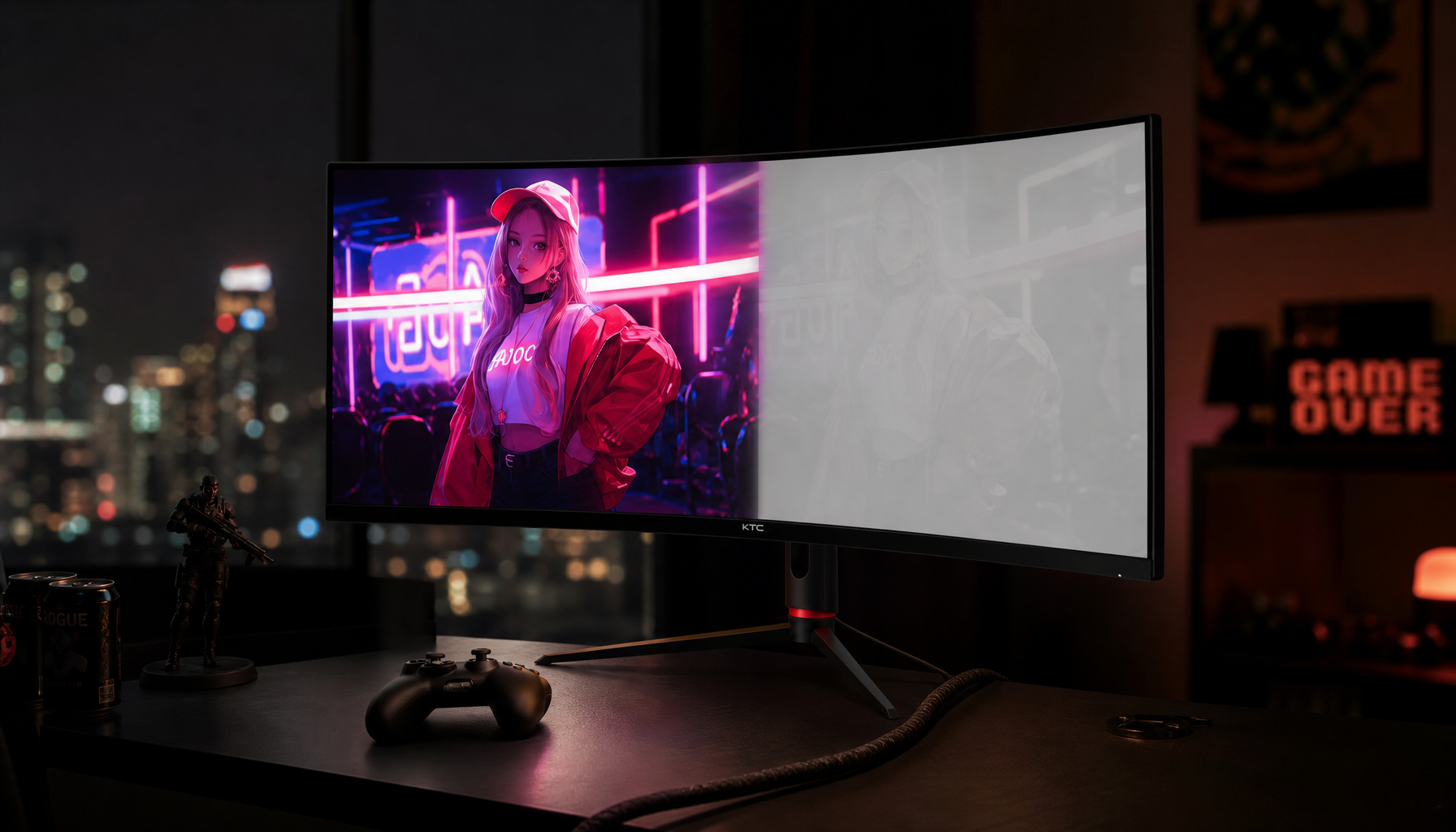
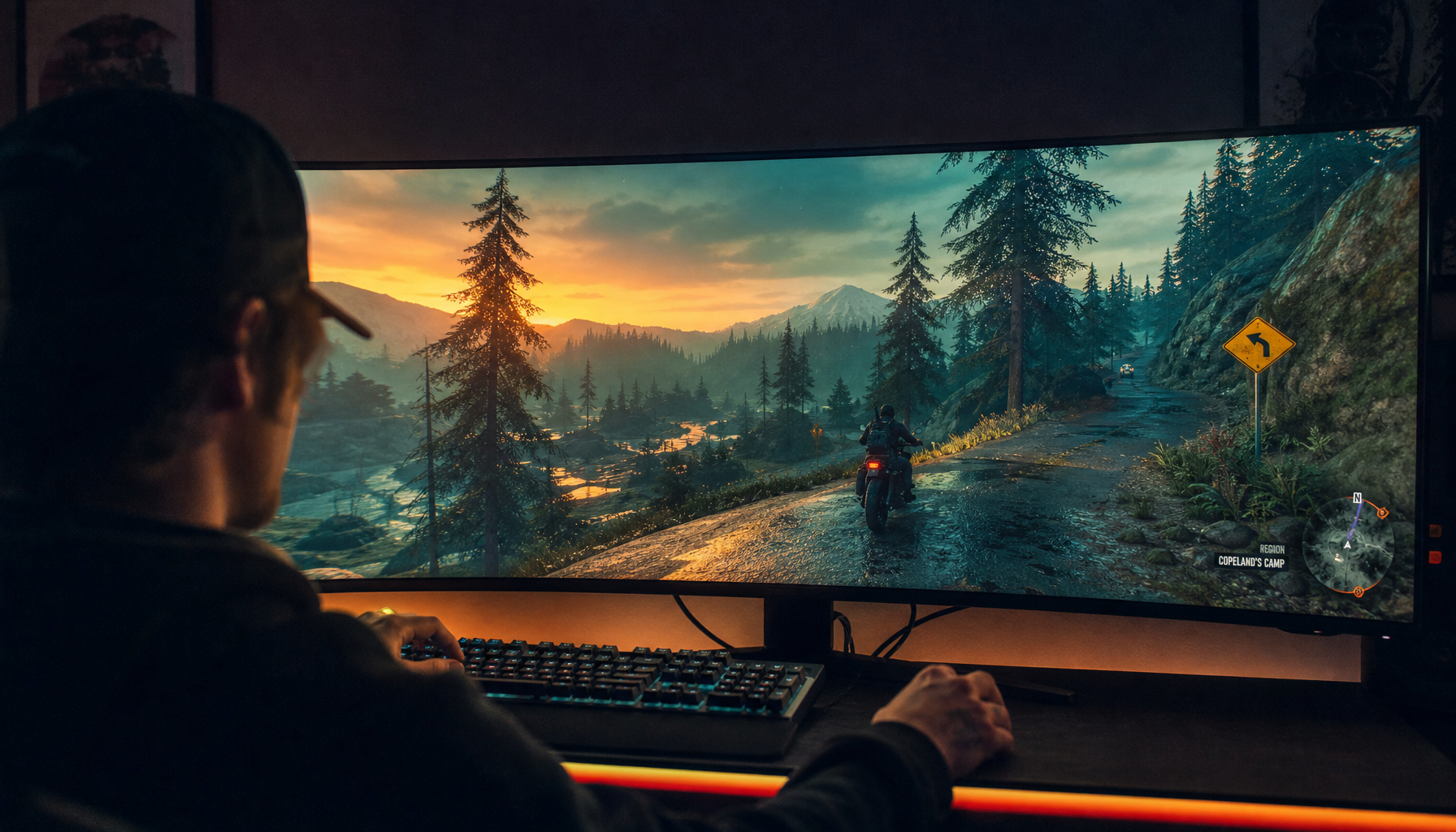
Some games look darker in HDR because the game, operating system, graphics card, cable, and monitor must map brightness differently than in SDR. HDR works best when the display has enough brightness, contrast, local dimming, and accurate calibration.
Does your game suddenly look dim, washed out, or harder to read the moment HDR turns on, even though SDR looked punchy seconds earlier? A practical calibration pass can often restore shadow detail, prevent clipped highlights, and reveal whether the problem is your settings or the monitor’s HDR limits.
HDR Is Not Just Brighter SDR
SDR is predictable: most desktop monitors are designed around a familiar brightness range, often with one backlight behavior across the screen. HDR changes the target. It asks the display to preserve deeper shadows, brighter highlights, and wider color at the same time, which means the image can appear darker if the monitor cannot reproduce that full range.
HDR gaming can show more detail across dark and bright scenes, including shadowed rooms and sunny environments, while Auto HDR can expand some older games into an HDR-like presentation. That extra range is useful, but it also exposes weak links. If a game assumes your display can reach 1,000 nits and your monitor is closer to entry-level HDR, the monitor must compress the image, and the midtones may appear too dark.
Consider a dark cave in a role-playing game. In SDR, the game may lift the whole scene so you can see walls, loot, and enemies. In HDR, it may reserve brightness for torches, spell effects, or daylight at the cave entrance. On a capable HDR display, that looks dimensional. On a basic HDR monitor, it can look as though someone lowered the backlight.

The Main Reasons HDR Looks Darker Than SDR
Your Monitor Accepts HDR but Does Not Display It Well
The most common problem is hardware, not the game. Many monitors can receive an HDR10 signal, but that does not guarantee strong HDR contrast. The difference between HDR compatibility and convincing HDR becomes obvious in dark scenes.
KTC’s comparison explains that DisplayHDR 400 is an entry tier that does not require local dimming, while DisplayHDR 1000 and DisplayHDR 1400 require more advanced backlight control. That matters because dark HDR scenes need the monitor to keep black areas low while pushing highlights high. Without local dimming, the backlight often compromises across the entire image.
HDR class |
What it usually means in dark games |
Practical expectation |
HDR-compatible, without meaningful certification |
Can accept the signal, but may look like dim SDR |
Use SDR unless HDR is clearly better |
DisplayHDR 400 |
Higher peak brightness than SDR, but limited black depth |
Acceptable for casual HDR, weak for horror or space scenes |
DisplayHDR 600 with local dimming |
More convincing highlights and contrast |
A good middle ground when tuned well |
DisplayHDR 1000 or higher |
Stronger brightness and lower black levels |
Better for cinematic HDR gaming |
OLED |
Excellent blacks and pixel-level contrast |
Excellent in dark rooms, but full-screen brightness can dim |
Mini-LED |
Strong brightness and local dimming zones |
High impact, with possible blooming around bright objects |
The key is contrast control. A 400-nit monitor with shared backlighting can technically display HDR yet still make a moonlit forest look flatter and darker than SDR. A 1,000-nit Mini-LED monitor or a capable OLED display has more room to separate moonlight, fog, interface elements, and shadow.
The Game’s HDR Sliders Do Not Match Your Screen
HDR games often include sliders for peak brightness, paper white, black level, interface brightness, or saturation. These are not cosmetic controls. They tell the game how to map its lighting engine to your display.

HDR behavior depends on coordination among operating system settings, monitor settings, graphics settings, and the game itself. Reviewers use dark scenes, bright highlights, and local-dimming challenges as consistent review test scenes because one title can look excellent in HDR while another looks crushed. Each game may interpret peak brightness and midtone brightness differently.
If a game asks you to raise a logo until it is barely visible, do not push far past that point in search of stronger HDR. On many monitors, that tells the game your display can handle brighter highlights than it really can. The result may be dimmer midtones, clipped bright effects, or both. If the game has a paper-white slider, it often controls the brightness of ordinary surfaces such as snow, walls, menus, and skin. Set it too low and the entire game feels gloomy; set it too high and HDR loses depth.
Desktop HDR Can Make SDR Content Look Wrong
Many PC players leave HDR on all day, then wonder why the desktop, launcher, browser, and some games look odd. HDR mode changes how the operating system treats SDR content, and the SDR brightness balance may not match your usual monitor brightness.
An HDR-capable display is only the starting point. You still need to select the correct display, enable HDR for that display, and decide when Auto HDR improves older games. For mixed office and gaming use, a practical approach is to leave HDR off for everyday productivity and enable it for games with native HDR or well-behaved Auto HDR. That prevents spreadsheets, browsers, and creative work from being judged through a gaming tone map.
This is especially important in a multi-monitor setup. If your HDR-capable monitor is paired with an older SDR display, confirm that the correct panel is selected before changing HDR settings. Otherwise, you may tune the wrong screen and blame the game.
Room Lighting Reduces Perceived Contrast
HDR depends on perceived contrast. If daylight, overhead lighting, or reflections strike a matte screen, blacks look elevated and shadow transitions become harder to see. The image may feel darker even if the panel is producing the intended levels.

For HDR use, peak brightness above 1,000 nits can be especially valuable, while OLED and Mini-LED displays have different strengths in black depth and sustained brightness. In a bright room, a monitor with limited peak brightness has less ability to overcome ambient light. In a dark room, the same screen may look far more balanced because your eyes can distinguish lower shadow levels.
Try the same HDR scene at night with nearby lights off. If the game suddenly looks better, the issue is not calibration alone. The room, screen coating, and display brightness headroom are also affecting the result.
Why SDR Sometimes Looks Better
SDR can look better because it is simpler and often tuned more aggressively for visibility. Developers know most SDR players need readable shadows, so dark areas are commonly lifted and midtones are easy to see. HDR may be more accurate and immersive, but it can feel less immediately bright if the display cannot reproduce the intended contrast.
HDR is also only one part of monitor quality. Many players are better served by matching resolution, refresh rate, and panel type to the games they actually play, with 27-inch 1440p often providing a balanced format for work and entertainment. A fast 1440p SDR image with clean motion can be more useful than weak HDR on a monitor without local dimming.
The best display also depends on the system driving it. Premium OLED displays offer deep blacks, fast response, and vivid color, while still carrying cost and burn-in tradeoffs. For a competitive shooter, visibility and latency may matter more than cinematic contrast. For a single-player space simulation, HDR contrast may be the main reason to upgrade.
How to Fix Dark HDR in Games
Start with the signal path. Use HDMI 2.0, HDMI 2.1, or DisplayPort 1.4 or better where your monitor and graphics card support it, and confirm that the game is running on the HDR display. Then update the graphics driver, because HDR behavior can change across games and driver releases.
Next, calibrate the operating system and the game separately. Select the HDR monitor before changing HDR settings. Enable HDR only for that display, then adjust SDR content brightness until desktop applications look comfortable. If the game has native HDR, use its own calibration pattern rather than copying someone else’s values. Two monitors with the same resolution and refresh rate can behave very differently in HDR.
Then tune the display itself. Use the monitor’s HDR mode that preserves the most accurate tone mapping, not necessarily the most dramatic-looking preset. If local dimming has adjustable levels, test a dark scene with a bright object, such as a torch in a hallway or a neon sign at night. Too little local dimming can look gray. Too much can crush shadow detail or create halos. The right setting keeps important dark detail visible without turning black into fog.

Finally, make an honest choice. If your monitor is DisplayHDR 400 without local dimming, SDR may be the better mode for some games. Choose the mode that gives you the clearest image on the hardware you own.
OLED, Mini-LED, and IPS: Which Handles Dark HDR Best?
OLED is often the strongest choice when a game is built around darkness, stars, black interface elements, stealth, or horror atmosphere. Each pixel can shut off, so black stays black beside a bright highlight. The tradeoff is sustained brightness. A large snowy field, bright desert, or white game menu may dim compared with a high-end Mini-LED monitor.
Mini-LED is often better when you want strong full-screen brightness and impactful HDR highlights. It can drive brighter scenes harder than many OLED monitors, which helps on daylight maps and in bright rooms. The compromise is blooming, where a bright object can glow into nearby dark areas, especially around subtitles, crosshairs, or white interface elements.
Basic IPS HDR monitors remain useful for productivity, color consistency, and fast gaming, but they are often why HDR looks darker than SDR. Without strong contrast or local dimming, the monitor must approximate too much of the HDR range. A VA panel can sometimes produce deeper native contrast than IPS, making it worth considering when uniformity and color accuracy are not the highest priorities.
When to Use Auto HDR
Auto HDR is worth trying for older SDR games, especially if you have a capable HDR display and the game lacks a native HDR mode. It can add brightness and color range to supported titles, making some older games feel more vivid.
Use it selectively. If Auto HDR makes menus too bright, skin tones unnatural, or night scenes harder to read, turn it off for that title and use SDR. Native HDR usually gives better control because the game can expose peak brightness, paper white, and black-level settings directly.
A Practical Calibration Pass
Open a game with a reliable dark scene and a bright highlight in the same frame. A nighttime city, cave entrance, campfire, or science-fiction corridor works well. Set the monitor to its intended HDR mode, enable HDR for the correct display, and run the game’s HDR calibration. Adjust peak brightness until the test image matches the instructions, then set paper white for comfortable normal brightness rather than maximum punch.
Afterward, check three qualities in actual gameplay: shadow detail should reveal objects you are meant to see without making the whole scene gray; bright highlights should stand out without becoming flat white patches; and interface elements should remain readable without glowing excessively. If your monitor cannot satisfy all three, prioritize visibility for competitive games and contrast for cinematic games.
Should You Buy a New Monitor for Better HDR?
Upgrade only if HDR is central to your gaming. If you mostly play esports titles, work during the day, and play casual games at night, a fast SDR or modest HDR monitor may be the better value. If you play cinematic role-playing games, racing games, space games, horror titles, or HDR-heavy console games, the jump to OLED, Mini-LED, DisplayHDR 1000, or a strong DisplayHDR 600 model can be dramatic.
Do not buy on an HDR logo alone. Look for peak brightness, sustained brightness, black level, local dimming behavior, panel type, color coverage, and real-world testing. HDR that looks dark is often a settings problem, but HDR that never looks convincing is usually limited by the hardware.
FAQ
Why Does HDR Make My Game Look Washed Out Instead of Dark?
Washed-out HDR usually points to weak contrast, incorrect color handling, raised black levels, or SDR content being processed in HDR mode. Check that the game is actually outputting HDR rather than SDR within an HDR desktop, and test another HDR mode on the monitor.
Should I Leave HDR On All the Time?
For gaming-only setups, leaving HDR on can be convenient. For mixed office, browsing, and creative work, it is usually cleaner to leave HDR off and enable it when playing HDR games. That keeps SDR content from looking dim, flat, or inaccurate.
Is DisplayHDR 400 Bad?
DisplayHDR 400 is not useless, but it is limited. It can improve brightness and color on some screens, yet it often lacks the local dimming and black depth needed for convincing dark HDR scenes.
HDR should provide more depth, not less visibility. Calibrate the full display chain, respect the limits of your panel, and choose SDR when it produces a clearer competitive or work-focused image. The best display mode is the one that makes the game readable, rich, and consistent.