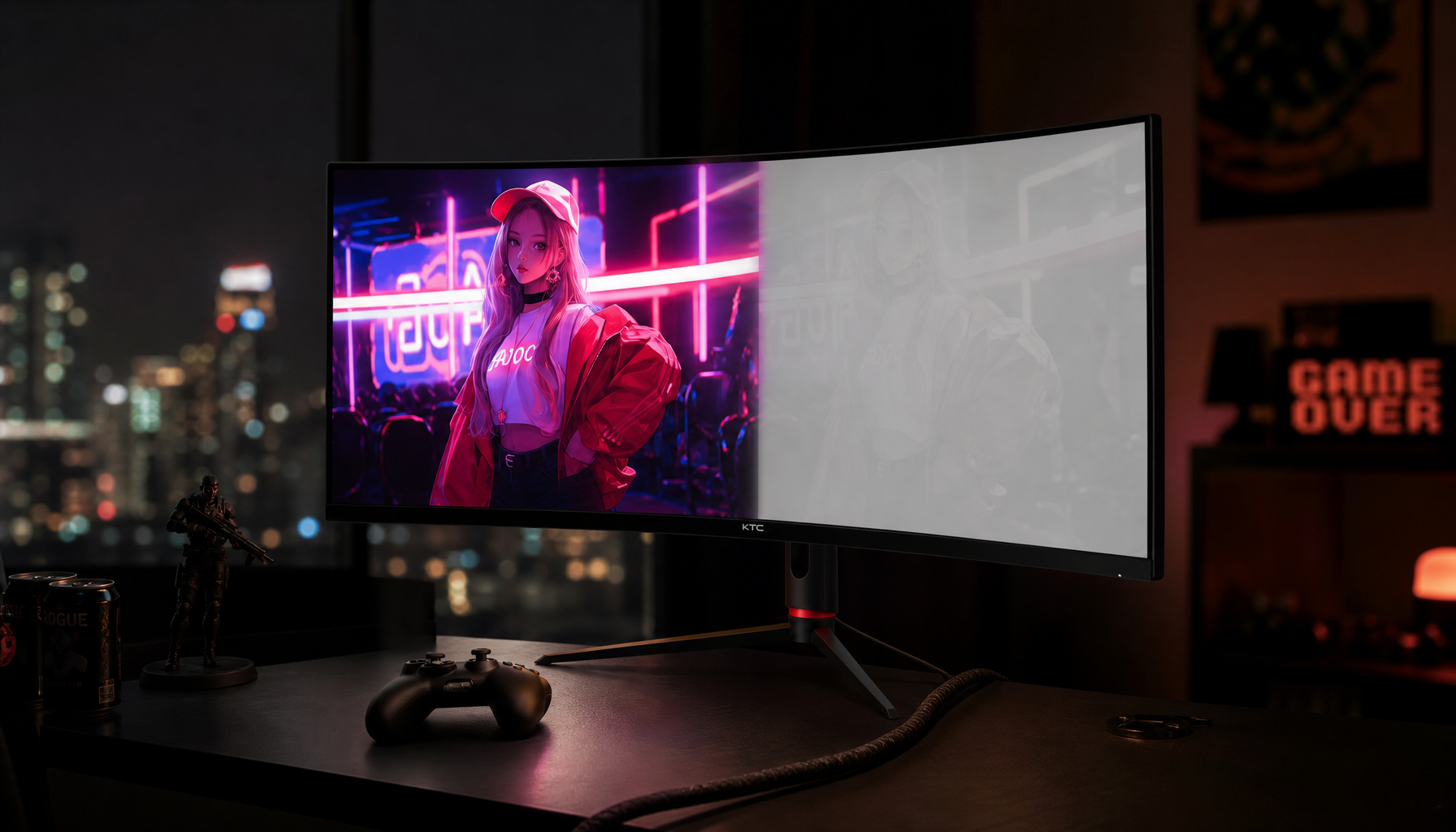
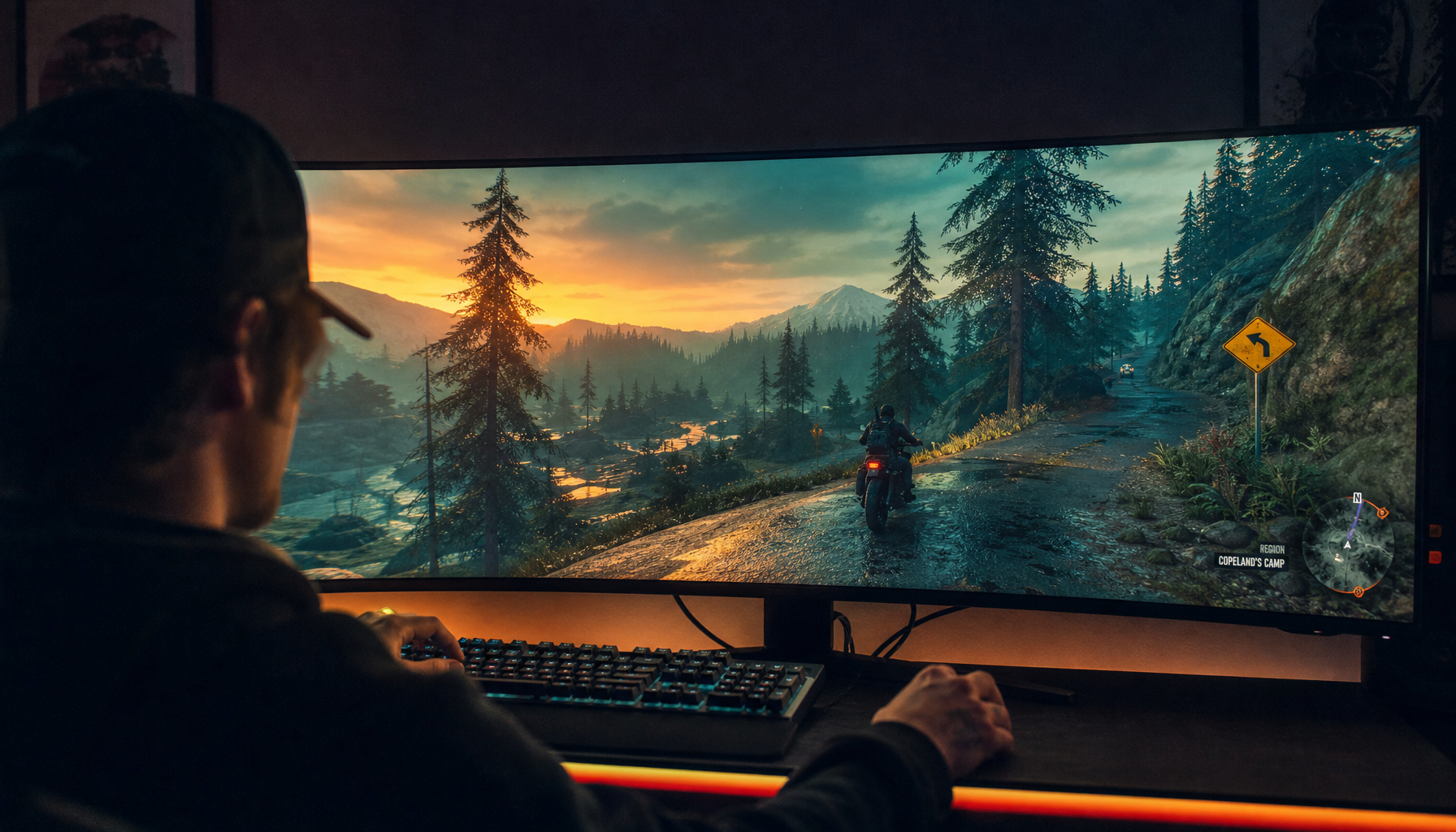
Motion clarity often looks worse on a larger screen at the same refresh rate because your eyes track motion across more visible space, making blur, pixel lag, and frame persistence easier to notice.
Bigger Screens Make the Same Blur Easier to See
A 60 Hz, 120 Hz, or 144 Hz display refreshes at a fixed rhythm, but screen size changes how much motion your eyes must follow. On a larger monitor or TV, a fast-moving target travels across more physical screen area, so each held frame becomes more visible during eye tracking.

This is why a 27-inch 144 Hz gaming monitor can feel sharper than a 43-inch 144 Hz display, even when both update 144 times per second. The larger screen magnifies persistence blur because your eyes are sweeping across a wider image.
Motion clarity is not just smoothness. It is how readable moving images remain, and it depends on both sample-and-hold blur and pixel transition speed, two core causes highlighted in modern motion performance discussions.
Refresh Rate Is Only One Part of the Equation
Refresh rate controls how often the display updates, but it does not guarantee that pixels finish changing before the next frame. If pixel response is slow, the old image partially lingers into the new one, creating ghosting or smearing.
That matters more on a large screen because trails are physically longer and easier to detect. A dark object sliding across a big VA panel, for example, may show more visible smear than the same motion on a smaller, faster IPS or OLED panel.

Overdrive can help by pushing pixels to transition faster, but aggressive settings may create inverse ghosting. A balanced mode usually beats the most aggressive option for real-world clarity, especially when frame rates fluctuate.
Viewing Distance Changes the Result
Large screens are not automatically worse. They become more revealing when you sit close.
A 32-inch monitor on a desk fills more of your field of view than a 24-inch monitor at the same distance. That immersive scale is useful for racing, flight sims, and cinematic games, but it also exposes blur during quick camera pans and fast strafing.

Move farther back, and the same blur becomes less obvious because each motion artifact occupies less of your visual field. This is why a large living-room display can look acceptable from a couch but smeary up close as a desktop screen.

Bigger screens do not create more blur by themselves; they make existing blur more visible when size, viewing distance, and motion speed increase together.
How to Keep Large-Screen Motion Sharp
For gaming and productivity, the goal is not just a bigger panel. It is a bigger panel with enough speed to support its scale.
Prioritize these specs and settings:
- Use the highest native refresh rate available in your display settings.
- Choose fast pixel response, especially OLED or well-tuned IPS.
- Keep overdrive on a balanced setting to avoid overshoot.
- Use VRR when frame rates vary.
- Sit far enough back for the screen size.
For competitive play on large screens, 120 Hz is a baseline, 144 Hz to 240 Hz is better, and OLED has a major advantage because its pixel transitions are extremely fast. For office work, scrolling clarity also improves with higher refresh, but native resolution and proper scaling matter just as much for text comfort.
The Buying Takeaway
At the same refresh rate, a larger screen exposes more motion blur because the image covers more physical and visual space. The solution is not just to buy more Hz; it is to match screen size with faster response, stronger refresh performance, proper distance, and clean settings.
For an immersive setup, go large only when the panel technology can keep up. A big display should expand control and presence, not turn every flick shot, race corner, or spreadsheet scroll into a smear.