Ultrawide monitors feel more immersive because they widen the scene, pull more of the game into your side vision, and create a more cinematic frame than a standard 16:9 screen when the game supports the format.
Ever feel like a standard monitor shows the action clearly but not the world around it? A 3440x1440 ultrawide can render about 34% more pixels than a 2560x1440 screen, which means more visible game space but also more work for the graphics card. Here is how to tell whether that wider view will actually improve your setup, your games, and your frame rates.
How Ultrawide Changes the Gaming View
A standard gaming monitor usually uses a 16:9 aspect ratio, while many ultrawide gaming monitors use 21:9 and super ultrawide models use 32:9. That difference is not just about size; it changes the shape of the image. A 21:9 screen gives you more horizontal space, and a 32:9 screen can feel like two standard monitors joined without a center bezel when the game renders it properly.

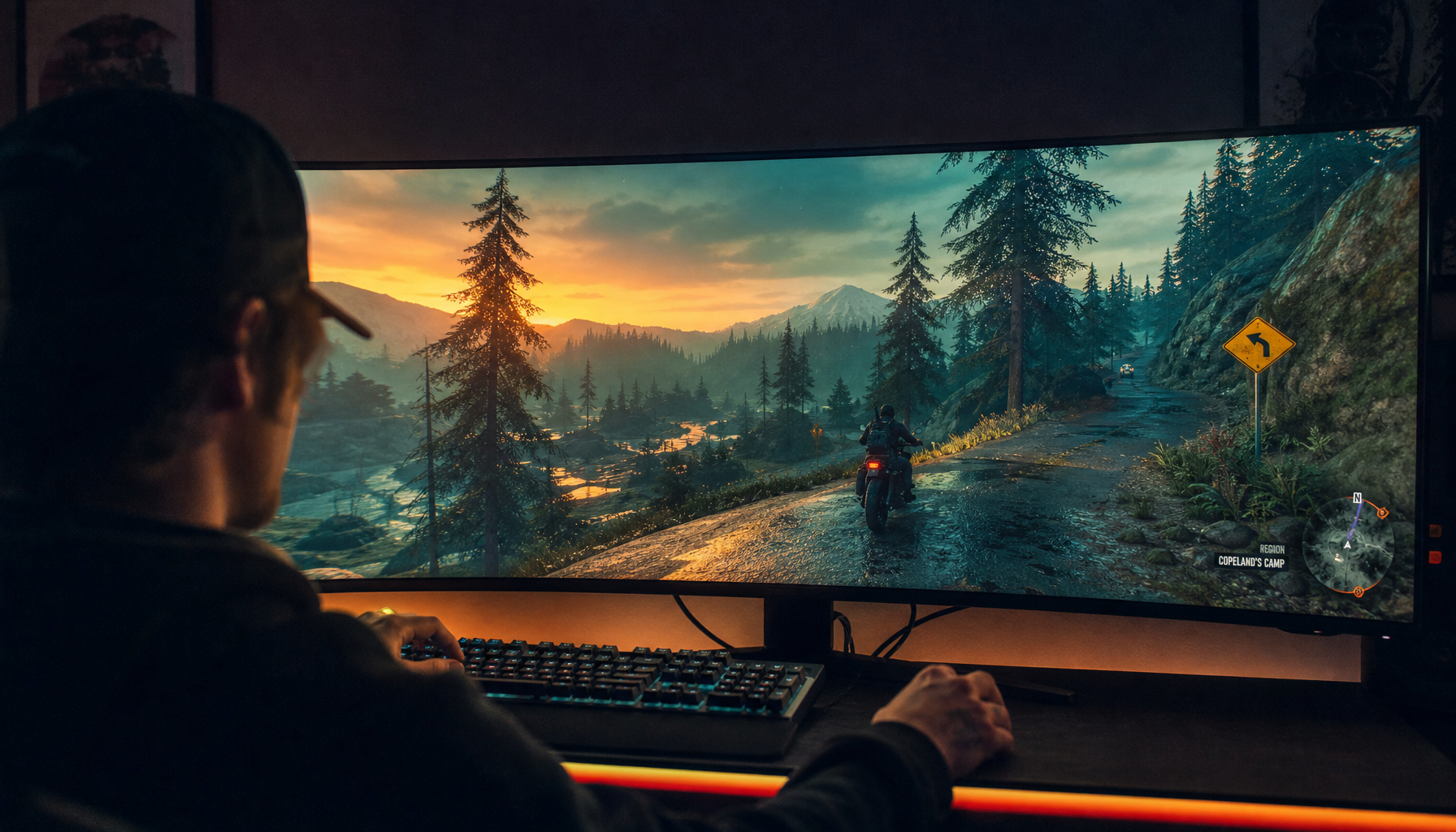
The key word is “properly.” In supported games, more horizontal screen space can reveal extra scenery, cockpit detail, track edges, enemies at the side of the frame, or landscape that would sit outside a standard 16:9 view. That is why an ultrawide display often feels less like looking through a window and more like sitting inside the game space.
Wider View Is Not the Same as Stretching
A good ultrawide implementation expands the field of view horizontally. A poor implementation simply stretches a 16:9 image, which can distort characters, weapon models, vehicle dashboards, or objects near the edges. That kind of stretching looks wider at first glance, but it does not add meaningful information.
Before judging an ultrawide monitor by a store demo or a screenshot, check how your actual games handle 21:9 or 32:9. Some titles support ultrawide gameplay but keep menus or cinematic scenes at 16:9, while others need field-of-view adjustment or community fixes to look correct.
Why Peripheral Vision Makes the Screen Feel Bigger
Ultrawide immersion works because the display reaches farther into your natural horizontal vision. On a standard monitor, the main action usually stays in the center, with less information near the sides. On a wider monitor, the game world can occupy more of your peripheral vision, especially when you sit close enough for the screen to fill your forward view without forcing constant head movement.

This is most noticeable in games with large spaces: open-world adventures, racing games, flight simulators, exploration games, and cinematic third-person games. A wider image lets the edges of the screen carry useful context instead of feeling like unused space, which is why expanded field of view can make gameplay feel more natural than on a standard screen.
The Cinematic Effect
The 21:9 shape is also close to the wide framing many players associate with movies. On a 34-inch ultrawide, open-world games can feel more panoramic because the horizon, skyline, road, cockpit, or battlefield stretches across a broader canvas. That does not automatically make the graphics sharper, but it changes how the same game is presented.
A practical example: moving from a 27-inch 16:9 1440p monitor to a 34-inch 21:9 3440x1440 monitor does not just enlarge the UI. It adds horizontal pixels and changes composition. In a landscape-heavy game, you may see more of the valley, track curve, cockpit controls, or enemy movement at the edge without panning the camera as often.
Curved vs. Flat Ultrawide Monitors
Curvature can strengthen ultrawide immersion, but it is not magic. A curved ultrawide brings the far left and right edges slightly closer to your eyes, which can make a wide panel feel more consistent from edge to edge. On large 21:9 and 32:9 displays, curved monitors can feel larger than flat screens of the same diagonal because the sides sit more naturally within your forward view.

That said, curvature does not add pixels, panel area, sharpness, contrast, or refresh rate. A 34-inch 3440x1440 curved monitor and a 34-inch 3440x1440 flat monitor have the same resolution. The curved model may feel more enveloping, but image clarity still depends on panel quality, resolution, pixel density, scaling, contrast, and motion performance.
Understanding Curve Ratings
Monitor curve ratings use “R” values. Lower numbers mean a stronger curve: 1000R is more aggressive than 1500R, and 1500R is more aggressive than 1800R. As a practical buying guide, 1000R roughly aligns with about 3.3 ft, 1500R with about 4.9 ft, and 1800R with about 5.9 ft of viewing distance.
For a 34-inch ultrawide, many gamers do well with a moderate curve if they sit around 27 to 32 inches from the screen. For a 49-inch 32:9 super ultrawide, curvature matters more because the edges are much farther apart. A flat 49-inch panel can make the sides feel distant, while a curved panel can keep the outer parts of the image easier to see without leaning or turning as much. As a reference point for this class, a 49-inch curved gaming monitor pairs a 49-inch 5120x1440 ultrawide format with a 1000R curve and 180Hz refresh rate, which makes it useful for comparing size, curve, resolution, and GPU demands against smaller 21:9 options.
Room Lighting Matters
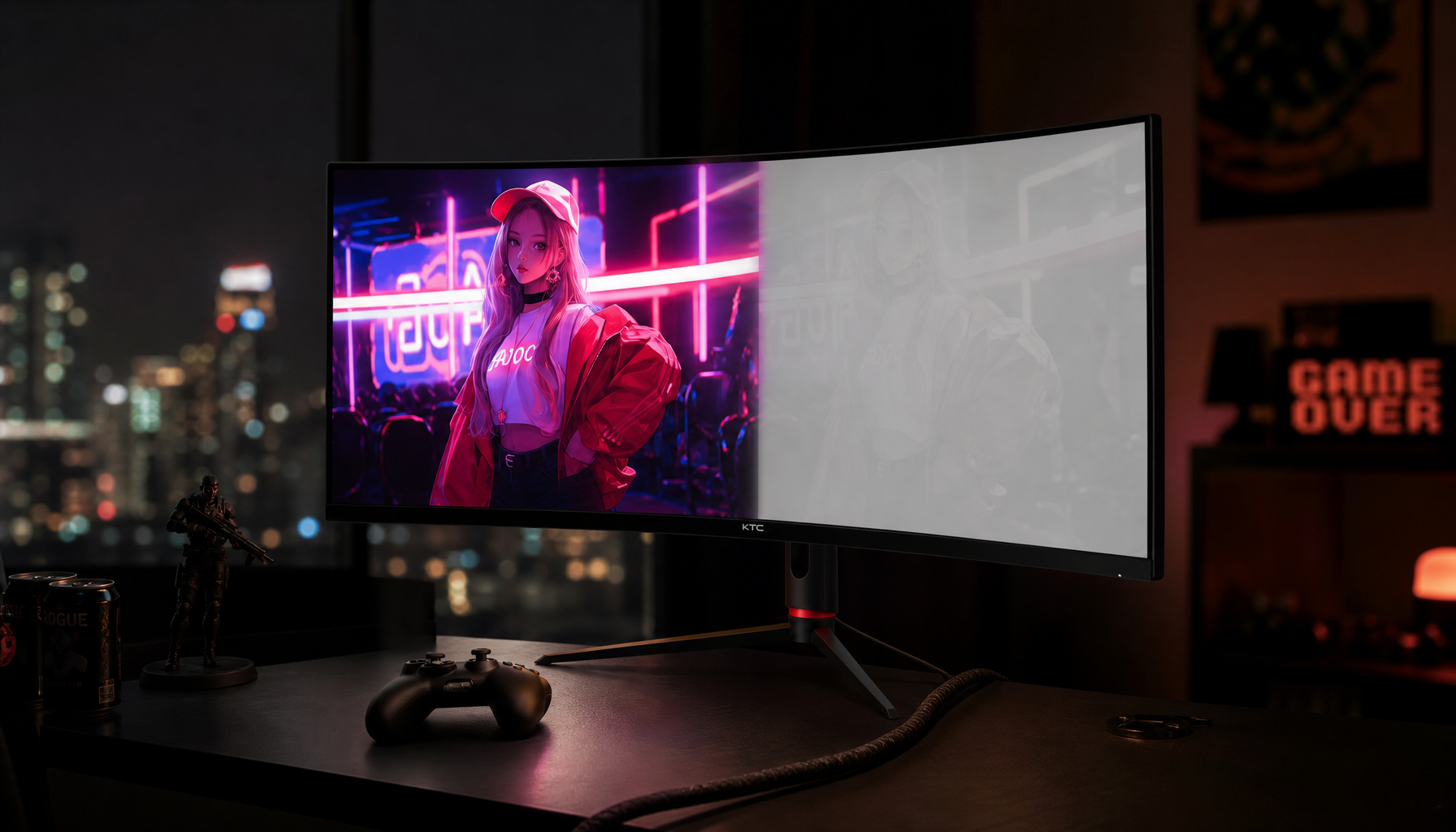
A curved ultrawide usually feels more immersive in a darker room because the screen’s wraparound effect is easier to notice when walls, windows, desk lamps, and reflections are less distracting. Bright rooms can reduce the effect by raising perceived black levels and adding glare, especially on glossy OLED or high-contrast panels.
For best results, place the monitor so bright windows are not directly behind you or in front of the panel. Bias lighting behind the screen can help reduce eye strain without washing out the image. If your gaming desk is in a bright home office, prioritize anti-glare coating, good brightness control, and panel contrast as much as curve radius.
Which Games Benefit Most From Ultrawide
Ultrawide monitors are not equally useful in every game. They shine when the extra horizontal view helps you understand space, motion, or scenery. They are less transformative when the game is locked to a narrow view, uses fixed camera framing, or prioritizes a compact competitive sightline.
Racing games and flight simulators are strong examples because cockpit views can show more mirrors, dashboard detail, runway space, road curvature, or surrounding traffic. Open-world games also benefit because wide landscapes look more expansive, and exploration feels less boxed in.

Best-Fit Genres
Game Type |
Ultrawide Benefit |
What to Check First |
Racing games |
Wider track awareness, better cockpit presence |
HUD placement, mirror visibility, FPS at native resolution |
Flight simulators |
More instrument panel and side-window context |
GPU load, cockpit scaling, 60 FPS target |
Open-world adventures |
More panoramic scenery and environmental context |
Cutscene support, FOV controls, UI scaling |
Third-person action games |
More cinematic framing and side awareness |
Camera behavior, black bars in cinematics |
Strategy and simulation games |
More map, timeline, or panel space |
Text readability, UI scaling, edge usability |
Competitive shooters |
Wider awareness in supported titles, but not always preferred |
Anti-stretch behavior, tournament rules, high refresh rate |
Real-World Game Examples
Some games use ultrawide particularly well. A flight simulator can benefit from a wider cockpit view, though it needs a strong GPU to approach smooth frame rates at 3440x1440. An open-world action game may support 21:9 and 32:9 gameplay, offer movable HUD elements, and include field-of-view adjustment up to 100 degrees, although its cutscenes may remain 16:9.
Other games are more mixed. A cinematic action game may support ultrawide gameplay and cutscenes, but its maximum ultrawide output can leave slim side bars on common 3440x1440 monitors. The lesson is simple: ultrawide support is game-specific, so check a game database, patch notes, or PC community reports before assuming every title will fill the screen perfectly.
Performance Tradeoffs: More Immersion Costs More Pixels
The performance cost is one of the most important ultrawide buying factors. A standard 2560x1440 monitor displays about 3.7 million pixels, while a 3440x1440 ultrawide displays almost 5 million pixels. That is roughly a 34% to 35% increase in pixel workload per frame, so ultrawides render more pixels and can reduce frame rates compared with a standard 1440p display.

This matters if you care about high refresh rates. A game that runs around 140 FPS at 2560x1440 may not hold that same frame rate at 3440x1440 with identical settings. You may need to lower shadows, ray tracing, anti-aliasing, or volumetric effects, or use upscaling features when available.
Resolution and Refresh-Rate Comparison
Display Format |
Common Resolution |
Approx. Pixel Count |
Gaming Impact |
16:9 1080p |
1920x1080 |
2.1 million |
Easier to drive at very high FPS |
16:9 1440p |
2560x1440 |
3.7 million |
Strong balance for high-refresh gaming |
21:9 ultrawide 1440p |
3440x1440 |
5.0 million |
More immersive, about 34% more GPU load than 2560x1440 |
32:9 super ultrawide |
5120x1440 |
7.4 million |
Very wide view, much heavier GPU demand |
16:9 4K |
3840x2160 |
8.3 million |
Sharper but harder to drive at high refresh rates |
Practical Hardware Guidance
For 3440x1440 gaming, treat the monitor as harder to run than 1440p but easier than 4K. If you mostly play esports titles, a midrange-to-upper GPU may be enough to drive high refresh rates with tuned settings. If you play demanding AAA games with ray tracing, an ultrawide can push you toward a higher-tier graphics card.
Also check the monitor’s refresh rate and adaptive sync support. A 144 Hz or 165 Hz ultrawide is a good match for many gaming PCs, but only if your GPU can regularly land inside that range. If your games hover around 60 to 90 FPS at 3440x1440, a high-quality 100 Hz to 144 Hz panel with variable refresh can still feel smooth, but you should not expect the same FPS you saw on a standard 1440p screen.
Compatibility, Desk Space, and Ergonomics
Ultrawide support is much better than it used to be, but it is still inconsistent. Some games fill the screen during gameplay but switch to 16:9 cutscenes with black bars on the sides. Others stretch UI elements, crop menus, lock field of view, or show pillarboxing when they do not support the aspect ratio.
A reliable pre-purchase step is to check the games you play most often. A gaming publication points players toward a PC gaming information platform for 21:9 and 32:9 support, and unsupported PC games may display black bars instead of using the full panel. That is not a dealbreaker for everyone, but it can undermine the exact immersion you are paying for.
Desk Depth and Viewing Distance
A 34-inch or 49-inch ultrawide needs more room than a standard monitor. A common comfort range for large curved ultrawide displays is about 24 to 31 inches from your eyes, while typical gaming setups often sit around 27 to 32 inches. If your desk is shallow, the edges can feel visually demanding, and the screen may dominate your view in a way that is tiring rather than immersive.
Ergonomics matter because wider screens can require more head movement. A 2024 lab study summarized in an ultra-wide monitor ergonomics discussion found that wider displays increased head-rotation demands, and some users found a 40-inch display overwhelming compared with smaller options. That supports a practical rule: a 34-inch 21:9 ultrawide is often the safer first ultrawide than a 49-inch 32:9 model.
Competitive Gaming Considerations
For competitive shooters, bigger and wider is not automatically better. Some players prefer a 24-inch or 27-inch 16:9 monitor because it keeps all critical information closer to the center of vision and can be easier to scan quickly. A high-refresh 16:9 display may also be cheaper and easier to drive at 240 Hz or higher.
If you split time between cinematic games and competitive games, choose based on priority. A 34-inch 144 Hz or 165 Hz ultrawide is a strong all-around option for mixed gaming. If ranked competitive play is your main focus, a 16:9 high-refresh monitor may still be the more practical choice.
Action Checklist Before Buying
- Check your top 10 games for 21:9 or 32:9 support, including gameplay, menus, HUD, and cutscenes.
- Match resolution to GPU power; 3440x1440 needs about 34% more pixel rendering than 2560x1440.
- Decide whether you need 144 Hz, 165 Hz, 240 Hz, or simply smooth variable refresh in your real games.
- Measure your desk depth and confirm you can sit roughly 24 to 32 inches from a 34-inch ultrawide.
- Choose curvature based on size: flat can work at 29 to 34 inches, while 34-inch to 49-inch models benefit more from a curve.
- Check monitor stand size; large ultrawide bases can consume a lot of desk space, so a monitor arm may be worth budgeting for.
- Review return policies, because comfort and perceived immersion depend heavily on your seating distance, desk layout, and room lighting.
FAQ
Q: Does an ultrawide monitor always show more of the game?
A: No. It only shows more when the game supports the ultrawide aspect ratio and renders a wider field of view. Some games use black bars, some stretch the image, and some support ultrawide gameplay but keep cutscenes or menus at 16:9.
Q: Is a curved ultrawide better than a flat ultrawide for gaming?
A: Usually, but mainly on larger screens. A curve helps a 34-inch or 49-inch ultrawide feel more natural by bringing the edges closer to your viewing angle. It does not improve resolution, sharpness, refresh rate, or panel quality by itself.
Q: Is 3440x1440 much harder to run than 2560x1440?
A: Yes. A 3440x1440 ultrawide renders almost 5 million pixels, compared with about 3.7 million pixels on a 2560x1440 monitor. That extra workload can lower FPS, especially in demanding games with high settings or ray tracing.
Final Takeaway
Ultrawide monitors feel more immersive because they change both the shape and reach of the gaming image. A good 21:9 monitor can add meaningful side vision, cinematic framing, and stronger presence in supported games, especially racing games, flight simulators, open-world adventures, and visually rich single-player titles.
The best first choice for many gamers is a 34-inch 3440x1440 ultrawide with a solid refresh rate, adaptive sync, and a moderate curve. It offers a clear immersion upgrade without the extreme desk-space and GPU demands of a 49-inch 32:9 super ultrawide. Before buying, confirm game support, GPU headroom, desk depth, and viewing distance; those details decide whether ultrawide feels impressive or inconvenient.
References
- Rock Paper Shotgun: The 35 best PC games to play on an ultrawide monitor
- KTC: Why Gamers Are Switching to Ultrawide Monitors?
- KTC: Why Gamers Are Switching to Ultrawide Monitors?
- KTC: Ultra-Wide Monitor Ergonomics: A Guide to All-Day Comfort
- KTC: Curved Monitors: Why Dark Rooms Boost Immersion
- KTC: Curved Monitor Perceived Size vs. Flat Screen FOV Guide
- KTC: Curved Monitor Perceived Size vs. Flat Screen FOV Guide
- XDA Developers: 4 things I wish I knew before buying an ultrawide monitor