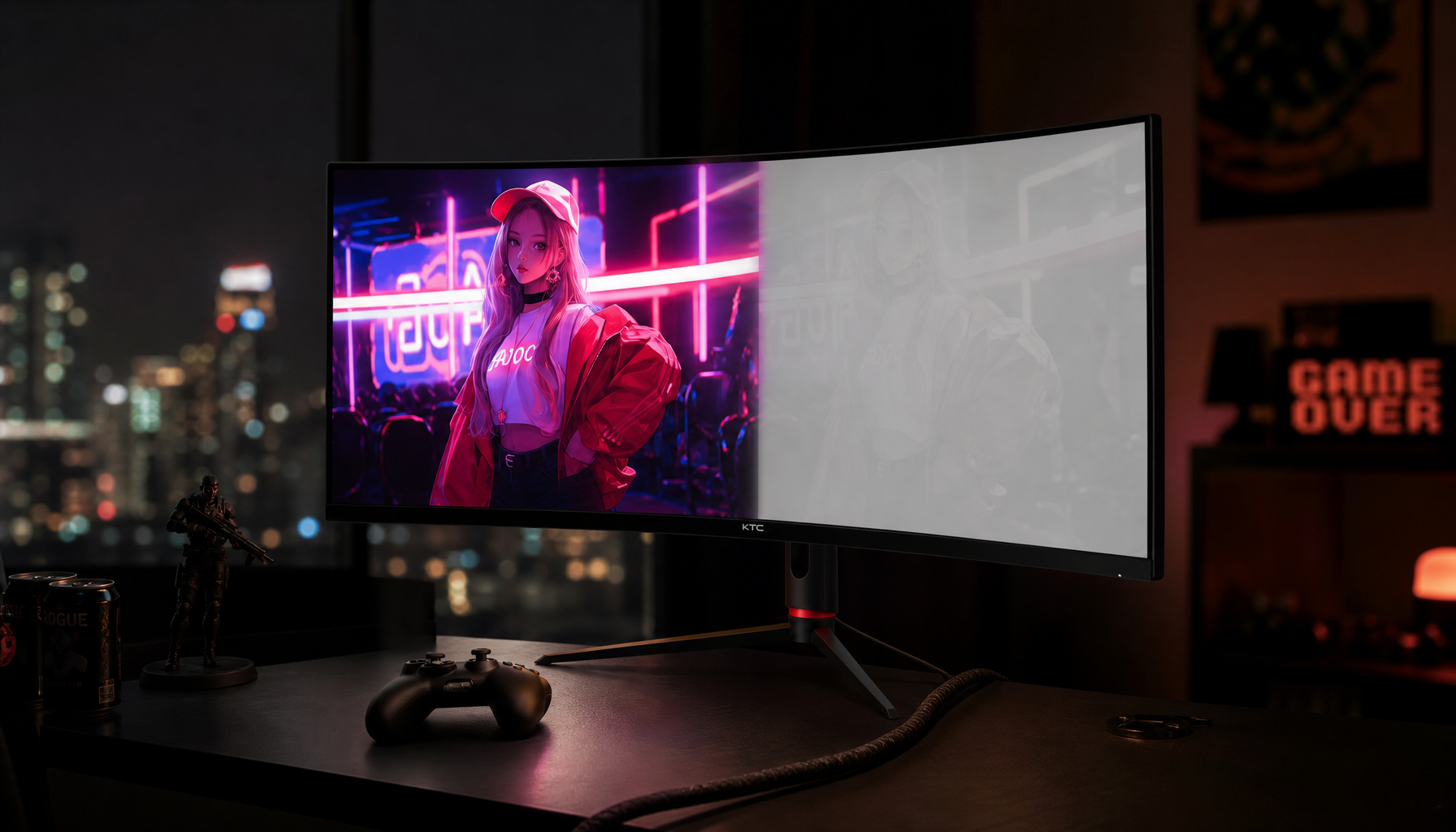
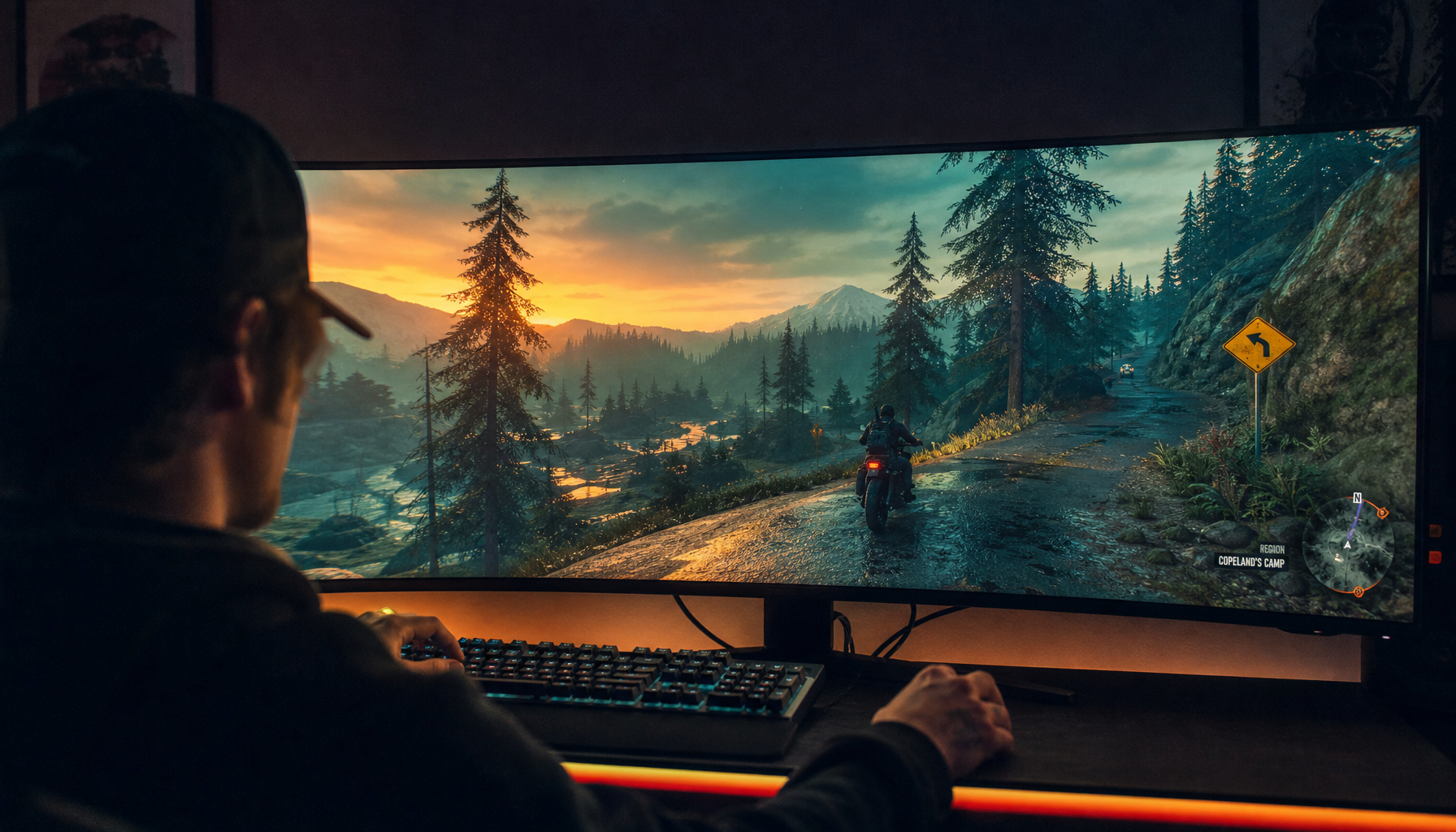
Window light usually destroys monitor shadow detail more than overhead lighting because it is brighter, more directional, and more likely to reflect from the screen into your eyes. Raising brightness helps whites and midtones, but it cannot make reflected blacks darker.
Ever load into a dark game map, open a black terminal theme, or watch a night scene and wonder why everything looks gray even though your gaming monitor is set near maximum brightness? A simple 60-second glare check, followed by a 20- to 30-minute monitor warm-up before testing, can separate a bad room setup from a real panel problem. Here is how window light changes perceived contrast, why overhead lighting is usually easier to manage, and what to change before buying another display.
Shadow Detail Depends on Perceived Contrast, Not Just Monitor Specs
The Black Floor Problem
A monitor’s advertised contrast ratio describes the gap between its brightest white and darkest black under controlled conditions, but your eyes judge contrast in the room where the display is actually used. When ambient light reflects off the panel, it raises the visible black floor, so dark gray steps that should be separate start looking like one flat patch; this is why perceived contrast depends on room light, screen reflectance, viewing angle, and eye adaptation as much as the panel’s own performance.

This matters most in dark content. In a competitive shooter, the difference between black and dark gray can be the outline of an opponent in a doorway. On an ultrawide monitor, it can be worse because more screen area is exposed to side light, and curved edges may catch reflections at different angles than the center.
Brightness Is Not a Black-Level Fix
Turning the brightness slider from 40 to 90 may make the HUD, desktop, and white web pages easier to see, but it does not remove reflected light sitting on top of the image. Whites can be pushed brighter; blacks cannot go below the monitor’s physical black level, and raising monitor brightness mainly lifts whites and midtones instead of restoring the lost separation between black and near-black.
A practical example: if a window reflection makes a black loading screen look charcoal gray, adding brightness often makes the menu text pop while the background still looks washed out. That is why gamers often say a monitor has “bad blacks” in the afternoon but looks much better at night.
Why Window Light Is More Damaging Than Overhead Lighting
Direction, Intensity, and Reflection Angle
Window light is usually a large, bright, directional source. If the window is behind you, the screen can act like a dim mirror; if the window is behind the monitor, your eyes adapt to the bright background and the screen looks dull. A monitor placed near a window is easiest to control when the display is perpendicular to the glass, because windows behind the user can create strong reflections while windows behind the monitor can make the screen appear dimmer.
Overhead lighting is usually less destructive because it is often more diffuse, less intense than direct daylight, and less likely to reflect straight back into your eyes when the monitor is tilted correctly. It can still cause glare, especially with exposed bulbs, glossy panels, or ceiling fixtures directly above the screen, but it is easier to fix with indirect lamps, dimmers, low-glare bulbs, or by turning off one light bank.
Window Light vs. Overhead Light on a Monitor

Lighting condition |
What it does to shadow detail |
Common symptom |
Best first fix |
Window behind the user |
Creates mirror-like screen reflections |
You see the window, blinds, or your own outline in dark scenes |
Rotate the desk or close shades |
Window behind the monitor |
Forces eye adaptation to a bright background |
The screen looks dim even at high brightness |
Move the monitor perpendicular to the window |
Side window |
Adds uneven light across the panel |
One side of an ultrawide or dual setup looks flatter |
Keep the screen perpendicular and use blinds |
Direct overhead light |
Can reflect from the upper screen area |
Washed-out top edge or visible fixture reflection |
Tilt the display and use indirect lighting |
Soft bias light behind monitor |
Reduces harsh room contrast without hitting the screen |
More comfortable dark-room viewing |
Use neutral, low-intensity rear lighting |
The key difference is that overhead lighting can often be softened or redirected, while daylight from a window may be many times brighter than the monitor’s black level. If you can see a window shape on a black screen, the room is setting the effective black level more than the panel is.
Matte, Glossy, IPS, and VA Panels React Differently
Coatings Change the Shape of Glare
Glossy and lightly coated panels tend to preserve image clarity when the room is controlled, but they show sharper reflections when a window is behind you. Matte anti-glare coatings reduce those mirror-like reflections, yet strong daylight can still spread across the screen as a gray haze, which lowers contrast over a wider area. In both cases, glare is present if you can see reflections of windows, lights, or yourself in the monitor screen.

For gaming monitors, this is why a matte 27-inch fast IPS display can still look washed out beside a window even though it does not show a crisp reflection. The glare has not disappeared; it has been diffused across the image, and the dark gray steps in caves, night maps, letterbox bars, and shadowed UI panels become harder to separate.
Panel Type Sets the Starting Point
IPS panels are popular for high-refresh-rate gaming because they usually deliver fast response, wide viewing angles, and good color, but their native contrast is often lower than VA. In bright surroundings, IPS displays can lose perceived depth sooner because their native contrast is commonly around 700:1 to 1,500:1, while VA panels usually preserve darker blacks longer with typical native contrast around 2,500:1 to 6,000:1.
That does not mean VA is automatically better for every buyer. A fast IPS monitor may still be the better choice for esports motion clarity and wide-angle desk setups, while a VA ultrawide may be more satisfying for single-player games, movies, and dark scenes in a moderately lit room. The room decides how much of that contrast you actually get to see.
Set Up the Room Before Blaming the Monitor
Use Geometry First, Settings Second
The most effective fix is usually physical placement. Put the monitor at a right angle to nearby windows, keep the screen centered in front of you, and sit at least 3 ft from the glass when possible; workstation guidance also recommends reducing window light with shades or partitions and keeping lighting as even as possible to limit visual discomfort.

Viewing distance matters too. For many desks, 20 to 30 inches works well, with up to about 40 inches for deeper desks or larger displays. The top of the monitor should sit at or slightly below eye level, and the screen center should fall slightly below your horizontal line of sight, because a typical viewing distance and modest downward viewing angle help keep the display comfortable and easier to align away from reflections.
Run a Quick Reflection Test
Open a black image or a dark game scene during the time of day when the problem is worst. If you can see the window, blinds, a ceiling fixture, or your face, change the room before changing the monitor: rotate the screen, tilt it slightly downward or away from the light source, close blinds halfway, or move a lamp so it illuminates the desk rather than the panel.
A simple hand-shield test is also useful. If blocking the bright source with your hand, a folder, or the monitor’s side briefly improves comfort or black detail, that source is part of the problem. This test is especially helpful before buying an anti-glare filter, monitor arm, or replacement display.
Tune Brightness, Contrast, and Picture Modes for the Actual Room
Calibrate Under Normal Lighting
Set up the monitor in the lighting you actually use, not in a perfectly dark room unless that is your normal setup. Use black-level and white-level test patterns, disable dynamic contrast, eco modes, HDR simulation, black enhancers, and aggressive gaming presets, then adjust brightness so whites are comfortable without turning the whole screen into a light source. Controlled calibration often targets about 80 to 120 cd/m², and excessive brightness near 80 or 100 on the monitor slider can make edge shading, clouding, and IPS glow more visible.
For daytime use, you may need a higher brightness setting than at night, but treat brightness as a comfort and white-level control, not a shadow-detail cure. If the black test squares disappear only when the blinds are open, the fix is lighting control, not a new contrast preset.
Check for Real Panel Uniformity Issues
Before deciding your monitor is defective, let it warm up for 20 to 30 minutes, use its native resolution, connect through a digital input, and test full-screen gray, black, and white images from your normal seat. If unevenness changes when you move your head, viewing-angle behavior is likely; if a fixed dim patch remains after warm-up across images, inputs, and devices, a fixed dim patch may point to a panel or backlight uniformity issue.
This distinction saves money. A $30 blackout curtain may solve a window reflection that looks like “bad contrast,” while a true backlight defect will remain visible even at night, even with the room lights controlled, and even from another computer.
Buying Guidance for Bright Rooms and Dark Games
What to Prioritize in a Monitor
If your desk must face or sit near a window, prioritize practical contrast more than peak brightness alone. A higher native contrast panel, effective anti-glare treatment, adjustable stand, standard mount support, and enough brightness for daytime comfort are more useful than a spec sheet that only emphasizes maximum nits. For dark-room movie use or atmospheric games, a VA monitor or a display with strong local dimming may preserve shadow depth better than a typical IPS model, assuming its motion performance fits your gaming needs.
For high-refresh-rate esports, a fast IPS display can still be the right buy, but plan the room around it. Use blinds, place the screen perpendicular to the window, avoid direct light aimed at the panel, and consider soft bias lighting behind the monitor for evening sessions. A monitor arm is often worth more than a minor brightness upgrade because it lets you raise, rotate, and tilt the display out of the worst reflection path.

When Accessories Help
Anti-glare filters, monitor visors, curtains, and bias lights work best after the desk layout is reasonable. A visor can block side light, an anti-glare filter can reduce visible reflections, and a circular polarized filter may help in window-heavy spaces, but accessories cannot fully compensate for a bright window reflected directly into a glossy panel.
For ultrawide monitors, the accessory decision is more sensitive because the screen spans more angles. A 34-inch or 49-inch curved display may catch side-window light on one edge even when the center looks good, so test the screen with dark content in the afternoon before deciding whether the issue is panel uniformity, curve geometry, or room lighting.
FAQ
Q: Is overhead lighting always better than window light for monitor shadow detail?
A: Not always, but it is usually easier to control. A soft overhead or indirect lamp that does not reflect on the screen is less damaging than direct daylight from a window. However, an exposed ceiling bulb above or behind you can still create glare, especially on glossy or lightly coated monitors.
Q: Should I just buy a brighter gaming monitor for daytime use?
A: Buy enough brightness for comfort, but do not expect brightness alone to restore blacks. Ambient light raises the apparent black floor, so a brighter display may make white menus and HUD elements easier to read while dark scenes still look gray. Fix window angle, reflections, and blinds first.
Q: Are VA monitors better than IPS monitors near windows?
A: VA monitors often hold darker-looking blacks longer because they usually have higher native contrast, but they are not immune to window glare. IPS monitors can still be excellent for high-refresh-rate gaming, especially when the room is controlled. In a bright room, placement and light control matter as much as panel type.
Key Takeaways
Window light damages monitor shadow detail because it attacks the weakest part of the image: black and near-black tones. A monitor can make whites brighter, but it cannot make reflected daylight disappear from the panel surface.
Start with the room. Place the monitor perpendicular to windows, use blinds or curtains, sit at least 3 ft from the glass when possible, tilt the screen away from reflections, and test with dark content at the time of day you actually use the display. Then calibrate brightness and black levels under that same lighting.
When buying, match the monitor to the room as well as the games. Choose VA or strong local dimming when deep blacks matter most, choose fast IPS when motion clarity and viewing angles matter more, and treat anti-glare coatings, adjustable stands, standard mounts, and window control as part of the real display system.