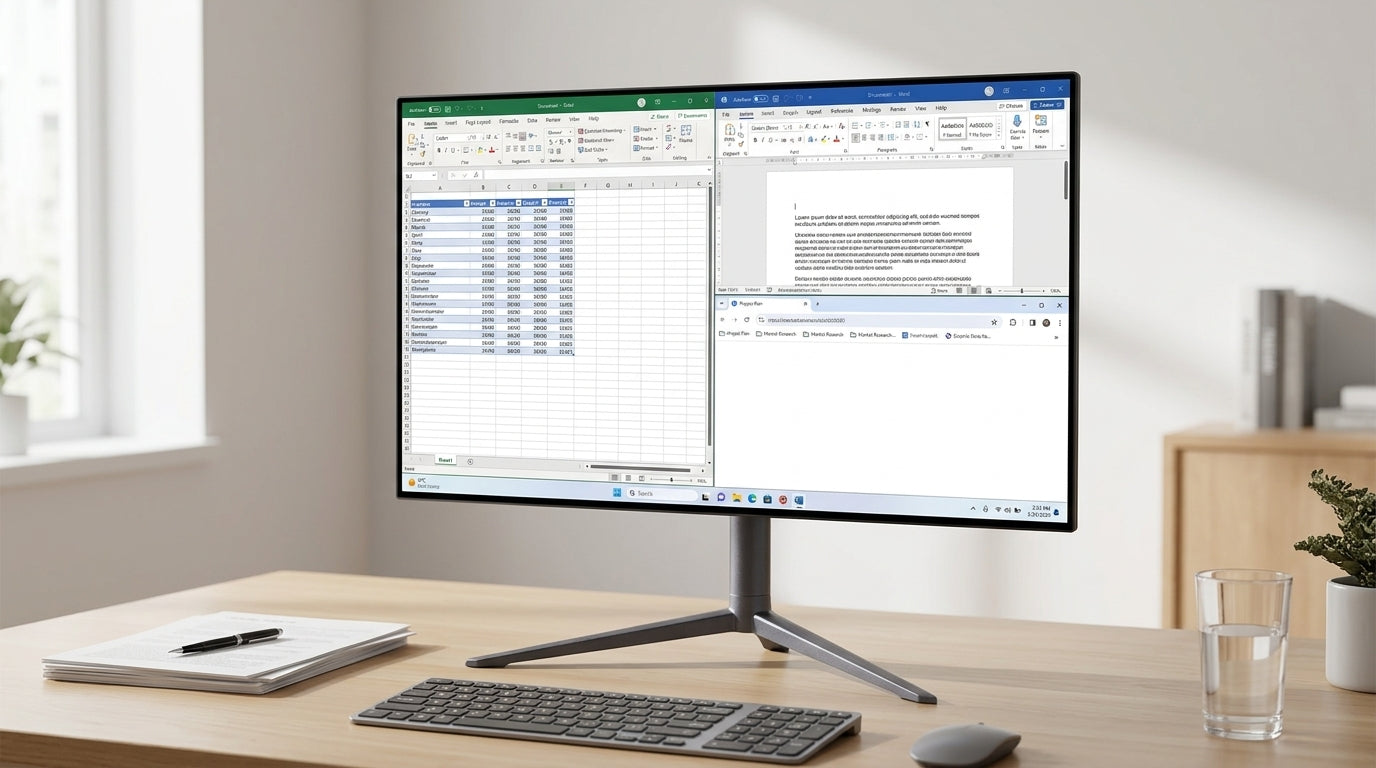
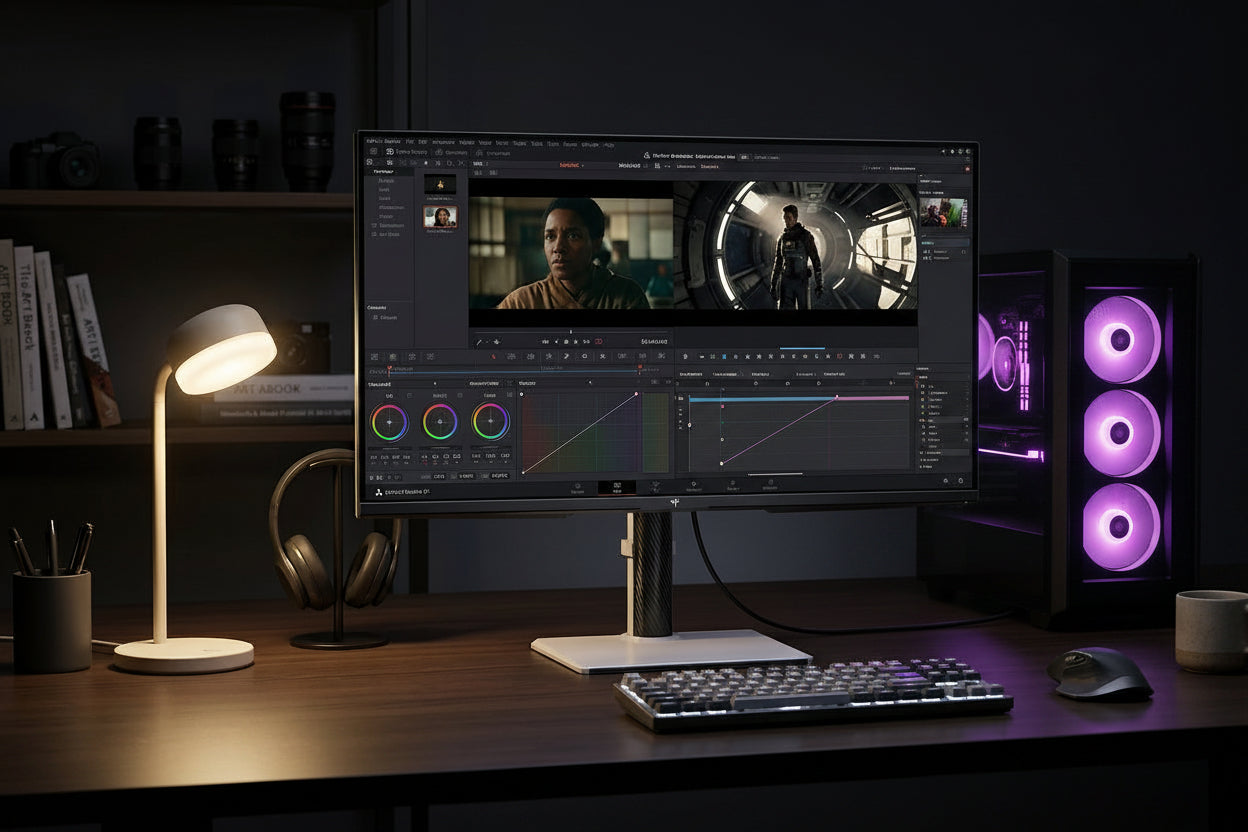
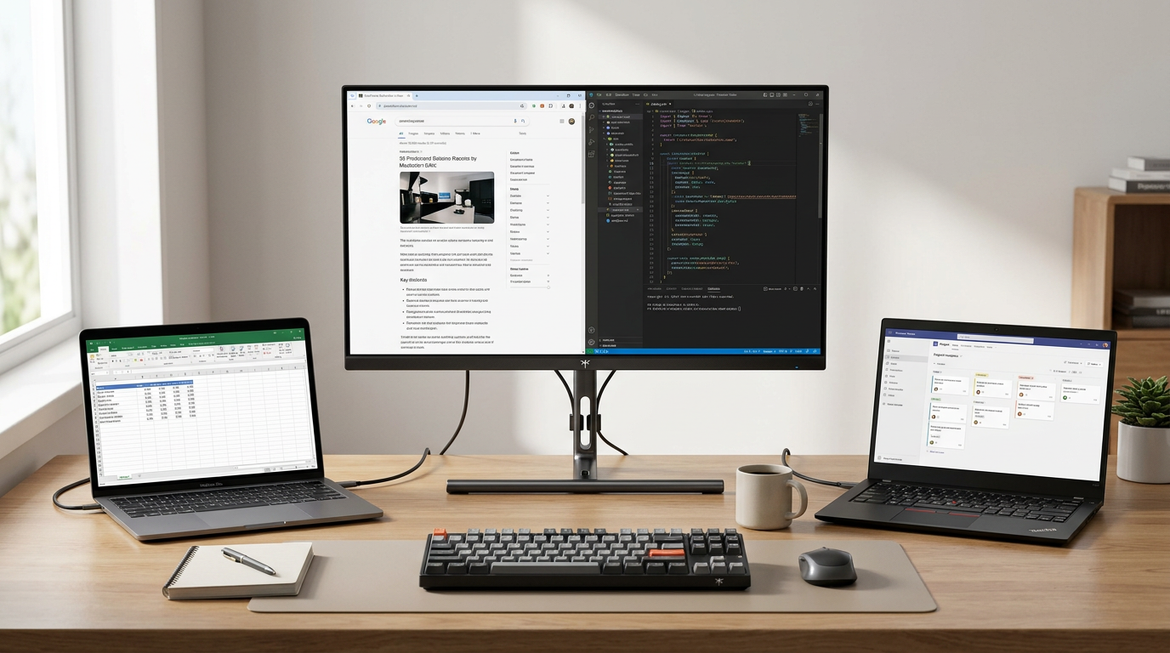
Bright rooms are usually a visibility problem first and a spec problem second. Finding the best monitor for bright room use means balancing brightness, glare control, and placement before chasing refresh rates or extra features. If your desk faces a window or sits under strong overhead lighting, coating and placement matter as much as peak brightness, and sometimes more.

For most buyers, a monitor that is bright enough in a dark room will still look washed out in daylight if reflections are not controlled. If you cannot move the desk or change the room layout, prioritize glare control and brightness headroom before refresh rate or extra features.
Why Bright Rooms Wash Out Displays
Ambient light raises the screen's apparent black level, which makes contrast feel flatter and text less crisp. Window reflections and ceiling lights can also hide dark UI elements, shadow detail, and fine interface lines.
That is why a monitor can seem excellent at night but underperform during the day. As RTINGS explains in its matte-vs-glossy guide, reflection control is a major part of how readable a display feels in real rooms, not just on a spec sheet. Luminance is measured in nits, and higher values improve visibility under ambient light.
If your desk faces a bright window, the first thing to check is not the panel type, but whether the screen is catching direct light. A small change in angle can help more than a big jump in brightness. See Why Your Display Looks Perfect at Night but Washed Out During the Day for placement tips.
Brightness Targets That Matter
In practice, brightness targets depend on whether you care more about SDR desktop use or HDR highlights. For many controlled rooms, around 300 nits can be workable, while 400 nits or more gives more margin near windows or during daytime use.

That does not mean "more is always better." In bright rooms, extra brightness helps visibility, but it does not fully solve glare by itself. You still need a coating that diffuses reflections and a setup that avoids direct light. HDR peak brightness improves highlight punch but does not replace anti-glare treatment or room placement.
For buyers comparing premium displays, Mini-LED is often the safer bright-room upgrade because it can keep highlights punchy while preserving more contrast than a plain bright panel. KTC's M27P6 Mini LED monitor is one example of that approach, with 1,152 local dimming zones and HDR1400-class peak brightness.
If you want more headroom for daytime gaming and mixed work, that kind of display makes sense. If your room is already dim or mostly used at night, the extra brightness may matter less than color accuracy or ergonomics.
Anti-Glare and Panel Trade-Offs
The safest bright-room choices usually start with a matte or anti-glare surface. Those coatings diffuse mirror-like reflections better than glossy screens, which is why they tend to stay more readable near windows and under office lighting.
Here is the practical trade-off:
| Option | Bright-room behavior | Best use case | Main trade-off |
|---|---|---|---|
| Matte IPS / Fast IPS | Good reflection control, stable everyday readability | Home office and mixed gaming | Usually less dramatic contrast than OLED |
| Mini-LED | Strong brightness headroom, better HDR punch | Bright rooms with gaming and media use | Cost and local-dimming behavior can vary |
| OLED | Excellent contrast in controlled lighting | Dim rooms and contrast-focused use | Reflections and sustained brightness can be a concern in sunlit spaces |
| Curved VA | Can help immersion, may shift reflections | Some gaming setups | Shape is not a substitute for coating or placement |
If your room is bright and you want one screen for both work and gaming, flat IPS or Mini-LED is usually the safer starting point. If you can control the room lighting well, OLED becomes more attractive. The KTC OLED 27" 2K 240Hz/0.03ms USB-C Gaming Monitor | G27P6 offers strong contrast when reflections are managed.
For readers comparing shapes as well as coatings, the question is often whether curvature actually helps with glare. The short answer is that it can change how reflections land, but it does not remove them. That is why a detailed look at Do Curved Monitors Reduce Side-Window Glare Better Than Flat Screens? is useful if you are deciding between flat and curved options.
How to Pick the Right Bright-Room Monitor
- Check your room first. Window direction, desk angle, and ceiling lighting change the priority order more than most spec sheets do.
- Set your brightness floor. If you use the monitor in full daylight, start by looking for stronger peak brightness, not just gaming features.
- Choose the surface and panel. Matte coating and stable panel behavior matter more in sunlit spaces than a small refresh-rate jump.
- Verify stand adjustment. Height, tilt, and swivel help you move the screen out of direct reflections when the desk cannot move.
- Treat refresh rate as secondary. Once the screen is readable, then compare port options, resolution, and gaming specs.
A useful rule of thumb: if the room stays bright most of the day, buy for visibility first. If you only occasionally see glare, a balanced IPS or Mini-LED monitor may be enough.
For that reason, the KTC M27T6S Mini LED monitor can be a sensible middle-ground choice when you want bright-room usability without going all-in on the highest resolution tier. The main point is not that it is "best" for everyone, but that its 450 nits of SDR brightness and Mini-LED backlight give it more daylight margin than a typical dimmer panel.
If you want maximum desktop sharpness and stronger HDR headroom, the M27P6 Mini LED model is the more aggressive bright-room option. If your room is only moderately lit and you care more about motion performance, the trade-off may favor a different setup.
Room Setup Checks Before You Buy
Before you hit add to cart, verify the conditions that most often decide whether a monitor feels comfortable in a bright room:
- Place the screen perpendicular to windows when possible.
- Prefer a matte or anti-glare surface if you have side-window or overhead-light reflections.
- Check that the stand offers enough height and tilt to move the panel out of glare.
- Match resolution to your use case so text stays sharp without overbuying GPU demand.
- Confirm warranty, shipping, and return terms before ordering.
If you want a broader place to compare sizes and feature sets, start with the Gaming Monitor collection, then narrow by room fit instead of chasing the biggest spec number. For shoppers looking specifically at sharper desktop use, the 4K Monitor collection is a better browsing path than starting from general gaming models.
Related Resources
Compare options by room lighting first:
- KTC Mini LED 27" 180Hz 2K HDR1400 Gaming Monitor | M27T6 for balanced bright-room HDR.
- Why Some 2026 Gaming Monitors Combine Mini-LED Backlights With Quantum Dot Films for backlight technology details.
- The Great Display Debate: Glossy vs. Matte Coatings for OLED Monitors for coating trade-offs.
FAQs
How Many Nits Do I Need for a Bright Room?
Around 300 nits can work in controlled lighting, but 400 nits or more gives more daylight margin, especially near windows. That said, brightness alone does not fix reflection issues, so coating and desk angle still matter.
What Panel Type Is Best for Sunlit Desks?
Matte IPS or Mini-LED is usually the safest all-around answer for bright rooms. OLED can still be excellent, but it is easier to prefer when you have better room control and fewer direct reflections.
Can a Curved Monitor Reduce Glare?
Curvature can change reflection angles, but it does not remove glare. If glare is your main issue, coating and placement should come first, and curvature should be treated as a secondary preference.
Why Does My Monitor Look Washed Out in Daylight?
The usual causes are ambient light, direct reflections, and poor screen placement. Increasing brightness can help, but it is often less effective than turning the screen away from the light source.
Should I Choose Mini-LED or OLED for a Bright Office?
Mini-LED is usually the safer bright-room choice because it gives you more brightness headroom. OLED is a stronger fit when contrast matters most and the room is easier to control.
Bright-Room Monitor Fit by Lighting Scenario
This chart summarizes which display type usually fits common bright-room setups best, based on glare control, brightness headroom, and room flexibility.
Show scenario table
| Scenario | Best fit tier |
|---|---|
| Direct Window Light | Mini-LED or matte IPS |
| Bright Office Lights | Mini-LED or matte IPS |
| Moderately Lit Room | IPS, Mini-LED, or OLED depending on preferences |
| Controllable Dim Room | OLED |