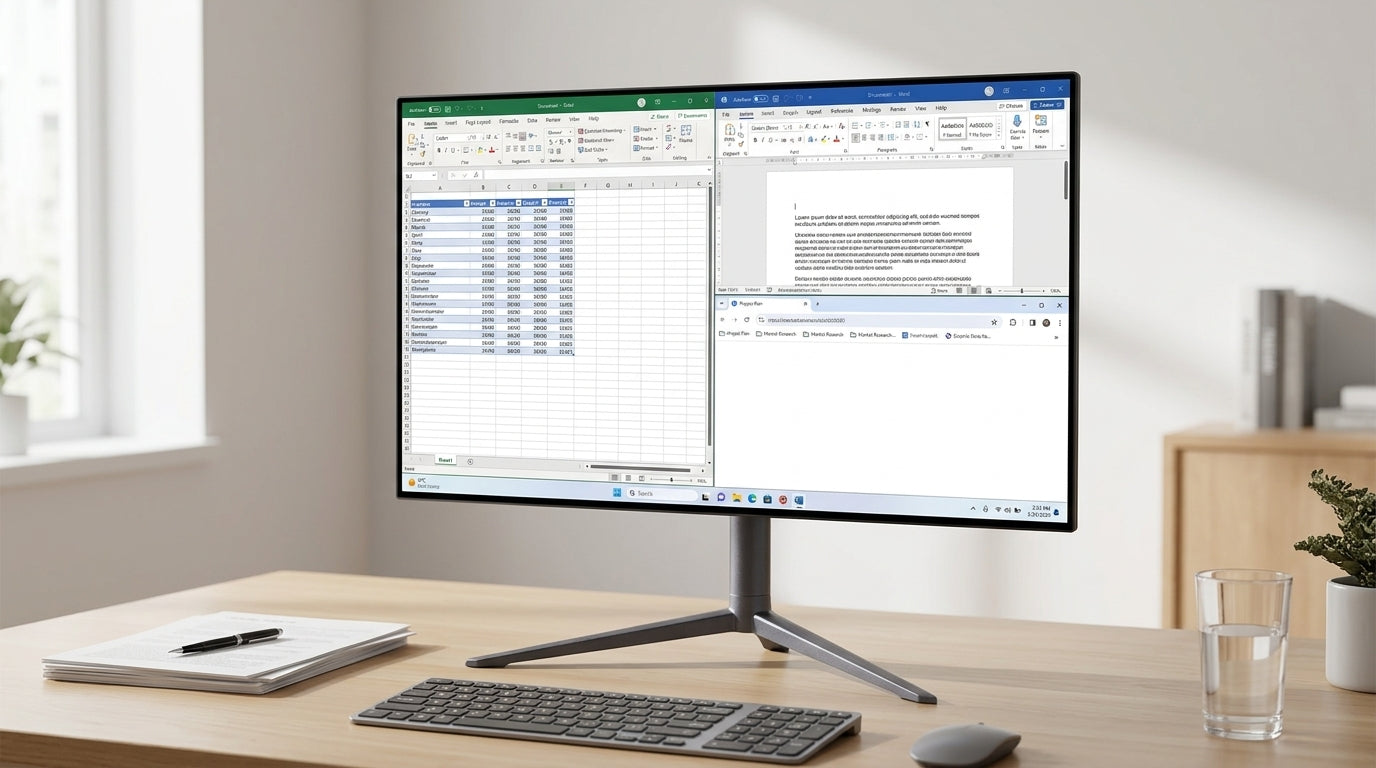
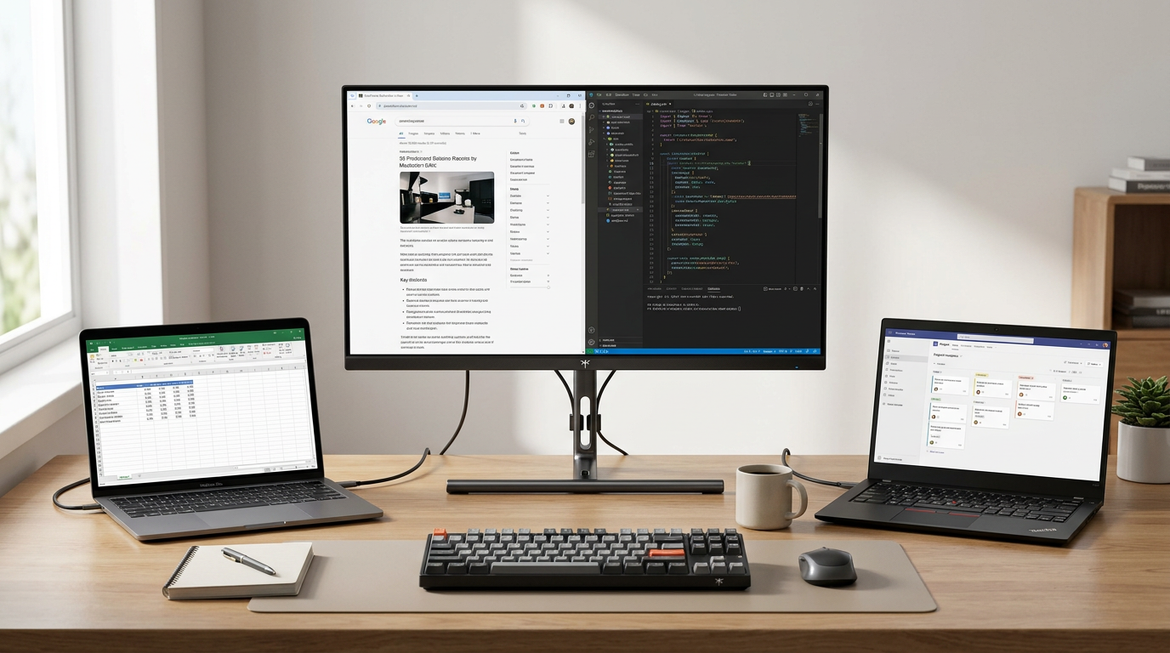
The best ktc monitor for coding and text clarity is usually the one with the highest usable pixel density at your desk distance, not the one with the flashiest spec sheet. For most developers and spreadsheet users, that means 27-inch 4K is the safest balance, 27-inch 5K is the sharpest close-up choice, and 27-inch QHD only makes sense if budget matters more than fine text detail. A ktc monitor for coding prioritizes effective pixel density over raw specs.

What Makes Text Feel Sharp
For coding and spreadsheets, text clarity comes mostly from pixel density, native resolution, and screen size working together. A monitor can look "high resolution" on paper but still feel soft if the pixels are spread across too large a panel for your viewing distance.
That is why the effective PPI view matters more than resolution alone. PPI is the number of pixels packed into each inch of screen, which is a plain way to think about how tight the text rendering looks at arm's length.
A useful rule of thumb is simple: if you want crisp code on a normal desk, 27-inch 4K or 27-inch 5K is easier to live with than 27-inch 1440p. Scaling can make the interface readable, but it does not fully replace actual pixel density when you spend hours scanning text.
If a screen looks fuzzy after setup, the issue is often not the panel itself. It can be scaling, the wrong native resolution, or a mismatch between the screen size and the workspace distance. For that reason, higher resolution is not a magic comfort fix; the sharper setup is the one that fits your desk and stays comfortable all day. See also the guide on why text looks blurry at 125% or 150% display scaling.
Resolution Choices That Actually Matter
If you are choosing between 1440p, 4K, and 5K, the decision usually comes down to how much sharpness you want versus how much scaling convenience you are willing to accept.
| Resolution class | What it usually means for text | Best fit | When it breaks down |
|---|---|---|---|
| 27-inch QHD | Good value, but less fine text than 4K or 5K | Budget-conscious coding, documents, light spreadsheets | If you are sensitive to softer text or like very dense code views |
| 27-inch 4K | Strong balance of sharpness and usability | Most coding, spreadsheet, and mixed office setups | If you want maximum density or sit very close to the screen |
| 27-inch 5K | Very high text density and the cleanest close-up look | Premium text-first desks and dense reading work | If price matters or your apps are not scaling-friendly |
| 32-inch 4K | More canvas, slightly looser density than 27-inch 4K | Users who want a larger workspace | If the desk is shallow or you sit very close |
The practical middle ground for most buyers is 27-inch 4K. It is usually sharp enough to make code and spreadsheets feel clean without forcing the UI into awkward scaling. If you want to prioritize maximum sharpness over cost, 27-inch 5K is the premium move. If you want more physical workspace and can sit a bit farther back, 32-inch 4K can be a better fit.
Browse focused options in the 2K Monitor or 4K Monitor collections. Office Monitor is the easiest category path if you want to compare office-focused sizes and resolutions without starting from a spec sheet.

Monitor text clarity for coding: safe fit by setup
For coding and spreadsheet work, the safest choices are usually the setups with higher pixel density at a comfortable viewing distance; the recommendation shifts once clarity needs or desk distance change.
View chart data
| Category | Lower comfort edge | Upper clarity edge |
|---|---|---|
| 27-inch QHD | 110.0 | 110.0 |
| 27-inch 4K | 163.0 | 163.0 |
| 27-inch 5K | 218.0 | 218.0 |
| 32-inch 4K | 138.0 | 138.0 |
IPS, Mini-LED, and OLED Trade-Offs
If text clarity is the main goal, IPS is still the safest default. It generally gives steady text appearance and wide viewing angles, which matters more on a work desk than dramatic contrast tricks. Pixel density drives perceived sharpness more than advertised resolution alone.
Mini-LED can be appealing in bright rooms because it adds stronger brightness and contrast headroom. That can make the screen feel more confident in daylight, but it does not change the basic rule that resolution and pixel density do the heavy lifting for text.
OLED can look excellent in the right use case, but for a coding-first monitor guide it should be treated carefully when the screen will hold static content for long stretches. For that reason, Mini-LED vs. OLED trade-offs are worth reading as a room-lighting and content-type decision, not as a simple "better panel" verdict.
In plain terms: if you mostly read code, documents, and spreadsheets, start with IPS and the right resolution. If your room is very bright, Mini-LED may be worth a look. If your desk is mostly for static productivity, OLED should not be the default pick just because it sounds premium.
Stand Height, Viewing Distance, and Desk Fit
Start with desk depth before you choose size. A big monitor can feel worse than a smaller one if it sits too close, because your eyes have to move more and the text can feel visually crowded.
- Measure how far your eyes sit from the screen.
- Match that distance to the panel size, not just the diagonal number.
- Make sure the stand can keep the top of the screen near eye level.
- If it cannot, plan on a monitor arm.
- Check port placement and cable routing before you buy.
A 27-inch panel is often the easiest fit for a typical home office desk. A 32-inch display can work well if the desk is deep enough and you want a larger canvas. The vertical vs. horizontal dual monitor productivity setup is also helpful if you are deciding whether one larger screen or two smaller ones will fit your workflow better.
The main regret trigger here is buying for screen size alone. If your desk is shallow, a larger panel can actually reduce comfort, even if the resolution itself is strong.
Best Fits for Coding and Spreadsheets
Here is the cleanest way to think about the current KTC office options for this use case:
Best Budget QHD Pick
If budget is the priority and you still want a usable coding monitor, KTC 24"/27" 2K IPS 100Hz Home & Office Monitor丨H24T27 is the value-oriented starting point. In practical terms, a 27-inch QHD screen is fine for office work, code, and light spreadsheet use, but it will not look as fine-grained as 4K or 5K.
That makes it a good fit when the main goal is saving money, not chasing the sharpest text. If you know you are sensitive to soft text, this is the first option to rule out rather than the one to stretch for.
Best 4K Value Pick
For most buyers, KTC 27" 4K IPS 60Hz Low blue Light Home&Office Monitor | H27P27 is the most balanced answer. The 27-inch 4K panel, 400 nits brightness, IPS panel, flicker-free technology, hardware blue light filter, and VESA mount support make it a straightforward productivity choice for daily coding.
This is the model I would start with if you want one monitor that feels sharp without becoming fussy. It is also the option that usually makes the least sense to overthink, because the size and resolution pairing is already in the comfort zone for many desks.
Best Premium Text-Clarity Pick
If you want the highest text density in this group, KTC 27" 5K@60Hz 2K@120Hz Home&Office Monitor | H27P3 is the premium choice. It uses a 27-inch 5K IPS panel with 500 nits brightness and a tilt-only stand, so the main appeal is sharpness rather than stand flexibility.
This is the better fit when text clarity matters more than price and you sit close enough to appreciate the extra density. It is less compelling if you mainly want a larger work area, because 5K at 27 inches can be overkill for users who prefer simpler scaling.
Best Large-Canvas Option
If you want more screen area rather than maximum density, KTC 32" 2K IPS 100Hz/120Hz Home&Office Monitor | H32D6 is the wider-canvas option. It uses a 32-inch WQHD IPS panel with 350 nits brightness, 100Hz/120Hz overclock headroom, and anti-blue-light plus flicker-free support.
That makes it more attractive for users who want a bigger desktop footprint for code, browser tabs, and documents. It is not the sharpest text-first choice in the lineup, so pick it only if your desk is deep enough and you prefer space over density.
If you want to browse the whole category from there, the 4K Monitor collection is the quickest path for higher-density options, while 2K Monitor is the easier budget comparison path.
What to Check Before You Buy
Before you add a monitor to the cart, use this short filter:
- Confirm the native resolution, not just the advertised refresh rate.
- Check whether 27 inches or 32 inches fits your desk depth.
- Make sure the included stand is enough for your posture.
- Verify the ports you actually need for your laptop dock or desktop.
- Look for flicker-free and low blue light features if you work long hours.
- Decide whether you want a fixed-height stand or a VESA arm from day one.
For readers comparing options on a practical home-office budget, the productivity monitor buying guide is a useful broader follow-up after you narrow resolution and size.
A simple decision sentence usually does the job here: if you are a text-first coder, buy for PPI first; if you are a spreadsheet-heavy user with more desk depth, 32-inch 4K can make sense; if your desk is shallow, avoid chasing size before sharpness.
Which Setup Should You Actually Choose?
Match the monitor to your primary workflow and desk constraints rather than chasing the highest spec. Use these quick checks:
- Desk depth under 24 inches? Start with 27-inch 4K or 5K.
- Need maximum text density for dense code? Choose 27-inch 5K.
- Want extra workspace for multiple windows? Consider 32-inch 4K if depth allows.
- Budget limited and text softness acceptable? 27-inch QHD works.
Test scaling in your actual apps before purchase when possible. For most coding desks, the best monitor for coding and text clarity is the one that keeps text crisp without forcing awkward scaling or an uncomfortable viewing distance. If you are still unsure, start with the office category and compare by size, resolution, and stand first, not by gaming features.