


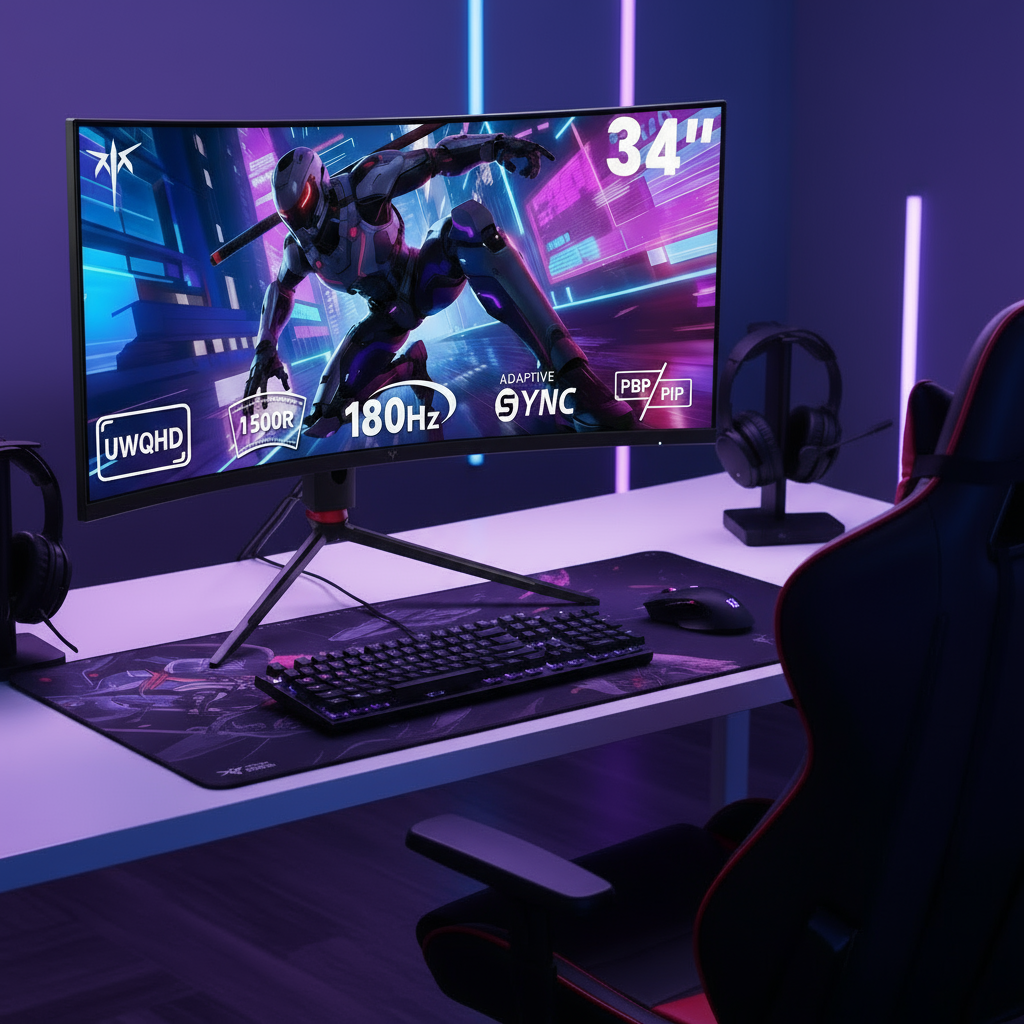


For sim racers seeking maximum immersion from a single display, a 49-inch 1000R curved monitor stands out as the top choice when your cockpit seating distance is roughly 60-80 cm. It delivers seamless horizontal wrap that mimics sitting inside the car without bezels, but only if your rig, GPU, and mounting hardware can handle the size, weight, and resolution demands. At greater distances or in hybrid desk/rig setups, a gentler 1500R curve or even a triple-monitor array often proves more practical.

Why Size and Curvature Are the Dual Pillars of Sim Racing Immersion
Immersion in sim racing comes from filling your peripheral vision so the brain accepts the on-screen world as real. A large curved panel creates that "presence" effect, making speed and cornering feel more visceral than on a flat 27-inch or 32-inch monitor.
A 49-inch 32:9 ultrawide gives the screen real estate of two 27-inch monitors side by side, but without the distracting center bezel that breaks the illusion in traditional dual-screen setups. This single-panel approach simplifies cable management and GPU load compared with triples while still delivering substantial horizontal coverage.
The combination of size and curvature determines how naturally the image sits in your field of view. When chosen correctly for your seating distance, the display edges stay in consistent focus, reducing the need for constant eye refocusing during long races.
Curvature Physics: Why 1000R Is the Cockpit Standard for 2026
The "R" in 1000R or 1500R refers to the radius of the curve in millimeters. A 1000R monitor curves with a 1-meter radius, while 1500R uses a 1.5-meter radius and therefore appears flatter.

As this monitor curvature guide explains, 1000R curvature closely aligns with the natural curvature of the human field of vision. For sim rigs where the driver sits 60-80 cm from the screen, this tighter curve keeps edge pixels at a more uniform focal distance, reducing distortion and eye strain during extended sessions.
In contrast, 1500R panels suit setups where the monitor sits farther back or serves double duty for productivity work. Our Curved vs. Flat Monitors: Which Is Better for Gaming Immersion? article explores similar trade-offs across different gaming scenarios.
The following chart helps visualize these fit zones:
Sim Racing Monitor Fit by Curvature and Viewing Distance
This chart shows the typical fit range for 1000R and 1500R monitors across common cockpit viewing distances. It is meant to guide immersion-focused setup choices, not to claim a single universal optimum.
Show Data Table
| Viewing distance | 1000R fit | 1500R fit |
|---|---|---|
| 60 cm | 1 | 0 |
| 70 cm | 1 | 0 |
| 80 cm | 1 | 1 |
| 90 cm | 0 | 1 |
| 100 cm | 0 | 1 |
Calculating FOV: Matching Screen Size to Your Cockpit Distance
Field of View (FOV) is the angular width of the virtual world you see on screen. In sim racing, correct FOV creates 1:1 scale realism—so the steering wheel on screen matches the physical wheel in your hands.
A 49-inch super-ultrawide lets you run wider horizontal FOV numbers at closer seating distances than a standard 16:9 panel. This wider coverage enhances peripheral awareness of track edges and other cars without forcing you to sit farther back.
Measure your exact eye-to-screen distance, then use an online FOV calculator for your specific game (iRacing, Assetto Corsa Competizione, etc.). The result becomes your in-game FOV setting. Mismatched FOV is one of the most common causes of motion discomfort in sim racing.
Performance vs. Resolution: Balancing GPU Load on Super-Ultrawide Panels
A 49-inch DQHD panel (5120×1440) contains nearly as many pixels as 4K. Driving this resolution at high refresh rates demands a powerful GPU—typically an RTX 4080 or better—to maintain smooth frame times in modern sim titles.
Refresh rate matters more than many realize for racing. At least 144 Hz helps eliminate motion blur during rapid steering inputs and high-speed cornering, making car control more precise. Our How to Choose the Perfect Monitor to Match Your Graphics Card guide provides further details on balancing these specs.
Variable Refresh Rate technologies like G-Sync or FreeSync smooth out frame-rate fluctuations. See our G-Sync vs. FreeSync: Which One Is Better for Gaming in 2025? comparison for the latest insights on these adaptive sync options.
The Weight of Immersion: Practical Mounting and Rig Fit for Behemoth Displays
A 49-inch curved monitor is roughly 4 feet wide and can weigh over 30 lbs. Standard desktop monitor arms often sag or fail under this load, especially with the forward center of gravity created by the curve.
As detailed in this VESA mounting guide, heavy-duty arms or rig-integrated mounts rated for at least 44 lbs are essential. Most large ultrawides use a 100×100 mm VESA pattern; confirm your rig plate matches before purchase.
Measure your cockpit width carefully. The monitor should not interfere with wheel movement or block normal room access. Many dedicated sim rigs now include reinforced monitor mounts precisely for these behemoth displays.
Single 49-inch vs. Triple 32-inch: Which 'Behemoth' Setup Fits Your Racing Style?
A single 49-inch 1000R ultrawide delivers a seamless, bezel-free image that many drivers find more immersive for casual and intermediate racing. Setup is simpler, cable management is cleaner, and GPU demands are lower than running three separate displays.
Triple 32-inch setups can achieve wider total horizontal FOV—often approaching 180°—which provides superior peripheral awareness for competitive or professional-level sim racing. However, they require complex mounting brackets, precise alignment, multiple video outputs, and significantly more graphics power.
Our Should Your Next Gaming Monitor Be an Ultrawide? A Gamer's Guide examines these single versus multi-monitor considerations in depth.
For most home cockpit builders, the single 49-inch 1000R option strikes the best balance between immersion, practicality, and cost. Choose the triple route only if your rig space, budget, and GPU can fully support the added complexity.
The KTC H49S66 49" DQHD 180Hz 1000R Curved Gaming Monitor exemplifies the current state of single-screen sim racing displays, offering 180 Hz refresh, strong contrast, and built-in KVM functionality for clean multi-device switching. Pair it with a high-end GPU and proper heavy-duty mounting, and it becomes the centerpiece of a truly immersive rig.


