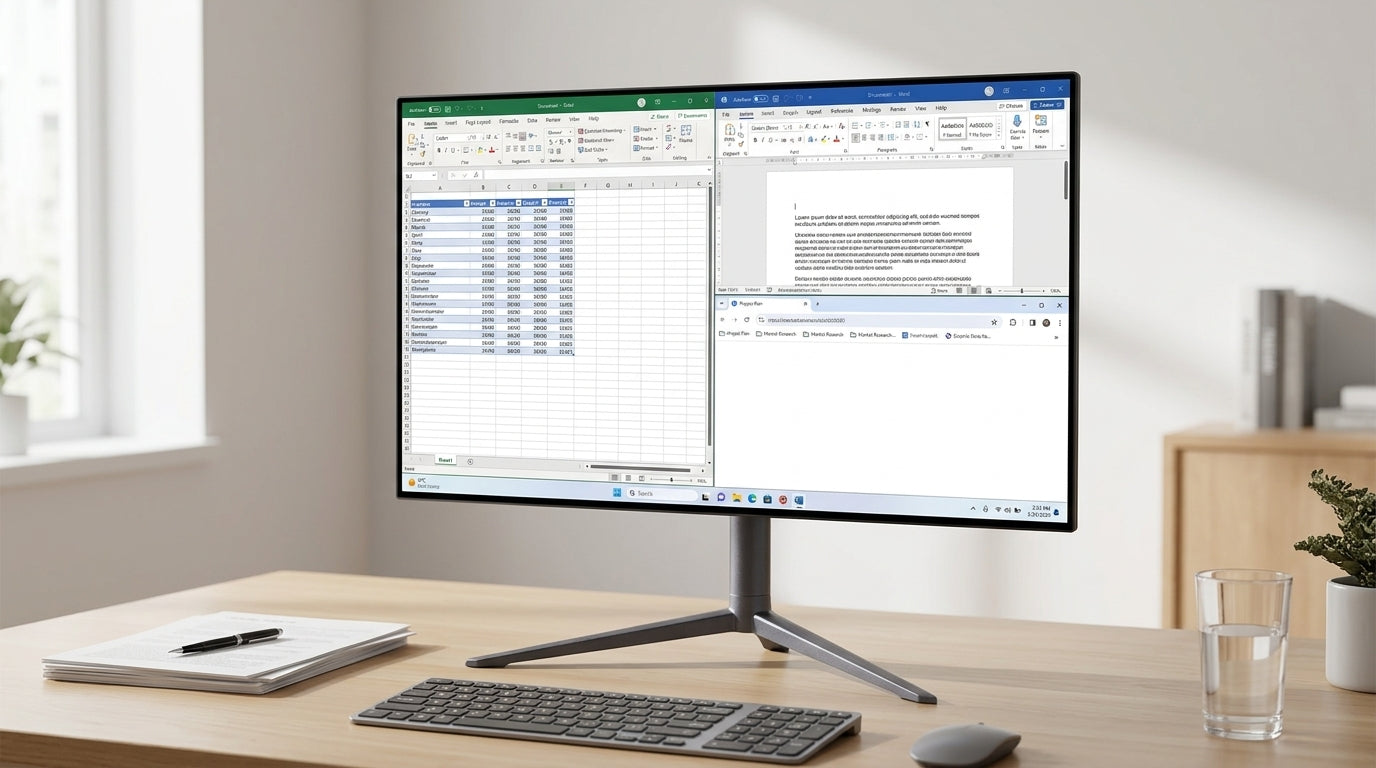
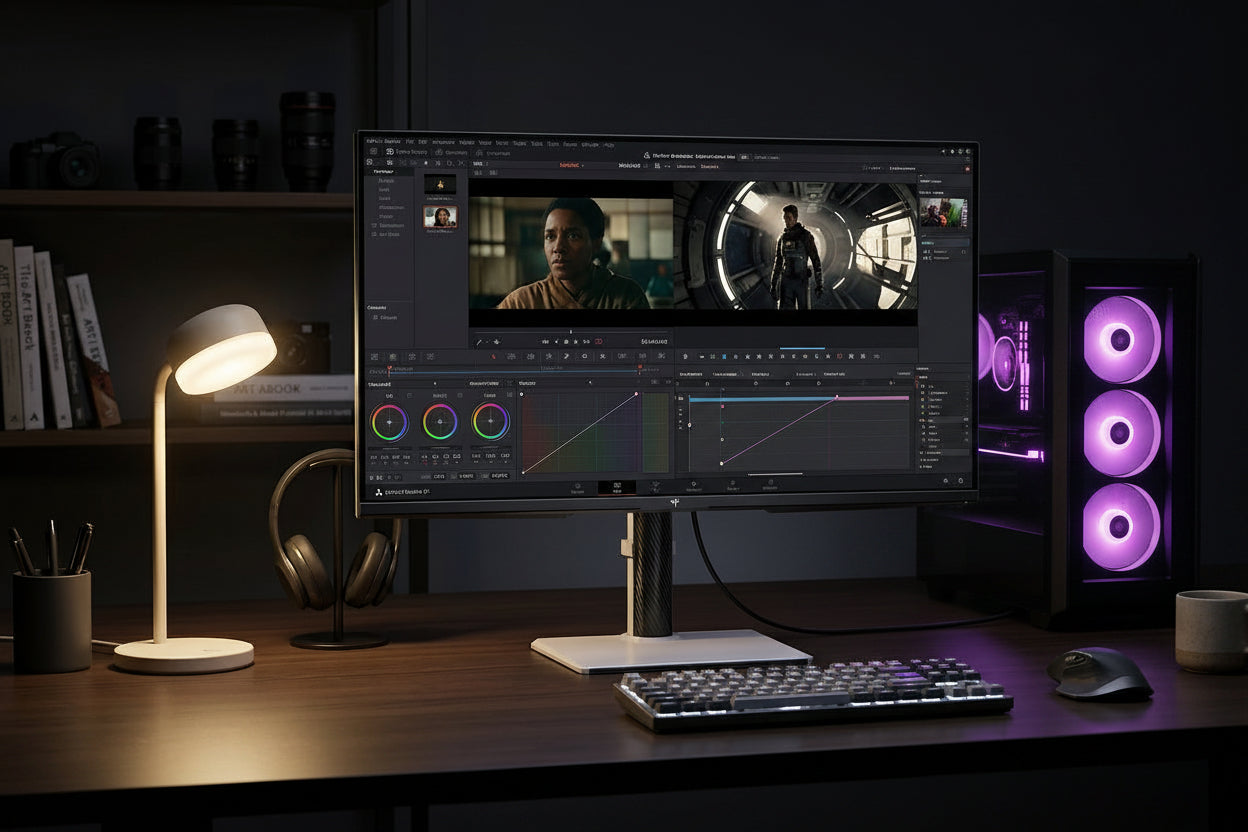
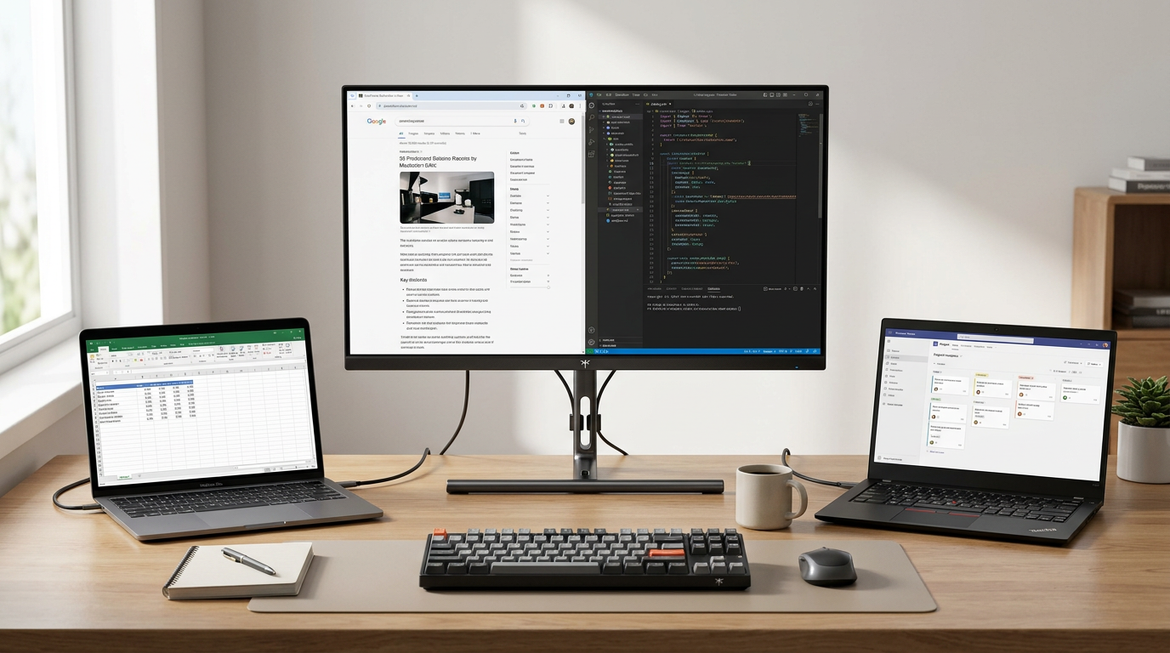
A hybrid work monitor should solve the desk problem first, then the display problem. If two devices share one keyboard and mouse, make switching convenience part of the first decision. If most of your day is reading, writing, or spreadsheets, put text clarity ahead of gaming speed. Brightness and refresh rate matter too, but they should come after you know how the desk actually gets used.

Start With Your Desk Priorities
Hybrid work often turns into a small switching problem that gets annoying fast: laptop to desktop, work to play, calls to games, one input to another. That is why the first question is not "What spec is highest?" It is "What needs to change on this desk every day?" Owl Labs' State of Hybrid Work 2025 reinforces the practical side of that friction by showing how often hybrid setups create setup and switching overhead.
If you use one computer only, a built-in KVM is optional. If you use two computers and want one keyboard and mouse to follow both, KVM moves up the list quickly. That is the kind of condition that can make a monitor feel clean and simple instead of constantly fiddly.
A hybrid monitor setup guide can help if your use flips between PC work and entertainment modes often. The point is not to buy for every possible use. It is to avoid paying for features that do not remove a real pain point.
What a Hybrid Work Monitor Must Do
For most buyers, the hybrid work monitor buying framework comes down to four filters in order: desk switching, text clarity, room-light fit, and refresh rate. RTINGS notes that office work is generally well-served by 60Hz to 100Hz, while higher refresh rates matter more for gaming and fast motion. That means refresh rate is important, but it is usually the tie-breaker, not the first filter, for a dual-use desk.
If the desk runs two computers with one mouse and keyboard, start by checking switching. If the desk is mostly one laptop plus occasional console play, the monitor can be judged more like a work-first display with a gaming bonus. That is a different buying problem.
Text Clarity and Screen Size
Text clarity is the productivity filter that most hybrid buyers should check first. The question is not just whether a monitor is 27 inches or 32 inches. It is whether the size and resolution stay readable at your normal sitting distance. KTC's 27-inch 1440p pixel-visibility guide treats 27-inch QHD as a practical sweet spot for many desks, which matches how many people want a balanced workspace without pushing into oversized territory.
For work-heavy desks, sharper text matters more than chasing a high refresh number. For gaming-heavy desks, a faster panel can matter more once text is already acceptable. That is the main tradeoff: clarity first if the day is full of reading, speed first if the night is mostly motion-heavy games.
KVM and Input Switching
Built-in KVM matters when one monitor has to control two computers without a pile of extra peripherals. KTC's KVM switch explainer frames it correctly: KVM is valuable when two machines share one desk and one set of input devices. It is much less important if you never plan to share peripherals.
That makes KVM a first-order feature for dual-PC desks and a convenience feature for single-PC desks. If you already have a dock, keyboard shortcuts, or a software switch workflow that feels fine, KVM may not change enough to justify paying more for it.
Brightness, Contrast, and Room Light
Brightness and contrast should be judged against the room, not treated like universal upgrades. KTC's brightness and contrast guide makes the right point: the same monitor can feel different in a bright room, a shaded room, or a room with a window behind the desk.
If your desk sits near a window or under strong overhead light, room fit matters more. If your room is relatively dim, raw brightness is less likely to change the buying decision than contrast behavior and panel type. That is why brightness is useful, but only when tied to actual lighting conditions.
Refresh Rate and Motion Smoothness
Refresh rate matters most when motion matters. RTINGS says a 60Hz monitor can work well for office tasks, and higher refresh rates mainly become valuable for smoother gaming, scrolling, and fast movement. In plain terms, 60Hz to 100Hz is often enough for office use, while 120Hz and above becomes more relevant when games are a serious part of the desk.
If you split time between documents and games, a moderate refresh rate can be a balanced compromise. If gaming is the main reason to upgrade, refresh rate should rise in priority. If not, it is easy to overspend on speed and underbuy on readability or desk fit.

| Scenario | KVM | Text Clarity | Brightness Fit | Refresh Rate | Practical Size Branch | Likely Best Fit |
|---|---|---|---|---|---|---|
| Two computers share one desk | High | Medium | Medium | Medium | Usually 27-inch QHD or 32-inch 4K | A monitor with built-in KVM and simple input switching |
| Mostly docs, calls, and spreadsheets | Medium | High | Medium | Low to Medium | 27-inch QHD or 32-inch 4K | A productivity-leaning monitor with readable text |
| Gaming after work in a bright room | Medium | Medium | High | High | 27-inch QHD, 27-inch 4K, or 32-inch 4K | A faster display that also handles room light well |
| Need more horizontal workspace | Low to Medium | Medium | Medium | Medium | Ultrawide | A width-first monitor, not just a larger 16:9 screen |
Match Monitor Types to Real-World Needs
A hybrid desk does not need every monitor type. It needs the type that solves the right problem. If you want a neutral branch for mixed use, the choice often starts with a 27-inch QHD model or a similar balanced setup. If you want more workspace, a 32-inch 4K display is a separate productivity branch. If you want more width for side-by-side windows, ultrawide is the width-first branch.
KTC's All Monitors collection shows how broad the range can be, from office-focused screens to high-refresh gaming panels and ultrawide options. That breadth is useful, but it can also blur the decision if you do not sort the use case first.
| Monitor Family | Best Fit | Strongest Benefit | Main Tradeoff | When It Breaks Down |
|---|---|---|---|---|
| 27-inch QHD office or hybrid monitor | Balanced work and gaming | Practical middle ground for text and motion | Less workspace than 32-inch 4K | When you want more desktop space or wider split-screen work |
| 32-inch 4K office-first monitor | Work-heavy hybrid desks | More room for windows and larger on-screen content | More desk footprint and a less gaming-first profile | When gaming speed matters more than workspace |
| Ultrawide monitor | Width-first multitasking | Side-by-side apps and a wide timeline view | Different layout, not interchangeable with 16:9 | When app compatibility or desk width is limited |
| Fast gaming monitor | Gaming-heavy hybrid use | Better motion handling | Can over-prioritize speed over work comfort | When long reading sessions dominate the day |
A 32-inch 4K model can be a sensible fit if your day is full of windows, dashboards, and large documents. The Office Monitor collection is the cleaner place to browse that branch, because it groups work-oriented monitors by size and refresh rate instead of mixing them with pure gaming models.
If your priority is mixed work plus play and you want a concrete example of the productivity-leaning branch, the KTC 32" 4K Smart Monitor is a natural reference point. It fits the desk-comfort side of the decision because it combines a 32-inch 4K canvas with built-in KVM, 65W USB-C hub support, and a 60Hz profile. That does not make it the best choice for everyone. It does make it a useful check if your desk is more about switching between work devices than maximizing gaming speed.
By contrast, a monitor like the KTC Mini LED 27" 180Hz monitor sits closer to the gaming-leaning side of the decision. Its 27-inch QHD format still fits the baseline many hybrid buyers want, but the higher refresh rate and Mini-LED HDR focus matter more if gaming is a major part of the evening use case.
Fit the Size and Resolution to Your Desk
The cleanest starting point for many hybrid buyers is 27-inch QHD. It gives a practical blend of desk footprint, readable text, and enough gaming headroom without pushing the desk into a much larger form factor. That is why it often works as the baseline comparison point before you decide whether to move up or sideways.
Use 32-inch 4K when the main goal is more workspace, larger content, or easier window tiling. Use ultrawide when the goal is width-first multitasking or a more immersive horizontal layout. Those branches are not the same, even if they both feel "bigger" in a store listing.
A 32-inch 4K screen can help when documents, calls, and side-by-side apps are the real day-to-day workload. But if you mainly want a gaming display with text that still works well, a 27-inch QHD baseline can be easier to place on a normal desk. If you want more on-screen width than a standard 16:9 layout, ultrawide is the separate branch to compare, not just a larger version of the same thing.
Use This Final Fit Checklist
- Start with the desk behavior. Do two computers share the same keyboard and mouse, or is this mostly one-PC use?
- Check your reading load. If you spend more time in documents, email, and spreadsheets, text clarity should outrank refresh rate.
- Check the room. Bright windows and strong overhead lights make brightness and contrast more important.
- Decide whether gaming is secondary or central. If it is secondary, office and setup convenience should lead.
- Compare size branches. Use 27-inch QHD as the neutral starting point, 32-inch 4K for more workspace, and ultrawide for width-first multitasking.
- Verify ports, cable types, stand adjustability, and return policy before checkout.
If you want a fast self-test, ask whether your ideal monitor should save time every day, not just look better in a spec sheet. If the answer is yes, the hybrid work monitor buying framework should push you toward the branch that fits your desk first and your games second.
FAQs
How Do I Choose Between KVM, Brightness, and Refresh Rate First?
Choose KVM first only if two computers must share the same desk and peripherals. After that, check room-light fit, then text clarity, then refresh rate. That order usually keeps hybrid buyers from overpaying for speed before the desk problem is solved.
What Screen Size Is Best for Work and Gaming on One Desk?
For many shoppers, 27-inch QHD is the safest starting point. Move to 32-inch 4K if you want more workspace or larger content. Choose ultrawide only if horizontal space and split-screen work matter more than a standard 16:9 layout.
Can a Gaming Monitor Work Well for Text-Heavy Work?
Yes, if the resolution, size, and viewing distance still make text comfortable to read. The catch is that some gaming-first models put more value into motion than workspace comfort, so the best fit depends on how much reading you actually do.
Why Does Room Light Change Which Monitor Feels Better?
Because brightness and contrast are perceived differently in a bright room than in a dim one. A panel that feels fine in a quieter office can feel less usable near a window, so the room should be part of the buying decision.
Can I Skip KVM If I Only Use One Computer?
Usually yes. If you only use one computer, KVM is more of a convenience feature than a necessity, and you may get more value from better text clarity, a better stand, or a more appropriate refresh rate.
When Does Ultrawide Make More Sense Than 32-Inch 4K?
Ultrawide makes more sense when horizontal workspace is the real problem, especially for side-by-side windows or timelines. 32-inch 4K makes more sense when you want a larger traditional canvas and sharper desktop layout.
For most buyers, the best hybrid monitor is the one that fixes the desk first and the gaming wish list second. Start with switching needs, then text clarity, then room light, then refresh rate. If you want to browse by setup type, the office monitor range is the cleanest place to begin, while all monitor options help when you are still deciding between hybrid, gaming-first, and ultrawide branches.