A USB-C KVM monitor can simplify a shared laptop-and-desktop desk, but only if the monitor, cable, and source devices all support the right functions. USB-C does not automatically guarantee video, charging, or KVM switching, so the safest buy is the one that matches your actual workflow, not just the port label.

What a USB-C KVM Monitor Actually Does
A USB-C KVM monitor combines a display with a practical switching hub, but the useful parts are separate. USB-C may carry video, USB data, and power delivery, while KVM is what lets one set of peripherals follow the active computer. Those functions often travel together, but they do not all come from the same label.
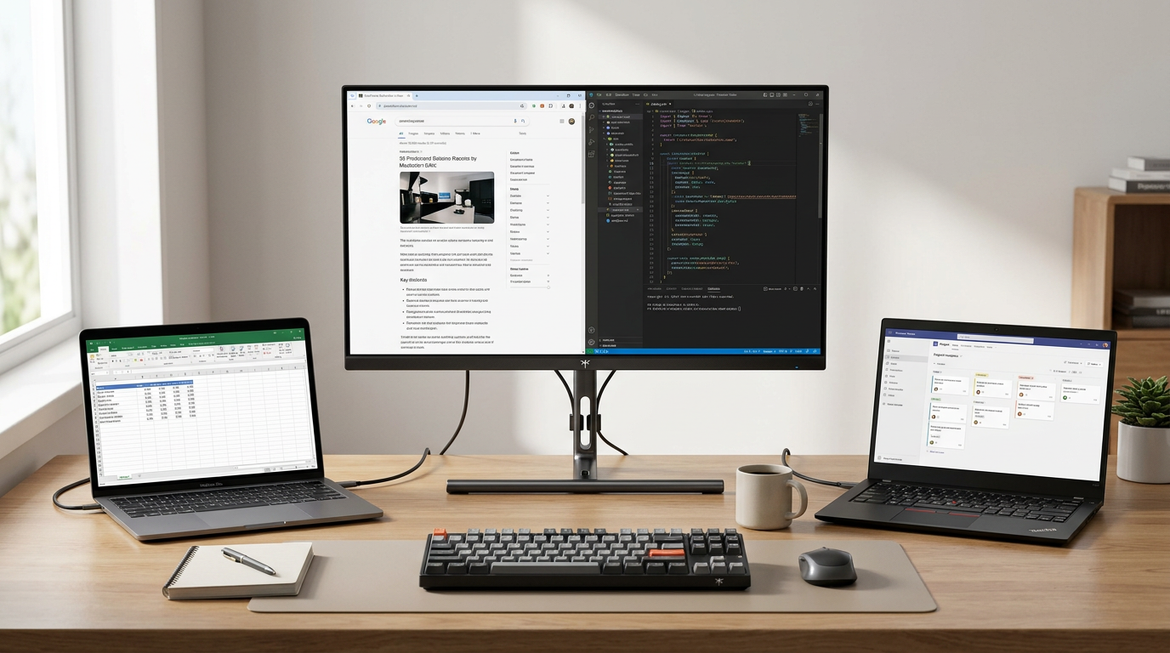
For a desk shared by a laptop and a desktop, the real benefit is fewer cable swaps and faster source changes. That matters most when you switch daily and want the keyboard, mouse, and display to feel like one setup instead of two. If you only want a cleaner desk and switch occasionally, a simpler USB-C monitor may be enough.
A good way to think about a USB-C KVM monitor is this: USB-C is the connection path, while KVM is the control behavior. A monitor may support one without fully replacing the other. If you need both computers to feel equally easy to use, that distinction matters.
If you want a deeper hybrid-work breakdown, see this hybrid workflow guide.
What to Check Before You Buy
Before you compare brands, check the source laptop first. The laptop's USB-C port has to support video output if you expect one-cable display use over USB-C. A charging-only or data-only port will not behave like a display connection.
Next, confirm how the monitor handles KVM. A common KVM setup uses the laptop over USB-C for video, data, and power, while the desktop connects through HDMI or DisplayPort plus a separate USB upstream path for keyboard and mouse control. KTC's monitor KVM and USB upstream setup guide shows why those paths should be checked separately.
Power delivery is helpful, but treat it as convenience, not proof. USB Power Delivery can support up to 100W or more, yet actual charging speed still depends on both the monitor's output and the laptop's needs. If your laptop already charges slowly on some docks, do not assume a monitor's USB-C port will fix that.
Refresh rate deserves the same caution. If you want a high-refresh desktop path, verify the exact input you plan to use, because USB-C, HDMI, and DisplayPort do not always behave the same in every setup. For a troubleshooting-oriented check on high-refresh links, this setup library is useful.

Where USB-C Helps and Where It Does Not
| Connection path | Best when | What it helps with | When it breaks down |
|---|---|---|---|
| USB-C laptop path | Laptop-first hybrid desks | One-cable convenience, clean desk layout, possible charging, simple source switching | The laptop port is charging-only, the cable is not full-function, or you need more headroom for desktop gaming |
| Desktop video path plus separate USB upstream | Gaming PC plus work laptop | Better separation of video performance and peripheral control, often safer for high-refresh desktop use | You want every device to travel through one cable, or the monitor does not expose the needed upstream path |
| Mixed MacBook and Windows workflow | Mixed-device desks | Predictable switching when each machine's port behavior is verified in advance | You assume the same USB-C behavior on both machines without checking video and charging support |
The practical rule is simple. Use USB-C when it genuinely reduces friction for the laptop side. Use HDMI or DisplayPort when the desktop side needs more predictable bandwidth or you do not want to tie video and charging to the same cable. That is why the safer choice changes by scenario, not by connector brand.
For readers comparing MacBook behavior with Windows desktops, this Mac display guide is a useful follow-up, especially if you are trying to match a laptop to a high-resolution monitor.
USB-C KVM monitor: safer connection path by scenario
Use this as a check-before-buying guide: the safer path depends on whether USB-C needs to carry video, charging, and peripherals at once.
View chart data
| Scenario | Laptop-first hybrid desk | Gaming PC + work laptop | MacBook + Windows mixed workflow |
|---|---|---|---|
| USB-C laptop path | 1.0 | 0.0 | 0.0 |
| Desktop video path + separate USB upstream | 0.0 | 1.0 | 1.0 |
Which Monitor Fits Your Use Case
For a hybrid work laptop and desktop desk, prioritize a monitor that reduces cable changes and makes source switching painless. Power delivery helps here, but only if the laptop actually accepts charging over USB-C. If you care about keyboard and mouse sharing, check that separately from the video input path.
For a gaming PC and work laptop combo, put refresh rate and the desktop input path first. USB-C can still be useful for the laptop side, but it should not force a compromise on the gaming machine. If the desktop needs more bandwidth or more predictable performance, DisplayPort or HDMI is often the cleaner path.
If you want a practical product example with strong USB-C power delivery and dual-mode flexibility, the KTC 27" 4K 160Hz/320Hz 90W Gaming Monitor | H27P6 is worth checking against your own devices. Its 90W USB-C, 4K 160Hz mode, and 1080p 320Hz mode make it a good fit to verify whether your laptop and desktop can actually support the setup you want.
For MacBook and Windows mixed workflows, do not assume both machines will behave the same way just because they share USB-C. Confirm the video mode, charging expectation, and switching behavior on each device before you buy. If you prefer an even wider desk footprint for multitasking, the KTC 49" DQHD 180Hz 1000R Curved Gaming monitor丨H49S66 is a category example to compare, especially if your goal is broad screen space plus USB-C PD and KVM-style convenience.
Setup Fit Test Before You Order
- Check the laptop first. Does its USB-C port support video output, or is it charging-only?
- Check the desktop next. Will it use HDMI or DisplayPort, and does that input support your target refresh rate?
- Check the USB path. If you want shared peripherals, confirm the monitor has the upstream route needed for KVM-style switching.
- Check charging. Decide whether USB-C power delivery is just a convenience or a real replacement for your current charger.
- Check the desk. Make sure the stand, cable reach, and monitor position work for daily use.
If any one of those checks fails, the monitor may still be fine, but the setup changes. That is usually the moment to move from a USB-C-first idea to a more conventional HDMI or DisplayPort path. When you want a broader browse path, all monitors is the safest place to compare options, while gaming monitor options and office monitor options help narrow the use case.
Final Takeaway
A USB-C KVM monitor is a good fit when you want cleaner switching between a laptop and a desktop, but only after you verify video support, charging behavior, and peripheral routing. If USB-C only solves one part of the desk, another input path may be the better buy. Check the laptop port, desktop input, and KVM path first, then choose the monitor that matches the setup you will actually use.
FAQ
Can USB-C Alone Handle KVM Switching?
Not by itself. USB-C can carry video and power, but KVM-style peripheral control depends on whether the monitor also supports USB upstream switching. If you need the keyboard and mouse to follow the active source, verify that behavior separately before buying.
How Do I Know If My Laptop Will Work With a USB-C KVM Monitor?
Start with the laptop's USB-C port. It has to support video output if you want one-cable display use, and it must also support charging if you expect power delivery. If the port is data-only or charge-only, the setup will not behave like a full USB-C monitor connection.
What Is the Difference Between USB-C Charging and USB-C Video?
They are different functions. A laptop may charge over USB-C without sending video, and it may send video only if the port and cable support display output. That is why a port label alone is not enough to predict the result.
Can I Use One Monitor for a Gaming PC and a Work Laptop?
Yes, but the best setup depends on what matters more. If gaming performance is the priority, the desktop path may be better through HDMI or DisplayPort, while the laptop can still use USB-C for convenience. If the goal is simpler switching, verify that the monitor's USB-C and KVM behavior match your devices.
Why Would I Choose DisplayPort or HDMI Instead of USB-C?
Choose them when the desktop path needs more predictable performance or when you do not want video, charging, and data all tied to the same cable. USB-C is often the cleaner laptop path, but HDMI and DisplayPort can be the safer choice for gaming PCs and mixed setups.