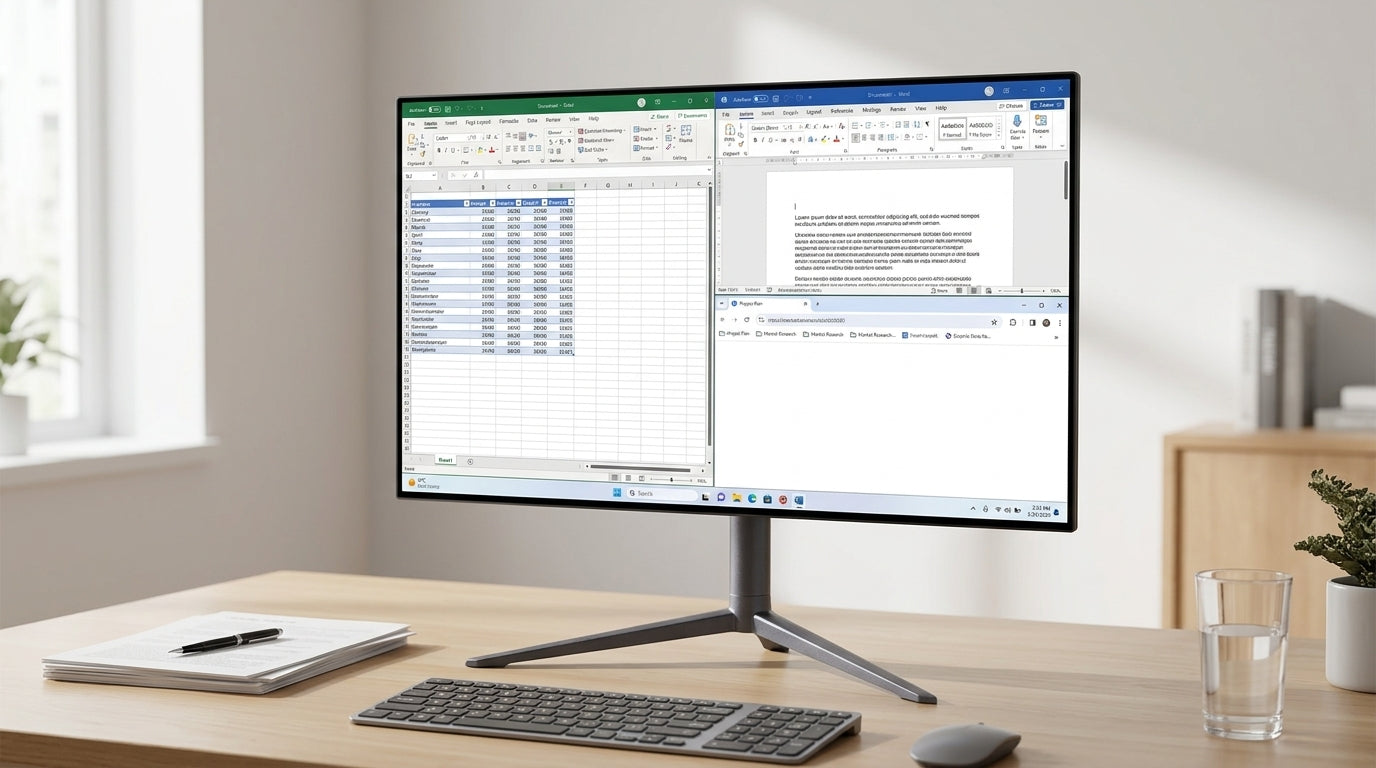
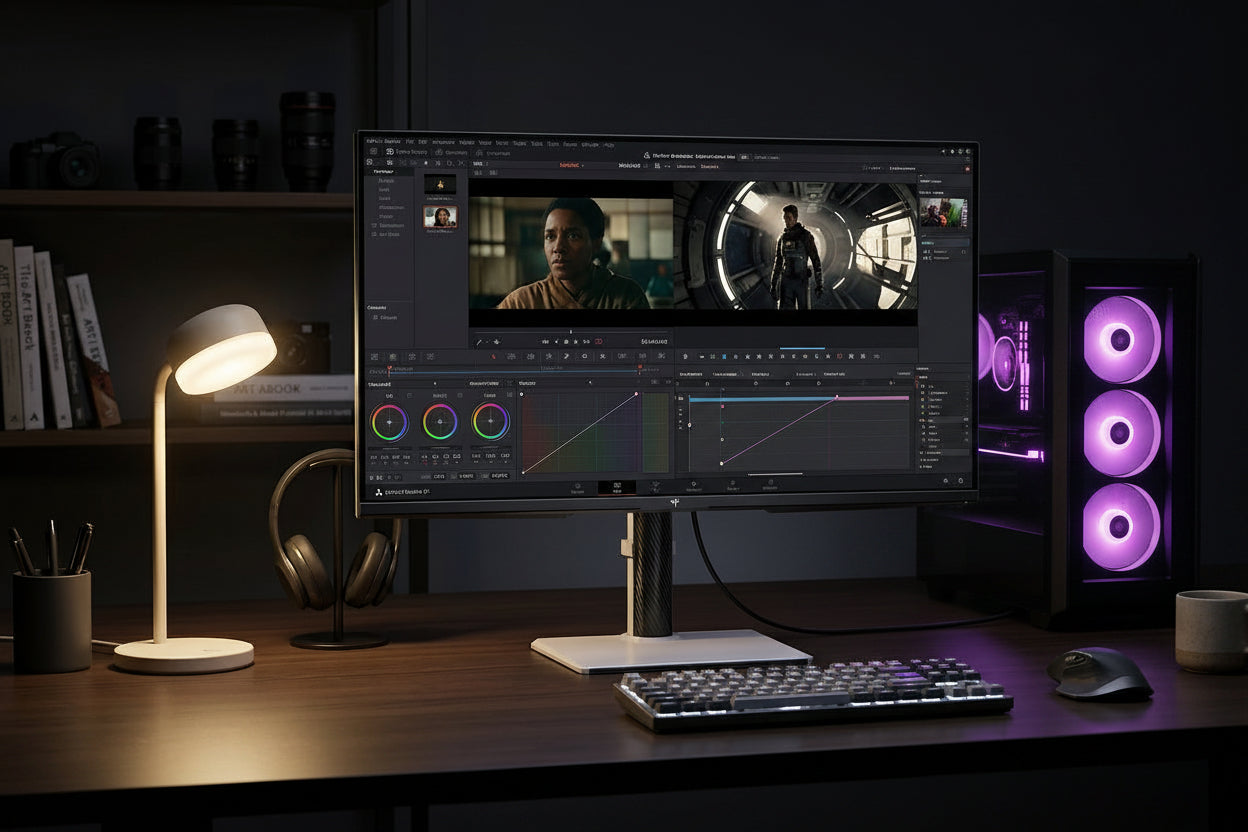
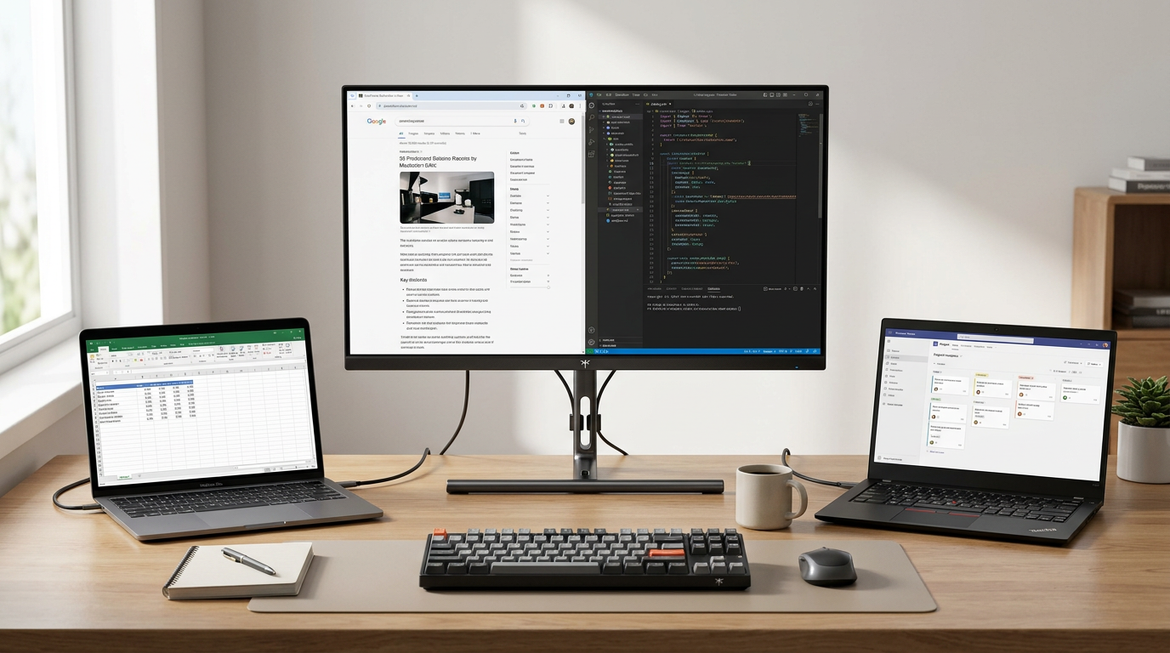
Mini-LED bright room monitor performance depends more on placement, coating, sustained brightness, and local-dimming tuning than on the headline HDR number alone. If your desk sits near a window or under overhead lights, those setup details usually decide whether the screen feels clear or washed out.

Why Bright Rooms Expose Monitor Weaknesses
In a sunlit office, the biggest problem is often not the panel itself but the room around it. Bright ambient light lowers perceived contrast, so dark text, shadow detail, and UI borders look flatter than they do in a dim room. A monitor that looks great at night can feel much less punchy once daylight hits the desk.
Reflections matter just as much. As RTINGS explains in its reflection testing, anti-glare coatings can cut mirror-like reflections from windows and overhead lights, but they may slightly soften the crispness you notice on glossy screens. That is why a Mini-LED bright room monitor still needs a smart desk angle and good coating, not just a high spec sheet.
A useful decision sentence is this: if glare is your main issue, improve placement and coating first; if the room is controlled, you can care more about HDR behavior and zone count. Another boundary is simple: if your room stays bright all day, a monitor with strong peak output usually has an easier job staying legible than one that only looks impressive in a dark room.
If you want a broader explainer on the room problem, Mini LED Monitors for Bright Room Offices is the most relevant follow-up.
Mini-LED Specs That Matter Most
For bright-room use, the first spec to check is sustained SDR brightness, not just HDR peak brightness. Peak HDR matters for highlights, but everyday work happens in SDR most of the time. In plain terms, if you read documents for hours, the screen has to stay readable in normal mode, not just burst brighter for short scenes.
Mini-LED also helps because it can keep highlights punchy while preserving stronger overall brightness. A study comparing display behavior in high ambient light notes that Mini-LED panels can sustain higher peak brightness than typical OLED panels, which helps maintain legibility when the room is bright. That does not make Mini-LED automatically better in every room, but it does explain why daylight-heavy desks often lean this way.
Peak Brightness and Sustained SDR Output
A monitor can advertise a very high HDR figure and still feel merely average during a long workday. That is why sustained SDR output matters more for spreadsheets, browser windows, and documents. A good rule is to treat SDR brightness as the daily-use number and HDR brightness as the special-mode number.
For most buyers, the right question is not "How bright can it get for a moment?" but "Can I keep it readable without running everything at max?" If your answer is no, the room or the coating is the bigger bottleneck than the refresh rate.
Anti-Glare Coating and Reflections
Anti-glare coating is worth paying attention to because it attacks the most annoying bright-room problem: direct reflections. On the other hand, heavier matte treatment can make fine text feel a little less sharp than a glossy panel in controlled lighting. That tradeoff is usually acceptable in a bright office, but it is worth knowing about before you compare samples.
This is the simplest filter: if you work near a window, prioritize glare reduction over the last bit of perceived crispness. If your room is dim or you mostly game at night, the balance can shift back toward image polish.
Local Dimming Zone Count and Blooming Control
More local dimming zones can improve HDR contrast, but they also make the monitor more sensitive around small UI elements. On desktop backgrounds, aggressive dimming can create halos or blooming around white text, taskbar icons, and small bright windows. That does not mean local dimming is bad; it means the setting can be too aggressive for office work. Local dimming improves contrast for HDR content but can produce visible blooming or halos around bright elements on desktop (testufo local dimming test).
A practical rule is to start with stronger dimming for HDR content, then reduce it if small UI elements look fuzzy or glow too much on light backgrounds. If you constantly switch between documents and games, the best setting is often a compromise rather than the most dramatic HDR mode.
For background reading on that tradeoff, What "Local Dimming Zones" Mean in Monitor Backlight Technology explains why zone count changes HDR behavior, and Can a Monitor Without Full-Array Local Dimming Deliver True HDR is useful if you are comparing non-mini-LED options.
Stand Adjustability and Desk Placement
Stand movement is not glamorous, but it changes bright-room usability fast. Height, tilt, swivel, and pivot let you move the screen out of direct reflection paths and line it up with your eye level. Even a strong panel will feel worse if it is aimed straight at a window.
If you can adjust the screen enough to change the angle of reflection, you often get a bigger improvement than from chasing a slightly brighter spec. For daytime desks, ergonomic range is a real image-quality feature.
Mini-LED Versus OLED in Daylight
In bright rooms, Mini-LED usually has the easier job. The reason is simple: higher brightness helps the image stand up against ambient light, while OLED often looks its best when the room is more controlled. That does not make OLED a poor display technology, but it changes the fit.
| Room condition | Mini-LED fit | OLED fit | Likely better choice | Why it flips |
|---|---|---|---|---|
| Bright window-side desk | Strong | More dependent on control of reflections | Mini-LED | Higher brightness and better daylight legibility usually matter more than perfect black levels |
| Mixed daylight and overhead light | Strong | Good if reflections are controlled | Mini-LED | Mini-LED gives more margin when lighting changes through the day |
| Dim office or evening use | Good | Strong | OLED | Controlled lighting lets OLED's contrast advantages show more clearly |
| Static UI for long work sessions | Strong | More conditional | Mini-LED | Mini-LED avoids the OLED burn-in concern that some buyers want to avoid |
A good decision sentence here is: if your room is bright for most of the day, Mini-LED is often the safer default; if you keep the room dim and want the blackest possible dark scene performance, OLED becomes more attractive. Another boundary is that you should not judge either panel from a dark-room demo if your actual desk faces a window.
If you are still comparing categories, 4K Monitor collection and Gaming Monitor collection are useful browsing paths, but the room itself should decide the panel class first.
Settings for Readability and HDR Balance
Start with readability, then tune HDR. That order matters because a bright-room monitor that looks dramatic in HDR but awkward on the desktop will annoy you every day. The settings below are about reducing friction, not chasing the most dramatic demo mode.
- Set the monitor in SDR first and raise brightness until text is comfortable at your actual desk lighting.
- Move the screen angle before you touch more advanced settings, because glare can hide more detail than brightness can recover.
- Reduce local dimming if white windows or taskbar elements glow too much.
- Turn on HDR only for HDR games or video, then compare it with SDR on your own desk.
- Avoid oversharpening and harsh color presets if text starts to feel tiring in strong light.
The biggest mistake is testing in a dark room and assuming the same settings will work next to a window. Re-test after every change with your real daylight, overhead lighting, and normal apps open. That is the fastest way to avoid a bright spec sheet with disappointing daily use.
If you want a model-specific example, How Mini LED Backlighting Works in LCD Monitors and What It Means for Gaming Image Quality is the right background article.
Model Fit for Different Bright-Room Buyers
If you want the most premium mixed-use option, the KTC Mini LED 27" 4K 160Hz HDR1400 Gaming Monitor | M27P6 is the most complete fit in this lineup. Its 600 nits SDR brightness, HDR1400 peak brightness, 1,152 local dimming zones, and full ergonomic stand make it the strongest match for a bright desk that also needs sharp 4K work.
If you want a lower-cost Mini-LED setup for a bright office, the KTC Mini LED 27" 180Hz 2K HDR1400 Gaming Monitor | M27T6 gives you 1440p, HDR1400, 400 nits SDR brightness, and the same full stand range. That makes it a more value-focused pick when you want Mini-LED contrast without paying for 4K.
If you care more about speed and color coverage than HDR peak height, the KTC Mini LED 27" 200Hz 2K HDR1000 Gaming Monitor | M27T6S is a practical middle ground. It has 450 nits SDR brightness, HDR1000, 200Hz refresh, and full ergonomics, so it suits users who split time between work and gaming in a bright room.
The simple filter is this: choose the M27P6 when 4K clarity and strongest bright-room headroom matter most, choose the M27T6 when value matters most, and choose the M27T6S when you want 1440p speed with a little more color breadth. If you are only using the screen for basic office tasks in moderate light, a non-Mini-LED office monitor may be the cheaper and less complex fit.
For browsing the whole category, All-Mini-LED Monitors is the cleanest starting point.
Final Bright-Room Setup Check
Check placement and stand range before brightness numbers. If the screen avoids direct window reflections, the stand can tilt or swivel enough to change the angle, and SDR brightness stays comfortable under daylight, a Mini-LED bright room monitor becomes far easier to use daily. When the room stays dim and dark-scene contrast is the priority, OLED remains worth considering instead. Match the panel to the actual desk lighting rather than the spec sheet.

FAQs
Q1. How Do I Reduce Glare on a Mini-LED Monitor Near a Window?
Start with placement and angle, not settings. Move the panel so the window is not directly behind your line of sight, tilt it away from the reflection path, and use blinds or curtains if you can. A matte coating helps, but no coating fully cancels a bad angle.
Q2. What Brightness Level Is Enough for a Sunny Home Office?
There is no single universal number because room light, screen size, and coating all change the result. In practice, you want enough SDR brightness that text stays readable without maxing out the panel all day. If you still see washed-out contrast, the reflection problem is bigger than the raw brightness number.
Q3. Can Mini-LED Work Well for Both Office Tasks and HDR Gaming?
Yes, but it usually works best if you treat SDR and HDR as separate modes. Use SDR for documents and spreadsheets, then switch to HDR for games or video that benefit from it. If you leave HDR on all day and dislike the desktop look, the monitor may still be good, but the setup is not ideal.
Q4. Why Does Local Dimming Sometimes Make Desktop Text Look Odd?
Local dimming can brighten or darken small zones around text and icons, which may create halos or a slight glow. That effect is more visible on white backgrounds and in mixed desktop use. If it bothers you, reduce the dimming strength for work and reserve the stronger setting for media.
Q5. How Do I Choose Between Mini-LED and OLED for a Bright Room?
Use the room first, then the panel. If your desk is near a window or under strong overhead light, Mini-LED is usually easier to live with because it has more brightness headroom. If your room is controlled and you care most about dark-scene contrast, OLED can be the more satisfying choice.