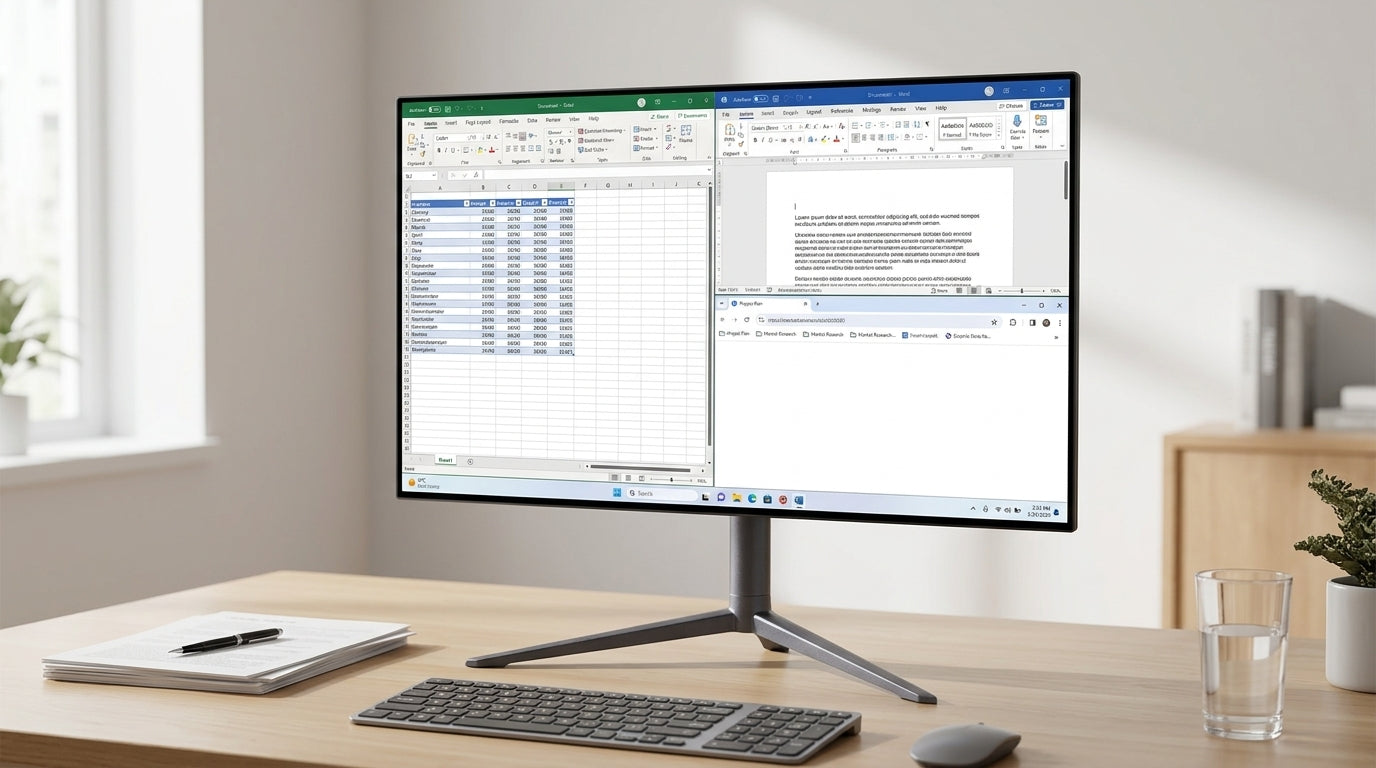
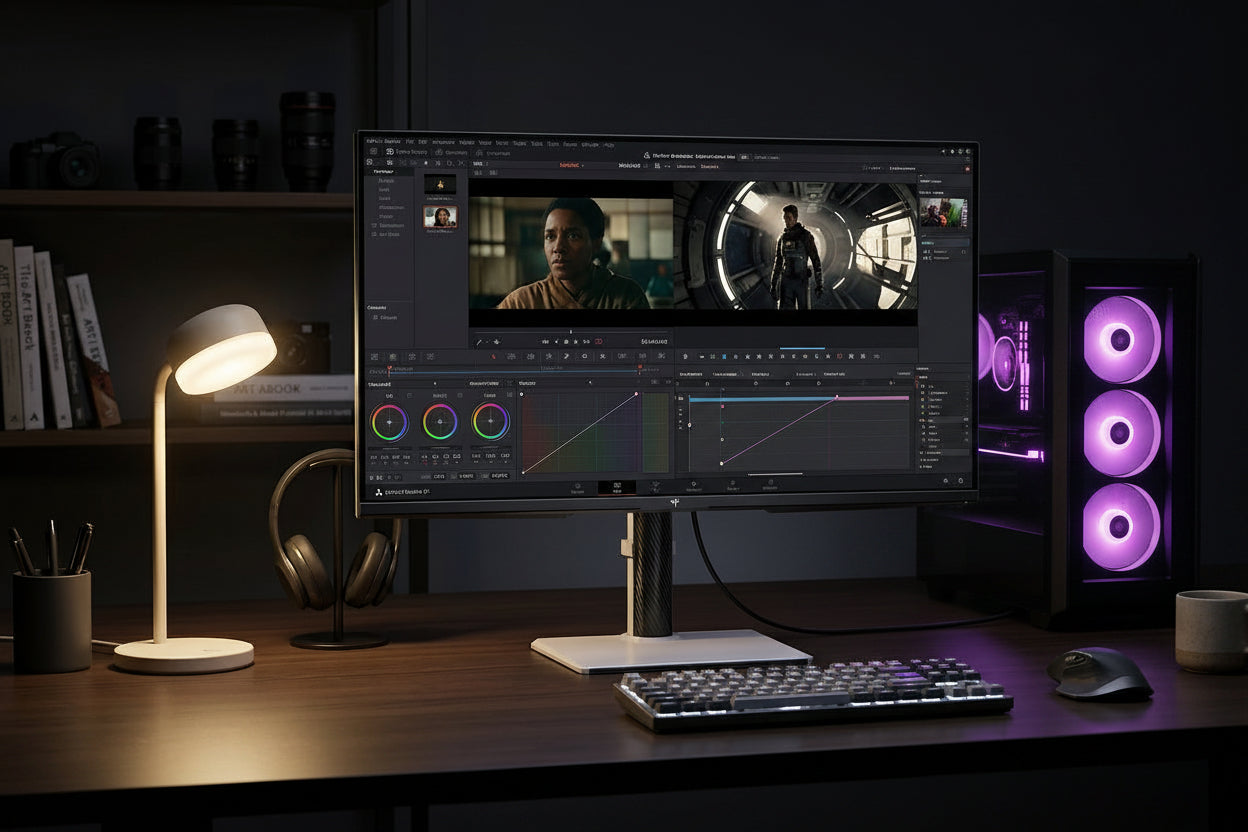
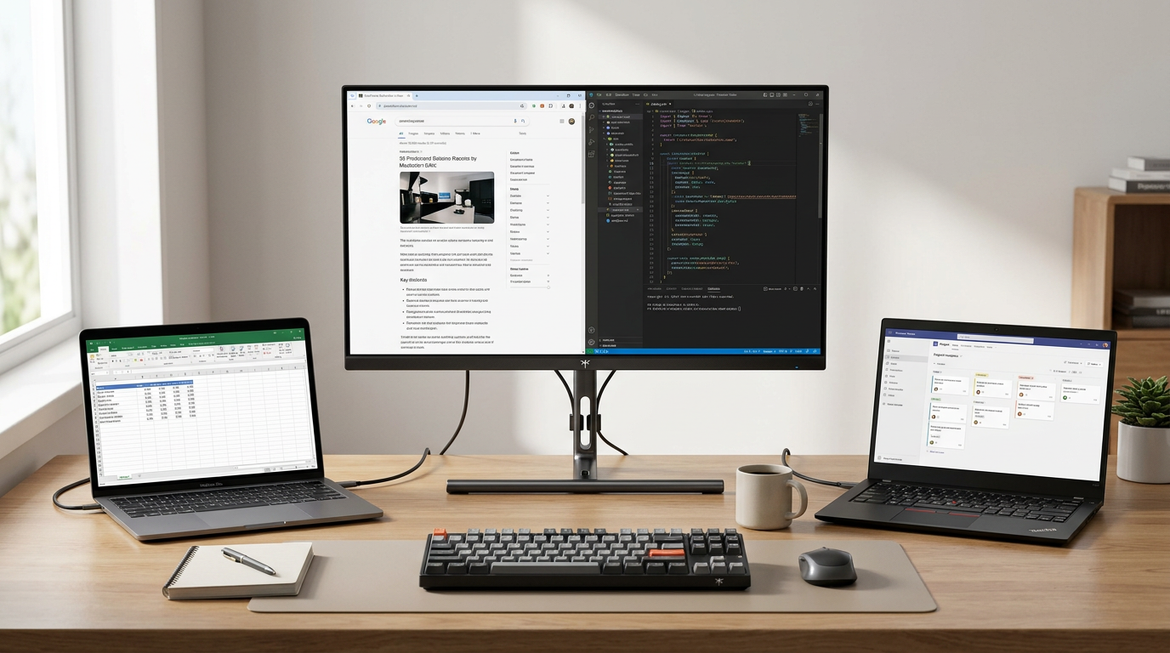
A mini led monitor bright room office setup works best when you care more about readable SDR and stable contrast than about the cheapest possible panel. In a room with windows or strong overhead lighting, ambient light can lift the screen's black level and make a monitor look flatter even if the spec sheet has not changed. The practical question is not just how bright the panel is on paper, but whether it stays legible through a full workday.

Why Bright Rooms Make Monitor Specs Harder to Read
In real offices, the light in the room changes what your eyes think the screen is doing. OSHA notes that ambient light can raise the effective black level of a display, which makes contrast look weaker even when the panel itself is unchanged. That is why a monitor that seems fine in a dim room can feel washed out next to a window or under ceiling panels. For a quick background refresher, see this guide on peak brightness and contrast perception.
Typical office lighting often lands around 300 to 500 lux in published research, and higher room light makes reflections and low black levels more obvious. In plain terms, lux is just how much light reaches a surface. The higher the room light, the less forgiving the monitor becomes. That matters most for SDR work, where the screen spends most of its time showing documents, browsers, and app interfaces rather than dramatic HDR scenes.
A good decision sentence here is simple: if your desk faces a bright window or strong overhead light, prioritize a monitor that keeps contrast usable under real room light rather than one that only looks impressive in a dark demo.
Brightness Metrics That Matter Most
For a mini led monitor bright room office buyer, the important numbers are peak brightness, SDR brightness, local dimming zones, and anti-glare treatment. Peak brightness is the short burst of light a screen can reach for HDR highlights. Sustained SDR brightness is what matters most when you are staring at spreadsheets for eight hours. VESA DisplayHDR definitions offer helpful context for brightness claims.

Local dimming zones matter because they let a monitor brighten small parts of the image without lifting the whole screen as much. That can help keep dark areas from turning gray when a bright window, white spreadsheet cell, or taskbar sits on the same screen. For a deeper explainer, see what local dimming zones mean in monitor backlight technology.
Anti-glare finish and screen angle matter just as much as raw brightness in many offices. NIST's work on daylight readability shows why reflections can undo a spec advantage fast. If your desk points toward a window, a matte finish and enough tilt or swivel are often the difference between "bright enough" and "still annoying."
Mini-LED Versus Standard LCD for Office Use
Mini-LED usually gives you better local contrast control than a conventional edge-lit LCD when bright and dark content overlap. That does not mean every office needs Mini-LED. It does mean bright-room buyers are more likely to notice the difference in mixed-light environments, especially when they move between white documents, dark UI themes, and occasional HDR video.
| Factor | Mini-LED | Standard LCD |
|---|---|---|
| Bright-room contrast | Usually holds up better | More likely to look washed out |
| HDR highlight handling | Stronger if zones and brightness are good | Limited by backlight design |
| SDR productivity | Good when brightness is sustained | Often fine in moderate light |
| Reflection tolerance | Depends on coating and setup | Also depends on coating and setup |
| Value for basic office work | Usually higher cost | Often better value |
A standard LCD can still be the right choice if your office is only moderately bright and your work is mostly text, email, and documents. Mini-LED becomes more attractive when ambient light is strong enough that you keep changing brightness or closing blinds just to keep the screen readable. If you want a side note on the setup trade-off, the relationship between brightness and perceived contrast is the right lens.
Office Workflows That Benefit Most
Mini-LED helps most when the room light is part of the work problem, not just the background.
- Spreadsheets and dashboards stay easier to read when the screen does not flatten under overhead lighting.
- Video calls feel less distracting when your own interface elements do not fade every time the sun shifts.
- Mixed days with documents, browsers, and a few HDR clips are easier when you do not need to keep adjusting brightness.
- Long work sessions are less frustrating when you can leave the monitor in one usable setting instead of tuning it every few hours.
This is also where a room-specific check matters. If you can work all day with blinds open and still read small UI text at a comfortable brightness, Mini-LED is more likely to pay off. If your room is already controlled and dim enough, the extra cost may not change your daily experience much.
For the video-call angle, KTC's washout troubleshooting note is a practical reminder that office lighting can make a good-looking display feel worse than expected.
How to Choose the Right Mini-LED Model
Start with the room, then the panel, then the ergonomics. That order matters because a monitor that looks great in a spec comparison can still be annoying if it sits in the wrong light or at the wrong height. Here is a simple decision path for a mini led monitor bright room office setup:
- Check the room layout first. Note whether the desk faces a window, sits under direct ceiling light, or changes light through the day.
- Match size and resolution to your viewing distance. Sharp text matters more than flashy HDR if you read all day.
- Compare peak luminance, zone count, and anti-glare treatment before you care about gaming extras.
- Check stand adjustment next. Tilt, swivel, and height let you move the screen away from reflections.
- Verify ports and USB-C only after the display itself is a fit.
The three KTC Mini-LED options line up well with those priorities. The KTC Mini LED 27" 4K 160Hz HDR1400 Gaming Monitor | M27P6 is the premium option for buyers who want the strongest brightness headroom and the sharpest desktop picture. The KTC Mini LED 27" 200Hz 2K HDR1000 Gaming Monitor | M27T6S is the more balanced bright-room choice when you want strong office visibility without moving into 4K pricing. The KTC Mini LED 27" 180Hz 2K HDR1400 Gaming Monitor | M27T6 is the middle ground if you want Mini-LED contrast in a 1440p setup.
Which Bright-Room Setup Fits Your Desk
This is the most useful way to think about the choice: the room can flip the recommendation.
| Office condition | Better fit | Why it tends to fit |
|---|---|---|
| Strong window light most of the day | M27P6 or M27T6S | More brightness headroom helps preserve readability |
| Overhead lights with moderate window glare | M27T6S or M27T6 | A balanced 1440p setup can be easier to live with |
| Controlled room light and mostly documents | Office Monitor collection | Lower cost can make more sense than Mini-LED |
If your desk faces strong windows, start by looking at the All-Mini-LED Monitors collection. If your room is more controlled and you mainly want a work-first setup, the Office Monitor collection is the better browsing path. For 4K options that also handle bright rooms, browse the 4K Monitor collection. That is the main split: Mini-LED is most persuasive when bright-room visibility is a real daily problem, not just a nice-to-have.
A direct takeaway: if you work in daylight-heavy conditions and hate constant brightness changes, Mini-LED is the safer room-tolerant choice; if your room is only moderately bright, a standard office monitor may still be the smarter value.
Bright-Room Monitor Checklist
Before you buy any bright-room monitor, verify these five things:
- Peak brightness is high enough for your actual room light, not just a spec comparison.
- The screen has a matte or anti-glare finish.
- The stand can tilt or swivel away from direct reflections.
- The size and resolution match how far you sit from the panel.
- The return window, warranty, and shipping timing are comfortable for an unseen purchase.
If you are comparing options in one sitting, start with the room, then check the panel, then check the stand. That sequence keeps you from overpaying for brightness you cannot really use. It also helps you avoid a common mistake: buying for HDR marketing first and office comfort second.
Quick Setup Checks
- Measure desk-to-window angle before final placement.
- Test anti-glare coating under your actual overhead lights.
- Confirm sustained SDR brightness at 50-60% setting for an eight-hour day.
FAQs
Q1. How Many Nits Do I Need for a Bright Office?
There is no single number that works for every desk, because window direction, screen coating, and how close you sit to the panel all change the result. In practical terms, a higher nit rating helps, but the useful question is whether the monitor still looks readable at your normal brightness setting without reflections taking over.
Q2. Can Mini-LED Reduce Washed-Out Text in Daylight?
Usually, yes, because Mini-LED can hold contrast better than many standard edge-lit LCDs when the room gets brighter. The improvement is most noticeable on text-heavy screens with dark UI themes or mixed white and black content. Anti-glare treatment and monitor angle still decide a lot of the real-world result.
Q3. Why Does HDR Look Better on a Bright-Room Monitor?
HDR needs enough brightness headroom to keep highlights visible when the room itself is already bright. If the monitor is too dim, daylight can flatten the image and make HDR look ordinary. Strong zone control helps too, because it keeps bright highlights from lifting the whole screen.
Q4. Can I Use a Mini-LED Monitor for 8-Hour Workdays?
Yes, if the stand adjustment is good, the screen stays comfortable at a stable brightness, and the finish does not fight your room lighting. Mini-LED is not only for media or gaming. It can work well for long office days when your desk setup supports it and the screen is not forcing constant correction.
Q5. What Matters More on a Window-Facing Desk, Brightness or Anti-Glare?
Both matter, but anti-glare and placement often decide whether the brightness rating is actually usable. A bright panel still looks bad if it reflects a window directly. In most window-facing setups, the first fix is angle and surface treatment, then brightness.
Bright-Room Office Pick, Kept Simple
For a mini led monitor bright room office setup, Mini-LED makes the most sense when daylight or overhead lighting is a daily nuisance. Choose for sustained visibility, anti-glare behavior, and stand flexibility first. If your room is only moderately lit, a standard office monitor can still be the better value for pure work.
Related Resources
- 2026 monitor buying checklist
- Mini-LED HDR Performance Tuning Guide
- Why Your Home Office Monitor Setup Works in Winter but Not Summer