


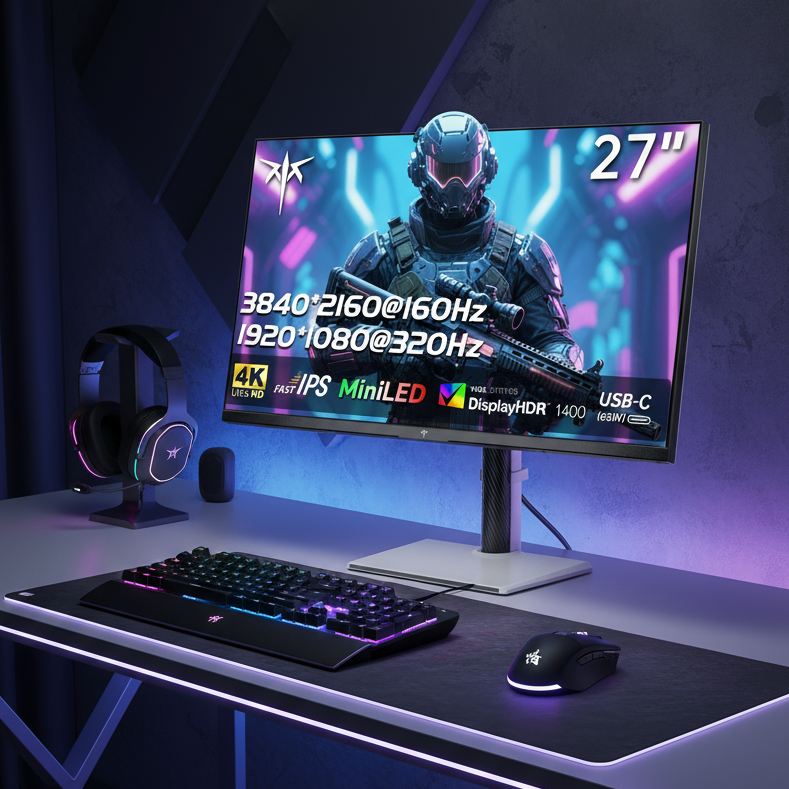
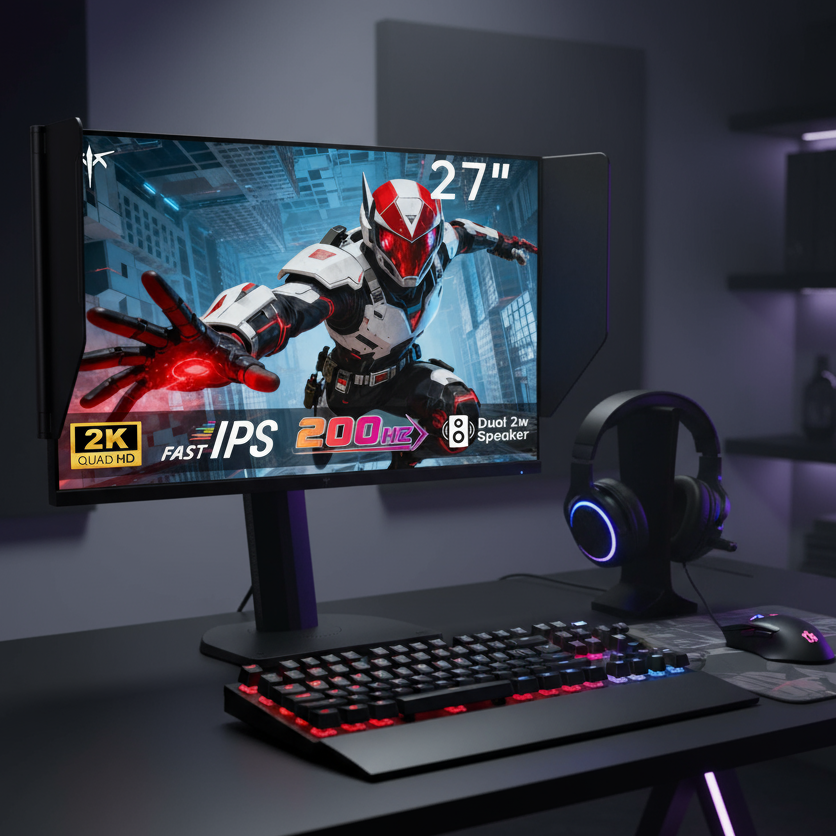
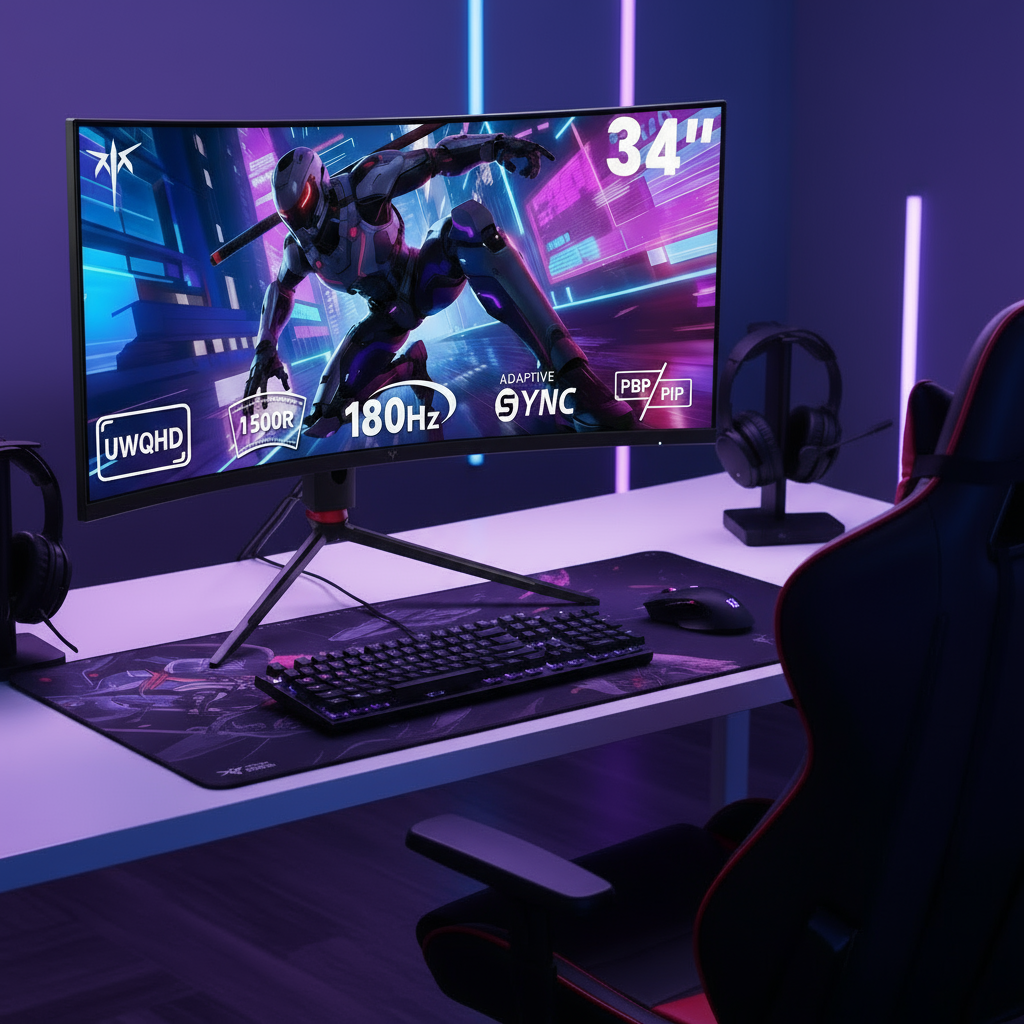


In 2026 the monitor market has moved past marketing numbers like HDR400 and raw GtG response times. Shoppers who want a future-proof display must now demand stricter standards such as VESA DisplayHDR 1.2 certification, ClearMR motion ratings, adequate local-dimming zones on Mini-LED models, and explicit burn-in coverage on OLED panels. Meeting these ten non-negotiable specs helps you avoid regret whether you game competitively, work long hours, or mix both on the same screen.

The First Filter: Choosing Between OLED and Mini-LED in 2026
Your daily environment and work-to-play ratio should decide the panel type before you look at any other spec. OLED delivers perfect blacks and 0.03 ms response that feels instant in dark-room competitive play, yet it carries a real burn-in risk when static UI elements stay on screen for eight or more hours each day. Mini-LED with 1,000-plus local dimming zones handles bright rooms far better and avoids image retention, making it the safer choice for hybrid users who also edit documents or code.
The $600–$700 price boundary often flips the value equation. Below this level a well-implemented Mini-LED usually offers more longevity and brightness for the money. Above it, OLED becomes attractive if your room stays dim and your usage is mostly gaming. Room lighting matters: in bright conditions OLED can look washed out while Mini-LED maintains contrast. Text clarity on OLED can suffer from its subpixel layout compared with sharp IPS-based Mini-LED panels.
The chart below visualizes these trade-offs using tiered fit scores derived from typical usage patterns and VESA guidance.
OLED vs Mini-LED: Room Light and HDR Fit
A tiered comparison of when each panel type is the safer fit, with HDR certification as a separate quality floor.
View chart data
| Category | OLED fit | Mini-LED fit |
|---|---|---|
| Dark room / low ambient light | 3.0 | 1.0 |
| Mixed light / daytime use | 2.0 | 2.0 |
| Bright room / glare | 1.0 | 3.0 |
| Static PC hours | 2.0 | 3.0 |
| HDR floor: DisplayHDR 400 | 3.0 | 1.0 |
| HDR floor: DisplayHDR 600 | 2.0 | 2.0 |
| HDR floor: DisplayHDR 1000+ | 1.0 | 3.0 |
Do not choose OLED for heavy static productivity without accepting the maintenance routines and potential warranty limitations on refurbished units. Conversely, avoid VA-based Mini-LED panels for fast-paced competitive titles where black smearing can appear despite high zone counts.

The New HDR Standard: Why VESA DisplayHDR 1.2 is Non-Negotiable
HDR400 certification no longer qualifies as meaningful high dynamic range. It often relies on global dimming that turns dark scenes into a uniform cloudy gray instead of delivering true contrast. As the official VESA DisplayHDR 1.2 specification explains, the updated standard tightens requirements for luminance, color volume, and bit depth so that colors stay saturated even at higher brightness levels.
For Mini-LED panels, 1,000 or more local dimming zones have become the industry-recommended minimum on 27- to 32-inch screens to control blooming effectively. This local dimming guide shows why fewer zones create visible halos around bright objects in dark scenes. Hybrid users also need at least 95 % DCI-P3 coverage so that HDR content mastered for cinema looks accurate rather than washed out.
Demanding VESA DisplayHDR 1.2 (or True Black variants) moves the baseline from marketing labels to measurable performance. High-end HDR400 OLEDs can still outperform low-end LCDs thanks to per-pixel lighting, yet the certification gap remains a reliable filter for most buyers.
Motion Clarity Beyond the Numbers: ClearMR and the 240Hz Sweet Spot
Raw response-time claims such as 1 ms GtG are often best-case laboratory figures that do not reflect real motion blur. VESA ClearMR certification measures the actual ratio of clear pixels to blurry ones during fast movement, making it a more trustworthy metric. The VESA ClearMR standard recommends tiers of ClearMR 13000 or higher for modern gaming monitors.
A 240 Hz refresh rate paired with an OLED panel frequently delivers better perceived motion clarity than a 540 Hz LCD because the near-instant pixel response of OLED reduces persistence blur. The jump from 240 Hz to 1000 Hz saves only about 3 ms of frame time—well inside normal human reaction time of roughly 150 ms and difficult to sustain with current GPUs in demanding titles. For most gamers 240 Hz sits at the perceptual sweet spot; higher rates mainly serve marketing and a small group of esports professionals.
Avoid chasing 1000 Hz unless your setup can maintain the required frame rates and you accept the premium cost. Focus instead on a panel that achieves high ClearMR scores while matching your resolution target.
Future-Proofing Your Desk: Connectivity, Bandwidth, and Longevity
DisplayPort 2.1 with UHBR 10 or 20 support removes the need for heavy compression when driving 4K at 240 Hz or higher. The DisplayPort 2.1 overview details how the bandwidth increase from 32.4 Gbps to as much as 80 Gbps protects image quality on next-generation GPUs. HDMI 2.1 at full 48 Gbps remains essential for console compatibility.
For laptop users, 90 W USB-C Power Delivery has become the practical minimum to charge modern gaming notebooks while carrying video and data over one cable, as confirmed by the USB Power Delivery specification. Look for monitors that also include KVM functionality with proper EDID emulation; budget switches without it often scramble Windows desktop settings when you change inputs.
On OLED models, insist on a three-year warranty that explicitly covers permanent image retention. This burn-in mitigation overview notes that manufacturers have standardized such coverage to give buyers confidence, yet refurbished units may lack the full term. Color accuracy should reach Delta E under 2 with 95 % DCI-P3 gamut so the same screen works for both gaming and light creative tasks.
The Final Shopper's Checklist: 10 Specs to Verify Before Checkout
Print or screenshot this list and check each item on the product page or in the manual before you buy:
- VESA DisplayHDR 1.2 certification (skip HDR400).
- 1,000+ local dimming zones on Mini-LED or true per-pixel control on OLED.
- VESA ClearMR 13000 or higher tier.
- 240 Hz refresh rate as the balanced performance target.
- DisplayPort 2.1 with UHBR 10/20 support.
- HDMI 2.1 with full 48 Gbps bandwidth.
- 90 W USB-C Power Delivery for laptop convenience.
- Delta E < 2 factory color accuracy.
- 95 % DCI-P3 gamut coverage.
- Three-year burn-in warranty that explicitly covers image retention.
Run through these ten points in order. If a monitor fails more than two, it is probably not future-proof for 2026 and beyond. Cross-reference the specs against your room lighting, daily usage hours, and GPU output before adding the item to your cart.
Frequently Asked Questions
Is HDR400 still worth considering in 2026?
Only if your budget is extremely tight and you accept SDR-like contrast. Most HDR400 panels use global dimming that fails to deliver the deep blacks and saturated highlights modern content expects. VESA DisplayHDR 1.2 or higher is the practical minimum for noticeable improvement.
How many local dimming zones does a good Mini-LED monitor need?
At least 1,000 zones on 27- to 32-inch models to keep blooming under control. Fewer zones often produce distracting halos around bright objects against dark backgrounds, reducing the HDR benefit.
Does 1000 Hz actually improve competitive gaming?
The extra refresh rate provides diminishing returns for all but the most elite players. Human reaction time far exceeds the tiny frame-time savings, and current GPUs rarely sustain the required frame rates in AAA games. A 240 Hz OLED with strong ClearMR performance is usually the better real-world choice.
Should I avoid OLED if I work eight hours a day on the same screen?
Yes, unless you use pixel-cleaning routines and accept some risk. Static content such as taskbars and spreadsheets stresses OLED far more than Mini-LED. For hybrid productivity-plus-gaming use, high-zone Mini-LED is generally safer and brighter in typical offices.
Is a 3-year burn-in warranty enough protection?
It has become the industry standard and offers meaningful coverage, yet it does not eliminate all risk. Check that the warranty explicitly lists image retention and confirm whether refurbished units carry the full term before purchase.
Do I need DisplayPort 2.1 if my GPU is only a few years old?
If you plan to stay at 1440p or lower and 144–165 Hz, DisplayPort 1.4 may still suffice. For 4K at 240 Hz or future GPU upgrades, DP 2.1 prevents compression artifacts and ensures headroom.
What is the best monitor type under $600 in 2026?
A Mini-LED IPS with at least 1,000 zones, VESA DisplayHDR 1.2, and 240 Hz typically delivers the strongest value. OLED becomes competitive only when your room is dark and your usage is almost entirely gaming.


