MacBook users usually run into three problems: the monitor charges too slowly, text looks softer than expected after scaling, or the desk gets cluttered with extra docks and cables. The best monitor for MacBook use keeps USB-C simple, handles macOS scaling cleanly, and avoids extra hardware friction.
If your MacBook is your main work machine, start with the connection path before you think about panel extras. Apple notes that MacBook USB-C and Thunderbolt ports can handle video, charging, and data, but the exact behavior depends on the model and port, so the same monitor can feel effortless on one Mac and frustrating on another. For most buyers, that means the first question is not "How good is the panel?" It is "Will this monitor actually handle my MacBook the way I want it to?" Apple's USB-C and Thunderbolt guidance is the right place to confirm that starting point. MacBooks can also charge via USB-C power delivery from compatible displays, provided the wattage meets the model's needs.
Why MacBook Monitors Feel Easier or Harder to Use
A monitor feels "Mac-friendly" when it reduces friction instead of creating new issues. In real use, the main pain points are weak charging, fuzzy text after scaling, and a setup that needs a hub on top of the monitor. That is why a monitor for MacBook should be judged by workflow fit first, not by refresh rate or gaming branding.
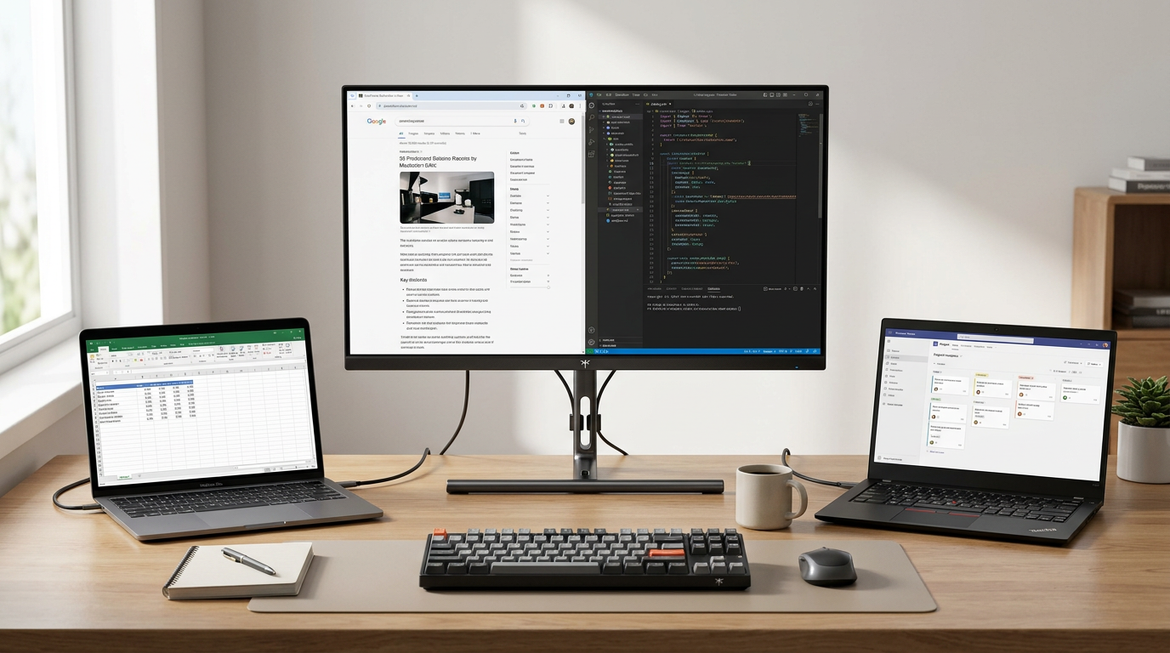
One useful rule is this: if you want one cable and a closed-lid desk, the monitor has to carry video, charging, and USB in a way your MacBook model actually supports. If you only need external display output and you already use a dock, the monitor can be simpler. The convenience gap is real, but it only matters if you are trying to replace extra hardware with the display itself.
Best Monitor for MacBook Pro: USB-C, Color, and Text Clarity is a useful follow-up if you want a broader buying lens beyond KTC options.
What Sharp Text and Scaling Look Like on macOS
For most MacBook users, text clarity matters before color extras do. Apple's external display scaling options let macOS present scaled resolutions, and that often makes a 4K screen feel easier to read than a lower-resolution panel that looks fine on paper but soft on the desk.

What this means in practice is simple: a 4K display is often the safer middle ground, while 5K becomes more attractive if you spend a lot of time reading, editing, or writing all day. A sharper panel does not automatically solve everything, though. If the scaling mode feels awkward to your eyes, the advantage disappears fast, so the real test is how the interface looks after a normal work session, not just in spec sheets.
For creators, color accuracy is still worth checking, but only after text readability feels right. If you spend most of your day in code, docs, spreadsheets, or browser tabs, the screen that looks clean and stable at arm's length is usually the better purchase, even if it is not the most exciting one.
Which USB-C and KVM Features Matter Most
A USB-C monitor for MacBook is most valuable when it removes steps. The features that matter most are enough USB-C power delivery for your model, a confirmed video-over-USB-C path, and KVM or USB switching if you share the desk with a Windows PC. If any one of those is missing, the setup can still work, but it stops being a true one-cable desk.
Here is the quick filter:
| Decision Area | What To Check | When It Matters Most |
|---|---|---|
| USB-C power delivery | Make sure the wattage matches your MacBook model and workload | Closed-lid use, longer work sessions, or charging while docked |
| Video over USB-C | Confirm the monitor supports display input through the same cable | One-cable setup and simpler cable management |
| KVM / USB switching | Check that keyboard and mouse handoff is supported cleanly | Shared Mac and Windows desks |
| Downstream USB ports | Confirm ports are present and usable for peripherals | If you want the monitor to replace a hub |
A setup breaks down when it looks like a dock replacement but still requires extra adapters for basic use. If you are switching between Mac and Windows, KVM matters more than most marketing copy suggests, because peripheral handoff is where shared desks usually get annoying.
The USB-C and KVM Monitor Setup Guide for Hybrid Work and Gaming is a good internal walkthrough if you want the switching logic in more detail.
If you want a specific 4K option with stronger USB-C charging and KVM support, the KTC 27" 4K 160Hz/320Hz 90W Gaming Monitor | H27P6 is the model to check first. Its 90W USB-C power delivery, KVM support, and 4K class resolution line up well with the common MacBook desk problems this guide is trying to solve, especially when you want one cable and shared peripherals. It is less compelling if you do not need device switching or if you care more about text density than charging headroom.
A Practical Shortlist for MacBook Desks
The cleanest choice depends on which part of the MacBook experience matters most to you.
- Choose a 5K office-style monitor if your desk is text-first, your work is mostly reading or writing, and you want the cleanest-feeling macOS scaling experience.
- Choose a 4K USB-C monitor if you want a practical balance of clarity, one-cable convenience, and easier compatibility across different MacBook models.
- Choose a Mini-LED or higher-motion option if your desk leans more toward mixed use, HDR, or gaming and less toward pure text comfort.
That trade-off matters because the best monitor for a MacBook is not always the most premium display. If your real goal is a stable work dock, then a well-matched 4K screen can be the better buy than a sharper panel with features you will not notice every day.
For readers who want to compare the higher-end direction, the KTC 27" 5K@60Hz 2K@120Hz Home&Office Monitor | H27P3 is the more text-first option to review. Its 5K class resolution and 65W USB-C charging make sense when you care most about reading comfort and a cleaner-feeling desktop workflow. It is not the first pick if you need stronger charging headroom or routine Mac-and-PC switching.
If your setup is more mixed-use, the KTC Mini LED 27" 4K 160Hz HDR1400 Gaming Monitor | M27P6 is the better navigation point. It fits better when you care more about HDR and motion than about the highest text density.
Setup Checks Before You Buy
- Confirm your MacBook model's USB-C behavior, especially whether the port supports video output and the charging level you expect.
- Decide whether the desk will use one cable, a dock, or a KVM path, then pick the monitor around that real workflow.
- Check scaling and text size expectations on the size and resolution you are considering, because that is what you will notice every day.
- If you will switch between Mac and Windows, verify the upstream USB path and peripheral-sharing plan before ordering.
- Use the return window only after a real desk test, because readability and cable stability are much easier to judge in person than in a product listing.
4K & 5K High-Refresh Monitors is a sensible starting collection if you want to browse by resolution and refresh class instead of by individual model names.
For most MacBook users, the right monitor is the one that matches the way you actually work, not the one with the longest spec list. If you need one-cable docking and shared-device switching, prioritize USB-C power delivery and KVM support. If you mostly want crisp macOS text, prioritize scaling and pixel density first.
How Does macOS Scaling Change the Way a Monitor Looks?
macOS scaling can make the same display look much better or much worse depending on the chosen mode. The most useful test is simple: check whether text looks clean at your normal sitting distance after a full work session, not just right after you plug it in.
What USB-C Port Behavior Should I Confirm on My MacBook?
Confirm three things: video output, charging support, and whether the cable or dock chain changes behavior. This matters because a monitor can be technically compatible but still feel underpowered if the full path is not right.
Can a MacBook and Windows PC Share One Monitor Cleanly?
Yes, but only if the monitor's USB switching and upstream connection are set up correctly. The practical test is whether your keyboard and mouse move to the other machine without extra unplugging or surprise resets.
Why Does a MacBook Sometimes Need a Higher-Pixel-Density Display?
Higher pixel density often makes interface elements look cleaner on macOS, which is helpful if you spend long stretches reading or editing. The benefit is most noticeable when you care about text comfort more than raw screen size.
Can One-Cable Docking Still Be Worth It If Charging Is Not Maxed Out?
Usually, yes. If the cable cleanup and easier desk swaps matter, a slightly lower charge rate can still be a good trade, as long as it keeps up with your typical workload and battery habits.
FAQs
Q1. How Does macOS Scaling Change the Way a Monitor Looks?
macOS scaling can make the same display look much better or much worse depending on the chosen mode. The most useful test is simple: check whether text looks clean at your normal sitting distance after a full work session, not just right after you plug it in.
Q2. What USB-C Port Behavior Should I Confirm on My MacBook?
Confirm three things: video output, charging support, and whether the cable or dock chain changes behavior. This matters because a monitor can be technically compatible but still feel underpowered if the full path is not right.
Q3. Can a MacBook and Windows PC Share One Monitor Cleanly?
Yes, but only if the monitor's USB switching and upstream connection are set up correctly. The practical test is whether your keyboard and mouse move to the other machine without extra unplugging or surprise resets.
Q4. Why Does a MacBook Sometimes Need a Higher-Pixel-Density Display?
Higher pixel density often makes interface elements look cleaner on macOS, which is helpful if you spend long stretches reading or editing. The benefit is most noticeable when you care about text comfort more than raw screen size.
Q5. Can One-Cable Docking Still Be Worth It If Charging Is Not Maxed Out?
Usually, yes. If the cable cleanup and easier desk swaps matter, a slightly lower charge rate can still be a good trade, as long as it keeps up with your typical workload and battery habits.
Related Resources
For deeper dives into MacBook-specific connectivity and scaling, explore The Magic Inside the Cable: How DisplayPort Alternate Mode Transforms the MacBook USB-C Output and 4K vs 5K Monitor: Which Is Better for Mac and Windows?. These resources expand on cable behavior, resolution trade-offs, and real-world desk setups without repeating the checks already covered here.