For a dependable single-cable dual 4K setup, choose Thunderbolt 4. USB-C 3.2 can be enough only when each monitor has its own capable video path, or when your laptop, dock, cable, and operating system explicitly support the exact dual-display mode you want.
Is your second 4K monitor stuck at a fuzzy resolution, capped at 30 Hz, or not detected at all after you plug into a neat-looking USB-C hub? A Thunderbolt 4 setup gives you a testable benefit: dual 4K at 60 Hz from one certified port and dock is a defined capability, while USB-C 3.2 depends heavily on the device’s hidden display implementation. You’ll leave with a practical way to decide what to buy, what to keep, and what to avoid.
The Short Answer: Thunderbolt 4 Is the Reliable Pick for Dual 4K
If your goal is two 4K monitors from one laptop connection, Thunderbolt 4 is the cleaner, more reliable standard. It uses the USB-C connector, but it is not “just USB-C.” The important difference is that Thunderbolt 4 mandates consistent performance, including 40 Gbps bandwidth and support for two 4K displays or one 8K display.
USB-C 3.2 is different. It may use the same oval connector, but USB-C describes the port shape, not the full capability behind it. A USB-C 3.2 port can be excellent for storage, charging, keyboards, mice, and one monitor, yet still fail to drive two 4K screens from a single dock because USB 3.2 itself does not guarantee that display output.
In real desk setups, this is where users get burned. The cable fits. The dock lights up. The mouse works. Then one display runs at 4K while the other drops to 1080p, mirrors the first screen, or stays black. That is not bad luck; it is a standards mismatch.
USB-C, USB 3.2, USB4, and Thunderbolt 4 Are Not the Same Thing

USB-C is the physical connector. USB 3.2, USB4, and Thunderbolt 4 are protocols that may run through that connector. Treating them as interchangeable is the fastest way to overbuy the wrong cable or underbuy the wrong dock.
The key practical split is simple: USB-C can support many standards, including USB 2.0, USB 3.2, USB4, and Thunderbolt, depending on the hardware. That means a laptop listing “USB-C” in the specs tells you almost nothing until you also confirm video output, DisplayPort Alt Mode, bandwidth, and monitor count.
USB 3.2 tops out below Thunderbolt 4 in common display-dock use. A common comparison places USB 3.2 at 5 Gbps to 20 Gbps for data and lists its video support as one 4K monitor, while Thunderbolt 4 is listed at 40 Gbps with two 4K monitors or one 8K monitor. For a productivity or gaming desk with dual 4K panels, that difference is not academic; it decides whether the setup behaves like a workstation or a troubleshooting project.

Connection Type |
Connector |
Typical Display Expectation |
Best Fit |
USB-C 3.2 |
USB-C |
Often one 4K display when video is supported |
Budget docks, peripherals, one-monitor desks |
USB4 |
USB-C |
Can support strong display output, but implementation varies |
Newer laptops where specs clearly confirm display support |
Thunderbolt 4 |
USB-C |
Dual 4K or single 8K is part of the baseline |
Single-cable dual 4K workstations |
HDMI or DisplayPort direct |
HDMI or DP |
Depends on port capability and GPU |
Reliable when using separate monitor cables |
When USB-C 3.2 Is Enough
USB-C 3.2 is enough if you are connecting only one 4K monitor, using a second monitor through a separate HDMI or DisplayPort output, or building a value-oriented office setup where 4K plus a lower-resolution secondary screen is acceptable. It can also work well when your laptop has two separate USB-C ports with independent video output, because each monitor gets its own path instead of fighting over one dock connection.
For example, a home office user with a 27-inch 4K main display over USB-C and a second 24-inch 1080p screen over HDMI does not need Thunderbolt 4 just to write reports, manage spreadsheets, and keep chat on the side. USB-C 3.2 is also a sensible choice for portable smart screens, because many portable displays are single-panel devices designed around one USB-C cable for power and video.
The catch is that “USB-C 3.2 with video” must be verified. Look for explicit wording such as DisplayPort Alt Mode, external display support, maximum resolution, and refresh rate. If the spec sheet says only “USB-C 3.2 Gen 2,” assume data first, not dual-display output.
When Thunderbolt 4 Is Worth Paying For

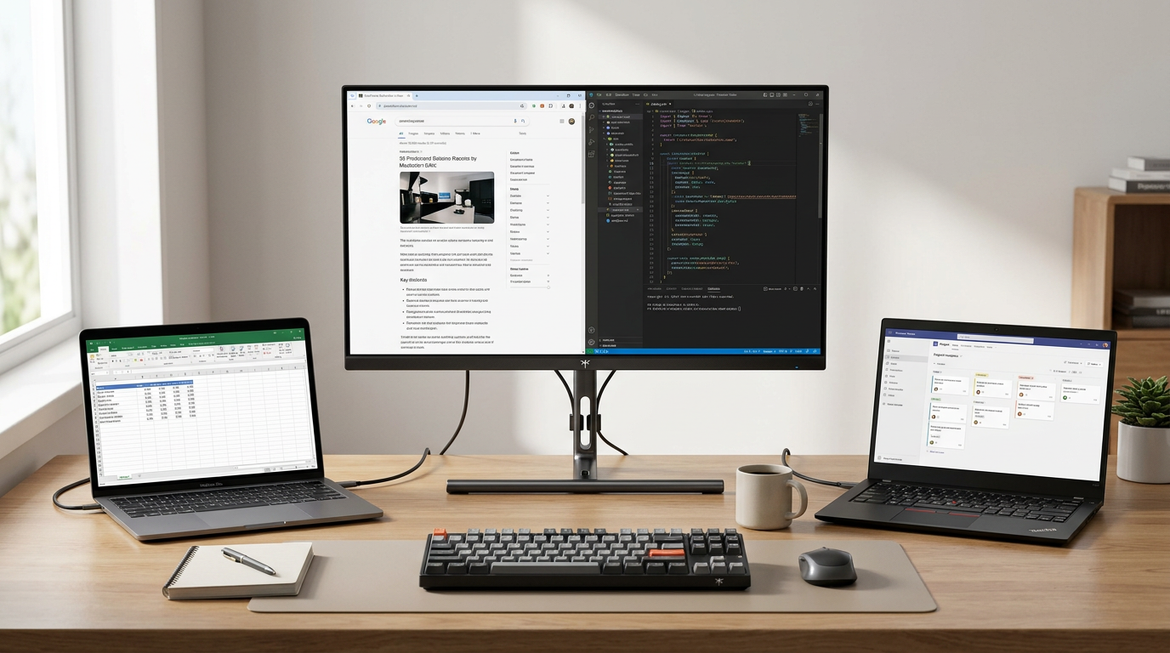
Thunderbolt 4 earns its premium when you want one cable from laptop to dock, two 4K monitors at 60 Hz, stable charging, fast storage, Ethernet, audio, and USB peripherals without juggling ports. For a focused trading desk, video editing bay, coding station, or hybrid gaming-and-productivity setup, that reliability is the value.
The strongest reason is guaranteed baseline behavior. Thunderbolt 4 supports dual 4K displays, 40 Gbps data transfer, stronger minimum power delivery than USB 3.2, and daisy-chaining. That matters when your workstation has a 4K primary monitor for color, a second 4K monitor for timelines or dashboards, and external storage attached to the same dock.
There is also a cable advantage. Thunderbolt 4-certified cables are built around more predictable performance, while generic USB-C cables may handle charging but not high-bandwidth video. If you have ever swapped three identical-looking cables before finding the one that unlocks full resolution, you already know why certification has practical value.
The Host Laptop Limit Still Matters
Thunderbolt 4 does not magically override your computer’s GPU or operating system limits. A manufacturer’s display support page makes the point clearly: the number of external displays depends on computer model, resolution, and refresh rate, and a hub or daisy chain does not increase the maximum number the computer can support.
That is a decision-critical nuance. A Thunderbolt 4 dock can be fully capable, but a base-model laptop may still support fewer external displays than a higher-end machine. On Windows laptops, the same idea applies through the GPU, USB-C controller, DisplayPort Alt Mode support, and dock chipset. Before buying the dock, check the laptop’s display-output table, not just the port shape.
A simple example: if your laptop officially supports only one external display, a dual-monitor Thunderbolt dock may connect cleanly and still give you one extended display. The dock is not broken; the host system is the limit.
Refresh Rate: Dual 4K at 60 Hz Is Different From Dual 4K Gaming

For office productivity, dual 4K at 60 Hz is usually the target. Text is sharp, pointer movement feels normal, and video calls or spreadsheets do not need esports-level refresh. Thunderbolt 4 is well matched to that use case.
For high-refresh gaming monitors, the decision changes. A pair of 4K 144 Hz displays is far more demanding than dual 4K 60 Hz. Thunderbolt 4 remains excellent for dual 4K at 60 Hz, while higher-refresh multi-display setups can hit bandwidth limits and may push you toward Thunderbolt 5-class hardware. If your primary screen is a 4K gaming monitor at 144 Hz or above, connect it directly through HDMI 2.1 or DisplayPort when possible, then use the dock for your productivity display and peripherals.
This is the performance-driven way to build the desk: protect the gaming monitor’s refresh path first, then optimize convenience around it.
Pros and Cons in Plain English
Choice |
Pros |
Cons |
USB-C 3.2 |
Lower cost, widely available, fine for one 4K monitor and everyday peripherals |
Dual 4K from one port is not guaranteed, specs are often vague, cable confusion is common |
Thunderbolt 4 |
Reliable dual 4K baseline, strong docking, fast storage support, cleaner single-cable desks |
Higher dock and cable cost, still limited by laptop display support |
Mixed direct cables |
Often best performance per dollar, especially for gaming |
More cables on the desk, less elegant laptop docking |
Buying Advice: Match the Port to the Workflow
Choose USB-C 3.2 if your desk is built around one 4K monitor, a portable smart screen, or two displays connected through separate confirmed video outputs. It is the value play when convenience matters but you are not asking one port to carry a full dual-4K workstation.
Choose Thunderbolt 4 if you want dual 4K from one cable and you do not want to decode every dock chipset and cable revision before each purchase. It is the reliable option for users who move a laptop between desk and bag, rely on external SSDs, or need a clean setup that works every morning.
Choose direct HDMI or DisplayPort for a high-refresh gaming monitor, then add Thunderbolt 4 for the rest of the desk if you also need a second 4K display and peripherals. That combination often gives the best immersive experience without wasting money on bandwidth you will not use.
FAQ
Can a USB-C 3.2 port run two 4K monitors?
Sometimes, but you should not assume it. USB-C 3.2 does not guarantee dual 4K display output, so the laptop, dock, cable, and display mode must all explicitly support it.
Is Thunderbolt 4 overkill for office work?
Not if you want two 4K monitors from one dock. It may be overkill for a single 4K monitor, but for a dual 4K office workstation, the reliability is often worth more than the price difference.
Does a Thunderbolt 4 cable fix a USB-C 3.2 port?
No. A better cable cannot add Thunderbolt capability to a non-Thunderbolt port. It may improve cable reliability, but the connection will fall back to what the host port supports.
Final Word
If dual 4K is central to your workflow, Thunderbolt 4 is the smart default: fewer compromises, fewer spec traps, and a cleaner path to a high-performance desk. USB-C 3.2 is still useful and cost-effective, but it belongs in setups where the display requirements are modest or clearly confirmed before you buy.