A small apartment gaming display should be chosen around desk depth, viewing distance, mounting safety, and whether the screen must also handle work, streaming, or console use. For most compact setups, a 27-inch 1440p high-refresh monitor or a carefully placed 34-inch ultrawide is easier to live with than an oversized screen that dominates the room.
Does your desk feel crowded before the keyboard, speakers, controller dock, and coffee cup even arrive? A setup can become more comfortable simply by matching the display to a 20- to 40-inch viewing distance, reducing stand footprint, and keeping cable paths short. The goal is to help you choose a gaming monitor, ultrawide, portable display, or compact TV-style option that fits the apartment instead of fighting it.
Start With the Room, Not the Monitor
Measure the working zone

Before comparing refresh rates or panel types, measure the real display zone: desk width, desk depth, wall clearance, seating distance, and the path your chair takes when you stand up. In a small apartment, a monitor is not just a screen; it is part of the furniture layout. A 48-inch-wide desk can technically hold a large display, but if the stand consumes the center of the surface, the keyboard and mouse may end up too close to your body.
Ergonomics should set the baseline. For a mixed work-and-gaming desk, the top of the screen should sit at or slightly below eye level, and a viewing distance of 20 to 40 inches is a practical target for comfort. That range matters in apartments because many desks are only 20 to 30 inches deep, so a bulky rear stand can push the panel closer than intended.
Decide what the screen must replace
A small-space display often has to serve several roles: gaming monitor, work screen, streaming screen, console display, and sometimes the apartment’s only large screen. If your desk doubles as a dining table or work area, prioritize one versatile monitor with good ergonomics, a modern single-cable connection, and enough refresh rate for your games rather than building a multi-screen setup that has to be moved every day.
A useful design test is simple: can you sit down, game for an hour, close the game, and use the same surface for work without moving three devices? If not, the display choice is probably too complex for the space. Small apartments reward fewer, better-positioned screens.
Choose the Right Display Format
Standard gaming monitor, ultrawide, portable, or TV-style setup
The best compact setup depends on what you play and how the room is used. A competitive player in a studio apartment usually benefits from a 24- to 27-inch high-refresh monitor because it keeps the whole image in view. A single-player or simulation gamer may prefer a 34-inch ultrawide because it adds immersion without requiring a second monitor.
Ultrawides can reduce desk clutter because one wide panel can replace two smaller screens, and a 21:9 ultrawide works best when you actually use side-by-side windows, notes, chats, or reference panes. The tradeoff is that long text lines become uncomfortable if you stretch a document across the full width, so the center third should stay reserved for the main task.
Display option |
Best small-apartment use |
Typical strengths |
Main space concern |
Practical recommendation |
24-inch gaming monitor |
Tight desks, competitive gaming |
Easy to fit, fast refresh, lower hardware demand |
Less immersive for cinematic games |
Choose 1080p or 1440p with a compact stand |
27-inch 1440p monitor |
One desk for work and gaming |
Strong balance of clarity, size, and speed |
Needs enough desk depth for comfort |
Best default choice for most apartments |
27-inch 4K high-refresh monitor |
Work-heavy gaming setup |
Sharp text, strong for creative work and gaming |
Requires stronger hardware for high frame rates |
Choose if your computer or console can drive it well |
34-inch ultrawide |
Immersive gaming plus productivity |
Replaces dual monitors, fewer cables |
Width and stand footprint |
Keep main content centered; avoid 40- to 49-inch models on shallow desks |
Portable monitor |
Flexible desk, travel, couch use |
Slim, easy to store, one-cable modern connector options |
Lower refresh rates and weak stands are common |
Use as a secondary screen, not the main competitive-gaming display |
32-inch TV-style display |
Console-first or budget setup |
Can serve gaming and media roles |
Input lag, desk distance, stand shape |
Check refresh rate, latency, and leg placement before buying |
When a portable monitor makes sense
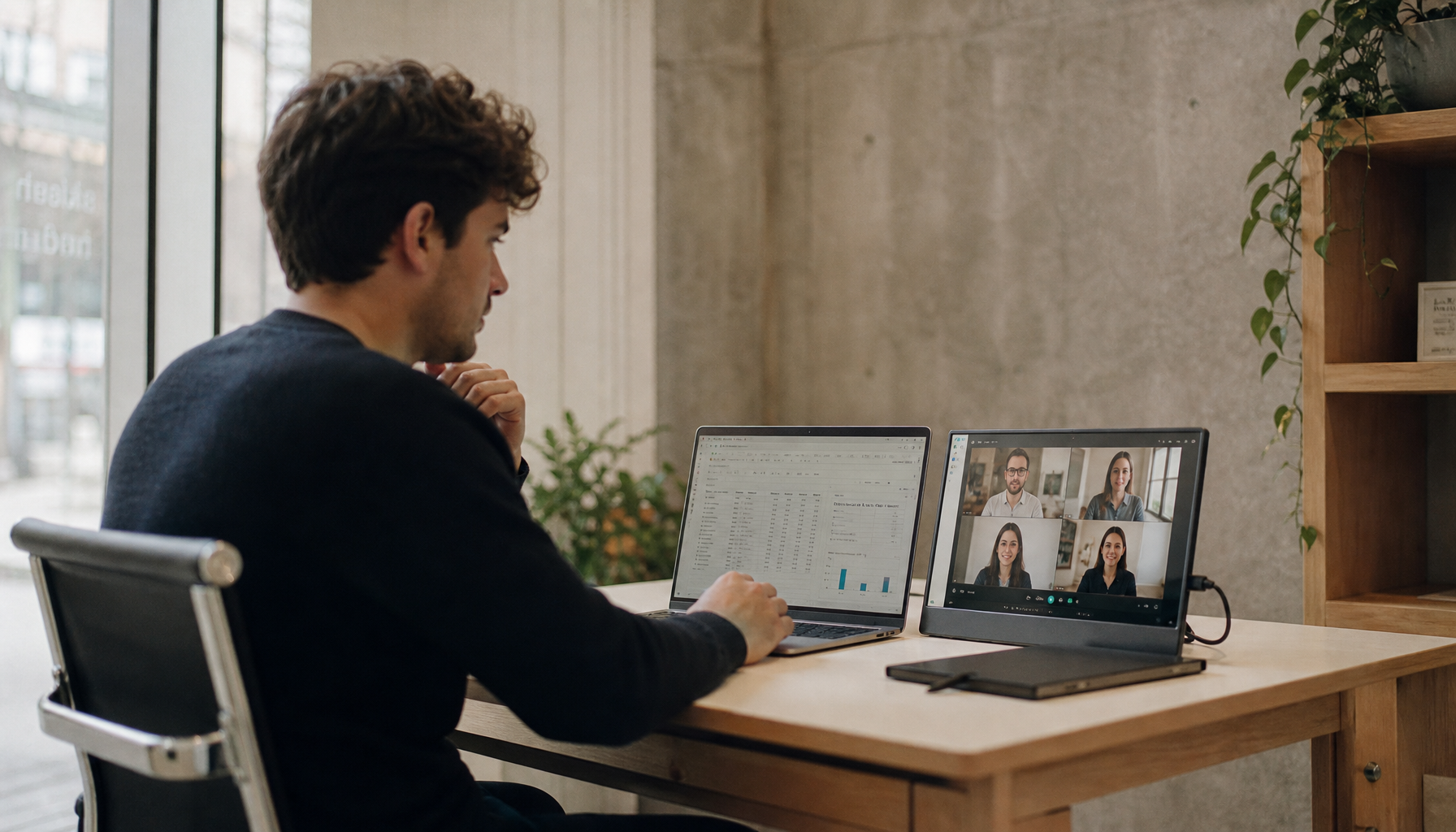
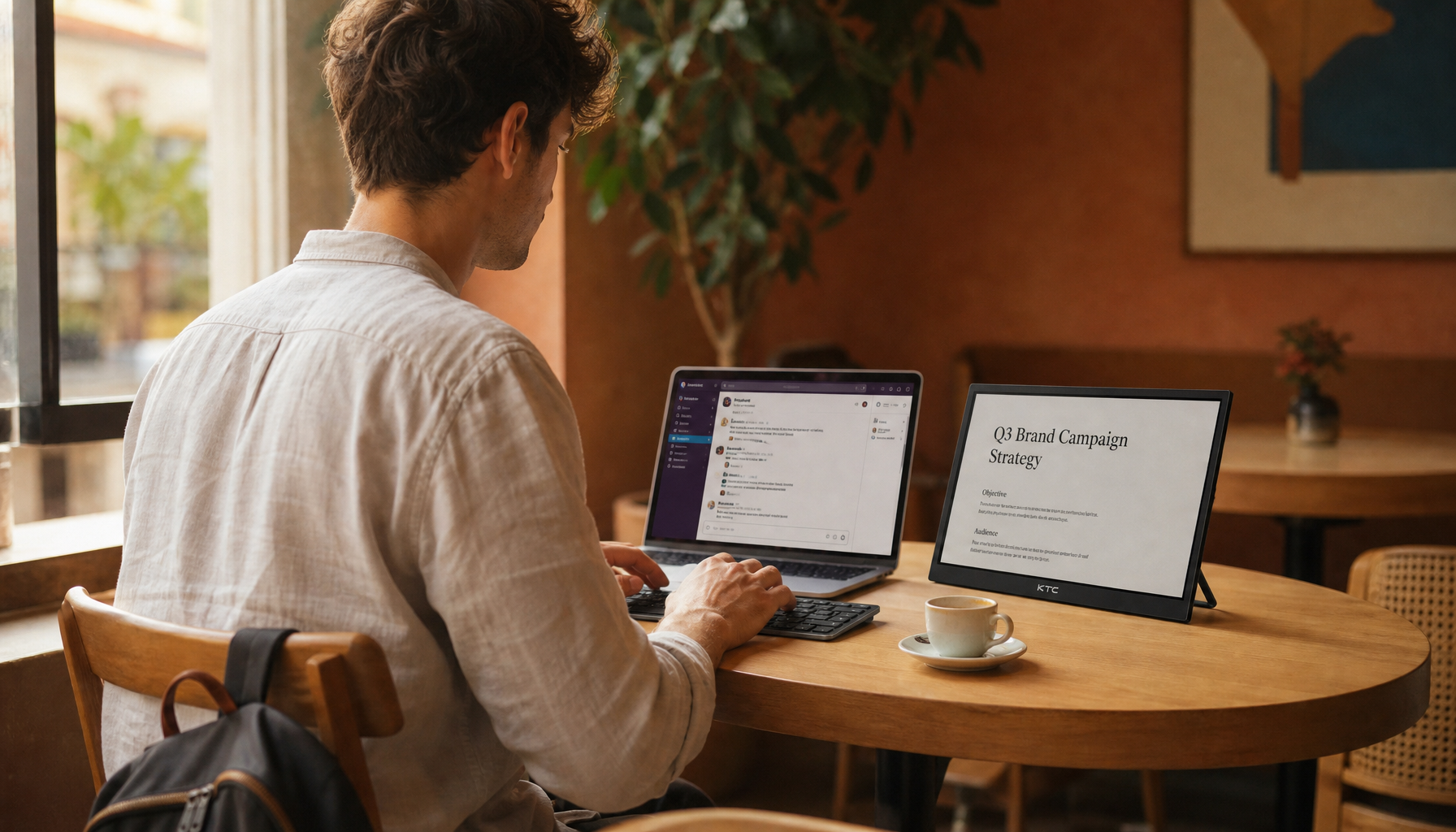
A portable monitor can be useful when the gaming area has to disappear after use. One real-world example is a 15.6-inch 1080p portable display that weighs 1.9 lb, measures 8.95 x 14.16 x 0.35 inches, and fits in a laptop bag; that is far easier to store than a second desktop monitor. However, the same type of screen may run at only 60Hz, which is fine for productivity and casual play but not ideal for fast competitive games.
The biggest portable-monitor weakness is not always image quality; it is the stand. A folding cover stand can be unstable and hard to adjust, even when the display itself is practical, and one tested model offered roughly two hours of battery life at moderate brightness with modern display inputs connectivity. For apartment gaming, treat portable displays as flexible secondary screens for chat, guides, or laptop sessions rather than replacements for a dedicated high-refresh gaming monitor.
Match Size, Resolution, and Refresh Rate to the Space
The safest default: 27-inch 1440p

For many small apartments, a 27-inch 1440p monitor is the cleanest compromise. It gives noticeably sharper text than 1080p at the same size, does not overwhelm a compact desk, and remains easier to drive at high frame rates than 4K. If you play shooters, racing games, action role-playing games, or sports titles, look for at least 100Hz, with 144Hz to 180Hz being a comfortable modern range.
A 27-inch 1440p monitor with strong viewing angles is especially practical when the same desk handles work and gaming because it balances readability, color, and motion. Some buying guidance points to 27-inch 1440p displays with 100Hz or higher refresh as a strong compact-desk option, while advanced backlighting versions can add higher brightness and stronger high-dynamic-range impact if the apartment has bright windows. For example, a 27-inch 2K high-refresh gaming monitor fits this category with 2560×1440 @ 200Hz and advanced zone-based backlighting, but the desk depth, viewing distance, and mount fit still matter as much as the spec sheet.
When 4K, 5K, or ultrawide is worth it

A 27-inch 4K monitor at 144Hz to 160Hz can be excellent if you work with text, spreadsheets, design tools, or media during the day and game at night. The catch is performance: sharper resolution asks more from the graphics hardware, so the monitor may not feel faster unless your hardware can sustain the frame rates you want. For users of a certain computer platform, 5K can make text exceptionally clean, but many 5K displays run at 60Hz, which limits fast-paced gaming appeal.
A 34-inch ultrawide is a better apartment fit than many 40- to 49-inch displays because it offers immersion without demanding an oversized desk. For reading, browsing, and work, keep the active window narrow and centered instead of filling the whole panel; reading comfort depends on scaling, zoom, glare, viewing distance, and posture as much as screen width. A practical range for a 34-inch ultrawide is roughly 24 to 31 inches from your eyes, which is achievable on many deeper desks but cramped on very shallow ones.
Mounting and Desk Safety Matter More Than They Look
Monitor arms save space only when the surface can handle them

A monitor arm can reclaim desk space, improve screen height, and make a small apartment setup feel cleaner. It is not automatically safe, especially on glass desks. Clamp pressure focuses force into a small area, and directly clamping an arm to bare glass can shatter the surface even if the arm itself is rated for the display.
This matters most with heavy curved and ultrawide gaming monitors. Heavy-duty arms for 34- to 49-inch displays commonly support about 22 to 44 lb, but the rating does not prove the desk is safe. A simple load example shows why: a 30 lb screen-and-arm load extended 12 inches creates about 360 lb-in of turning force, and clamp pressure concentrates force near the mounting point.
Glass desks, renters, and safer alternatives
Tempered glass is stronger than annealed glass, often by several times, but it still dislikes point loading, edge stress, and twisting force. Light-use glass tops may be around 1/4 to 5/16 inch thick, while heavier-duty tables may be closer to 3/8 to 1/2 inch. Reinforcement plates can spread clamp pressure over about a 10 x 6 inch area, but they do not fix thin glass, weak frames, or a large monitor pulled far forward.
For renters, freestanding stands, floor-based monitor supports, or a separate wood or metal desk are often safer than drilling into walls or clamping to questionable furniture. If you do use an arm, keep the display close to the mounting point, verify standard mounting compatibility, check the monitor’s weight without the original stand, and confirm the desk material is designed for clamping. The most apartment-friendly mount is the one you can trust at 11:30 PM without worrying about the desk surface, lease, or cables.
Control Cables, Heat, Lighting, and Storage
Keep the gaming area safe and breathable

Compact rooms collect cables, dust, and heat quickly. Keep the computer case away from cloth curtains or drapes, and avoid pushing the exhaust side directly against a wall. If the setup sits on carpet, elevate the tower to reduce dust intake and static risk; this also makes vacuuming around the desk easier.
Small apartments benefit from fewer boxes under the desk. A compact computer case can reduce tower size while still supporting many standard-sized graphics cards, and a small gaming space should account for cords, computer placement, displays, desks, and safety risks together. If the room is very dry, a small humidifier may also reduce static buildup, though it should be placed away from the display and electronics.
Design the screen around glare and daily use
Lighting affects display choice more than many buyers expect. If the desk is near a window, prioritize brightness, anti-glare coating, and adjustable positioning over pure size. Monitors with advanced backlighting that can sustain 400 to 1,000 nits can be easier to read in bright rooms while improving high-dynamic-range presentation in supported games.
Cable management should serve the way you actually use the apartment. A modern single-cable connection with 90 W power delivery can let a laptop connect with one cable for video, data, and charging, while a built-in input-sharing feature lets one keyboard and mouse control both a work laptop and gaming computer. That is more valuable in a 500 sq ft apartment than another decorative accessory because it removes daily friction from the desk.
A Practical Setup Checklist
Use this before buying or rearranging
A compact gaming setup should be tested on paper before money is spent. Measure the desk, mark the display footprint, and decide whether the screen must stay visible all day or disappear after use. This is especially important for ultrawides, which can look reasonable online but feel huge once they occupy the center of a studio apartment.
- Measure desk depth and confirm you can keep the screen roughly 20 to 40 inches from your eyes.
- Choose the screen size by use case: 24 inches for tight competitive setups, 27 inches for balanced gaming and work, or 34 inches for ultrawide immersion.
- Check stand footprint before buying; rear legs and deep bases can matter as much as panel size.
- Confirm standard mounting support, monitor weight, and desk strength before using a monitor arm.
- Avoid clamping heavy arms directly to bare glass; use safer furniture or mounting options for large displays.
- Route power, display, and data cables so the chair cannot catch them.
- Test glare at the time of day you usually play, especially if the desk faces a window.
A sample compact layout
For a practical studio-apartment desk, start with a 27-inch 1440p 144Hz to 180Hz monitor on an adjustable stand or safe arm, placed about 28 inches from your eyes. Put the computer on a small riser beside the desk or under it with airflow space, then run one cable bundle down the rear leg. If you also use a laptop, choose a monitor with single-cable power delivery and input-sharing support so you do not need a second keyboard, mouse, or dock on the surface.
For a more immersive version, use a 34-inch ultrawide but keep the desk at least deep enough to maintain comfortable distance. Keep the center third for the game or main work window, and reserve the side areas for chat, maps, browser tabs, or notes. Avoid 49-inch super-ultrawide displays unless the apartment has a dedicated desk zone, strong furniture, and enough seating distance.
FAQ
Q: What size gaming monitor is best for a small apartment?
A: A 27-inch 1440p high-refresh monitor is the best default for most small apartments because it balances image clarity, motion smoothness, and desk fit. Choose 24 inches if the desk is very shallow or you play competitive games where seeing the full screen quickly matters. Choose 34 inches only if you have enough desk width and can sit roughly 24 to 31 inches away.
Q: Is an ultrawide monitor practical in a compact apartment?
A: Yes, a 34-inch 21:9 ultrawide can be practical if it replaces a dual-monitor setup and the desk has enough depth. It is less practical if you mainly read full-width documents, have a very narrow desk, or need the monitor to disappear after each session. Keep the main window centered and use the sides for secondary content.
Q: Should I use a monitor arm to save desk space?
A: Use a monitor arm if the desk is strong, the monitor uses standard mounting, and the arm is rated for the display’s weight. Avoid clamping heavy arms directly to bare glass, especially with large ultrawides or curved monitors. For renters or glass desks, a freestanding stand, floor support, or sturdier desk may be the safer design choice.
Key Takeaways
A small apartment gaming display should fit the room’s daily rhythm, not just the game’s spec sheet. The strongest all-around choice is usually a 27-inch 1440p high-refresh monitor with an adjustable stand, good cable routing, and enough brightness for the room. A 34-inch ultrawide works when it replaces multiple screens and stays at a comfortable distance, while portable monitors are best as flexible secondary displays.
The final decision comes down to four checks: can you sit at the right distance, keep the screen at the right height, support the monitor safely, and still use the apartment comfortably when the game is off? If the answer is yes, the display is likely a good fit for small-space gaming.