Gaming setups are moving away from bright, pulsing RGB because the monitor has become the visual center of the desk. Subtle accent lighting supports comfort, contrast, focus, and immersion without competing with the screen.
Ever finish a long session and realize the lighting around your monitor felt louder than the game itself? For a high-refresh-rate display, ultrawide monitor, or HDR panel, calmer lighting can make the image easier to look at for hours while reducing glare, reflections, and visual fatigue. This guide explains why the trend is changing and how to choose lighting that actually helps your gaming display look better.
The Shift Is About the Screen, Not Just Style
Aggressive RGB lighting made sense when gaming desks were designed to look instantly recognizable: glowing towers, rainbow keyboards, reactive strips, and bright wall effects. The problem is that a modern gaming monitor is already doing the hard visual work, especially if it is running fast motion, HDR highlights, high contrast, or a wide color gamut. When lighting around the display is too bright, too saturated, or constantly changing, it can pull attention away from the screen.
From Showcase Lighting to Viewing Lighting
The newer approach treats lighting as part of the display environment. Instead of making every accessory visible, subtle accent lighting places soft illumination behind the monitor, under the desk edge, or along the rear wall. That makes the monitor feel integrated into the room while keeping the main image dominant.
This matters because ambient light does not make a monitor’s pixels faster or increase refresh rate, but it can change how clean motion feels to the viewer. Ambient lighting can reduce glare, contrast shock, eye strain, and tracking fatigue, all of which affect how comfortably you follow fast motion on a gaming display.
Why Minimal Setups Became More Practical
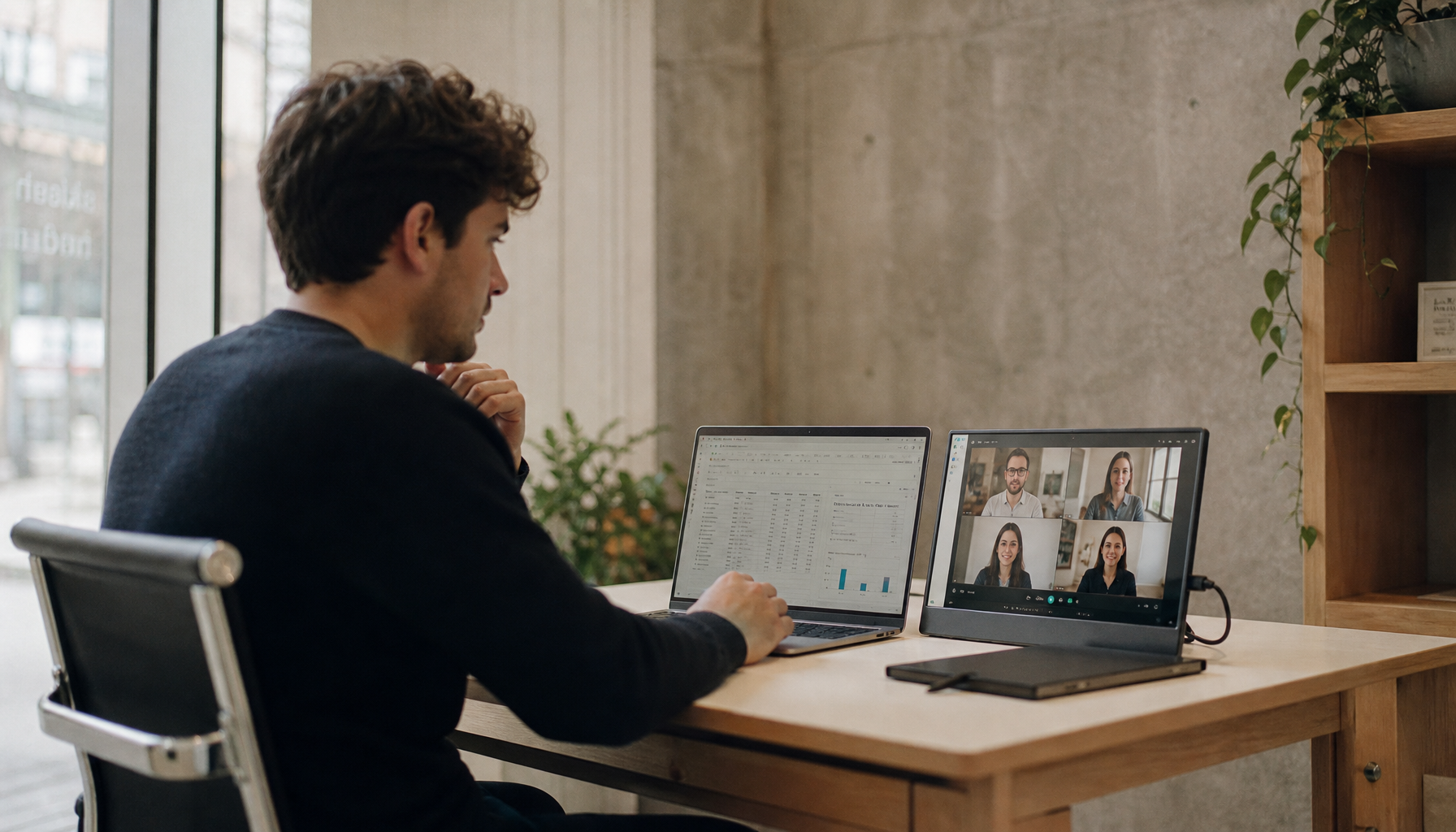
Gaming desks also do more than gaming now. The same 27-inch, 32-inch, ultrawide, or dual-monitor setup may handle work, streaming, video calls, editing, and console play. A calmer lighting setup is easier to live with across those uses because it does not turn every task into a light show.
That is why subtle accent lighting has become less of an aesthetic compromise and more of a display-centered upgrade. A neutral wall glow behind the monitor can support a late-night ranked match, a spreadsheet session, and a streaming scene without needing a full redesign every time the use changes.
Bright RGB Can Work Against Motion Clarity
A high-refresh-rate monitor depends on several real performance factors: refresh rate, frame rate, pixel response, overdrive tuning, sample-and-hold blur, strobing behavior, and in-game motion effects. Lighting cannot replace those specs. A 165 Hz or 240 Hz panel will still need good response behavior, and no LED strip can fix a poorly tuned overdrive mode.
The Contrast Shock Problem
Where lighting does help is perception. A bright screen in a pitch-black room creates a harsh jump between the display and everything around it. During camera pans, muzzle flashes, dark scenes, or bright HUD elements, your eyes keep adjusting between the screen and the room, which can make motion feel harsher during long sessions.

Soft bias lighting behind the monitor reduces that jump. Bias lighting is most useful when it is stable, low-level, and placed behind the screen rather than aimed into your eyes. A practical target is brightness around 10% of peak SDR white, with the strip mounted about 2 to 4 inches behind the monitor so the wall glows without visible LED dots.
Why Pulsing Effects Distract Competitive Players
Fast RGB effects can create their own visual noise. Strong pulsing, rapid color cycling, hard color jumps, and visible LED points near the panel can distract from enemy movement, crosshair placement, or small changes in the game image. This is especially noticeable on high-refresh-rate monitors where the whole point is to make motion easier to track.

For competitive gaming, a better baseline is static or slow-changing lighting. The practical range is modest: main ambient RGB around 20% to 40% intensity, with floor or desk-edge accents around 10% to 25%. That keeps the room from feeling blacked out while preserving the monitor as the brightest, clearest object in view.
Subtle Accent Lighting Improves the Viewing Environment
Subtle lighting does not need to be boring. The key is control: hide the light source, avoid glare paths, choose brightness based on the monitor, and keep color from contaminating the display area. Done well, accent lighting makes a gaming monitor feel more comfortable and more immersive.
Bias Lighting Behind the Monitor

The most display-friendly option is bias lighting behind the screen. It places a soft glow on the wall behind the monitor, reducing the contrast between a bright panel and a dark room. Bias lighting behind a monitor is a simple way to improve comfort because the display is no longer the only bright object in the room.
For color-sensitive use, 6500K neutral white is the safer choice because it aligns with the D65 white point used in professional display workflows. High-quality bias lights should also have a CRI above 90, which helps avoid odd color casts. That matters if your gaming monitor doubles as a content display for photo editing, video work, game capture review, or buying decisions where color accuracy matters.
Accent Lighting Around the Desk
Accent lighting around the desk works best when it supports the monitor rather than surrounding it with bright points. Rear desk-edge strips, low side-wall glow, and under-desk lighting are usually safer than exposed strips facing the viewer. Visible LEDs on the wall behind a glossy or semi-gloss screen can create reflections and make the panel look hazier.
A quick test is to look at a white browser window or a bright game menu from your normal seat. If the wall behind the monitor looks brighter than the screen, the lighting is too strong. If you can see individual LED points reflected in the display, move the strip, diffuse it, or lower the intensity.
Multi-Monitor and Ultrawide Desks Need More Care
Subtle lighting becomes even more important with wide screens and multi-monitor setups. A single 27-inch display is relatively easy to control, but an ultrawide or angled dual-monitor desk catches light from more directions. Windows, ceiling fixtures, desk lamps, and wall LEDs can all create reflections across different panel angles.
Placement Matters More Than Color
For multi-monitor desks, the first decision is placement. Multi-monitor desks create more glare risk because angled screens catch light from several directions. A practical layout is to place the monitor plane at a right angle to the main window so daylight enters from the side instead of bouncing straight off the screen.
Viewing distance also matters. A typical 27-inch or 32-inch monitor is easier to manage at about arm’s length, roughly 20 to 30 inches from the eyes. At that distance, small glare sources and bright wall points are easier to notice, so a soft rear glow usually works better than exposed lighting near the panel edge.
Layered Lighting Beats One Bright Source

A display-friendly desk usually uses three layers: soft ambient room light, a focused task light for the desk surface, and bias lighting behind the monitor. This works better than relying on one overhead fixture, which can reflect on the panel and wash out contrast.
The white-paper test is a useful adjustment method. Hold a sheet of white paper near the monitor. If the screen looks like a flashlight compared with the paper, lower monitor brightness or raise soft room light. If the paper is much brighter than the screen, reduce task or overhead lighting so the display does not look washed out.
What Lighting Works Best for Different Gaming Displays?
The right lighting choice depends on the monitor. A portable monitor on a small desk needs different control than a 49-inch ultrawide. A Mini-LED HDR display needs different tuning than a basic SDR panel. The common rule is simple: light the room enough to reduce strain, but not so much that it competes with the image.
Display-Specific Recommendations
For high-refresh-rate esports monitors, choose static neutral white or soft blue accents at low intensity. The goal is stable peripheral lighting that makes long tracking sessions easier without adding movement outside the game.
For OLED, Mini-LED, and HDR monitors, avoid bright colored lights close to the display. HDR highlights already create big brightness changes, and strong RGB around the screen can make black levels, shadow detail, and color perception feel less consistent. Synced ambient RGB can still work, but smooth transitions and restrained saturation are more useful than dramatic flashes.
For ultrawide monitors, use longer, evenly spaced backlighting so the glow covers the width of the panel. Large ultrawide setups may benefit from at least 60 LEDs per meter so the wall glow looks continuous rather than spotty. For portable monitors, a small clamp light, dimmable desk lamp, or short rear strip is usually enough because the screen area is smaller and often used closer to the face.

Comparison Table: Aggressive RGB vs Subtle Accent Lighting
Lighting choice |
Best use case |
Monitor impact |
Suggested settings |
Watch out for |
Aggressive reactive RGB |
Show builds, casual rooms, short sessions |
Can add immersion but may distract from motion |
Use only when effects are slow and indirect |
Rapid color jumps, visible LEDs, reflections |
Static bias lighting |
Competitive play, long sessions, dark rooms |
Reduces screen-to-room contrast and supports comfort |
6500K, CRI above 90, around 10% of peak SDR white |
Too much brightness behind the display |
Soft colored accents |
Casual gaming, streaming, relaxed setups |
Adds atmosphere without overpowering the monitor |
Main RGB at 20% to 40%, floor accents at 10% to 25% |
Saturated light spilling onto the screen |
Layered desk lighting |
Multi-monitor and ultrawide setups |
Controls glare from several angles |
Ambient light, task light, rear bias light |
Overhead glare and glossy reflections |
Synced ambient lighting |
Cinematic games and media |
Extends screen color into the room |
Smooth transitions, hidden strips, moderate saturation |
CPU/GPU overhead and excessive brightness |
How to Build a Display-Friendly Lighting Setup
A good gaming setup starts with the monitor and works outward. Set the screen where you actually sit, check reflections, then add lighting in layers. The best result is rarely the brightest setup; it is the one where the screen remains easy to read, motion remains comfortable, and the room does not feel visually harsh.
Action Checklist
- Set your monitor at a comfortable distance, usually 20 to 30 inches for a 27-inch or 32-inch display.
- Place the desk so windows sit to the side of the screen instead of directly in front of or behind it.
- Add bias lighting behind the monitor, mounted about 2 to 4 inches from the rear edge if your setup allows it.
- Start with neutral white around 6500K, especially if you care about accurate color or use the monitor for work.
- Keep main ambient RGB around 20% to 40% intensity and floor accents around 10% to 25%.
- Hide LED points with diffusion, rear placement, or indirect wall bounce.
- Use the white-paper test to balance monitor brightness with room lighting.
Buying Guidance for Monitor Owners
If you are buying lighting for a gaming monitor, prioritize dimming control, diffusion, color stability, and placement flexibility over the number of effects. Addressable LED strips are useful, but only if you can run them calmly. For large ultrawide setups, choose enough LED density to avoid a dotted wall pattern; for smaller monitors, a shorter strip with better diffusion is usually better than a long, harsh one.
Software also matters. A built-in dynamic lighting feature can have minimal overhead, a lightweight lighting-control app may be efficient and cross-platform, and another lighting-control platform may use 3% to 7% CPU or GPU depending on the setup. That overhead may not matter on a powerful desktop, but it is worth considering for competitive gaming, portable monitor setups, or systems already close to performance limits.
Common Misconceptions About RGB and Monitor Performance
The biggest misconception is that lighting can make a gaming monitor perform better in a technical sense. It cannot raise refresh rate, reduce pixel response time, fix overshoot, or improve frame pacing. Those are monitor and system performance issues.
RGB Does Not Fix a Bad Monitor Setting
If motion looks smeared, start with monitor settings before blaming the room. Check refresh rate in the operating system, confirm the game is running at the intended frame rate, test overdrive modes, and disable extreme strobing settings if they create discomfort. Lighting can improve perceived comfort, but it cannot rescue a panel with poor response tuning.
The second misconception is that all RGB is bad. Restrained RGB can look excellent around a gaming display when it is dim, indirect, and stable. The problem is not color; the problem is uncontrolled brightness, exposed LEDs, and effects that compete with the game image.
Darker Is Not Always Better
A fully dark room can reduce some reflections, but it can also make the monitor the only bright object in the environment. That is why many gamers who tried all-black rooms eventually added soft bias lighting behind the display.
The same logic applies to monitor brightness. A default LCD or gaming monitor brightness setting may be far too bright for nighttime use. A practical comfort target is to make the display no brighter than a well-lit book or sheet of paper under your room lighting, then adjust from there based on the game, panel type, and personal comfort.
FAQ
Q: Does subtle accent lighting actually improve gaming performance?
A: It does not improve the monitor’s technical performance, so it will not increase refresh rate, frame rate, response time, or pixel speed. It can improve the viewing environment by reducing glare, contrast shock, and eye fatigue, which may make it easier to track motion comfortably during long sessions.
Q: Is 6500K white lighting better than RGB behind a gaming monitor?
A: For accurate color and general comfort, 6500K neutral white is usually the better default because it aligns with the D65 display white point. RGB can still work for gaming atmosphere, but it should be dim, indirect, and stable so it does not shift your perception of the monitor’s colors.
Q: What is the best lighting setup for an ultrawide gaming monitor?
A: Use evenly distributed bias lighting behind the full width of the monitor, keep LED points hidden, and avoid bright side lights that reflect across the curved or wide panel. If the setup is large, use higher LED density so the wall glow looks smooth, then keep brightness below the display’s visual priority.
Key Takeaways
Gaming setups are moving away from aggressive RGB because modern monitors demand a cleaner visual environment. High-refresh-rate, ultrawide, OLED, Mini-LED, HDR, and portable displays all benefit from lighting that supports the screen rather than fighting it.
The best setup is usually simple: dim indirect bias lighting behind the monitor, low-intensity accent lighting around the desk, controlled window placement, and monitor brightness matched to the room. Use RGB when it adds atmosphere, but keep it subtle enough that the game image remains the clearest and most important thing you see.