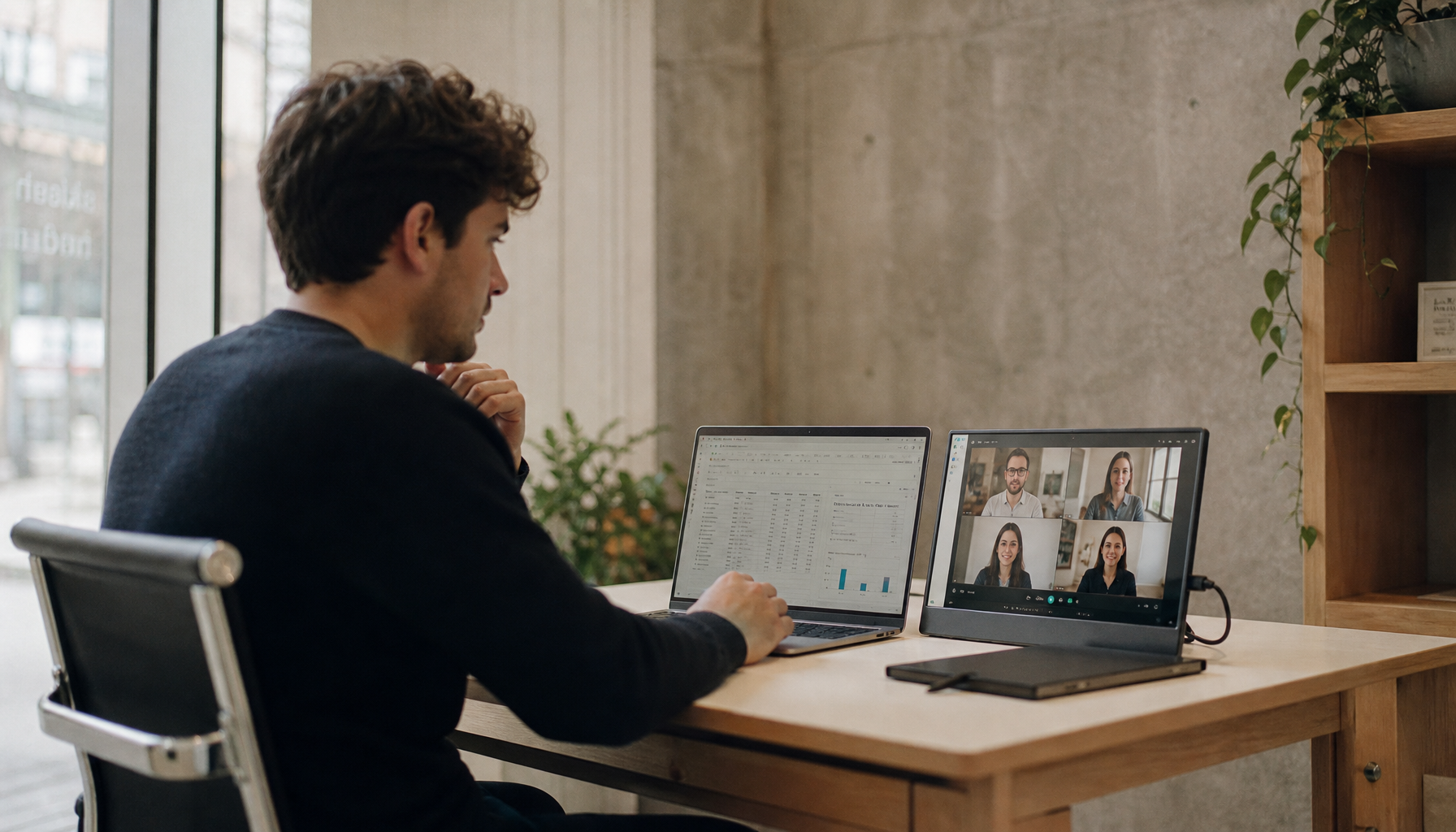
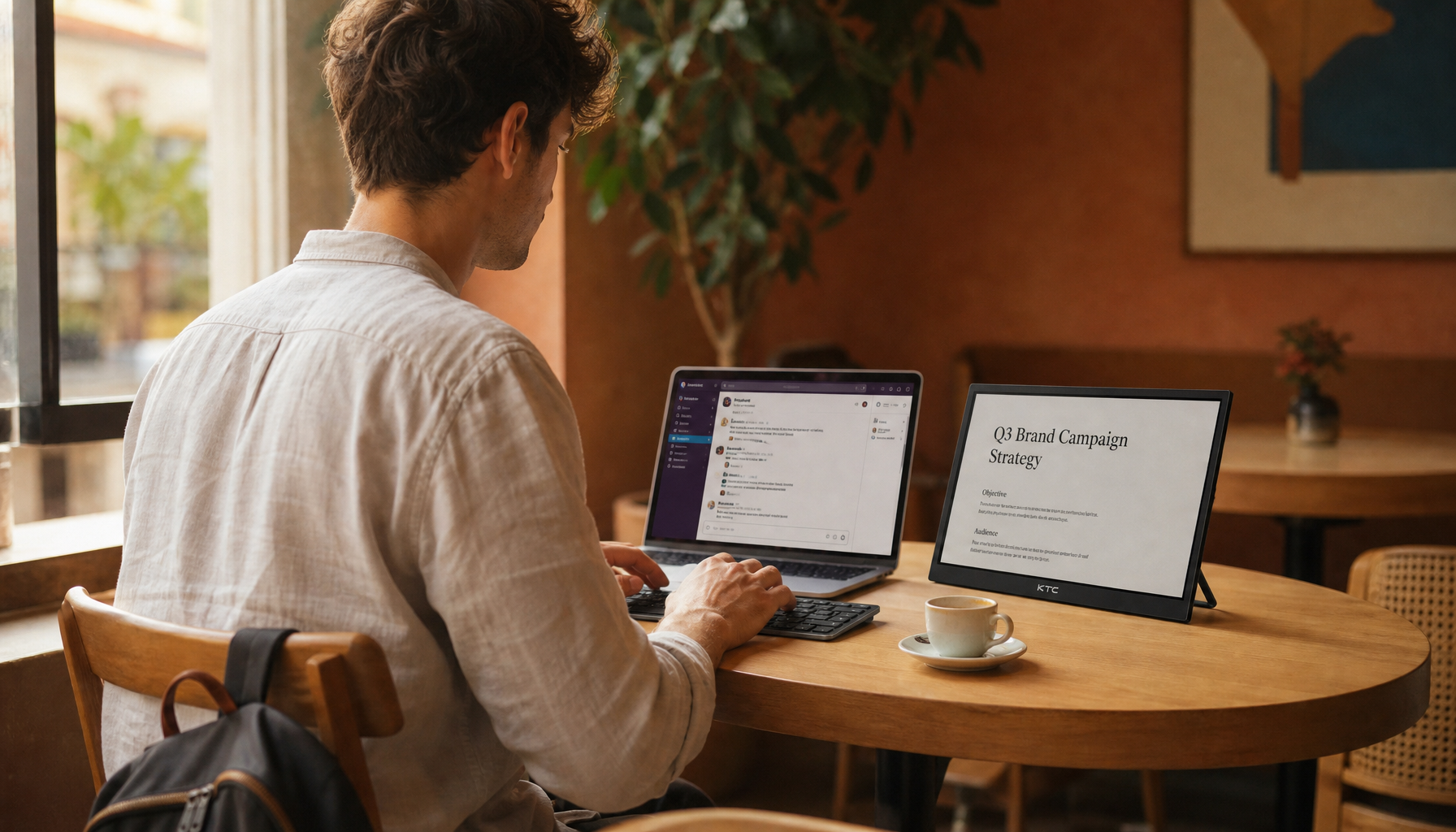
Productivity drops at a new hot desk because workers spend the opening minutes rebuilding the workstation: connecting displays, restoring window layouts, fixing posture, finding focus, and reorienting to nearby people and noise.
Is your first task at a shared desk really work, or is it hunting for the right cable, dragging windows back into place, and leaning toward a screen that sits too low? Portable display guidance notes that rolling smart displays can save up to 10 minutes of tech setup time per meeting, showing how much startup friction can hide inside “just plug in.” Here is how to identify the first-15-minute drain and reduce it without overbuilding every desk.
The First 15 Minutes Are a Setup Tax
At a permanent desk, your body and tools remember the environment. At a hot desk, that memory resets. The keyboard may be offset, the monitor may be too close, the dock may not support the resolution you expect, and your apps may reopen on the wrong screen.
A useful definition: hot-desk productivity loss is not only time spent away from work. It also includes presenteeism, where someone is present but operating below capacity; workplace research treats lost productivity mainly as absenteeism and presenteeism. In display terms, the person is “at work,” but the visual workspace is not ready for performance.
The first 15 minutes usually disappear into three areas. Physical setup includes connecting power, USB-C, HDMI, a dock, headphones, and charging. Visual setup includes restoring a two-screen or three-screen layout, scaling, brightness, color, and window positions. Cognitive setup is the work of re-establishing task priority, context, posture, and social boundaries.
Cause 1: Display Friction Breaks Visual Momentum

For knowledge workers, screen space is not a luxury; it is the working surface. Multiple-display setups improve productivity mainly because they reduce window switching, keep references visible, and lower cognitive load during multitasking-heavy work. Multiple monitors are most valuable when people compare information, monitor live data, or work across several applications.
At a new hot desk, that advantage often disappears. A developer who normally keeps code on the center screen, documentation on the left, and logs on the right may start the day on a single laptop display. A finance analyst may lose sight of a spreadsheet, dashboard, and communication thread at the same time. Even a five-second window switch repeated dozens of times becomes a real focus penalty.
The Practical Fix

Standardize the display path before standardizing the furniture. A hot desk should make it obvious whether the user connects through USB-C, HDMI, DisplayPort, Thunderbolt, or a dock. If the desk supports more than one external monitor, label the primary connection and keep the same display order at every station.
For teams that rely on portable or rolling screens, the key is not novelty; it is setup reduction. Portable rolling displays fit hot desking when workers move between quiet corners, shared tables, and temporary desks, but they are most useful when the movement is purposeful rather than constant. Rolling displays work best when wheels lock, pathways are clear, and charging is planned.
Cause 2: Mismatched Monitors Create Micro-Delays
A hot desk with “a monitor” is not the same as a ready workstation. Mismatched size, resolution, refresh rate, panel type, and scaling can make the same laptop feel slower and less precise. Triple-monitor guidance recommends matching size, resolution, panel type, and ideally model because inconsistent screens can create scaling issues, color mismatch, brightness variation, and visual discontinuity.
The loss shows up as small corrections. The cursor jumps between different scaling zones. Text looks sharp on one display and soft on another. The main app opens on the wrong screen. A designer wastes time judging color across mismatched panels. A project manager keeps resizing windows because the shared desk uses a different resolution from yesterday’s desk.
What Matters Most
The best hot-desk display standard is boring in the right ways. Use matching resolution where possible, keep the primary monitor centered, and avoid mixing 1080p and 1440p unless IT has tested scaling across the actual laptop fleet. For most office hot desks, two matched 24-inch or 27-inch displays are more reliable than a random collection of higher-spec screens.
For gaming, simulation, video editing, CAD, or color-sensitive creative work, the primary display should take priority. Put the best panel directly in front of the user and use secondary screens for tools, references, chat, timelines, or dashboards. This preserves immersion and reduces the correction loop that burns the first quarter hour.
Cause 3: Ergonomics Are Rebuilt From Scratch

A hot desk often looks clean but feels wrong. The monitor may be too low, the chair may not align with the keyboard, and the user may lean forward before noticing. Ergonomic display guidance recommends placing the screen top at or slightly below eye level and positioning it about an arm’s length away, roughly 20 to 30 inches, so text is readable without squinting or leaning.
Poor posture does not need hours to affect output. If the first email is written with shoulders raised, wrists angled, and the neck turned toward a side display, focus is already compromised. In shared offices, the body spends time negotiating the workstation before the mind can fully enter the task.
A Fast Ergonomic Reset
The fastest reset is visual alignment first, chair second, peripherals third. Put the primary display directly in front of the main task, not off to the side. Set the top of the screen near eye level. Pull the keyboard and mouse close enough that elbows stay relaxed near 90 degrees. If there is a second monitor, angle it inward so the user turns the eyes more than the neck.
Sit-stand options can help, but only when they are easy to adjust. Texas A&M research found stand-capable desks were associated with about 46% higher productivity among call center employees over six months, with workers sitting about 1.6 fewer hours per day, though stand-capable desks showed smaller gains in the first month as users adapted. The lesson for hot desks is clear: adjustable workstations need simple presets or obvious controls, not a guessing game.
Cause 4: Collaboration Signals Are Unclear
Hot desking is not only an equipment problem. It is also a proximity problem. In-person work depends on where people sit, who they can see, and whether the desk supports quick collaboration without derailing focus. Office research notes that 90% of in-person interactions happen at employees’ desks, while only 3% happen in common areas, making employees’ desks a major collaboration surface.
The first 15 minutes can be lost to orientation: finding the right team zone, checking whether the desk is reserved, deciding whether nearby conversation is relevant, and figuring out where to take a quick call. A worker may be physically present but socially mispositioned, especially if the hot desk separates them from the people they came in to work with.
Better Desk Design
A productive hot-desk area needs visible rules. Team zones, quiet zones, collaboration tables, and monitor-equipped focus stations should feel different at a glance. If every station looks identical, workers must spend energy deciding whether the place fits the task.
For display-heavy roles, the most reliable setup is a reserved class of workstation rather than a personally assigned desk. A finance analyst, developer, designer, or operations lead does not always need the same seat, but they often need the same screen capability.
Hot-desk issue |
What it costs in the first 15 minutes |
Better standard |
Unknown cable path |
Connection retries and dock confusion |
One primary USB-C or dock standard |
Mixed monitor specs |
Scaling fixes and window resizing |
Matched size and resolution |
Poor monitor height |
Leaning, neck turn, eye strain |
Adjustable arm or stand |
No display role |
Apps scattered across screens |
Center primary task, side references |
Unclear seating zone |
Social and focus reorientation |
Defined quiet and team areas |
Cause 5: The Desk Lacks a Repeatable Screen Workflow

A good hot desk should let the worker land, authenticate, connect, and start. A weak one asks the worker to rebuild the whole cockpit. The most common missing piece is a repeatable screen workflow: which display is primary, where communication lives, where references live, and how the layout returns after disconnecting.
This is where monitor strategy becomes productivity strategy. A dual-monitor setup gives most office workers enough visual surface to keep the primary task and reference material visible. A triple-monitor setup is justified when the role depends on simultaneous comparison, live monitoring, or creative tool separation. A portable smart screen makes sense when the worker moves frequently and values fast relocation more than fixed-desk precision.
Pros and Cons of Hot-Desk Display Strategies
Strategy |
Pros |
Cons |
Single external monitor |
Simple, low cost, fewer cable issues |
More window switching for complex work |
Dual matched monitors |
Strong balance of focus and reference space |
Requires consistent dock support |
Triple monitors |
Best for comparison-heavy workflows |
More scaling, mounting, and bandwidth risk |
Portable USB-C display |
Flexible for hybrid workers |
Smaller screen and cable dependence |
Rolling smart display |
Fast collaboration and mobile work zones |
Battery, stability, and floor conditions matter |
How to Protect the First 15 Minutes
The strongest fix is to treat the first 15 minutes as a measurable workstation-readiness window. A desk is ready when the laptop connects on the first attempt, the primary monitor appears in the correct position, the screen height can be adjusted quickly, the user has enough surface for a keyboard and mouse, and the seating zone matches the task.
For office managers, the practical move is to test the desk the way a real employee uses it. Walk up with a common laptop, connect it, open a browser, a spreadsheet, a chat app, and a video call, then time how long it takes to reach a usable two-screen layout. For individual workers, the best move is to carry a small personal kit: the right USB-C cable, a compact charger, a preferred mouse, and a saved window-layout routine if the operating system supports it.
The goal is not to make every hot desk premium. The goal is to make every first session predictable. When the screen, posture, and task layout snap into place quickly, the first 15 minutes become work again instead of workstation assembly.